


Jews and Jazz (Part One)
By ALAN SMASON, Exclusive to SOURCE 5775
While music historians generally agree that jazz music grew out of a confluence of European harmony and varying forms of music largely gleaned from the African-American experience including blue notes, improvisation and syncopation, little acknowledgment has been given to the influence of Jews in its development.
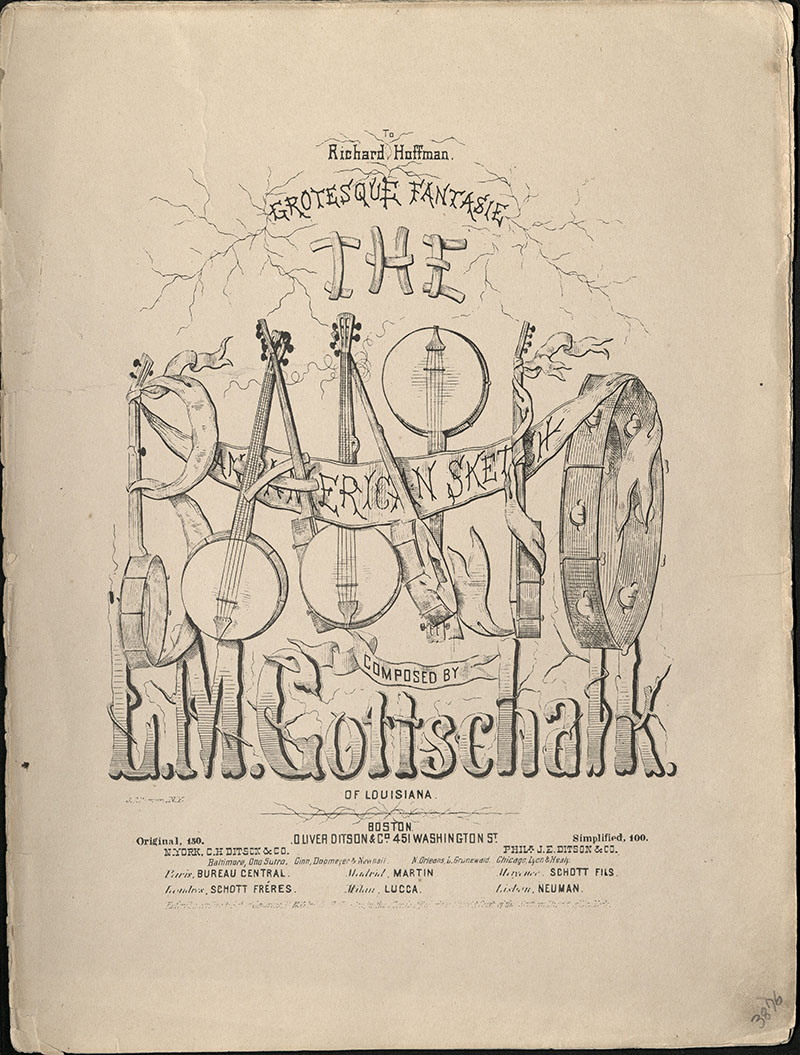
Louis Moreau Gottschalk’s “The Banjo” (Op. 15) like his earlier work “Bamboula” (Op. 2) combined African rhythms with European sensibilities. (Ralston Crawford Collection of New Orleans Jazz Photography, Courtesy of the Hogan Jazz Archive, Tulane University)
It turns out that all ethnic groups – Jews included – had a profound influence on each other in the birthing process of jazz. This is true for the Irish, Italian, German, East European, Chinese, Caribbean and Mexican communities; Jews were no less influential.
As to the earliest record of Jewish influence on jazz, scholars point back to a much earlier and simpler time. Louis Moreau Gottschalk, the son of a Jewish London banker and a Creole woman, was born in New Orleans in 1829 and is considered the first American- born composer and performer of note.
Hogan Jazz Archive curator Bruce Raeburn acknowledges Gottschalk’s major African- Caribbean influence defined by the heavy percussion he heard as a youngster on Sunday afternoons in the many gatherings at Congo Square. Given the day off by their owners, these slaves drummed and danced to the native beats of their tribal traditions, encouraging each other to connect to their common heritage. Gottschalk’s “Bamboula: Danse des negrés” (Opus 2) is often seen as the definitive work of this genre and the first time that European sensibilities mixed with African rhythms.
Raeburn has also cited his work “The Banjo” (Opus 15), published in 1854, as exciting because of its incorporation for the first time of of West African rhythms and techniques of playing. Gottschalk transcribed the sounds of the banjo playing he had heard as a youth to the European instrument of the piano. No other piece in the ante-bellum period demonstrated the “up-picking” and “down strumming” Gottschalk captured and it became one of his most popular pieces.
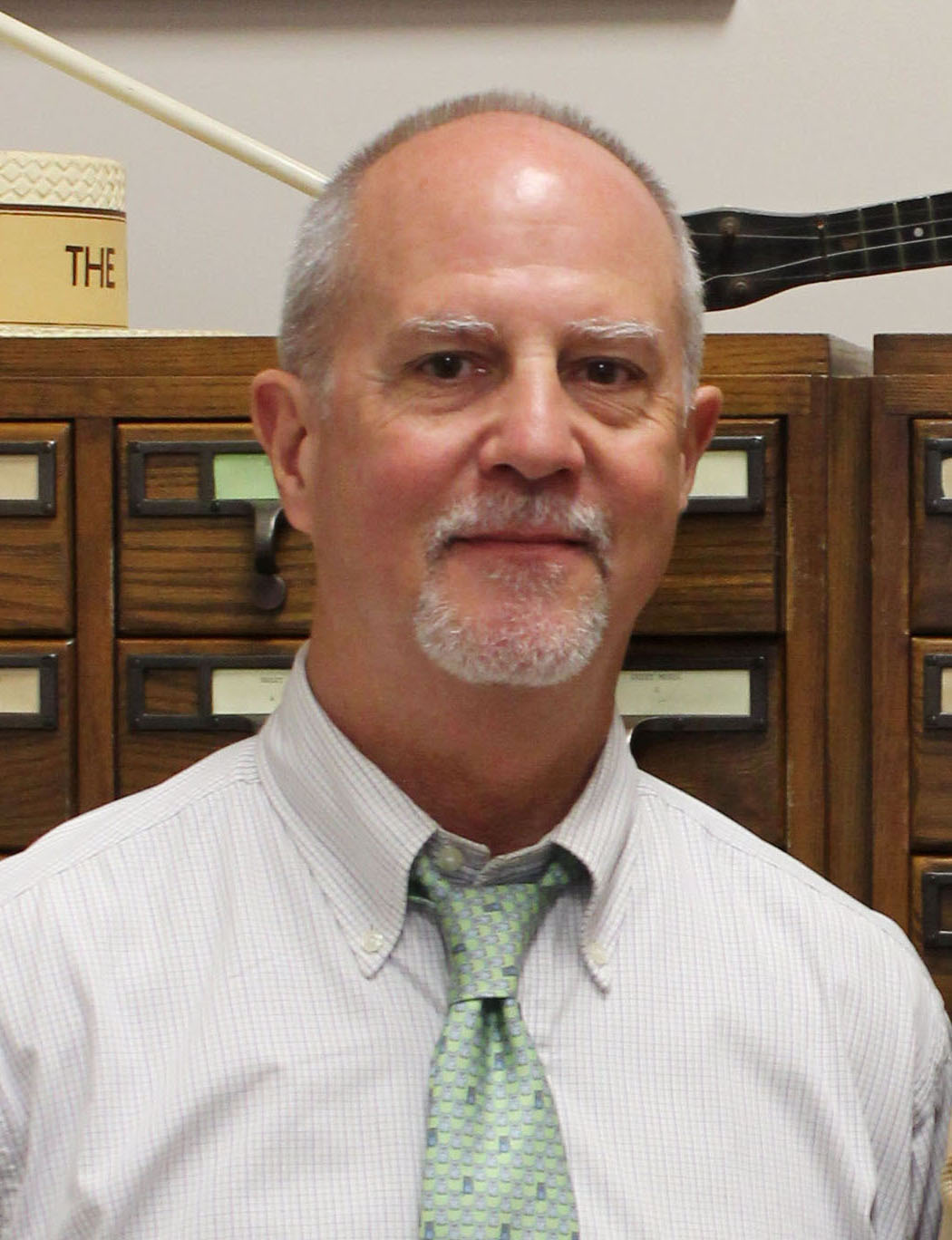
Bruce Raeburn, Tulane University’s Hogan Jazz Archives curator (Courtesy Hogan Jazz Archive)
The Ragtime era that followed Reconstruction in the Crescent City laid the basis for the origins of jazz. According to a number of scholars, the many immigrant families who lived in and around the South Rampart Street corridor – many of them Jewish – had a profound impact on its development.
In his book “The Empress of Steak and the Gorilla Man,” author Randy Fertel, the great- grandson of pawnbrokers and real estate titans Sam and Julia Fertel, recounts many of the events that took place during this musically rich and historically important period, especially as it related to his grandmother, Annie Fertel.
According to her grandson, she grew up over the closed Fertel loan office at the corner of Perdido and South Rampart. This was just across the street from where the pre-teen Louis Armstrong, who lived in a rooming house a few blocks away, had been arrested for discharging a firearm in public. That charge led the youngster to being sent off for discipline at the Colored Waif ’s Home for Boys.
Following his re-integration into society a year and a half later, Armstrong made his way back to South Rampart Street and listened to early jazz innovators like Joe “King” Oliver and Kid Ory at nearby African-American lounges such as the Little Gem Saloon. Run by non-Jewish businessman Frank Dourroux, the Little Gem Saloon expanded its original space to take over the office leased by Izzy Itzkovich’s Eagle Loan Company. Douroux renamed the new space as the Eagle Saloon and eventually its name also extended to the remnants of Bolden’s band, who hung out at the saloon.
Ironically, the Little Gem building became home to the David Pailet Loan Company from 1926 to 1949, before it became another important musical haunt, Pete’s Blue Heaven Lounge, from whence jazz funerals for the Zulu Social Aid and Pleasure Club would begin and end.
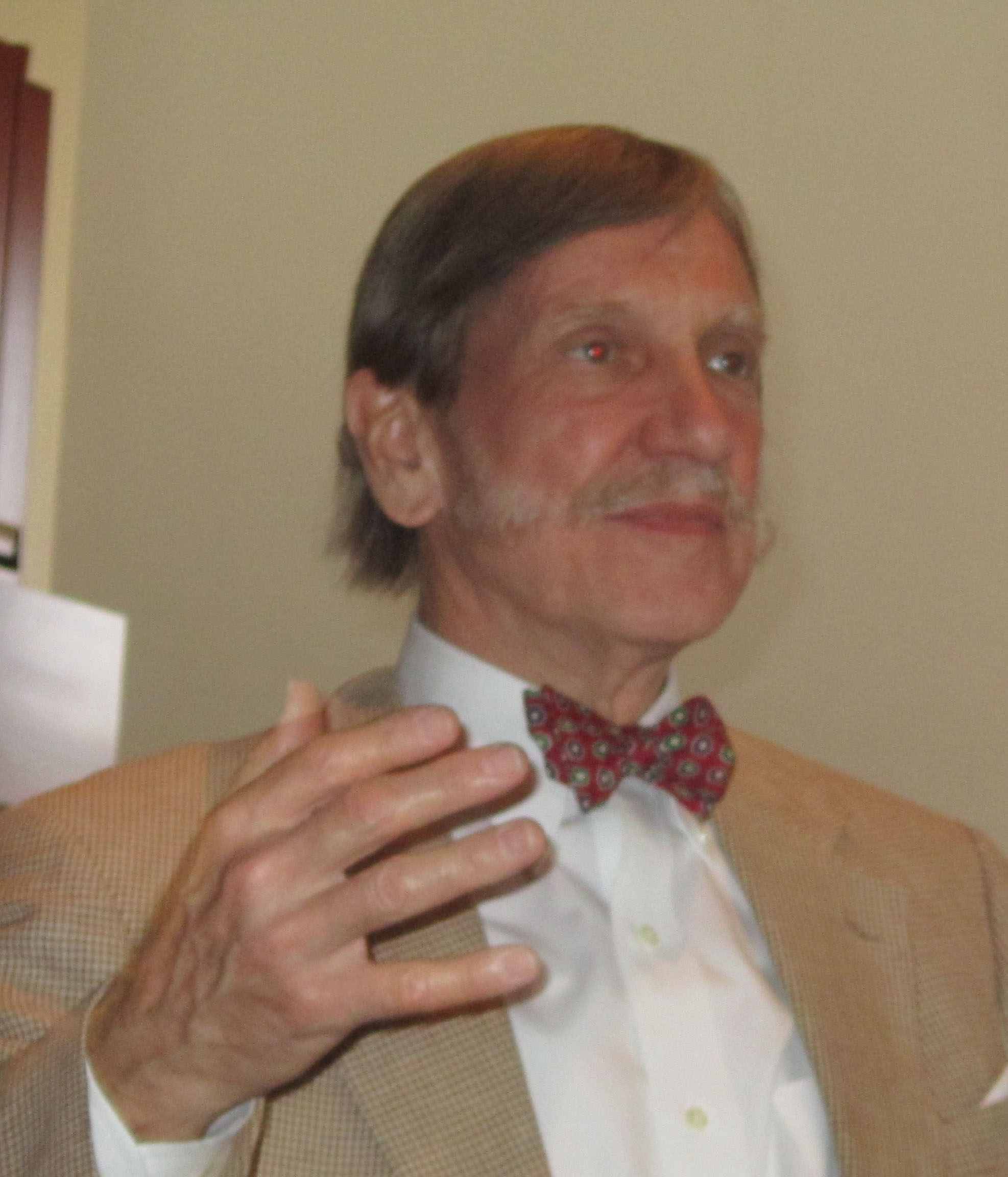
Historian and author Jack Stewart at a Jewish music symposium in 2013. (Photo by Alan Smason)
Oliver was very familiar with Armstrong and took him on as a protégé, eventually giving him his biggest break by inviting him to work in Chicago with his “Creole Jazz Band” in 1922.
Meanwhile, the Jazz era had broken wide open following the release of the first jazz record
by the Original Dixieland Jazz Band (ODJB) in 1917, featuring trumpet player Nick LaRocca. None of the ODJB members were Jewish, although LaRocca was replaced years later by Jewish frontman Henry “Hot Lips” Levine.
Jewish musicians of the era began to establish themselves as among the most talented and proficient of performers. Unlike a number of the jazz musicians who “faked” their way through songs, many of the Jewish performers actually read musical notation.
ODJB trombonist Edwin Edwards was quizzed in 1959 about his most memorable pre- ODJB jazz pairing and he cited an unusual group with whom he played. “…the best jazz band I… was connected with was, Achille Baquet, clarinet; Mike Caplan was the cornet player; Bob Stein was the drummer; Joe Wolfe, pianist; and myself on trombone.” Baquet was crossing racial lines by playing with Edwards and the other three, all Jewish musicians, who “could read music, improvise and play jazz too.”
Baquet and Edwards became celebrated jazz stars, but not their Jewish partners. Raeburn has speculated that their ability to read music may have kept them in demand and employed in a number of other “legitimate” musical enterprises outside of the realm of jazz.
Indeed, Caplan was a highly regarded trumpeter and cornet player who played with society music orchestras and swing bands throughout the 1930s and 1940s, most notably that of Max Fink, the son of the original Rampart Street residents.
Also of note were the Korn brothers – trombonist Marcus and clarinetist Montague “Monty” Korn. The sons of a colorful German rabbi who took his family to Poland, England and Scotland before emigrating to the United States, the Korns had fallen into obscurity until their careers were more recently rediscovered. Marcus Korn played with Caplan in a number of orchestras during his career, according to Stewart.

Jewish New Orleans jazz figure John Wigginton Hyman performed as Johnny Wiggs. (Courtesy of the Hogan Jazz Archive, Tulane University)
One of the most important of Jewish New Orleans jazz figures was John Wigginton Hyman, who performed under the colorful stage name of Johnny Wiggs. Born into a very influential Jewish family, his father, William Bryan Hyman, was a son of the chief justice of the Louisiana Supreme Court and related to U.S. presidential perennial hopeful William Jennings Bryan.
Originally a violinist, he allegedly switched to cornet after hearing King Oliver perform. Oliver became one of his mentors and he also was enamored of and actually played with Bix Beiderbecke on at least one date in 1928 after the Wigginton family moved to Ocean Springs, Mississippi.
Early in his career in 1927, he performed with others in the group Johnny Hyman’s Bayou Stompers. He became a music instructor and architectural drawing teacher for the Orleans Parish School Board and,
while teaching, was known as “Professor Hyman.” Fearful of recrimination from school board officials, he always used his stage name for all his appearances.
Among his contributions to the local jazz scene, Wiggs was responsible for composing and popularizing “Canal Street March,” the official march of the City of New Orleans, and “King Zulu Parade.”
In 1948, the year before Armstrong returned to the city of his birth to be King of the Zulu parade, Wiggs founded the New Orleans Jazz Club. That alone may have been enough to remember him as an important jazz figure, but as a music instructor at John McDonough No. 38 Elementary School, he met and encouraged a young would-be clarinetist named Pete Fountain, who would turn out to be one of the more important and well-known jazz artists of the latter half of the Twentieth Century.
Faded now to the dustbin of history, John Kornfeld was cited by Raeburn as yet another Jewish player, who may have indirectly sparked the career of another celebrated traditional jazz clarinetist: Louis Cottrell. Cottrell’s father – also named Louis, but who bore the appellation “Old Man” – was a friend of Kornfeld’s. While the elder Cottrell could not afford music lessons, his buddy Kornfeld could, the younger Cottrell reminisced. Kornfeld would return from his instruction to share and teach his friend, Old Man, everything he had learned. The elder Cottrell became a professional musician and his famous son followed suit.
Another early Jewish jazz musician, Romanian-born Charles Fischbein, is noted as a rarity of the day: a violinist and a band leader who led several different groups during the 1920s and who ended up fronting several jazz orchestras at posh nightclubs like the during the era of Prohibition.
Fischbein was one of the more successful, but lesser known Jewish jazz musicians who played in various groups throughout the period of the 1920s and 1930s. Saxophonist David Winstein, who eventually became the head of the local American Federation of Musicians union, was another steady player who played jazz and society orchestra dates.
Drummer Godfrey Hirsch, who later became a mainstay with Louis Prima’s band, started out as a pianist with the Gulf Coast Serenaders, while Gene Meyer was the stage name for Meyer Weinberg, yet another popular Jewish saxophonist.
These are just some of the regular Jewish players who benefited from the ability to read music and keep themselves pliant for whatever playing dates might pop up.
Jews have also distinguished themselves in the field of documenting the history of jazz through descriptive words and pictorial exposition.
Among the top photographers and cataloguers of jazz celebrities, three of the most prominent all lived and worked in New Orleans at one time or another: Al Rose, Herman Leonard and Jules Cahn.
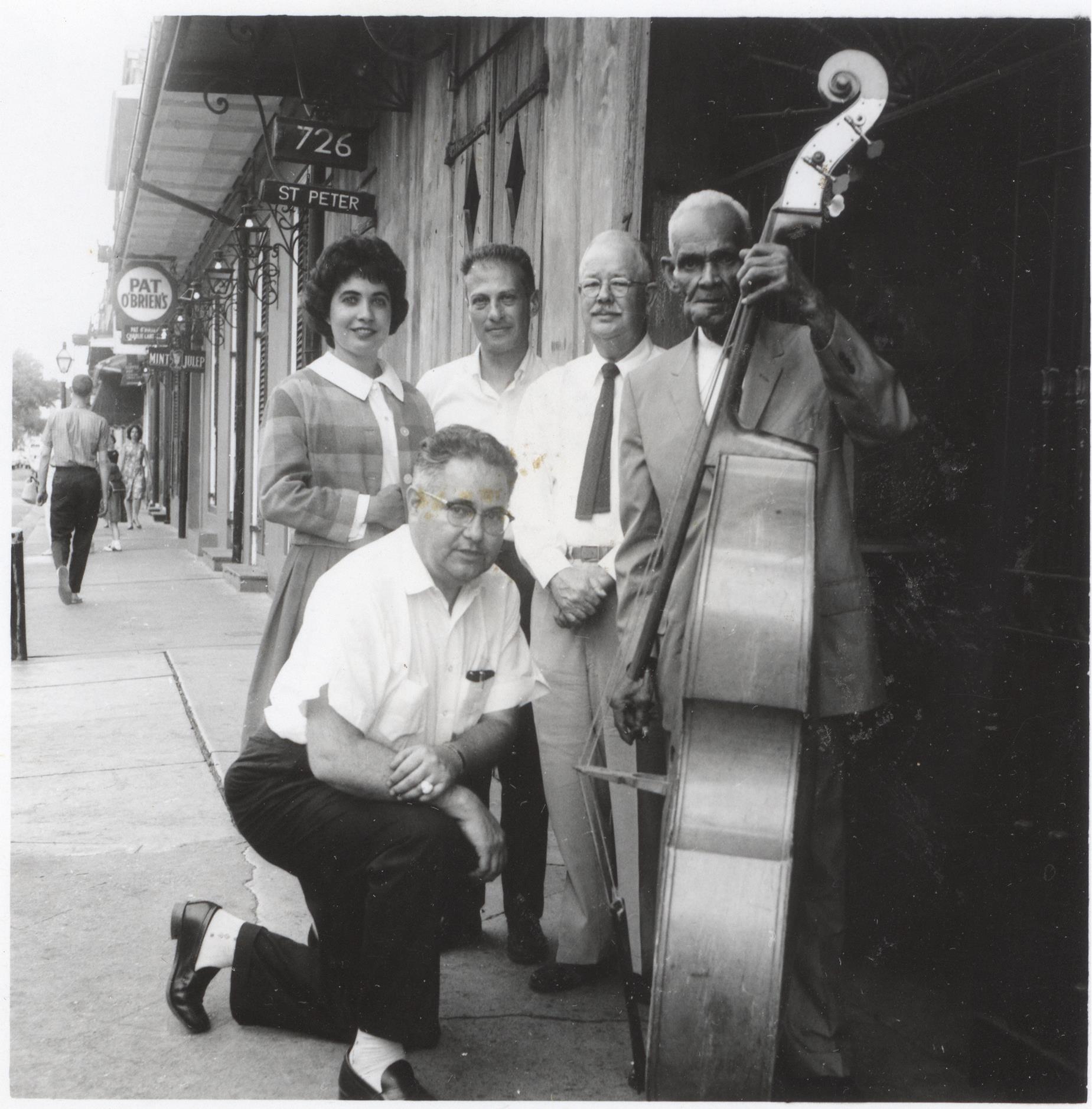
Photographer and jazz historian Al Rose, kneeling, with Sandra Jaffe, Bob Greene, Johnny Wiggs and “Papa” John Joseph in front of Preservation Hall, July of 1964. (Courtesy , Hogan Jazz Archive at Tulane University)
Rose, who also wrote a highly regarded study of the Storyville district, shot photos of nearly every major and minor jazz performer, oftentimes placing himself in the frame as his wife Diana took the shot.
Rose’s “I Remember Jazz: Six Decades Among the Great Jazzmen” published in 1987 by LSU Press is a personal account dating back to the times he first visited New Orleans in the decade of the 1930s. An earlier work written in 1984 with Dr. Edmond Souchon titled “New Orleans Jazz: A Family Album” is also important because of its record of historical jazz places. Rose, who never denied his Jewish heritage, also never revealed his real name, now known to just a handful of family members and his attorney.
Leonard began his photographic career in the streets of New York and was responsible for capturing some of the most iconic photographs of performers during the bebop and cool jazz periods that stretched out from the 1940s and into the 1950s.
After snapping hundreds of important shots of performers like Dexter Gordon, Billie Holiday, Miles Davis, Charlie Parker, Dizzy Gillespie and Duke Ellington, Leonard left New York’s Greenwich Village in 1956 and moved to Paris, where he snapped photos of important French cabaret stars and later lived in Ibiza and London. Following an exhibit of his work at the Gallery for Fine Photography, he so fell in love with the New Orleans culture and new opportunities for work that he moved to the city in 1991. Leonard lived here until Hurricane Katrina related flooding destroyed his home.
Cahn, a member of a wealthy New Orleans Jewish family made a point of taking photographs of jazz performers at every opportunity he could. His massive collection of photographs comprises the bulk of The Historic New Orleans Collection’s of prized jazz works.
Cahn began photographing “second line” jazz parades in the 1950s as a young man. He was extremely well regarded by local performers and had 15 years experience at the time that the first New Orleans Jazz Festival, founded by Jewish promoter George Wein, started in 1970 at the former site of Congo Square adjacent to the New Orleans Municipal Auditorium.
Until the time of his death in 1995, Cahn made every New Orleans Jazz and Heritage Festival he could and had access to all areas. Led by Dejan’s Olympia Brass Band, Cahn’s traditional jazz funeral was a major affair with participation by a number of parading organizations including the Young Men’s Olympian Brass Band, Money Wasters and Zulu Social Aid and Pleasure Club organizations.
Cahn and Rose were close friends with two other important Jewish New Orleans families whose impact on the preservation of jazz is epic: the Borenstein and Jaffe families.
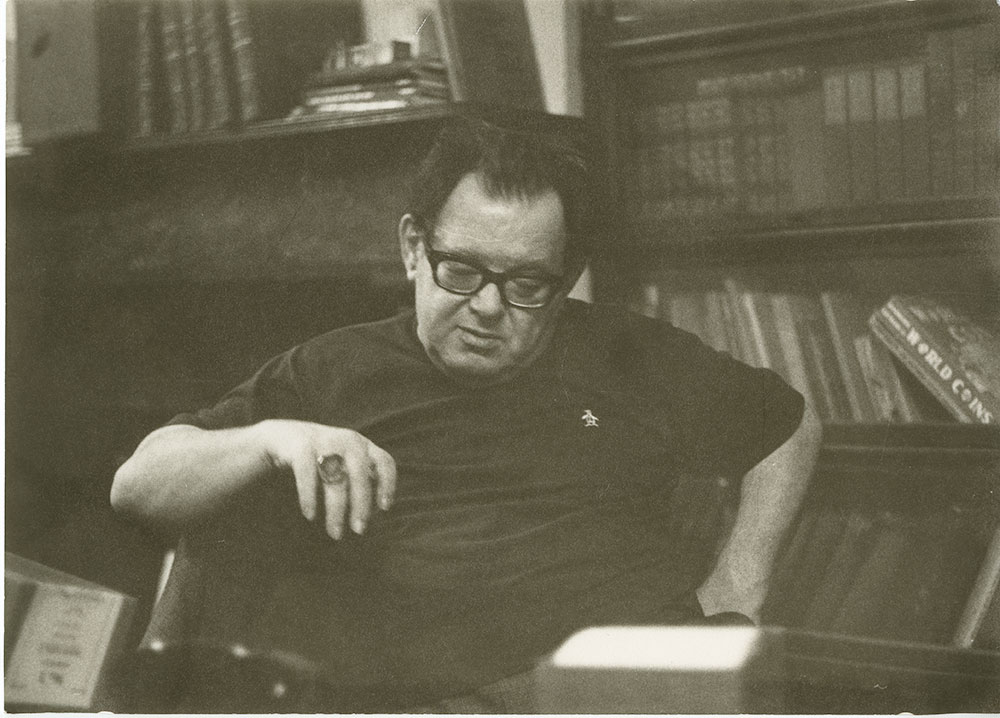
Larry Borenstein of art gallery fame. (Courtesy of the Hogan Jazz Archive, Tulane University)
Were it not for Associated Artist Galleries run by Larry Borenstein, the likelihood that traditional jazz would have died out due to lack of interest and that many of the more famous performers whose names are a part of the lexicon would have faded into obscurity is not that hard a stretch.
Located at 726 St. Peter Street, Borenstein’s gallery was a gathering place and cultural salon for jazz performers, visual artists and jazz enthusiasts. A native of Milwaukee, E. Lorenz Borenstein, reportedly a grand-nephew of Russian revolutionary Leon Trotsky, was a streetwise salesman, stamp collector and art vendor, who arrived in New Orleans on the very night of the Japanese attack on the American fleet at Pearl Harbor, according to William Carter in his book “Preservation Hall.”
At first Borenstein began to work as a salesman, selling and collecting stamps, coins and foreign currency. Following a disastrous devaluation of the British pound, he turned
to art as a means to provide a stable income and moved into the gallery in 1952 next to the famous Pat O’Brien’s bar. Borenstein found that he needed to be open late at night as spillover from the bar resulted in significant art sales. A lover of jazz, Borenstein couldn’t travel to listen to the musicians play at their usual haunts, so he encouraged “rehearsals” to be held at his place late at night. At first some white and black musicians would engage in jam sessions, but authorities and the local union both took a dim view of this.
Borenstein would supply beer and pass a kitty to reward the performers for their time.
Rose also recounts how Borenstein had one thing most jazz performers desired on a regular basis: a rest room. New Orleans at that time had segregated facilities. Finding a place to relieve themselves was tough enough, but there was not problem at the art gallery.
During the day, Borenstein would oftentimes offer a cool, refreshing glass of water as well. As Rose recounts about Lemon Nash in “I Remember Jazz,” “He’d put his ukulele down, satisfy his immediate need, and then, to replay Larry’s hospitality, he’d play and sing a tune.”
A street player, Nash knew hundreds of pop tunes from the Twenties and would launch into song, hoping for a tip or to linger in a friendly clime. Eventually, he began to show up more regularly, according to Rose, and to bring along the likes of Kid Thomas, Harrison Verret, Noon Johnson and other jazz performers to help carry more than one tune.
Regardless of this simplistic explanation, “Mr. Larry’s gallery,” as players referred to it, did become a beacon for players and enthusiasts alike as George Lewis, “Sweet Emma” Barrett, Punch Miller, Billie and DeDe Pierce and dozens of others –started to drop by with more regularity.
Gallery visitors began to reward the ensembles with more generous gratuities and word spread of the now nightly jam sessions. Eventually Borenstein moved his art facility to an adjacent facilty as the musicians moved in, but the enigmatic pegboard that decorated the walls and was used to hold up the original artwork at the facility remained.
While Borenstein did have a temper, he was a very caring individual who would do all he could to help the downtrodden musicians who played at his gallery. He was soon joined by two young lovers of jazz, who took his original “rehearsals” and transformed them into a worldwide institution.
![jaffes[3]](https://www.crescentcityjewishnews.com/blog/wp-content/uploads/2014/10/jaffes3.jpg)
The Jaffe family of Preservation Hall. (Courtesy of Preservation Hall)
Allan and Sandra Jaffe had allegedly met in a record store admiring the stacks of old jazz recordings, had fallen in love, married and then took allowed their first love of jazz to move them to the Crescent City for a stopover. Making acquaintances with several performers they met, the two were drawn to Borenstein’s gallery and never really left except to pack their possessions and move permanently here.In the early days, Jaffe and his wife spent much of their time converting the gallery – a gift from Borenstein to the Jaffes into a “kitty hall,” where musicians could play to their hearts’ content in front of an audience and reap the benefits of remuneration. Allan Jaffe, a graduate of the University of Pennsylvania was a businessman who had a vision and his vision was renamed Preservation Hall.
Sandra Jaffe passed a basket around at night and the lines of patrons became even more steady. The crowds never diminished and the Jaffes made the upstairs their domicile, raising the roof with hot jazz and a son, Ben, in the process.
“I’m not sure what it was about the music specifically that drew them to New Orleans,” relates their son. “But I do know there was something about the musicians and culture that resonated with them…they immediately felt that they were kindred spirits.”
Many of the musicians began to regard the Jaffes as their own kin. Whenever one grew sick or needed a hand, the idealistic couple paid medical bills and provided assistance, even taking care of burial costs in some cases.
Eventually, Jaffe became quite a prominent tuba player himself and he would sit in with the veteran players, learning techniques at the hands of the originators of the jazz art form. Allan Jaffe formed a tight knit group of players who, beginning in 1963, toured Japan and
later embarked on numerous international trips, helping to bring sharp focus on the importance of the remaining musicians of the earlier era.
Under Allan Jaffe’s direction, they recorded dozens of albums over the Columbia and Sony Music labels garnering even more worldwide attention.
The honeymoon ended when Allan Jaffe succumbed to the effects of cancer on March 10, 1987. He was only 51.
![ben jaffe 30800-0008[7]](https://www.crescentcityjewishnews.com/blog/wp-content/uploads/2014/10/ben-jaffe-30800-00087.jpg)
Ben Jaffe (Courtesy of Preservation Hall)
By then Sandra Jaffe had already taken over the operations and was preparing young Ben to eventually take over for his father. Like his father, he also became a proficient tubist and in more recent years has toured with the Preservation Hall Jazz Band as its leader.The most recent Sony Music release is a definite departure for the group, whose ranks include a new generation of players like Clint Maedgen and Wendell Brunious. “That’s It” is the first instance where the band has produced original music.
“In 2011 we celebrated Preservation Hall’s 50th anniversary,” Ben Jaffe reported. “The new album celebrates the next 50.”
The Jewish influence on jazz, as with other ethnic groups, is well documented. The legacy that Preservation Hall is ensuring with its new release and worldwide tours continues
a long line of Jewish influence from jazz’s earliest days. As long as the art form exists, Jews will, no doubt, be an integral part of its workings and an essential part of its mix.
