


To stay afloat, shuls merging across denominational divide
By BEN GITTLESON
(JTA) — Here in New Orleans, the Reform Jews of Congregation Gates of Prayer and Orthodox Congregation Beth Israel have enjoyed a symbiotic relationship as a result of the aftermath of Hurricane Katrina.
Prior to the storm, the Modern Orthodox congregation was firmly entrenched in Orleans Parish, where it has been founded and located for over 100 years. It was only after Hurricane Katrina dumped 10 feet of water in Beth Israel’s sanctuary in Lakeview that the congregation found refuge in the only Reform temple in Metairie. Gates of Prayer had suffered significatn damage, but they had escaped the worst of the storm and were functional.
Starting in 2006, Beth Israel began sharing office space with Gates of Prayer, eventually using a small chapel in the rear of the building for several years to conduct Orthodox services there. Last year Beth Israel moved to a building constructed next door on land purchased from the Reform synagogue. The congregations still share a playground.
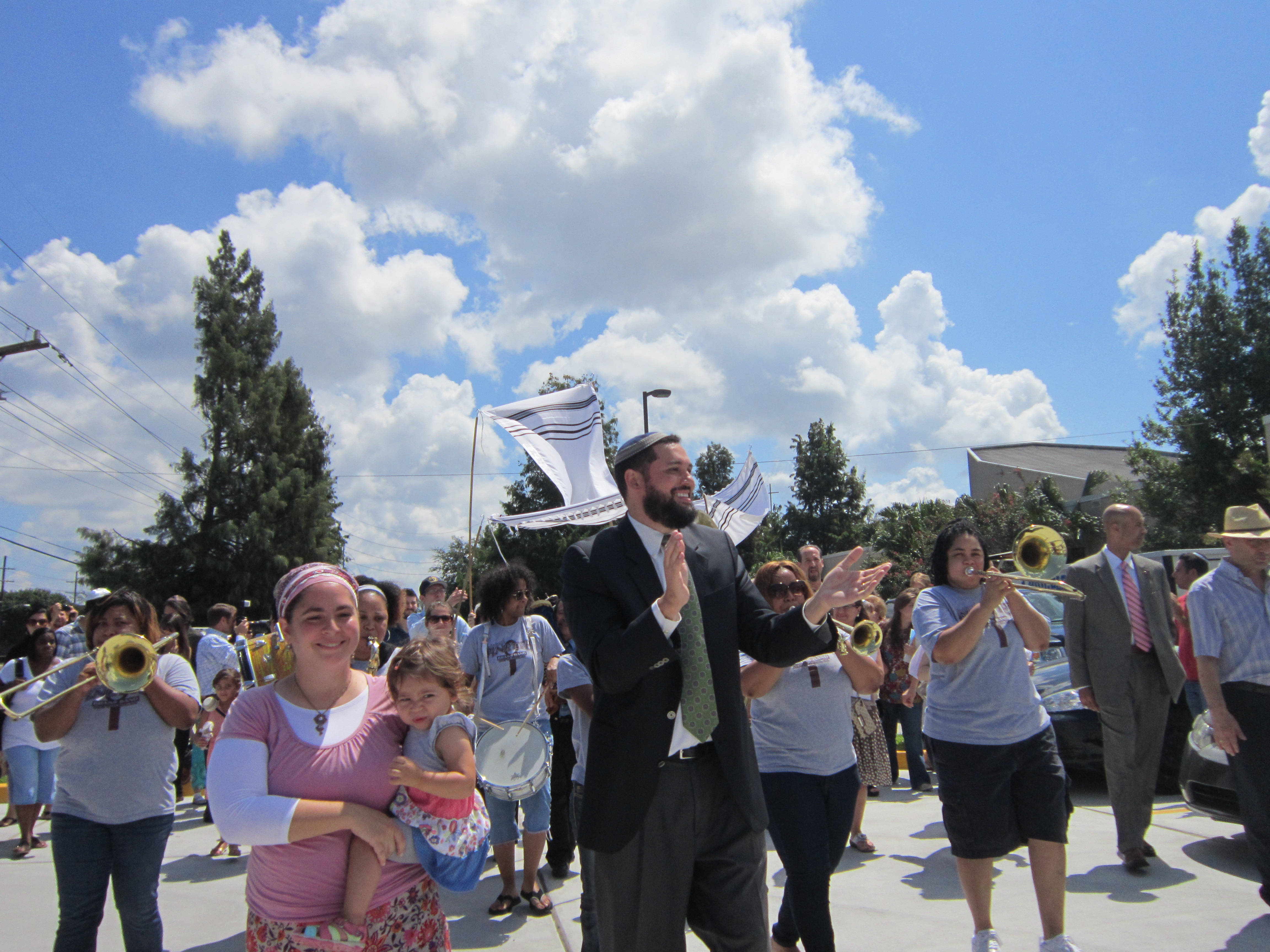
Rabbi Uri Topolosky, center, leads a Torah procession from Congregation Gates of Prayer to the new Beth Israel Synagogue at dedication in August, 2012. (Photo by Alan Smason)
“It’s all about relationships,” said Uri Topolosky, Beth Israel’s rabbi. “It’s all about a community that cared about itself, cared about each other and wanted to see a good thing happen.”
The phrase “necessity is the mother of invention” may well serve as a caveat to some Jewish communities hit by both internal and external challenges.
Not far away in Texas another Congregation Beth Israel can attest to that.
The Jews of Corpus Christi knew a decade ago they had to act fast to save their two synagogues. With at most 1,000 Jews left in the Texas town and only 60 families making up its membership, the 60-year-old Conservative synagogue was in shaky financial shape. So in 2005, B’nai Israel Synagogue merged with Temple Beth El, a Reform shul, to form Congregation Beth Israel, combining customs and sharing sacred spaces to preserve Jewish life in an area that saw its heyday around World War II.
The combined synagogue, and a small but growing number of others like it, makes a concerted effort to be inclusive despite denominational differences in liturgy and theology. Friday night services are tailored to Reform-minded members, while Saturday morning is conducted in the more traditional Conservative style, according to Kenneth Roseman, Beth Israel’s Reform-ordained rabbi.
Families marking a bar or bat mitzvah can choose which day and denomination they want for their celebration. Members even used furnishings from the old Conservative synagogue in a small chapel and put up some of the old building’s stained glass in the new congregation’s social hall.
“It’s not perfect,” said Roseman, “but it works.”
Across the country, scores of synagogues have overcome denominational differences to merge formally, share space or otherwise collaborate, often due to financial hardships wrought by shrinking Jewish populations. Shifting demographics and a challenging economic environment have led synagogues to consider remedies that previously were unthinkable, said Rabbi David Fine, the rabbinic director of the Union for Reform Judaism’s small congregations network.
“Many congregations worked hard for years to distinguish themselves,” Fine said. “It wasn’t so much ‘who are we’ but ‘who are we not?’– looking at the other place across town. Now it’s more ‘what do we have in common?’ ”
That kind of thinking was evident in the merger of the Reform Temple Beth El with Congregation Eilat, a Conservative synagogue in Southern California that was struggling with a significantly reduced membership. In 2010, the congregations merged formally with about 80 percent of Eilat’s 120 families joining the 650-family Beth El. Eilat members were granted board positions, one of Beth El’s kitchens was brought up to Conservative kosher standards and differences on issues such as music on Shabbat and patrilineal descent were followed in each denomination’s services.
Today, the congregation’s three rabbis — two Reform and one Conservative — run educational programming for the congregation at large and, on the High Holidays, deliver sermons to both the Reform and Conservative services.
“I think the success of it is measured by the fact that the lines are totally blurred now,” Welland said. “We’re one congregation; we’re one community.”
Some synagogues in financial straits have stopped one step short of a full merger, opting to share facilities revamped for the needs of communities with a range of practices and beliefs.
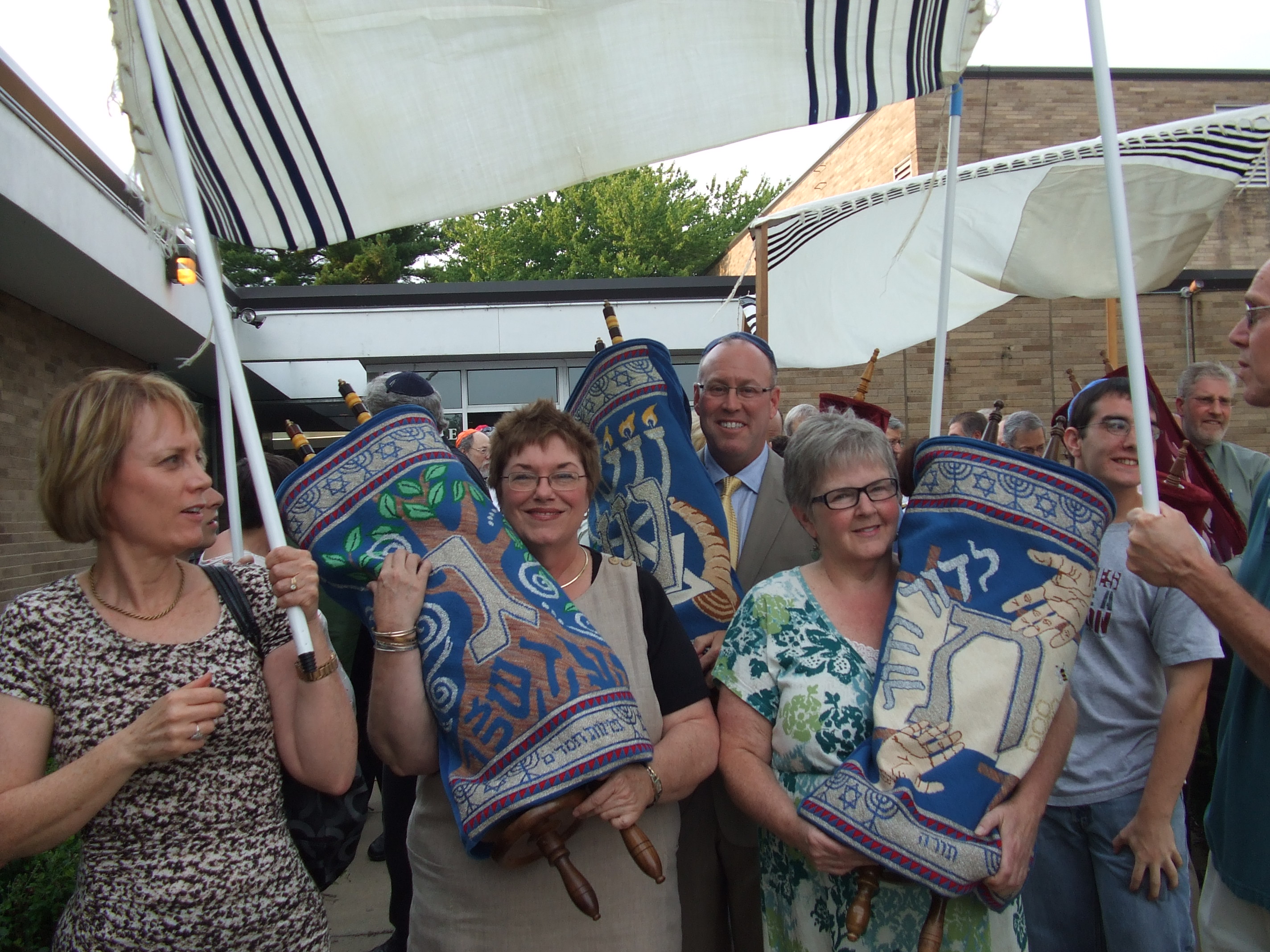
Members of the Jewish community in Canton, Ohio, celebrate the dedication of a new building housing the local federation and two synagogues, July 12, 2012. (Karen Phillippi)
In Canton, Ohio, Jewish leaders worried about a declining population sold the Reform Temple Israel and put the local Jewish community center facility on the market, according to Ed Buxbaum, CEO of the Canton Jewish Community Federation and a former president of the Reform synagogue. Last year, Temple Israel and the federation, which had been housed at the JCC, moved into the last remaining synagogue in town, a Conservative congregation, which renovated its building to meet the needs of all three.
The institutions now split the bills equally and hold equal shares of a nonprofit corporation set up to oversee the facility.
“It was not easy. It’s very difficult for people who have worshiped in a single facility for 55 years and whose families have had all their lifecycle services and everything” there, Buxbaum said. “Change is difficult.”
Both Canton and Corpus Christi have received inquiries from other communities contemplating similar moves. Corpus Christi has even produced a monograph detailing its merger.
