


OP-ED: Israel’s 75-year growing pains
By ALAN SMASON, Exclusive to the CCJN
On Tuesday evening, we will all celebrate Israel’s 75th anniversary, a remarkable story born out of the ashes of the worst period to afflict the Jewish people, the Holocaust.
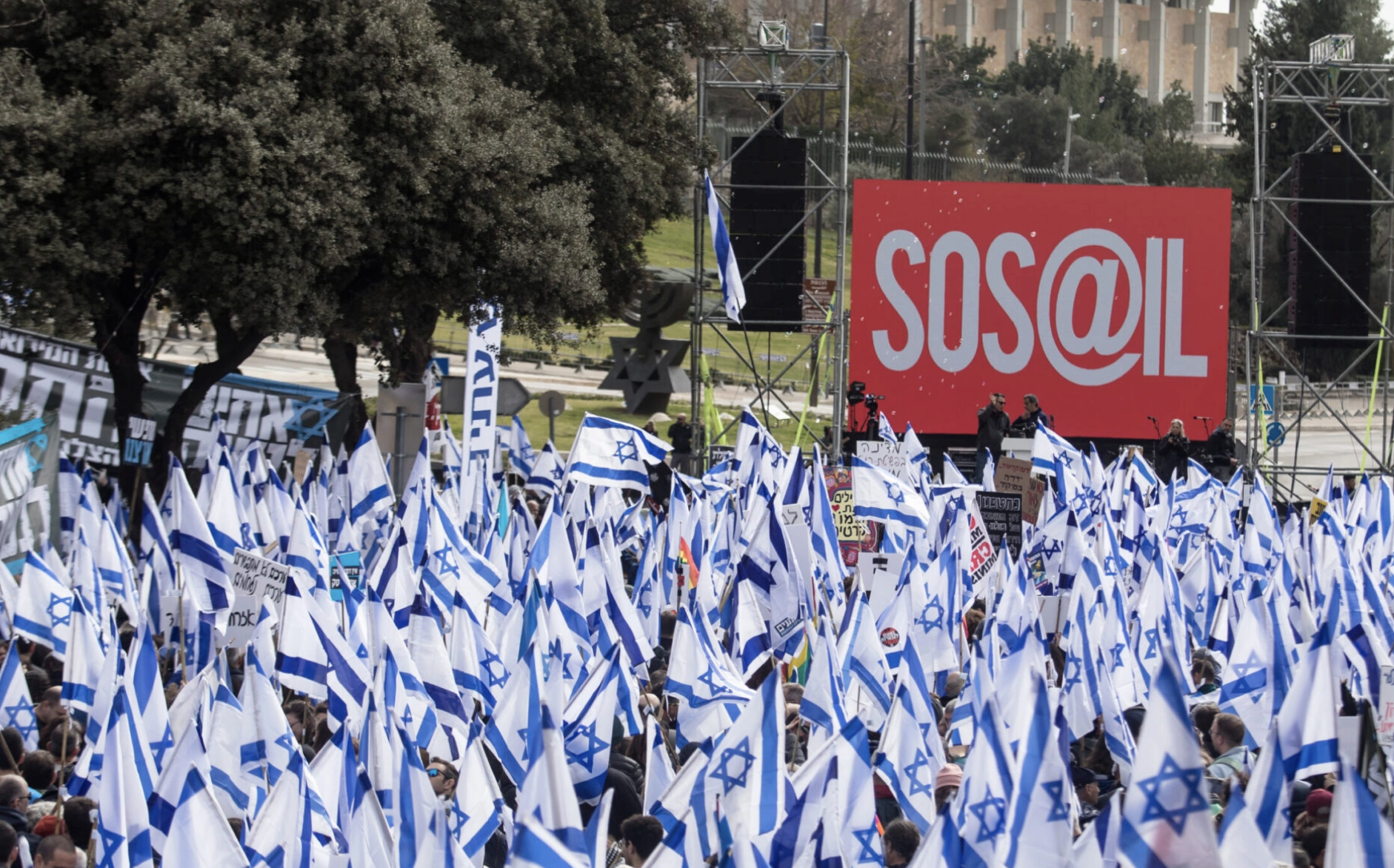
Protesters attend a massive demonstration at the Israeli Knesset on Feb. 13, 2023. (Amir Levy/Getty Images)
Yom Ha’Atzmaut recalls the date in 1948 – May 14 – when an upstart group of idealized Zionists, many of them Socialists, defied the world and declared their independence from the British Mandate that had been put into place in the region after World War I. The declaration was met with stiff resistance from the seven-member nations of the Arab League, who launched an immediate attack the following day. That war continued until a cease fire and tentative peace was declared in January of 1949.
Many of the 6,000 Israeli dead counted in the War of Independence – nearly 1% of the population at that time – were foreigners and 4,000 were soldiers, who will be memorialized on Tuesday evening with the Israeli Memorial Day, Yom Hazikaron.
Americans declared their independence from the mother stem in 1776, but even with their decisive victory at Yorktown, the Thirteen Original Colonies did not become the United States of America until 1789 with the drafting and signing of our Constitution, the founding document of our nation. It is a living, breathing document that governs our three-tiered system of government – the Legislative, Executive and Judiciary branches – with checks and balances on each.
Israel based its new government on a parliamentary democracy, similar to what exists in Great Britain and Canada. That system of government employs a prime minister, who organizes a ruling coalition government that serves with the confidence of its unicameral legislature – the Knesset; a largely ceremonial, de jure president, who is separate from the legislative branch and the only official who can issue pardons and commute sentences (apart from himself); and a separate judiciary comprised of civilian and religious courts. The entirety of the government is based on a document enshrined in the Knesset, which established the Basic Laws of governance.
The Basic Laws can be adjusted from time to time. The original 11 Basic Laws have had two additions: the Law of Return (1950), which allows for citizenship for Jews with at least one Jewish grandparent, and the Law of Jerusalem (1980), which establishes Jerusalem as the capital of Israel.
Because Israel operates with a document that is not a true constitution, its judicial system can be altered by the Knesset. Prime minister Benjamin Netanyahu and members of his ruling cabinet and coalition have been stifled by rulings from the courts and it is this attempt at reform of the judiciary, appointed by the Judicial Selection Committee, that has erupted in massive protests across the nation.
At the time of the establishment of the U.S. Constitution, the issue of slavery split the nascent government and a compromise over the issue stated that persons who were not free would consist of 3/5ths of a person for purposes of representation. This compromise guaranteed ratification of the Constitution, but failed to settle the issue adequately. Seven decades later, secession of the 11 Southern states and the formation of the Confederacy, resulted in the Civil War, our nation’s bloodiest conflict.
Israel is celebrating a major milestone this week, but the attempt at judicial reform has raised concern from the United States and other outside countries that the volatile issue could send its people onto the brink of their own violent civil war. Currently, judicial reform is off the table, but the ruling government has hinted it will return to the matter in the future.
While a Constitution for Israel is not likely to occur, a ruling document of that type might have stemmed this issue and prevented what some see as an abuse of power and others regard as a necessary action.
The one overriding image of the recent protests is that both sides wrapped themselves in the Israeli flag. The two factions may be apart politically, but deep down there is a love for their nation that still unites them. It is that love of Am Yisrael Chai (“The people of Israel is alive.”) that we trust will keep Israel united and moving forward as we all celebrate their remarkable anniversary.
