


Holocaust survivor Saul Dreier demonstrates his ‘Survival through Song’
By DEAN M. SHAPIRO, Special to the CCJN
When a man at the age of 91, with only a very limited musical background, decides to take up playing the drums – a challenging set of instruments to learn at any age – that accomplishment is worthy of being a news item. But when that same man is a Holocaust survivor and is still playing the drums eight years later as the leader of his own five-piece band, it becomes even more newsworthy!
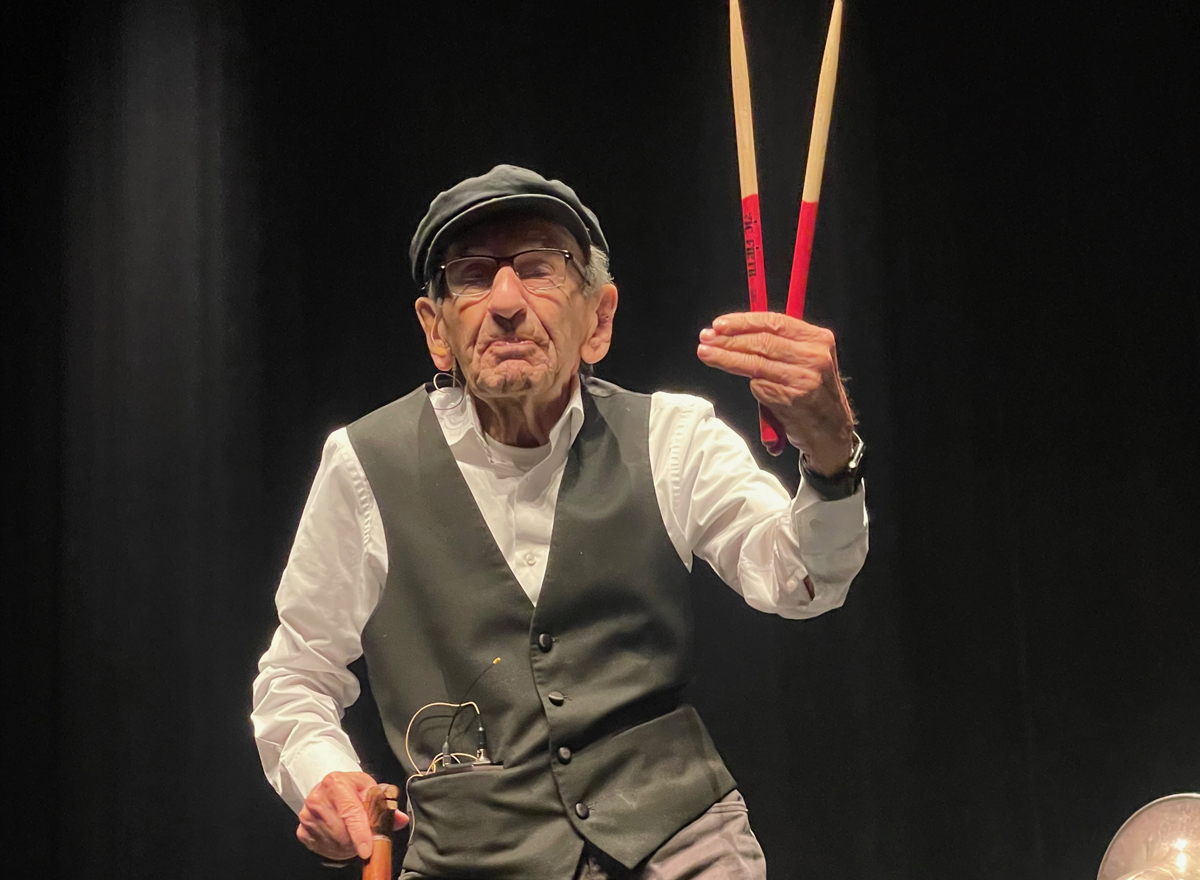
Saul Dreier, holding his drumsticks and his cane, appears at the JPAC on Wednesday, August 14. (Photo by Dean M. Shapiro(
That would describe the scene on Wednesday, August 14 at the Jefferson Performing Arts Center when 99-year-old Saul Dreier took center stage with his Klezmer-oriented Holocaust Survivor Band.
Sponsored by Chabad Jewish Center of Suburban New Orleans, the program, titled “Survival Through Song,” drew a diverse, near-capacity crowd of people who came to hear the stories and their message told by a man who survived captivity in four concentration camps during the Nazi reign of terror in World War II.
Born in Krakow, Poland on April 29, 1925, Dreier was 14 years old when the German army invaded his country and the war broke out. In 1944, at the age of 18, he was arrested and taken to the Auschwitz concentration camp, then moved to a camp in Plaszow, Poland where he worked in the factory owned by Oskar Schindler who, over the course of the war, was credited with saving the lives of thousands of Jews.
From there Dreier was moved to a camp in Mauthausen, Poland, then finally to Linz, Austria where he was liberated by the Allies in 1945.
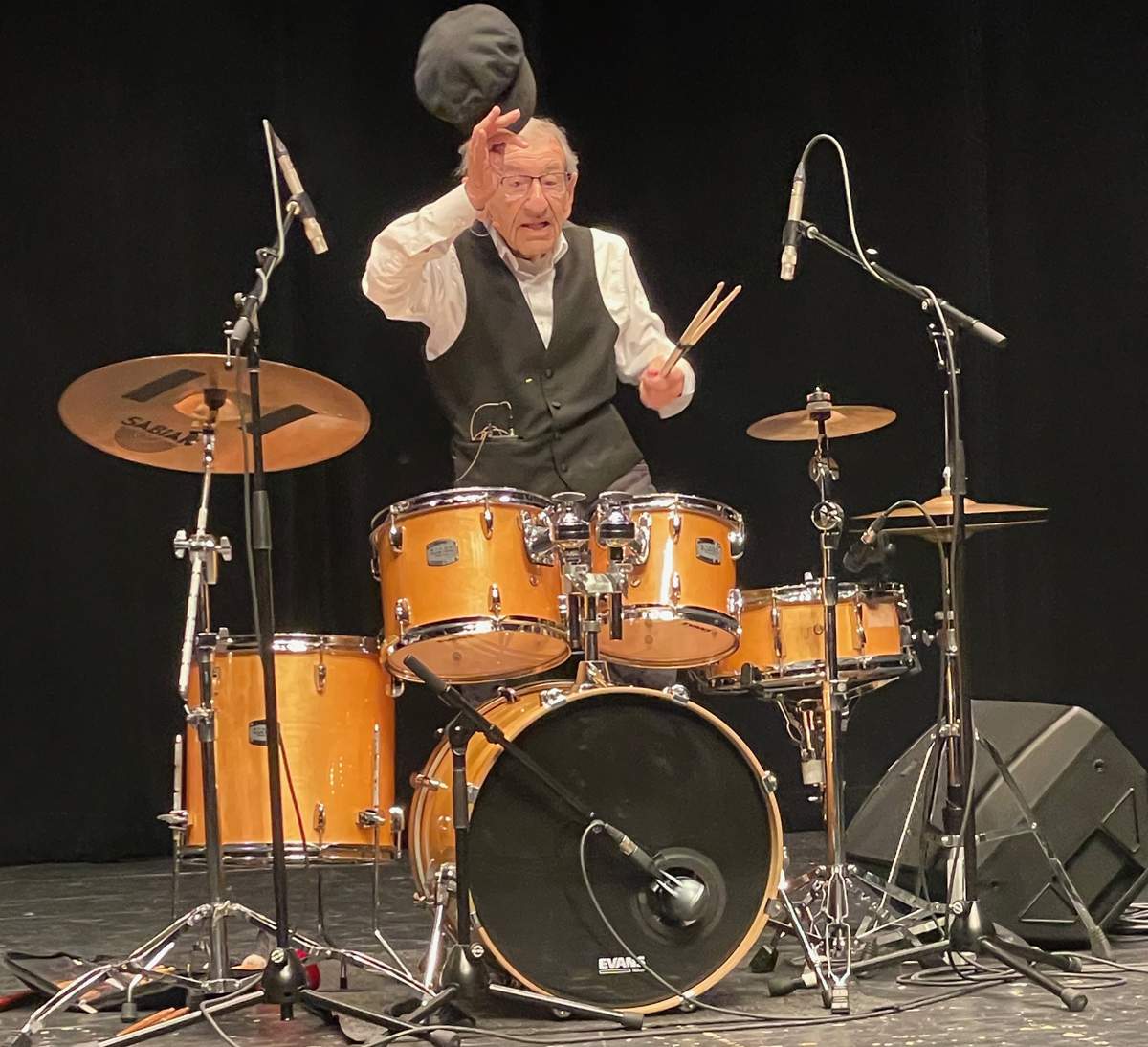
Ninety-nine-year-old Saul Dreier behind his drum kit at the Jefferson Performing Arts Center. (Photo by Dean M. Shapiro)
As quoted in his Wikipedia entry, Dreier relates a story that he experienced while incarcerated in one of the camps. “One day a truck arrived with a piano and a drum kit. The director of the camp asked who wanted to play the piano and a man from Yugoslavia raised his hand. Nobody wanted to play the drum kit, so I volunteered.” But nearly 65 years would pass before he would play another instrument.
Returning to Krakow, where the Nazis had decimated a large portion of the Jews they herded into a ghetto, Dreier learned that he was the last surviving member of his immediate family. He emigrated to the United States in 1949 where he lived and worked in the New York metropolitan area. He married his wife, Clara, in 1958 and, when he retired, they moved to Boca Raton in south Florida.
The death of classical pianist Alice Herz-Sommer – another Holocaust survivor – at the age of 110 in February 2014 inspired Dreier to once again take up the drums and start a klezmer band. Teaming up with another survivor, accordionist Reuwen “Ruby” Sosnowicz, they formed the Holocaust Survivor Band, adding up to five or six other, much younger members, including a female vocalist. After only a few performances at local synagogues and retirement homes, the band’s renown spread quickly and they were offered gigs in Las Vegas. Later, they later toured around the world.
In 2020, the two of them were interviewed for a documentary filmed by Tod Lending. Sosnowicz is no longer with the band.
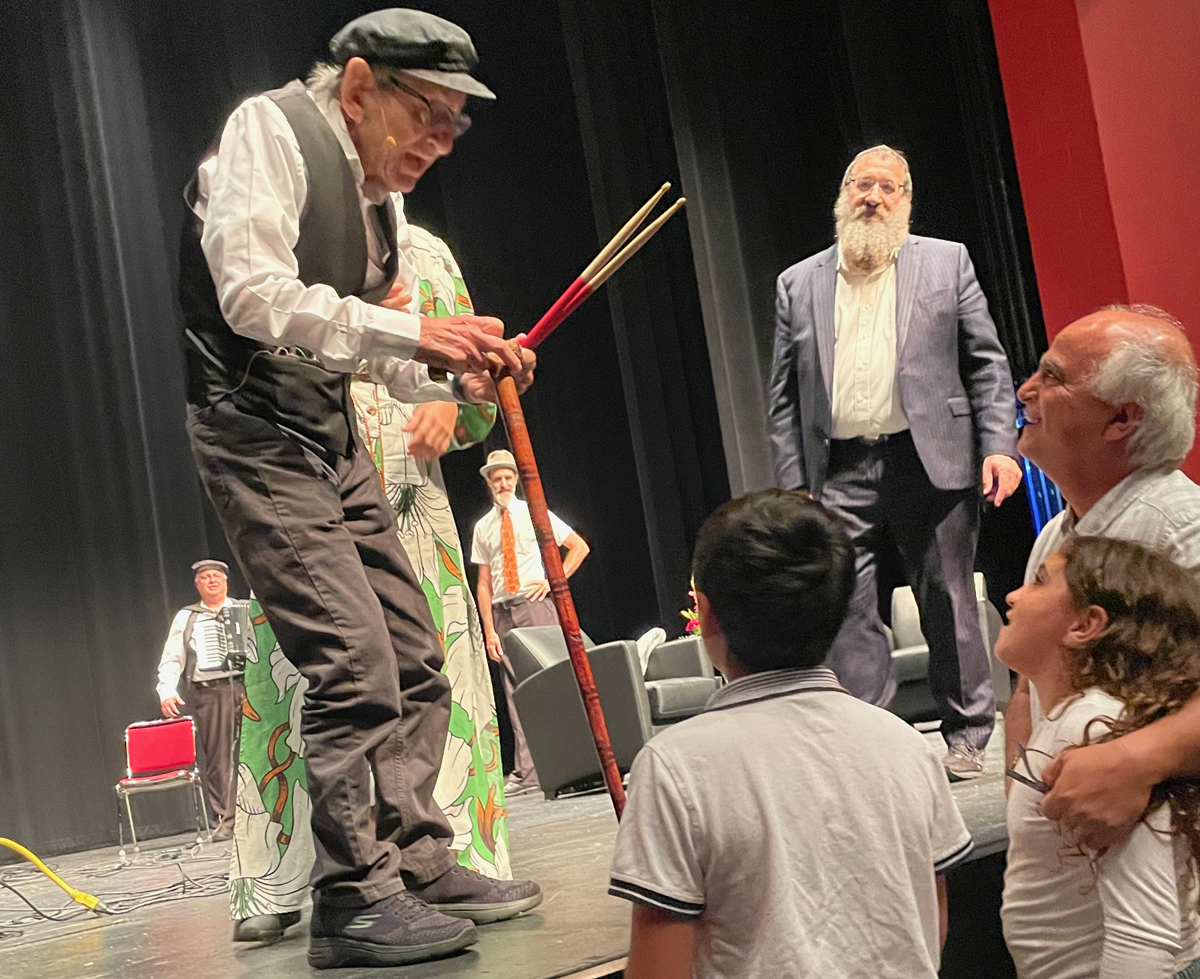
Saul Dreier, left, interacts with guests with Chabad of Metairie Rabbi Yossi Nemes, rear right. (Photo by Dean M. Shapiro)
Accompanied and assisted by a granddaughter at his Metairie performance, Dreier took center stage behind his drum kit, flanked by a banjoist, a tuba player, an accordionist and a clarinetist. After performing several Klezmer numbers, Dreier sat down for a 45-minute interview with Chabad Rabbi Yossi Nemes.
During their discussions, Dreier described some of the horrors he witnessed, including seeing babies thrown out of a fourth floor window into the street by Nazi soldiers and seeing members of his family being carted off, on their way to be transported to concentration camps. In his lighter moments he describes how he learned to play tunes by clapping two metal spoons together and he demonstrated on the stage with a pair of spoons he had with him. He also related the story about how he came about forming the Holocaust Survivor Band.
Near the conclusion of the performance, Dreier came to the front of the stage to auction off a signed pair of his drumsticks. After an intense round of bidding from the audience that started with $25, the sticks eventually sold for $600. The evening’s event ended with a performance of “Hava Nagila” as the audience stood clapping and singing along.
On the following day, the band gave a performance for Chabad Baton Rouge at the Crowne Plaza Executive Center.
