


Holocaust survivor ‘Manny’ Gabler recalls early days in Shanghai for International Holocaust Remembrance Day
By ALAN SMASON, Special to the CCJN
While he was just an infant when he first arrived with his parents in the open port city of Shanghai just prior to the onset of World War II, Manuel “Manny” Gabler still has an amazing recall regarding his early years. His time in Shanghai, along with 18,000 other displaced Jews there, informed his life and made for a most interesting conversation at this year’s International Holocaust Remembrance Day program at the National World War II Museum.

Manny Gabler is interviewed by Hannah Dailey on International Holocaust Remembrance Day, Tuesday, Jan. 27 at the National World War II Museum. (Photo by Alan Smason)
Gabler was interviewed by Senior Oral Historian Hannah Dailey on the stage at the Boeing Freedom Pavilion on Tuesday evening, January 27. That date is the anniversary in 1945 that the Auschwitz complex of concentration and death camps was liberated by members of the Red Army. Since adoption by the General Assembly of the United Nations in November of 2005, the date has served as International Holocaust Remembrance Day and is observed by the museum with a new program each year.
Gabler’s parents were married in Germany at the same time that the Nuremberg Laws went into effect, barring Jews from marrying non-Jews. Gabler’s father was a well-known Jewish bantam weight fighter known to the Gestapo. Gabler’s mother, he explained, eventually did convert to Judaism, but because their marriage was forbidden, the couple left Germany to travel to Milan, Italy, where their son was born in 1938.
After the Nazis arrived in Italy, the Gablers became increasingly concerned they might become targets of persecution and used money provided by HIAS – the Hebrew Immigration Assistance Society – and Italian patriots to eventually move to Genoa, where they boarded a ship out of Italy.
“The United States (and) Great Britain closed their doors to any immigrants so there was no place for Jews to go and they needed a safe haven. Shanghai happened to be one,” Gabler elaborated. “You could go there with no visa, no anything. There was an area of Shanghai called the International Settlement, which was occupied by the British. The Hongkew area we went to was right next door.”
The Gablers were able to find a place to stay without any passports and they were supported, he said, by two very wealthy Jewish families living there: the Sassoon family and the Khadouri family. They provided former storage units for temporary housing, he explained.
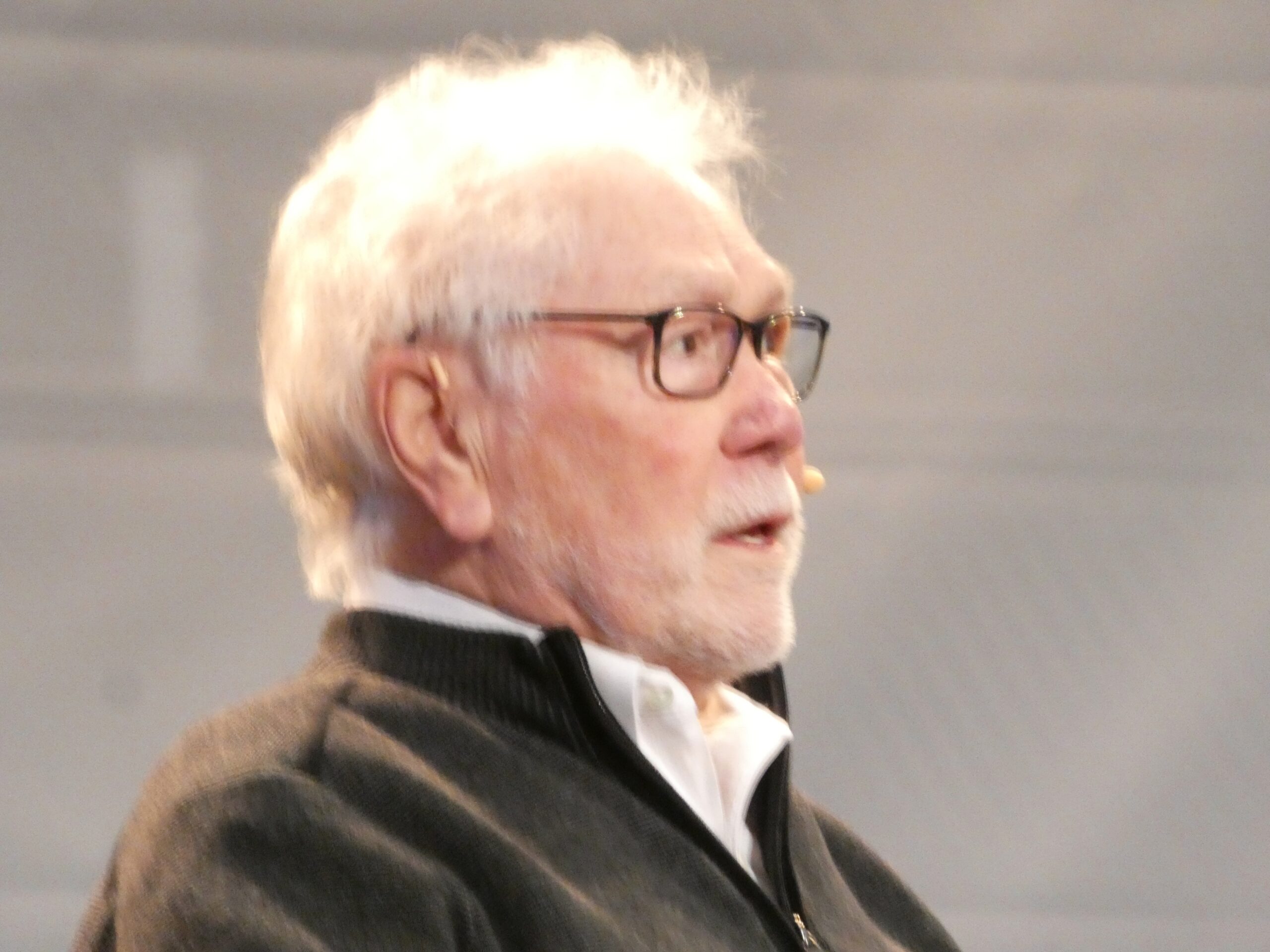
Manuel “Manny” Gabler speaks at the National World War II Museum on Jan. 27, 2026. (Photo by Alan Smason
“There were 150 people per room and rows and rows of bunk beds,” he remembered. “The women and children were on one floor and the men on another.”
Dailey asked questions about his memories while living in Shanghai. He recalled never having a lot to eat, but more telling was he recalled going to school in the morning and having to walk past bundles of dead children wrapped in newspaper along the street who had been placed there during the night.
“Because I was a child, I just I lived through that moment. It wasn’t something horrible for me to see,” he continued.”It wasn’t till later in life that I realized that this was terrible to see.”
The Gablers arrived with the clothes on their back and a ten Deutchmark note, but he claimed he received an excellent schooling.
The Jewish residents of Shanghai were never mistreated, he added. “The Chinese were a secular culture, so this kind of proves that bigotry is learned. The Chinese kids didn’t know to hate us because we were White or Jewish or whatever.” The Jewish kids and the Chinese kids all played together and accpeted each other, he noted.

National World War II Senior Oral Historian Hannah Dailey conducts the interview with Manuel “Manny” Gabler. (Photo by Alan Smason)
After Pearl Harbor, the Japanese, who had invaded China and controlled Shanghai, removed the British and the French settlers out of the Shanghai districts they occupied and had them interned in camps. Being Caucasians, the Jewish residents of Hongkew were easily spotted by Japanese military, who imposed rules on when they could leave their ghetto area.
Shanghai was bombed by American B-17s in July of 1945 and Gabler recalled his father picking him up from school amid all the devastation and bloodied bodies left in the streets.
Eventually, the Americans liberated the area, but the Gablers were not able to leave Shanghai after the war due to their not having proper papeerwork, he exaplained. He said they were able to get papers in order and leave Shanghai just prior to the capture of the city by Communist Chinese forces under Mao Tse Tung.
“We were refugees all over again,” Gabler mused. Most of the people had left Shanghai in 1947, but the Gablers did elect to travel to the United States, instead of a job offer from Australia, and came to San Francisco aboard a troop ship.
“We were put up in a hotel for a week before we left San Francisco and left for Pittsburgh, because my father had a job there,” Gabler added.
Much of his adventures in San Francisco consisted of eating new items, he added. He had his first fried chicken and his first donut there. The culture shock of seeing traffic and taking in the architecture was also jolting, he added.
Gabler and his brother returned to Hongkew in 1998 and found there were practically no Jews left there. He recognized his old Hebrew school while there and visited the place where he lived during the war. “I walked up to the door and the nail holes for the mezuzah were still in the door frame and hadn’t been painted in 50 years,” he told the audience with tears in his eyes. “It was a profound moment because I realized who i was.”
Presented by a grant from the Taube Foundation, this year’s talk between Gabler and Dailey was seen before a crowd of nearly 300 people and others over the museum’s streaming link. The talk followed a reception of light refreshments at the museum.
