


US forces hit IRGC targets across Iran
By JOSHUA MARKS
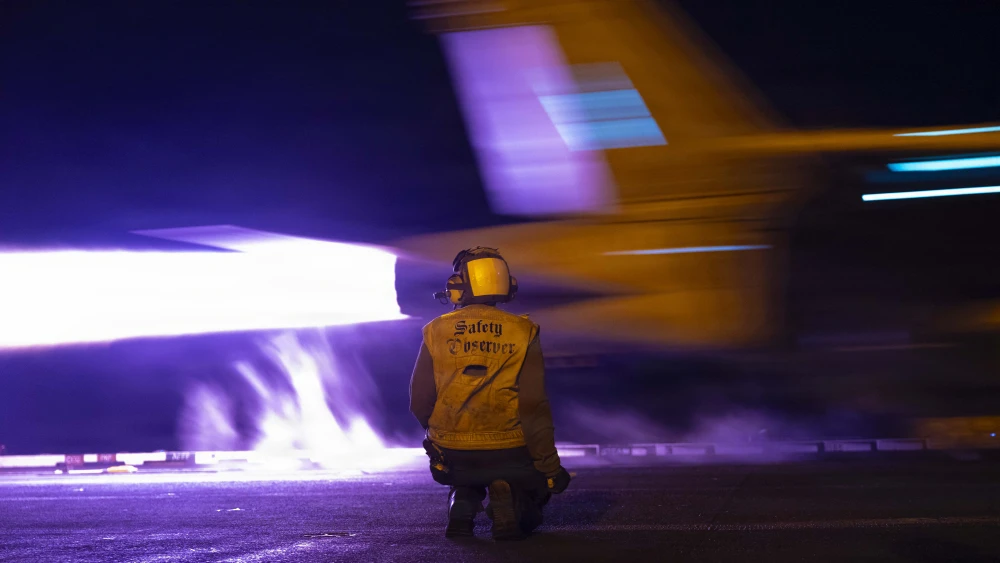
A U.S. Navy sailor aboard the aircraft carrier USS George H.W. Bush on July 29, 2026. The ship is deployed to the U.S. 5th Fleet. (Photo via U.S. Central Command)
American forces struck IRGC air-defense sites, radar installations, maritime assets, communications centers and mine-laying capabilities.
CENTCOM said the operation was launched in response to recent attempted Iranian attacks on commercial shipping in the Strait of Hormuz and U.S. service members deployed in the region.
“More than 50,000 U.S. service members are currently operating across the Middle East and remain vigilant, lethal, and prepared to continue executing operations directed by the Commander in Chief,” CENTCOM said.
“The United States is, as we speak, striking Iranian Targets near the Strait of Hormuz. The strikes are large and powerful, and in retaliation for the Iranians’ failed attempt at adding sea mines to the Strait, which currently has no mines (They have been completely removed or detonated!), and the Iranians shooting eight missiles, all successfully knocked down, at our Military Base in Jordan,” U.S. President Donald Trump wrote on Truth Social.
“If the failed Nation of Iran retaliates for this very justified attack, they will be hit again at a much harder and higher level, but it will not be the biggest attack of them all, that is waiting in the wings and, when it is over, there will be very little left of the Islamic Republic of Iran!” Trump added.
Tehran responded after the American strikes with a wave of missile and drone attacks targeting U.S. military assets in Jordan, Kuwait, Iraq and Bahrain, BBC News reported on Wednesday.
The IRGC fired a barrage of ballistic missiles at a U.S. Marine installation in Aqaba, Jordan. Jordanian air defenses intercepted 13 ballistic missiles, destroying 10 while three crashed in remote areas without causing casualties, according to the broadcaster. Kuwait’s armed forces also engaged incoming Iranian missiles early Wednesday.
The flare-up followed a renewal of direct hostilities on Sunday, when the U.S. military attacked Iranian rocket launchers at the Strait of Hormuz in its first military action in a month, breaking a lull in fighting during a six-month intermittent conflict. In response, the IRGC fired ballistic missiles at U.S. bases in Jordan. On Sunday night, Trump posted an AI-generated video depicting the destruction of Iran’s Kharg Island, which handles up to 90% of Iranian crude exports in peacetime.
Iranian President Masoud Pezeshkian on Tuesday signaled openness to de-escalation under previous terms.
“I am stating clearly that if the U.S. returns to its commitments under the Memorandum of Understanding, the Islamic Republic of Iran will immediately reciprocate,” Pezeshkian said at the Shanghai Cooperation Organization summit in Bishkek, Kyrgyzstan, according to Reuters.
The June agreement was intended to halt hostilities and set terms for further negotiations but later unraveled over disputes about its implementation.
Economic pressure campaign
Alongside military strikes, the administration has escalated financial measures against Tehran. U.S. Treasury Secretary Scott Bessent last week announced “Operation Economic Outcast,” an expanded sanctions campaign designed to cut off the regime’s remaining financial lifelines.
Speaking to CNBC on Monday, Bessent said sanctions and naval-blockade efforts have severed the Islamic Republic from global markets, accelerating domestic economic distress, soaring inflation, long lines for fuel and the collapse of the Iranian rial.
“The goal here is to create the conditions that they will want to come to the table, and the president’s been very clear: They have to give up their nuclear program, they have to turn over the highly enriched uranium, they have to stop their support of proxies and the strait has to be open,” said Bessent.
“Look, my experience with people like this, the main thing they care about is their head staying attached to their neck,” he added.
Bessent said on Tuesday that the Strait of Hormuz could largely lose its strategic leverage within two years as energy exports increasingly shift to overland pipelines, noting the administration is actively working to secure critical nodes in global supply chains.
However, Trump said on Wednesday that he is not trying to force Iran back to negotiations, rejecting an ABC News report and saying he prefers Washington’s current position.
“I like our position now much better, with almost total control of the Hormuz Strait, and their economy totally collapsing,” Trump wrote on Truth Social.
He also renewed his call for internal opposition to Iran’s leadership, asking: “When are the Iranian people going to rise up and fight?”
Israeli envoy: Regime collapse ‘soon’
Israeli Ambassador to the United States Yechiel Leiter said that although Iran has been defeated militarily, “there’s just a little bit of a time lapse until it actually collapses.”
Trump “has led an incredible effort to bring this regime down; I think it’s going to happen soon,” Leiter said in an interview on the “Scott Jennings Show” posted on X on Monday.
The ambassador likened Iran’s current trajectory to the Soviet Union in the 1980s, when outside observers could not pinpoint the exact date of its fall, but former U.S. President Ronald Reagan “saw it coming. He knew that it was the end of that evil empire. It was just a matter of time.”
Katz: Israel ready to strike Iran
Israeli Defense Minister Israel Katz said on Wednesday that Israel is prepared to strike Iran and would respond “with great force” to any Iranian attack on the Jewish state.
“The prime minister and I are in daily contact with the IDF, sometimes in the middle of the night via the red phone. We do not take any piece of information lightly. We do not want to be caught by surprise; we are prepared,” Katz said, according to Ynet.
“It must be understood: The IDF, including the Air Force, is prepared to strike in Iran. If they attack us, we will respond with great force, independently of anyone else,” he continued.
Speaking at the “Decision Time: Democracy and Society” conference organized by Ynet and Yedioth Ahronoth in collaboration with the Israel Democracy Institute, Katz warned that Iran could target Israel during the upcoming Jewish holiday season.
Tehran “likes to attack on Jewish holidays because they hate Jews,” he said, while stressing that Israel is prepared “in defense and in attack” and that its aircraft are ready to take off if the country comes under fire.
