


Gloria Steinem, Jewish feminist trailblazer, dies at 92
By RON KAMPEAS
(JTA) — Gloria Steinem, the trailblazing feminist who turbocharged the women’s rights movement’s second wave by casting the liberation of women as part of the broader project of eliminating other bigotries including antisemitism, has died at 92.
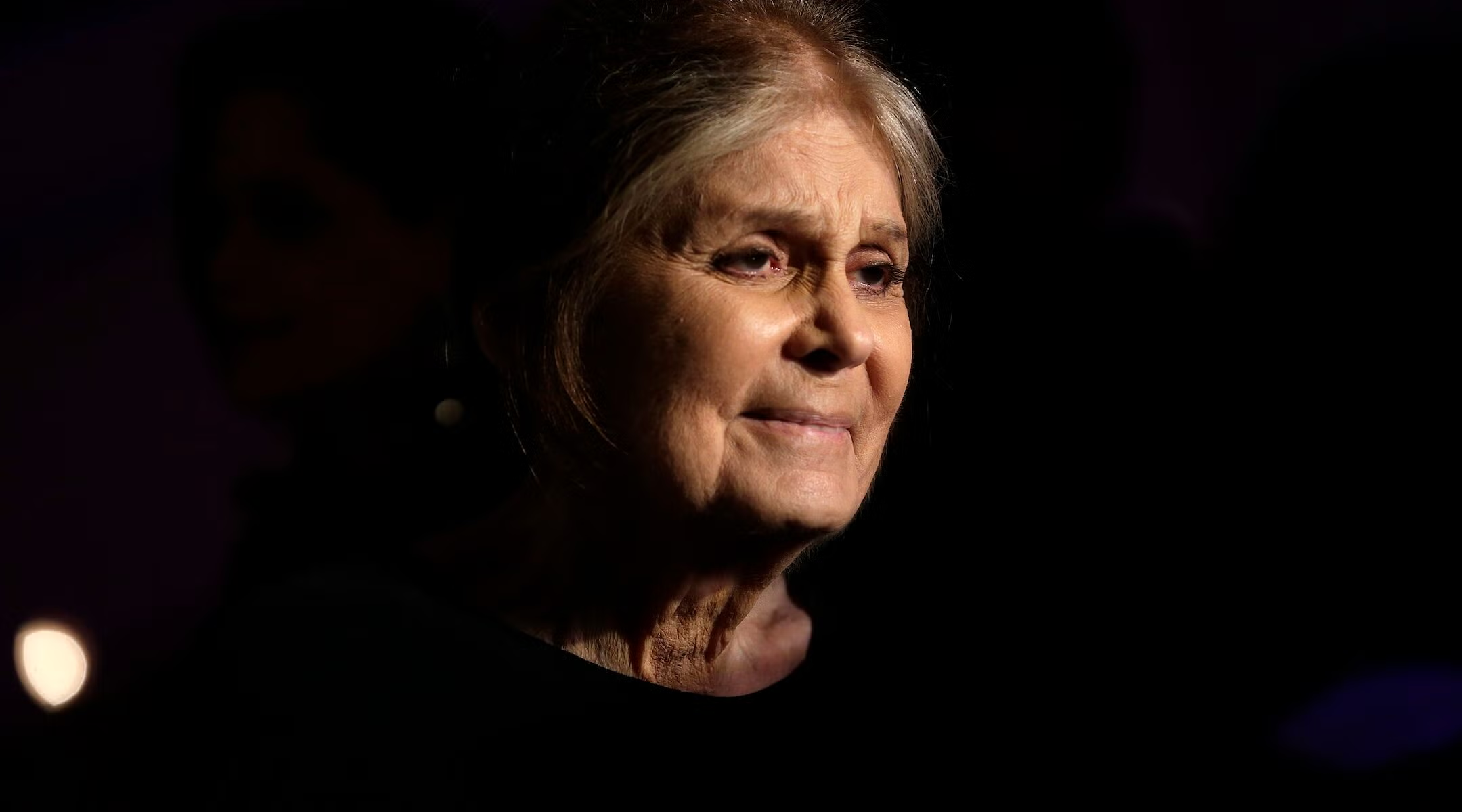
Gloria Steinem attends Equality Now 30th Anniversary Gala at Guastavino’s on November 15, 2022 in New York City. (Photo by John Lamparski/Getty Images)
“Yesterday, Gloria Steinem passed away peacefully at her home in New York City, surrounded by some of the many who loved her,” read a post Thursday on her Instagram account. “Gloria’s near-century on earth were years well-lived, and she continued working for equality until the very end.”
Steinem began her career as a journalist before moving to activism in 1969 after writing a story about women who’d suffered through illegal abortions. From there she became one of the most identifiable leaders of a movement that helped transform the daily experience of women in America.
Steinem was born in Toledo, Ohio, in 1934 to a Jewish father, Leo Steinem, and a Protestant mother, Ruth Nuneviller.
Her Jewish background informed her understanding of how oppression is structural and interrelated among targeted groups.
“Never in my life have I identified myself as a Christian, but wherever there is antisemitism, I identify as a Jew,” her friend and her fellow co-founder of the seminal magazine, Ms., Letty Cottin Pogrebin, quoted Steinem as saying in a profile she wrote for the Jewish Women’s Archive encyclopedia of Jewish women.
Steinem’s father, who booked musical acts and who sold antiques on the road, was a “wonderful, kind, charming, utterly irresponsible man,” she said.
He left the family when Steinem was 10 years old and Steinem – whose older sister was away at college – became primarily responsible for caring for her mentally fragile mother.
Yet it was her mother Ruth who instilled Steinem with her understanding of her Jewish background. It helped shape Steinem’s understanding of how one group may deprive another of essential rights.
“Steinem remembered that when she was 8 or so, her mother encouraged her to listen to a radio dramatization of Jewish torment under the Nazis and the story of a mother who could not get enough food for her little girl,” Cottin Pogrebin wrote. “‘This is going on in the world’,” Ruth Steinem said, ‘and we must know about it.’”
Steinem never shook the lesson. In 1981, speaking at Cornell University, she said liberating women was inextricable from liberating other vulnerable populations.
“We know, when we look at women and blacks in this country, or at women and Jews in Nazi Germany, or in South Africa, we understand that these two caste systems are interdependent and truly can only be fought together,” Steinem told the students.
It was a radical reimagining of what feminism meant, and was reflected in Steinem’s insistence on advocacy for others. Her outspoken support for minorities, for LGBTQ individuals and for others unsettled some second wave feminists. (The first wave was the suffragette movement, which decades earlier had brought about the right for women to vote.)
In the 1981 Cornell lecture, Steinem laid the groundwork for what would become known as intersectionality.
“Politics is any power relationship in our daily lives,” she said. “Any time one group of people or one person is habitually dominant over one another group or person, not because of experience or talent, but simply because of group of birth, whether that is race or sex or class, that is politics. That is a power relationship, and that is deserving of change.”
Her advocacy helped poison her relationship with an early ally, Betty Friedan, the Jewish feminist who launched second wave feminism with her 1963 book, “The Feminine Mystique.” Friedan believed the movement should remain focused on women’s liberation and dismissed Steinem as a grandstander.
“The media tried to make her a celebrity,” Friedan said of Steinem in 1972, “but no one would mistake her for a leader.”
Yet it was Steinem’s broader understanding of women’s rights as part and parcel of liberation movements that led her to sign a letter three years later decrying the United Nations General Assembly resolution equating Zionism with racism.
“We are appalled at the ‘racist’ label applied solely to the national self-determination movement of the Jewish people,” said the letter – spearheaded, as it happened, by Steinem’s erstwhile rival Friedan. “We decry this implicit denial of Israeli statehood and this incitement to world wide anti-Semitism.”
It was signed by 60 women, including the pantheon of Jewish second wave feminists, among them: Bella Abzug, the New York congresswoman; Joan Ganz Cooney, the co-creator of “Sesame Street”; Nora Ephron, the essayist and filmmaker; and Beverly Sills, the opera diva.
Steinem later joined in advocacy to release Ida Nudel, the Soviet Jewish refusenik.
She could be critical of Israel. In 2019, she swore not to visit Israel while Benjamin Netanyahu was prime minister after he came under pressure from President Donald Trump and banned entry to two Muslim congresswomen who are strident critics of Israel, Rashida Tlaib and Ilhan Omar.
She recalled a dinner in the 1980s she attended with Netanyahu, which she evidently did not enjoy. “You were a conversational bully to your guest, just as you are a bully to these two elected women leaders now,” she said in a statement.
Steinem herself was descended from Jewish feminist royalty – but did not know it until she was an adult, when she was enlightened by a feminist who was writing a monograph about her grandmother.
“I had a Jewish suffragist grandmother, Pauline Perlmutter Steinem, who died when I was about five,” Steinem wrote for the Jewish Women’s Archive. “She had addressed Congress, but nobody told me about that. They told me that she was a wonderful woman who kept a kosher table, had four sons, and was a pioneer of vocational education – different measurements of success – but not that she was also the first woman to be elected to a Board of Education in the state of Ohio, as a suffragist on the same ticket with the socialists and the anarchists.”
Cottin Pogrebin wrote that Steinem maintained at least one Jewish tradition for years.
“Every Passover for over twenty years, she joined a small group of ‘seder sisters’ — E. M. Broner, Phyllis Chesler, Lilly Rivlin, Michelle Landsberg, Bea Kreloff, Edith Isaac-Rose, and Letty Cottin Pogrebin — Jewish women in New York City who planned and performed a women’s seder, usually on the third night of Passover,” Cottin Pogrebin recalled in her Steinem entry in the Jewish women’s encyclopedia. “The founding premise of this seder was that women matter, that women must be acknowledged for their roles in the Exodus story and their current struggle for equality in Jewish life.”
Steinem did not marry until she was 66, when she wed David Bale, a South African activist who died three years later of cancer. She dated powerful men, many of them Jewish, including film director Mike Nichols and media magnate Mort Zuckerman.
Steinem was a lightning rod for the right wing, in part because she would not eschew glamour.
Midge Decter, a Jewish cofounder of the neoconservative movement, described in her autobiography, “An Old Wife’s Tale,” a debate she had with Steinem.
“Gloria was unforgettable that evening, for she turned up in a crotch high suede skirt and knee-high suede boots and kept warning the men in the audience that she and women like her were dead serious, and no longer were women going to put up with being their playthings,” Decter wrote. “Where I grew up we used to call that ‘teasing.’”
Steinem began her career as a journalist, famously going undercover as a Playboy bunny in 1963 to expose how grueling the work was. But she brought an unstinting seriousness to her career as an advocate, which began in 1969 after she attended, on assignment, a gathering of women who described their illegal abortions. The experience – and the memory of her own secret abortion in 1957 – radicalized her.
“They spoke about the dangerous illegal underground they had to enter, about bargaining with illegal abortionists, dealing with men who demanded sex before performing an abortion – incredible stories” Steinem wrote in her Jewish Women’s Archive essay. “For me it was like a big light coming on. I had had an abortion and never told anyone – not a girlfriend, not the man, nobody.”
She was a political columnist for New York Magazine: Her next essay was “After Black Power, Women’s Liberation.” She never looked back.
Steinem weathered controversies, including after her vigorous defense of Bill Clinton during the scandal over his affair with Monica Lewinsky. “If the president had behaved with comparable insensitivity toward environmentalists, and at the same time remained their most crucial champion and bulwark against an anti-environmental Congress, would they be expected to desert him?” she wrote in The New York Times. “I don’t think so.” More recently, she indicated she regretted the essay.
Steinem lived long enough to see many of the successes she helped bring reversed – including, perhaps most painfully, the 2022 overturning of Roe v. Wade, the 1972 Supreme Court decision identifying the right to an abortion.
“I don’t feel my work or the work of all the women and men who care about racial and sex equality has been struck down,” she told NPR then. “It’s just that it has a roadblock now, theoretically coming from the highest court in the land, but actually will impose hardships unequally but will not change the fact that we either have decision-making power over our own bodies, women and men, or there is no democracy.”
Her credo, Steinem said in a joint 2015 New York Times interview with an old friend and Jewish feminist trailblazer, Ruth Bader Ginsburg, the late Supreme Court justice, was kindness.
“Kindness matters enormously. And empathy. Finding some point of connection,” Steinem said then.
She also advised never standing down. “The great thing about obstacles is that they cause you to identify with other groups of people who are facing obstacles,” she said.
