


2026 Israeli elections: What you need to know
By JTA STAFF
(JTA) — On Oct. 27, Israelis will cast their votes in a process that will determine who is prime minister and who sits in the 120-seat parliament, the Knesset. Since the country’s founding in 1948, there have been 14 prime ministers and 25 parliaments. The process from the ballet box to determining the next premier is complicated. Here’s how it works.
1. What are people actually voting for?
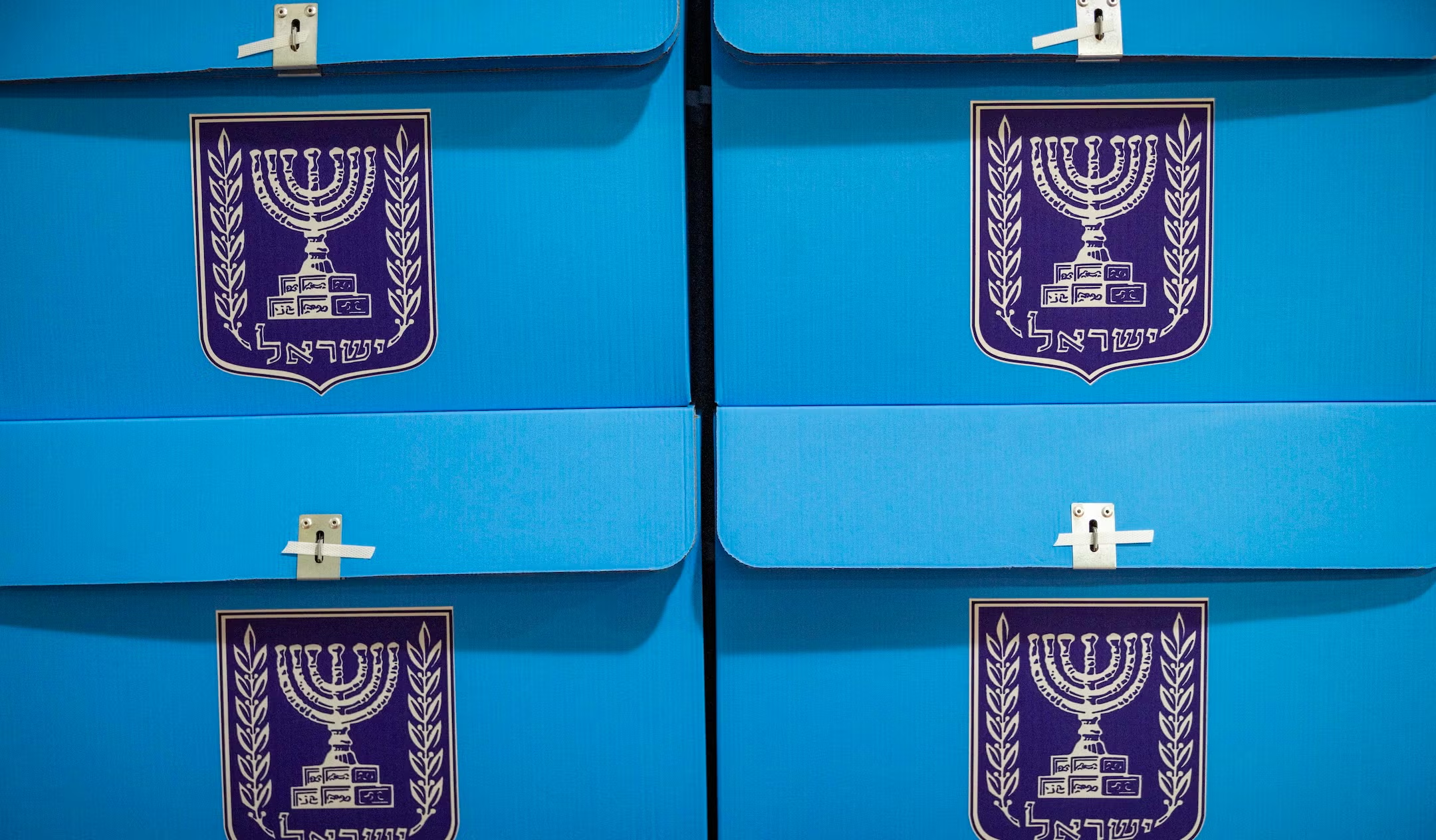
Ballot boxes for Israel’s upcoming general elections, Oct. 14, 2026. (Yonatan Sindel/Flash90)
Technically, the vote cast is for a party. The leader of the party that garners the most votes, however, is most likely to become prime minister, provided they can form a government. But that does not happen right away. The formal election results, due to be published no later than Nov. 4, only set the process of forming a government and choosing a prime minister in motion.
2. How many people and what percent of the Israeli population are eligible to vote?
Some 7,331,981 Israelis are eligible to vote, which is 71.15% of the overall 10,305,000 population. In the last election in 2022, there were 6,788,804 eligible voters, who made up 70.31% of the 9,656,000 population. Voter participation in Israel is typically high, and in that election, 70.63% of the eligible voters, 4,794,593 people, cast their votes.
3. How many votes does a party need to be in the Knesset, and how many parties are expected to secure that amount?
To enter the Knesset, a party needs the support of 3.25% of the votes cast, known as the threshold. That figure is the equivalent of four seats, known as mandates. Based on multiple recent polls, out of 38 registered parties, only 11 are expected to receive such support. Another four hover close to it. The party’s size also determines the number of parliamentarians it will have in the Knesset. The party leader that can gain enough allies to form a coalition becomes prime minister. Usually this coalition has at least a majority of parliamentarians – 61 of 120 seats – but it’s not a requirement. Minority governments led by Yitzhak Rabin and Shimon Peres from 1993-1996 held a plurality, but not a majority, of the seats. They were able to govern with the support of parties outside the coalition.
Parties predetermine their list of potential parliamentarians and rank them prior to the election, either through primaries or unilateral decisions by the party leader. The bigger the percentage of the vote they receive, the higher the number of members that party gets to send to the legislature. Voting in Israel is often a strategy game, where people choose between making sure their vote counts by supporting a party certain to enter the Knesset or risk making their vote insignificant by backing a party that doesn’t hit that mark.
4. Who are the prime ministerial contenders?
Incumbent Benjamin Netanyahu, who heads the ruling Likud Party, is vying to hold onto the premiership. According to most polls, the person who is leading, however, is former IDF Chief of Staff Gadi Eisenkot, who heads a newly formed party, Yashar. But a parliamentary system is not a two-party system and technically any leader of a party that passes the threshold and who is also slated to enter parliament can become prime minister if they can form a coalition that can secure the support of a Knesset majority. It is usually the case, though, that the head of the largest party is given first shot at coalition building.
5. How are the coalitions lining up right now?
In many past elections, blocs were linked by common ideology, with some of the dividing lines being the Israeli-Palestinian conflict, social welfare policies or religious issues. Netanyahu’s record as the longest-serving prime minister in Israeli history has increasingly turned campaigns from ones based on issues to personality. The blocs are more about who supports Netanyahu and who doesn’t than any other issue, allowing for parties on the right and the left to band together in ways that previously might not have been considered possible.
Heading into the home stretch of the election, Netanyahu’s bloc of right-wing and ultra-Orthodox parties slightly trailed Eisenkot’s bloc, which ranges from right-wing to left-wing and includes parties that are more or less in the center of the ideological spectrum – one that has swung sharply right in the decades following the Second Intifada and Hamas’ Oct. 7, 2023, attacks.
But polls show neither bloc over 61, so the direction of the next government will likely be determined by a handful of smaller parties that are struggling to pass the 3.25% vote threshold or Arab parties that Zionist parties usually have not been willing to include in governing coalitions. The government led by Naftali Bennett from 2021-2022 included an Arab party in the coalition, but not among its ministers. The Rabin-Peres 1993-1996 governments had the support of Arab parties outside the coalition.
6. Once the results are in, what needs to happen for a new government to be sworn in?
Within a seven-day period after the formal election results are published, Israeli President Isaac Herzog will decide who is given the first shot at forming a government, based on which party leader in the Knesset he believes has the best chance to pull in enough parties to create a governing coalition. The candidate must be a Knesset member but his (this year, all the viable parties are led by men) party does not need to have the largest number of votes or even the second-largest.
Herzog will make his determination after holding private audiences with all the party heads and receiving recommendations from them on which Knesset member they would support for the premiership. The candidate Herzog chooses has 28 days to form a governing coalition, with the possibility of a 14-day extension. That coalition must then be approved by a majority of the Knesset members present for the vote. During those 28-plus days, the prime ministerial candidate seeks to sway parties to join his coalition, often by promising powerful ministerial positions and agreeing to support their policy agenda. It’s a delicate balancing act because some parties refuse to sit with other parties or would not want to sit in a coalition that advances certain agenda items.
7. What if that candidate for premiership fails to form a government?
Should the first prime ministerial candidate fail, the president has three days to choose another candidate, often the Knesset member who heads the second-largest party. The only requirement is for the candidate to be a Knesset member. The same 28-day timeline applies, but with no extension if that candidate fails. The president could also decide not to appoint a candidate and to inform the Knesset that no candidate can form a government, a position the president is required to take if the second candidate for premiership fails to form a government.
8. What happens once the president tells the Knesset no government can be formed?
There is a 21-day period during which 61 parliamentarians can petition the president to grant a candidate, who must be a Knesset member, the power to form a government. The president has two days to grant that request and gives the candidate 14 days to form a government, which then needs the support of the Knesset. If no petition arrives or the appointed candidate fails to form a government, the Knesset dissolves and a new 90-day election cycle begins.
9. Can the Knesset legislate during the process of forming a government?
Yes. The 120 members of the 26th Knesset will be sworn into office 14 days after Oct. 27 and begin legislating without a government or a prime minister. The Knesset is dissolved within months, however, if a government cannot be formed and a new election is called. In the interim, the outgoing prime minister and his government remain in power in a lame-duck capacity.
