


‘Here There Are Blueberries’ play captures unlikely Holocaust images
By ALAN SMASON, WYES-TV Theatre Critic (“Steppin’ Out”)
In what might be considered as a preamble in “Here There Are Blueberries,” two unnamed characters address the prominent display of a well-lit vintage Leica camera that sits atop a tall stand on the empty stage as audience members arrive. The Leica camera, they explain, was commercially developed and mass produced in Germany. “Photography was the national pastime,” one proclaims as black and white images of everyday life project onto the screen.
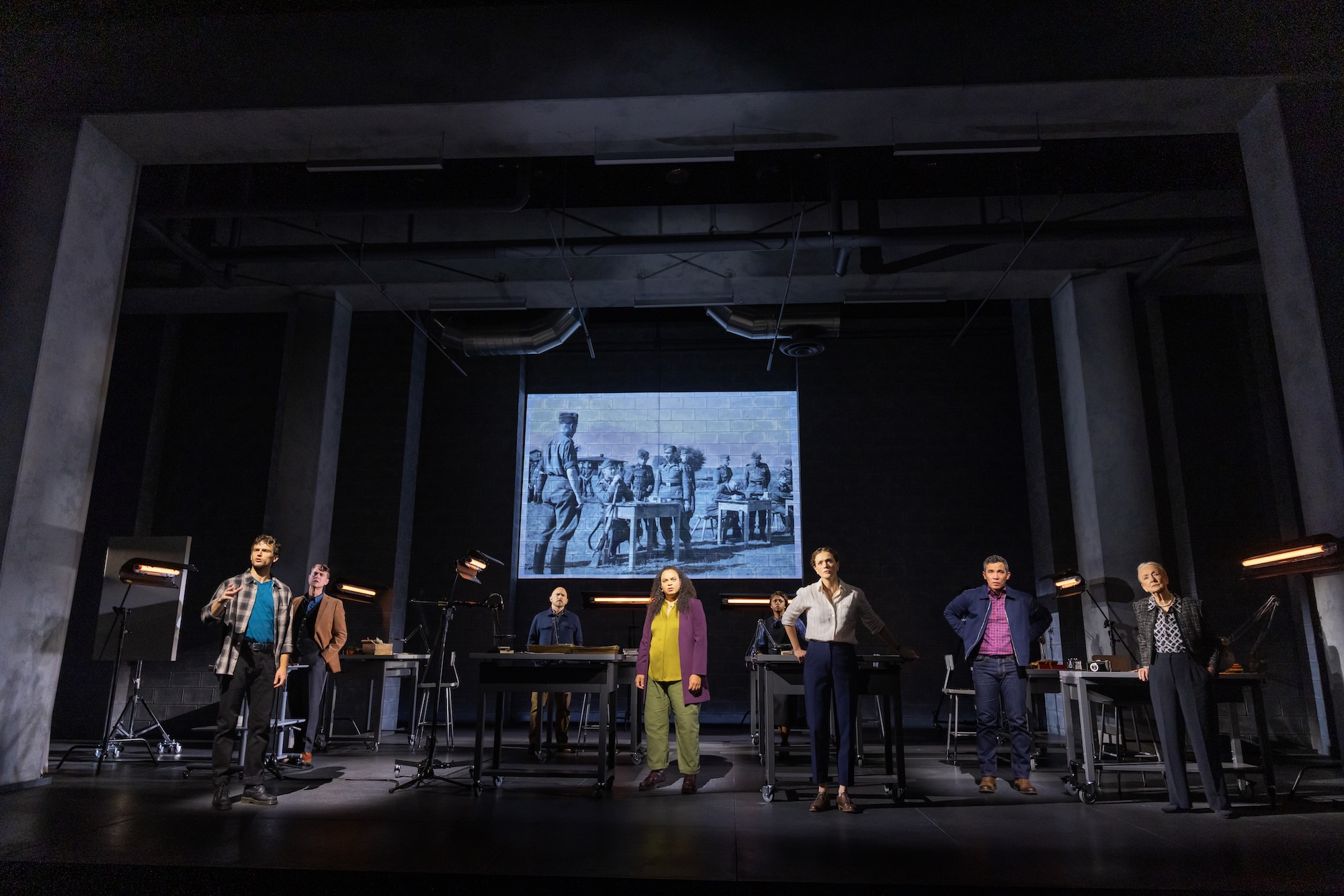
The cast of “Here There Are Blueberries” by Moisés Kaufman and Amanda Gronich. (Photo by Matthew Murphy)
But we soon notice a change in these candid shots. The photos at first seem quaint depictions of everyday life, but the innocent-looking scenes snapped at beaches and along roads begin to feature Nazi swastikas in the background and later on armbands. Soon, the Nazi salute is seen displayed by young school children as more evidence of the embrace of Nazism is seen. An important lesson is learned: photography and Nazism grew up together, each quickly embraced by a majority of the masses of German people.
Delia Cunningham greets us in her role as Rebecca Erbelding, an associate curator at the National Holocaust Memorial Museum in Washington, D.C. She tells how Holocaust survivors and their offspring have often contacted the museum, wanting to donate their photos or memorabilia. “People send us things,” she says.
In most cases, the photos prove not to be particularly noteworthy. As Auschwitz is the infamous name most associated with the death and concentration camps, many of the submissions are referenced as having been from “Auschwitz” when in reality they are not, she continues.
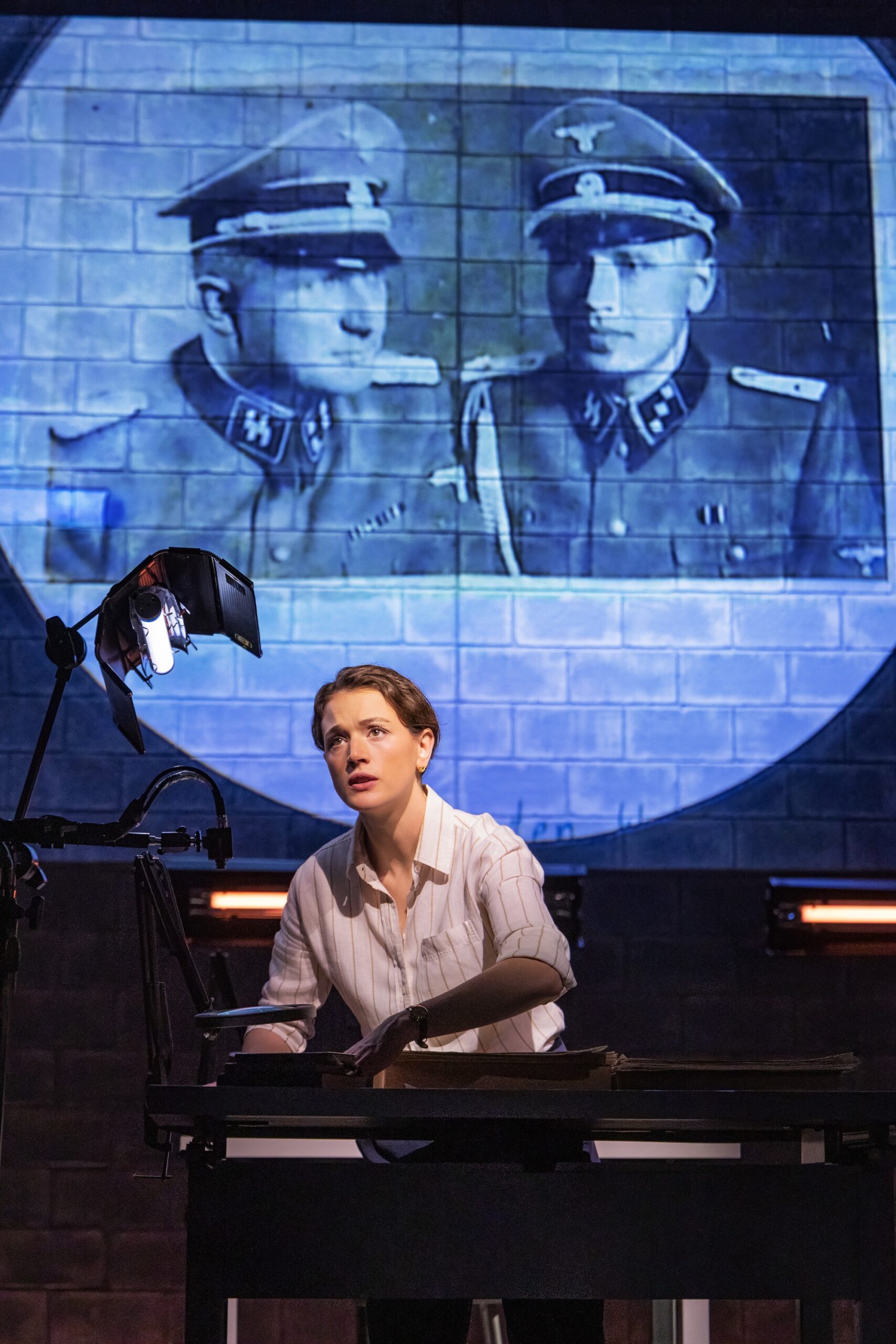
Delia Cunningham stars as Rebecca Erbelding in “Here There Are Blueberries. ” (Photo by Matthew Murphy)
So, when a retired U.S. Lt. Colonel, contacted the museum with an offer to let the museum examine an album of photos taken at “Auschwitz,” she is not particularly excited, expecting little of the 116 photos contained within it.
The package arrives and she immediately sees it has a cover page that identifies the location as Auschwitz and the date of June 21, 1944. So, this is Auschwitz, after all. She also notes the condition of the pages is less than ideal; many are damaged by water. But when she looks further at the images, she begins to recognize people she knows from her research. Indeed, her doctoral thesis was on one of the men whose image now stares back at her: Dr. Josef Mengele, the so-called “Angel of Death” at the Auschwitz-Birkenau complex. It was Mengele who determined life or death – either right or left – for new arrivals at the camps. Right led to the labor complex. Left led to the gas chambers.
Not only was this actually Auschwitz, she realizes, but this was Dr. Mengele at Auschwitz! As efficient as the Nazis were in their extermination practices, they were careful to hardly ever leave photographic evidence behind to document their misdeeds. This was the first photo that clearly documented Mengele’s presence at Auschwitz. There had never been a single photo like it in all the world.
As Erbelding went on to look further, she began to see even more faces she recognized. There was the commandant of Auschwitz, Rudolf Höss. And there was Karl Bischoff, the chief architect who designed the electrified fences and the guard towers for the death camps, an even more infamous figure. Unable to restrain herself, she reached out to Judy Cohen (Kathleen Chalfant), the chief acquisitions curator at the museum. The museum needed to have this collection donated for more research, the two agreed.
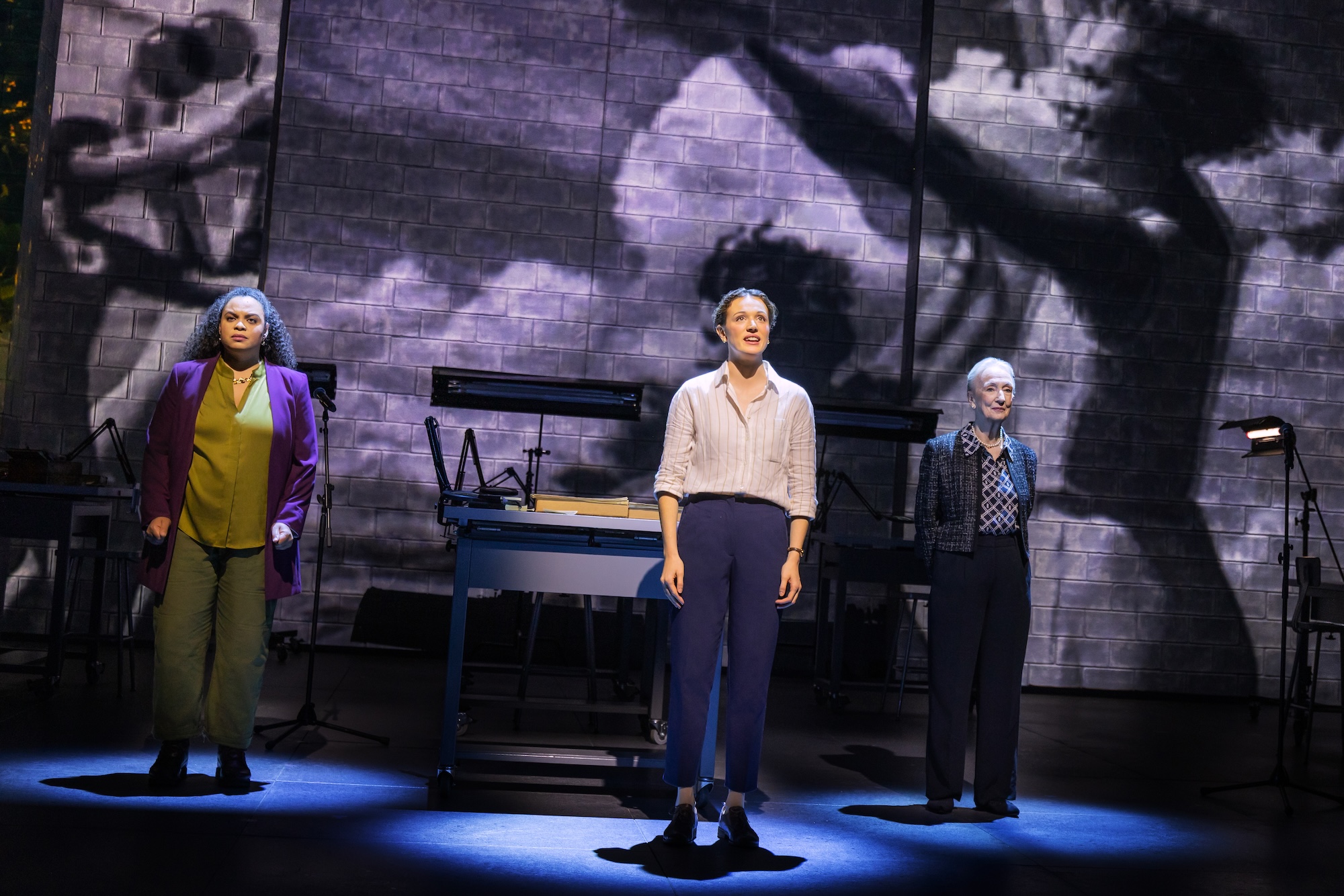
Michelle Beck (l-r), Delia Cunningham and Kathleen Chalfant as curators at the U.S. Holocaust Memorial Museu (Photo by Matthew Murphy)
With the donation secured a short time later, more of her fellow curators were consulted and their combined research yielded several indisputable facts. First, these pictures capture life at Auschwitz, but unlike other photos previously curated, not one victim is to be seen. These photos are of the highest ranking SS officers and their staff members who ran the camps and orchestrated the mass killings. Photos of this type have never been seen before.
It raised an important question. For years the museum has stood up to remember the victims of the Holocaust. Now comes the ethical challenge of whether researching the perpetrators – their killers – lies within the museum’s purview.
The heroes of this play by Moisés Kaufman (“The Laramie Project”) and Amanda Gronich are the curators at the museum. Each of the actors also portrays a number of secondary characters including survivors or their descendants who are interviewed in the slow process of research that yields the information about who is pictured in the photographs and at what time the shots were taken.
Kaufman also meticulously directs this modern-day detective story that was originally developed at his Tectnonic Theatre Company. Images of the actual photos are projected at the rear of the stage and as the curators speak about a specific figure, their image is highlighted to reinforce who they are or to emphasize their compliance in something the curators are describing. Sometimes filling up a portion of the rear, this emphasizes the tedious amounts of research carried out by the curators, made difficult by the fact that many of the people interviewed were not particularly interested in drumming up the past atrocities carried out by their predecessors or renewing unwanted attention to their family.
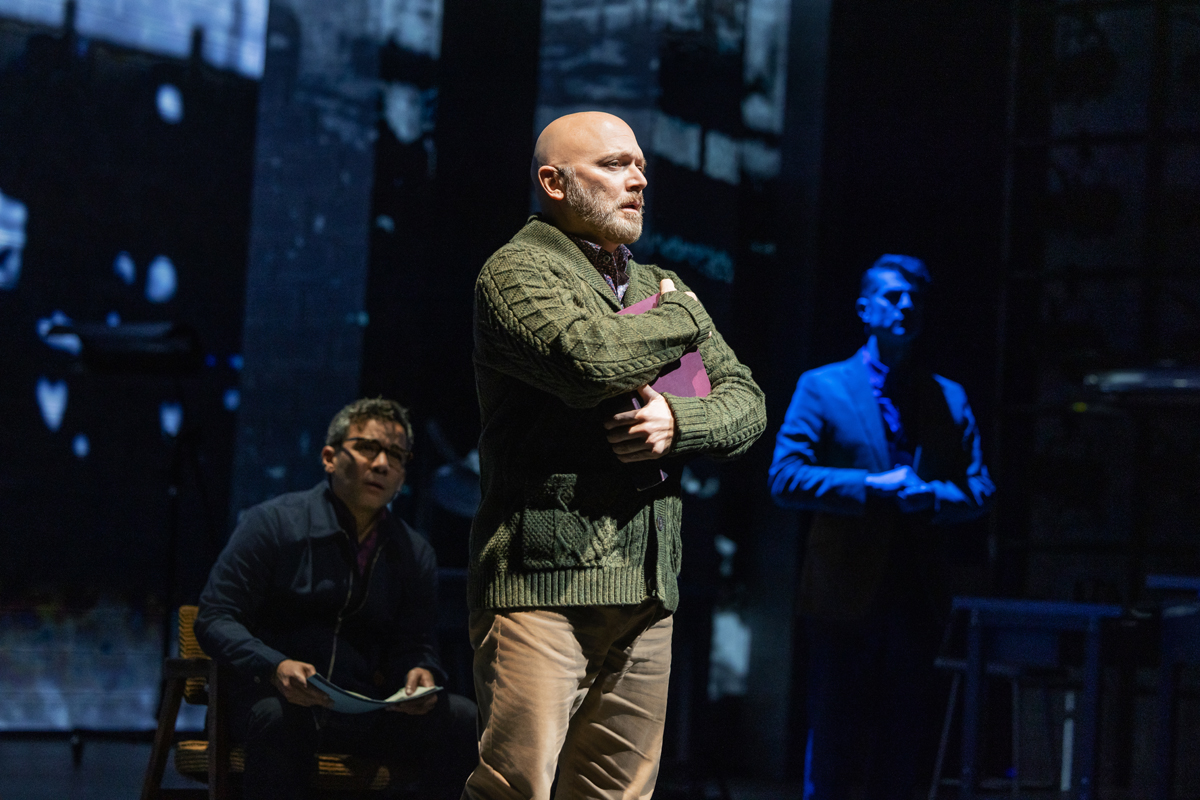
Michael Cerveris portrays Peter Wurths and others. (Photo by Matthew Murphy)
In addition to playing the unidentified officer who kept the album of photos for more than six decades before donating it to the museum, New Orleans actor Michael Cerveris, a two-time Tony Award winner, plays Peter Wirths, the son of Dr. Eduard Wirths. Dr. Wirths was the chief doctor at the Auschwitz-Birkenau complex and was responsible for supervising the work of Dr. Mengele and all the other doctors who worked there.
Already aware of his father’s complicity with the other Nazis, Peter Wirths is approached by Tilman Taube, the grandson of the chief doctor at the Sachsenhausen concentration camp, Dr. Heinz Baumkötter. Conrad Ricamora (a Tony-nominated actor for “Oh Mary“) performs as Taube, who astonishingly finds his grandfather featured in several photos in the album. He was unaware of his grandfather’s role. In the photos, both of the chief doctors are seen conferring and Taube and Wirths, as descendants, speculate on what they might have been discussing at Auschwitz.
Of course, the curators have done the research. Several key scenes involve Cunningham and Chalfant in their respective roles as museum curators Erbelding and Cohen. They know everything and they have drilled down to determine the identity of the owner of the photograph album: SS Lt. Karl Höcker (Scott Barrow). Their research yields the secrets behind several of the innocent-looking candid shots and the reasons for celebration in some of the other photos turn out to be disturbing, if not disgusting.
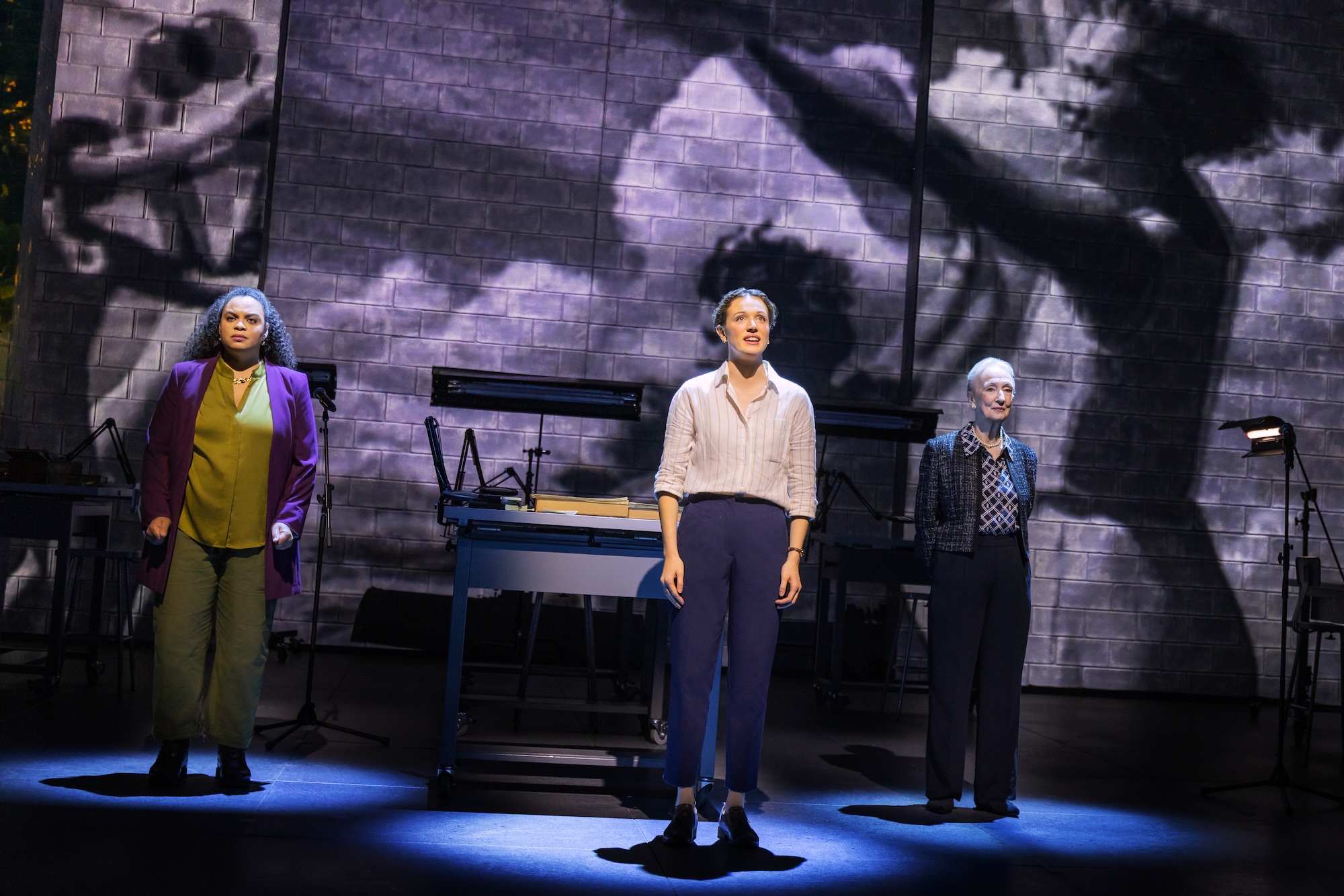
Michelle Beck, Delia Cunningham and Kathleen Chalfant portray members of the curator staff at the United States Holocaust Memorial Museum. (Photo by Matthew Murphy)
The title of the play is taken from one of the pages thus labeled with a series of photos showing the women at the camp, who ran the switchboard. They gleefully consume bowls of blueberries, apparently fresh-picked and distributed by the album’s owner, who is seen cavorting with the women.
The camera never lies, even if the women were to claim they had no knowledge of what was going on next to them while they gobbled down the berries or if the SS officers and top tier administrators of the camp were to suggest they were only following orders.
The photos stand as silent sentinels to the atrocities committed by the Nazis but they are unable to link the victims with the perpetrators. It is up to the curators to peel away the layers of disconnect and to attest to the troubling complicity everyone who is pictured had in the killings of hundreds of thousands.
However, the camera lens can only capture what it sees. It cannot discern good from evil. It cannot determine guilt or innocence. What the album’s contents show is that rank and file members of society can become part of a murderous regime and justify their roles as small in scope and hardly up to scrutiny. The pictures are not the arbiters here. The curators know better, though.
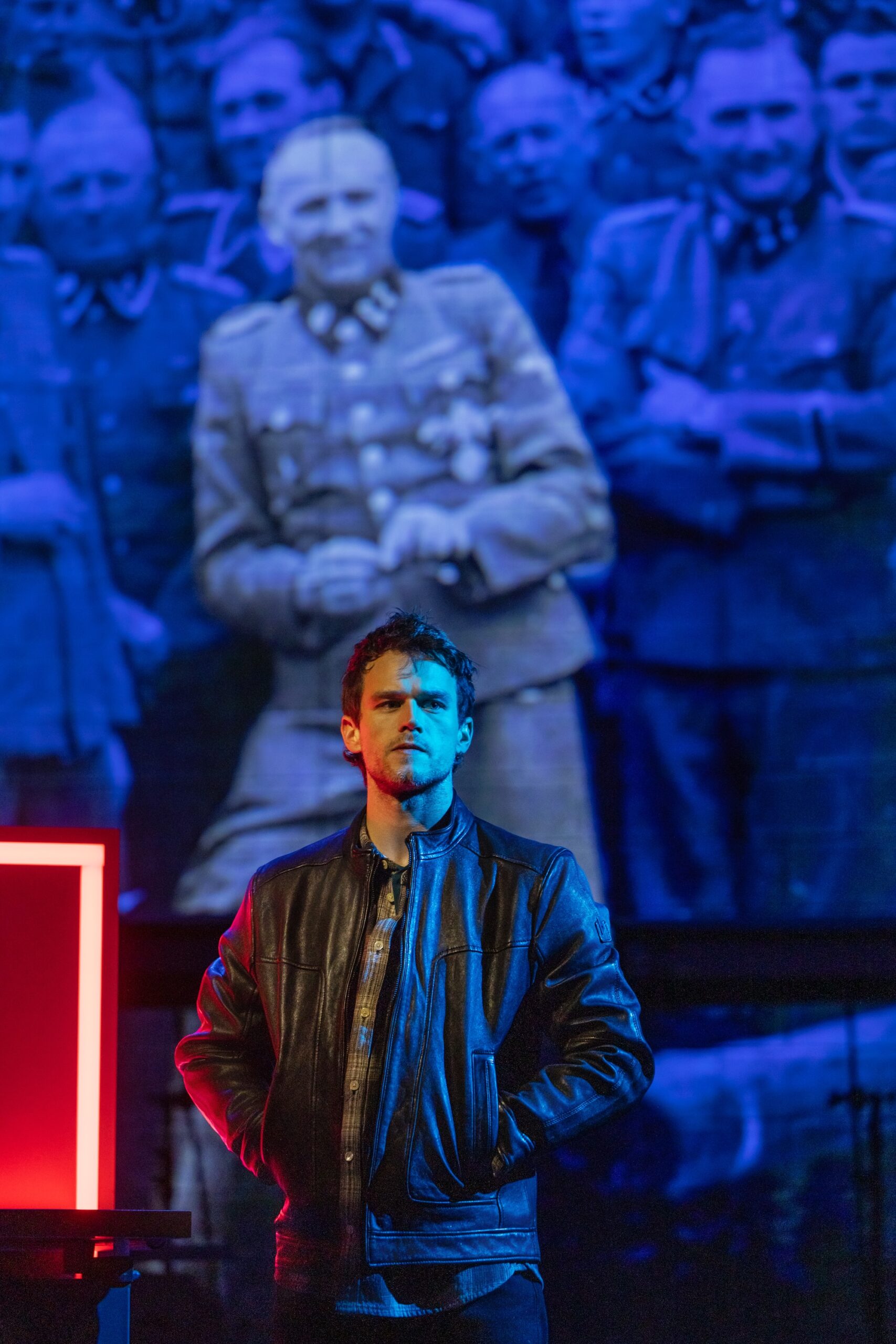
Rainer Höss (Brandon Flynn) stands behind a photo of his grandfather, Rudolf Höss, the longest serving commandant at Auschwitz, who was responsible for the deaths of more than one million people. (Photo by Matthew Murphy)
One of the roles taken on by Brandon Flynn is that of Rainer Höss, the grandson of the longest-serving Auschwitz commandant Rudolf Höss. The elder Höss was the recent subject of the Academy Award-winning film “Zone of Interest.” Rainer Höss describes his violent reaction on learning of his grandfather’s role in the war and his responsibility for implementing the utilization of Zykon B gas and the installation of the gas chambers at Auschwitz that exterminated more than one million Poles, Jews and Romani people.
The two grandsons of Höss (Flynn) and Dr. Baumkötter (Ricamora) interrogate each other, each having their own take on how to deal with the knowledge of what their grandfathers had done and more importantly how to live their own lives moving forward.
The other members of the ensemble – Montego Glover as Melita Maschmann, Michelle Beck as Charlotte Schünzel, and Scott Barrow as album owner Höcker – all deliver moving performances in their primary roles. As the curators, though, their approach is much more restrained. They rely on science and attention to details to discern the true story behind the photos.
The play has much to say to today’s audiences. In an era of rising antisemitism and at a time when so many of the younger generations fail to understand the depth of depravity and inhumanity by the Nazis, there is a need to remind them of the horrors. With the death of so many survivors at this juncture, Holocaust memory depends on institutions like the U.S. Holocaust Memorial Museum and second-generation
While most of “Here There Are Blueberries” does not address the actual killings that took place at the Auschwitz-Birkenau complex, there is a final connection back to photography that does indeed consider the victims and has a direct bearing on the research uncovered in the Höcker album.
At play’s end we know that the depiction of the Nazis as murderous beasts is not at all accurate. The camera lens has revealed them as happy people who smile and pose at every opportunity. Whether they are top SS officers or switchboard operators and secretaries, they are all complicit, but the camera cannot discern any malevolence on their parts. It begs the question about all of us. Would we be capable of carrying out the same kind of murderous campaign and still be comfortable in our own skin?
“Here There Are Blueberries“ (1 hour and 30 minutes with no intermission) continues its limited Broadway run through January 10, 2027 at the Ethel Barrymore Theatre, 243 W. 47th Street. For tickets through Telecharge, click here.
