


AfD initially gets 43.8% of votes, opening the possibility it could govern the German state of Saxony-Anhalt
By TOBY AXELROD
(JTA) — BERLIN – The right-wing extremist political party — the Alternative for Germany, or AfD — received a surprising 43.8% of the votes in Sunday’s election in Saxony Anhalt, according to the Statistical Office of the state of Saxony-Anhalt.
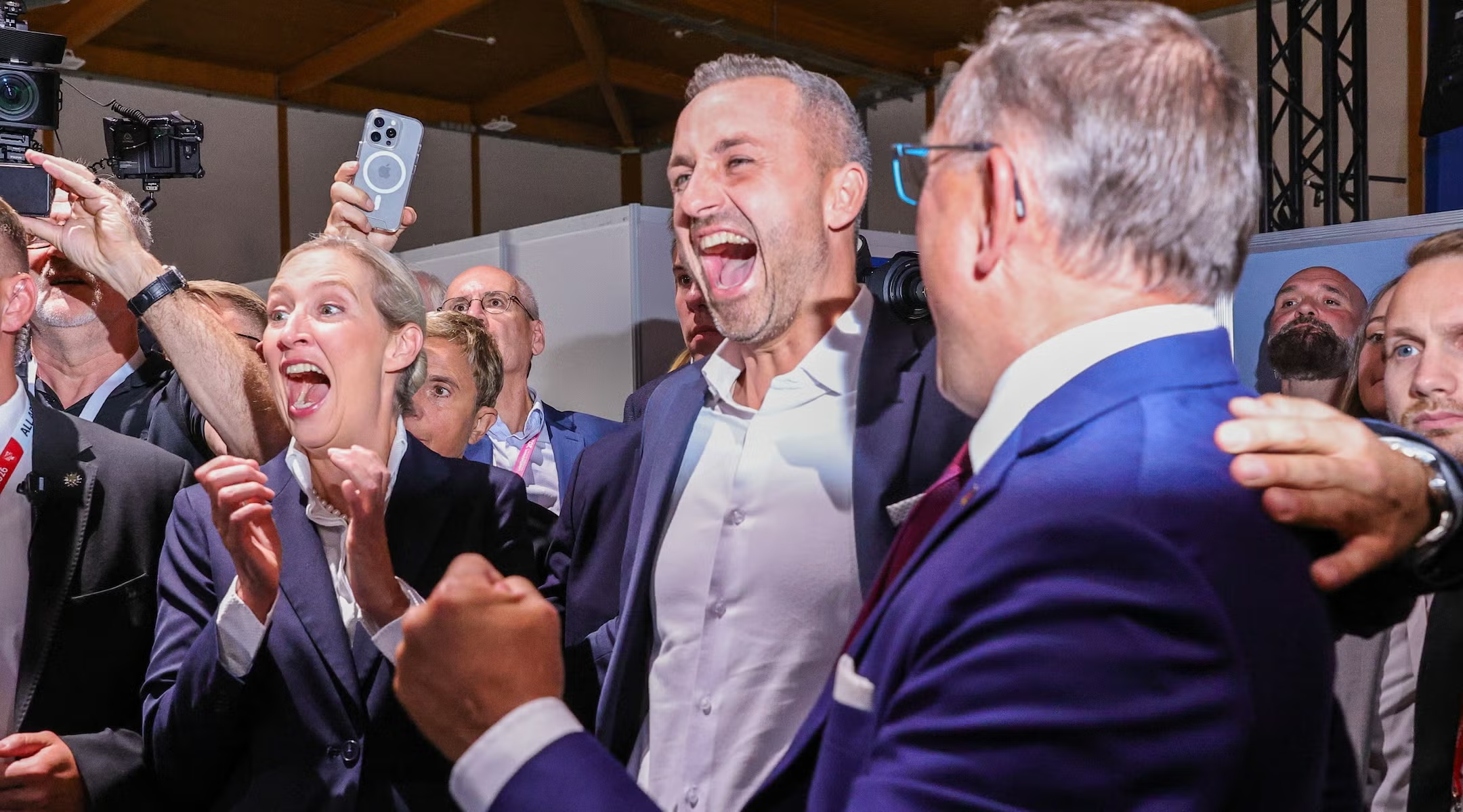
Co-Chairwoman of the Bundestag AFD faction Alice Weidel, Ulrich Siegmund, lead candidate of the far-right Alternative for Germany (AfD) and Co-Chairman of the Bundestag AFD faction Tino Chrupalla celebrate a first exit poll win to AFD on September 6, 2026. (Omer Messinger/Getty Images)
The vote raises the chances that, for the first time since the end of World War II, a far-right party could govern a federal state in Germany.
Support for AfD, founded in 2013, was high going into the election. It was widely imagined that it would be the most popular party, but would not have enough support to lead.
The initial 43.8% result, if combined with the 5.3% that the Bundnis Sahra Wagenknecht (BSW) received, could bring the AfD close to the needed 50% to govern. But it remains to be seen whether such a coalition could be formed.
The breakout of votes in the other parties is as follows: the Christian Democratic Union (CDU) received 17.3%, the Left party garnered 8.6%, the Social Democratic Party (SPD) 9.3% and the Greens 8.9%.
The results of Sunday’s election kicked off a slew of questions from journalists to leaders of the CDU and other mainstream democratic parties as to whether they would be ready to abandon their “firewall” against cooperation with the AfD.
So far, the AfD party leader, Ulrich Siegmund, has said he’d enter a coalition with any party that agreed to his platform. And the BSW is standing on the fence.
The narrow success of the BSW can change that equation, making it a potential kingmaker when it comes to forming a coalition. But it is unclear which way will the BSW – a party with both left and right positions – will go.
Speaking to his supporters after the results solidified, Siegmund declared that it was an historic evening. “We are going to get our country back, this is going to shake all of Germany.”
Most Germans know that this vote is larger than the future of Saxony-Anhalt and sets the course for the entire country, he added, certain of victory, even if full power remains elusive.
“We will be the alternative for Germany.”
The 77.8% of 1.7 million eligible voters who cast a ballot in this former East German state on Sunday are only a fraction of the 60 million voters spread through the country’s 16 Laender (federal states).
But the results are seen as a litmus test for upcoming general local elections in Lower Saxony on Sept. 13, and elections in the state of Mecklenburg-Pomerania and the city-state of Berlin on Sept. 20.
Whatever the final tally, the early election results have made it clear: A ballot cast for the AfD is no longer dismissible as a “protest vote.” Other mainstream parties are taking a plunge, while the AfD’s star continues to rise.
Pundits say that voters in this economically depressed state are drawn to: the AfD’s anti-immigrant and anti-European Union rhetoric; its promise to expel non-citizens; its focus on German national pride rather than on the dark side of its past; and its ambition to repair relations with Putin’s Russia. Their drumbeat resonates particularly in former East German states, which have suffered since unification with the closing of factories and flight of younger workers to western states.
The AfD has also done well in other former East German states, and increasingly in western ones. Last March, for example, it earned 19% of the popular vote in elections in Baden-Wuerttemberg, nearly doubling its previous tally there. In the 2025 federal election, it leapt to second place below the conservative CDU, led by German Chancellor Angela Merkel from 2005-2021. Opinion polls show the AfD is the leading party if federal elections were held today.
While some observers note that the party’s agenda on national issues could not be implemented on the state level, they are troubled by the party’s goals.
Stephan Kramer, president of Germany’s domestic intelligence agency in the state of Thuringia and former general secretary of the Central Council of Jews in Germany, told the Jewish Telegraphic Agency that the main concern is with the power the party could wield “over the interior ministry, police, the state intelligence service, education, appointments and the handling of sensitive information.”
“For the first time, the party could use the machinery of a state government and thereby gain substantially greater political and institutional influence at the federal level,” he said.
Support for the AfD fits right in with trends across Europe and the UK: According to the latest survey of European far-left, far-right and populist parties published by the PopuList research group, nearly a quarter of European and UK voters back far-right parties today, up from 5% in 1995. According to the Guardian newspaper, the biggest surge in support came in national elections in France and the UK in 2024 and Germany in 2025.
A key difference from U.S. state elections is that “voters do not directly elect the equivalent of a governor,” Paulina Fröhlich, senior expert for democracy at the Gütersloh-based Bertelsmann Foundation, told JTA. “Instead, the state parliament elects a state premier after the parties have built a coalition or secured enough support. So, the party that wins the most votes does not necessarily lead the government.”
In 1980, the CDU and its Bavarian sister party, the Christian Social Union (CSU), won 44.5% of the vote, but the (SPD) with 42.9% and the Free Democratic Party (FDP) with 10.6% support built a coalition government.
Two years ago in the state of Thuringia, the AfD became the first far-right party to get the most votes in a state election since World War II, but was blocked from forming a coalition.
After Sunday’s success for the AfD, it’s still unclear which team will build a government. The outcome could still be a coalition of minority parties. But given its significant electoral achievement, the AfD could be on the cusp of pulling together the needed majority to take power.
It can take months to form a state or federal government, including the appointment of the minister-president or chancellor, and ministers dealing with education, policing and culture (and foreign policy, on the federal level).
After the CDU and CSU won Germany’s federal election in February 2025 with only 28.5 percent of the vote, it took until early April for them to form a government with the SPD as they argued over policy differences. But neither party would work with the AfD, which came in second.
Most Germans still reject the AfD’s message. Several states have classified the party as right-wing extremist, a designation that its leaders have opposed in court. There are also calls to ban the party, including by prominent Jews such as Charlotte Knobloch, 93-year-old former chairwoman of the Central Council of Jews in Germany and head of the Jewish community of Munich and Upper Bavaria.
Knobloch, who survived the Holocaust in hiding with a German Christian family, told Stern magazine, “Even the Nazi Party started small and tried out what was possible,” and now AfD politicians “are testing the limits of what is acceptable.”
Banning the AfD would be a painstaking process, however, thanks to post-war protections of free speech. Former West Germany banned only two political parties: a neo-Nazi one in 1952, and a far-left Communist party in 1956. Later attempts to ban neo-Nazi parties stumbled on legal hurdles, and many politicians fear trying again, lest the AfD make hay of a failure.
Unlike in the United States, German elections include many political parties – from the large, mainstream ones to those on the fringes, which usually fail to meet the 5% vote threshold required to have seats in the parliament.
The AfD’s appeal “comes from a mixture of protest, distrust of established parties, concerns about migration and social change, and a sense among some voters that [AfD] articulates grievances others avoid,” said Kramer of Thuringia’s domestic intelligence agency.
“The AfD officially presents itself as supportive of Jewish life and Israel,” he added. But the platform “explicitly demands a complete ban on ritual slaughter without exception, which would directly affect Jewish religious practice. AfD leaders also use world conspiracy arguments and antisemitic language, we should not forget.”
It’s illegal in Germany to celebrate the crimes of National Socialism, to repeat Nazi slogans and other propaganda. But AfD leaders “do not always stay on the safe side of the law,” Kramer added. For example, Björn Höcke, who heads the party’s parliamentary faction in the neighboring state of Thuringia, “was convicted for repeating the banned Nazi stormtrooper slogan ‘Alles für Deutschland’ [everything for Germany], and the Federal Court of Justice rejected his appeal in August 2025, making that conviction final.”
Höcke “is a certified history teacher, so he knows what he is doing,” Kramer added. “I would not describe the AfD simply as a party that carefully stays legal. Rather, parts of it repeatedly test those boundaries, and in some cases demonstrably cross them, [moving the] boundaries of what is acceptable to say in public and what is not.”
In Saxony-Anhalt, the party is “classified as definitely right-wing extremist” and is under observation by the domestic intelligence service, Maik Reichel, director of Saxony-Anhalt’s State Agency for Civic Education, told JTA. “And I think we also have the most extreme AfD state branch.”
The party wants to “restrict state-sponsored [school] trips to memorial sites, which they say turn young people into ‘memorial zombies,’ ” Reichel added.
“Our mission is to provide pluralistic civic education” and the AfD is against diversity, Reichel said. The AfD also takes a nationalist perspective, “which means we leave out important dictatorial, anti-democratic periods that were truly terrible in Germany,” he explained.
The main architect of the AfD’s platform in Saxony-Anhalt, Hans-Thomas Tillschneider, is known for wanting “more Bismarck, less Hitler.” Otto von Bismarck (1815-1898), who served as Germany’s first chancellor from 1871-1890, is seen as a hero by some German nationalists.
Despite such concerns, the AfD gained in the polls. At the EU parliament level, the AfD has 15 members, the largest contingent in the far-right Europe of Sovereign Nations group.
The AfD’s party leader, and now potential minister president, Siegmund, age 35, is described as personable, even affable.
But his messages are not so friendly, critics say. Siegmund says his “100-day immediate action plan” includes a promise to “deport from minute one” many foreign nationals, including professional specialists; to cut funding to pro-democracy NGOs; to crack down on diversity programs in the state; and to cut taxes that support such programs.
In the immediate aftermath of the election, leaders of the CDU and SPD parties were peppered with questions about how and why they failed.
Ultimately, the other parties have to regain the people’s trust, said Reichel. In Saxony-Anhalt that means “solving the problems that concern people in a way that they actually notice a difference.”
