Tuesday, November 3rd 2026   |

Jewish Trivia Quiz

from RASHI, RAMBAM and RAMALAMADINGDONG: A Quizbook of Jewish Trivia Facts & Fun by New Orleans native Mark Zimmerman

Banned Books

A teacher in the Carroll Independent School District in Southlake, Texas who had an anti-racism book in her classroom was reprimanded, with the district’s executive director of curriculum and instruction issuing a statement requiring teachers to offer books showing both sides of controversial issues. The administrator stated, “Make sure that if you have a book on the Holocaust, that you have one that has an opposing, that has other perspectives.” Her comment led to a huge outcry by parents, Jewish organizations, and many public officials, leading to an apology by the District Superintendent. There has long been a history of politicians, school administrators, and others attempting to further their personal, political or religious perspectives by controlling the books used for instruction in schools or offered in libraries. Which of the following books was banned, or proposed for banning, and why?

Banned Book Week display

Banned Books Week 2012 by Rod Library is licensed under CC BY 2.0

A. The Baker Middle School in Corpus Christi, Texas banned Anne Frank: Diary of a Young Girl because parents said that the book was pornographic.

B. Anne Frank: Diary of a Young Girl was challenged in Wise County, Virginia because parents were concerned that Anne’s criticisms of her mother would undermined adult authority.

C. The Culpeper County, Virginia school system banned the The Diary of a Young Girl: The Definitive Edition because parents complained about the sexual content and homosexual themes.

D. Guantánamo Bay Detention Camp, the United States military prison in Cuba which currently houses fewer than 40 detainees, has banned Anne Frank: Diary of a Young Girl for unspecified reasons.

E. Anne Frank: Diary of a Young Girl was challenged by four members of the Alabama State Textbook Committee because the book was “a real downer.”

Click here for the answer.

Taiwan

Following a provocative escalation of military tension by China against Taiwan, Chinese President Xi Jinping announced that his country would be moving toward a “peaceful reunification” with Taiwan. However, Taiwanese officials asserted that they will not be intimidated, while hoping for what Taiwan’s President Tsai Ing-wen called “an easing of cross-strait relations.” There has been a Jewish presence in Taiwan since the mid-twentieth century, comprising mostly foreign business executives, students, and diplomats. The community currently numbers approximately 800. In the late 1970’s, members of the Jewish community decided to form an official organization, the Taiwan Jewish Community. What concerns were raised early in the history of the Taiwan Jewish Community (TJC)?

Confucius Temple - Taiwan's oldest Confucian Shrine

Taiwan_19 (Confucius Temple - Taiwan's oldest Confucian Shrine) by Dancing Fingers is licensed under CC BY 2.0

A. Saudi Arabia, the only Arab nation to recognize Taiwan at the time, was apprehensive that this official “club” for Jews was an indication of cooperation between Israel and Taiwan, which the Saudis found very concerning. To mollify the Saudis, the Taiwanese agreed to refer to the Taiwan Jewish Community not as a club but rather as a church.

B. The location of the Taiwan Jewish Community center is close to the Saudi Arabian embassy. To avoid offending the Saudis, a primary source of oil for Taiwan, the Taiwanese authorities required the TJC building’s sign to only include English and Chinese, with no Hebrew wording allowed.

C. Because of the enmity between Saudi Arabia and Israel, Taiwan wanted to minimize any concern that the Saudis might have about the establishment of an official Jewish group with ties to Israel. As a result, Taiwanese officials required the TJC to agree not to allow any Israelis to serve in a position of leadership of the community.

D. The original location of the Taiwan Jewish Community center was close to the Saudi Arabian embassy. To avoid offending the Saudis, the location of the TJC center was later changed to another site further away.

E. In response to pressure from Chinese restaurants located near the Taiwan Jewish Community building, who feared a loss of business as Jews moved into the neighborhood to be near the Jewish center, the TJC rabbi agreed to allow members of the Jewish community to follow the American Jewish minhag (custom) of eating wonton soup and egg rolls on Sunday nights and Christmas Eve.

Click here for the answer.

Siri

October 4 is the tenth anniversary of the introduction of Siri, Apple’s virtual assistant. Consumers were thrilled when Siri was first presented at an Apple press conference, answering requests for a weather report and other web searches. Siri was later followed by Google Assistant and Amazon’s Alexa, enabling consumers to accomplish all types of tasks simply by talking to their devices. But these systems are not perfect, as they often present answers that come from flawed websites, or they misunderstand the core of the question. What answer did Siri give that was controversial in the Jewish community, leading to a correction by Apple?

Siri

Para el iPhone 8 Apple renovará Siri con mejoras en inteligencia artificial by iphonedigital is licensed under CC BY-SA 2.0

A. Earlier this year, Siri responded to the question “What is the best kosher ice cream?” by responding, “Ben and Jerry’s, because they are both Jewish.”

B. In 2020, Siri responded to questions about Israel’s then-president Reuven Rivlin by saying “Reuven Rivlin is the president of the Zionist occupation state.”

C. When asked if bowling was allowed on the Sabbath, Siri responded, “According to a leading Jewish authority, ‘I told that kraut a thousand times that I don’t roll on Shabbos!’ ”

D. In response to a question about apartheid, Siri answered, “Apartheid is a policy or system of segregation or discrimination based on racial prejudice, as previously practiced in South Africa, and currently found in the Israeli-occupied territories of the West Bank and Gaza.”

E. In 2011, Siri responded to the question “What brand of jeans should I buy?” with “You don’t have to be Jewish to love Levi’s.”

Click here for the answer.

Sukkot 5782

The holiday of Sukkot began last Monday night, and continues for the next two days, ending with Shemini Atzeret on Tuesday and Simchat Torah on Wednesday. The holiday commemorates the time the Israelites spent in the desert, living in flimsy portable booths, and is also a harvest festival. What athlete, actor, celebrity or other famous person was in the news this past week because of Sukkot?

Sukkah

A. Mayim Bialik, who is Orthodox, is currently hosting Jeopardy as they continue their search for a permanent host. Five shows are taped in one day, covering an entire week of broadcasts. Taping is usually done on a Tuesday, but because the first day of Sukkot was last Tuesday, taping was switched to Monday instead to accommodate her holiday celebration.

B. An Orthodox Jewish baseball player, pitcher Elie Kligman, was drafted by the Washington Nationals this summer. The team knew that he would not work on Friday night and Saturday afternoon, or on Jewish holidays. The pitching coach used a calendar that listed Sukkot as being last Tuesday, and though the coach knew that Jewish holidays ended at sundown, he did not realize that in Orthodox Judaism, this holiday continued on for another evening and day. Kligman had assumed they correctly knew the schedule and only learned at the last minute that he was slated to pitch on Tuesday evening. The team was able to bring in a different pitcher for that game.

C. Vice President Kamala Harris and her Jewish husband, Doug Emhoff, hosted the first ever dinner in a sukkah held at Blair House, where the Vice President and her family are living. The sukkah, built in the courtyard behind the residence, was erected under the leadership of Chabad Rabbi Levi Shemtov, who also oversaw the building of the first-ever sukkah at the White House in 2019.

D. Following the success of Saturday Night Seder, held last April to raise money to fight the COVID pandemic and co-produced by Beanie Feldstein, the actor/singer just hosted a follow up program, Saturday Night Sukkah. The broadcast, available on YouTube, Facebook, and many other online services, brought together numerous celebrities, Jewish and not, to perform and raise additional funds. Performers included Lin-Manuel Miranda, Eugene and Dan Levy, Sarah Jessica Parker, Mayim Bialik, and Feldstein’s brother Jonah Hill, and the event has already raised more than $2 million.

E. NBA legend Shaquille O’Neal noted in a video that was shared on Twitter that Sukkot was his favorite Jewish holiday. Tweeted O’Neal, “You know why? Because we all go out and live in shacks.”

Click here for the answer.

Submarines

Submarines are in the headlines, as Australia canceled a multi-billion dollar submarine contract with France, opting instead to purchase from the United States and Great Britain. This has led to great diplomatic turmoil, including France’s recall of their ambassadors to the United States and Australia. Israel has a fleet of five Dolphin-class submarines, all purchased from Germany. While they have the capacity to fire torpedoes and anti-ship missiles, there is much speculation that Israel also has the capability of launching nuclear weapons from their submarines. What is found on each of Israel’s submarines that is not typically found on other nations’ submarines?

Israeli Dolphin Submarine

Dolphin-AIP -- Our-IDF-2018-IZE-013 by Zachi Evenor is licensed under CC BY 2.0

A. A Torah scroll.

B. A mikveh.

C. Separate meat and milk dishes and cutlery.

D. A customized navigation system based on Waze.

E. A screened-in porch.

Click here for the answer.

Yom Kippur

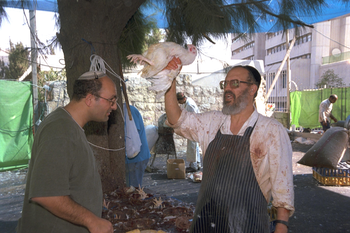
A tradition in some ultra-Orthodox communities before Yom Kippur is kaparot, the ceremonial swinging of a chicken over one’s head three times before slaughtering the bird. This act is a symbolic transfer of one’s sins to the animal, which is then donated to the poor. What other ceremony involving an animal is associated with Yom Kippur?

Kaparot ceremony

Kaparot by Government Press Office is licensed under CC BY-NC-SA 2.0

A. In some Sephardic communities, there is a ceremony similar to kaparot. However, the bird that is slaughtered is the stork, which is commonly found in Arab countries of the Middle East. The bird is ritually slaughtered even though it is not a kosher animal, and is then donated to non-Jewish neighbors as the giver recites the command from Leviticus 9:18, “Love your neighbor as yourself.”

B. The prophet Jonah was swallowed by a whale sent by God as he had disobeyed God’s command. In the belly of the fish Jonah repented and was saved. The Book of Jonah is now read every year on Yom Kippur afternoon, reflecting Jonah’s teshuva, or repentance, the primary Yom Kippur theme. Jonah is said to have been buried in Mosul, Iraq. Traditionally, Iraqi Jews have included a fish as part of their break-the-fast meal after Yom Kippur. Baked inside the fish is an apple, which both represents Jonah inside the whale as well as the completion of the Days of Awe, which began with apples dipped in honey.

C. It was traditional in some Jewish communities in Spain and Portugal around the 12th century to not only fast for Yom Kippur, but to ceremonially sell all of their food to a non-Jewish neighbor, similar to the Passover selling of chametz. The custom was elucidated by Maimonides in the Mishne Torah, and included a specific requirement that before selling the food, the Jew must ensure that he had fed all of his animals. The message was that caring for animals was the highest priority, even more important than one’s preparation for the Yom Kippur fast.

D. In Leviticus chapter 16, we read of the bringing of two goats to the High Priest in the Temple on Yom Kippur. One goat was sacrificed to God. The Priest then would lay his hands upon the second goat while confessing the sins of the Jewish community. That goat was then thrown to its death off a hill in the Judean desert, taking the sins of the people with it. This goat became known as the scapegoat.

E. Balaam, known for his blessings and curses, was traveling on behalf of Balak, the leader of the Moabites, to curse the Israelites. As Balaam rode on his mule, an angel sent by God appeared in the road, so the mule stopped. The mule saw the angel though Balaam did not, so he hit the mule, attempting to get her to continue. God enabled the mule to speak, and she criticized Balaam for his harsh treatment. Balaam’s eyes were opened to his bad behavior, and he asked God’s forgiveness. God accepted his teshuva, and Balaam continued on his journey, but only to bring God’s blessings to the Israelites, not the curses intended by Balak. On Yom Kippur in 1853, Russian Rabbi Smirnoff ben Stolichnaya created a drink in recognition of Balaam’s repentance, which he dubbed the Moscow Mule, and Russian Jews to this day break their Yom Kippur fast by drinking this concoction in copper cups.

Click here for the answer.

Rosh Hashanah 5782

Jews worldwide begin the celebration of Rosh Hashanah 5782 at sundown tonight. For the second year in a row, congregations are struggling to find appropriate ways to celebrate in a time of ongoing pandemic. Many synagogues are only holding online services, while others are meeting outdoors or limiting indoor attendance, or excluding those who are unvaccinated. But all are looking for a way to come together, as communities, as friends, as families, to celebrate the start of the new year. Some Sephardic and Mizrachi communities have traditionally included a seder as part of their Rosh Hashanah celebration. The tradition comes from the Talmud, Horayot 12a, where Abaye suggests that people should eat a variety of foods, including pumpkins, leaks, and dates. What else is traditionally included on the Rosh Hashanah seder plate, and why?

Apples, honey, and pomegranate

Rosh Hashanah | ראש השנה by Lilach Daniel is licensed under CC BY 2.0

A. A sheep head, symbolizing our wish to be heads and not tails, that is, leaders and not followers.

B. A cabbage head, which consists of multiple leaves tightly wound around each other, symbolizing the importance of the Jewish people embracing each other tightly for protection and support.

C. A chicken head, as a symbol that while we eat the body of the chicken, it is the head (in effect, the brain) that is the most important part of the animal, and by extension, humans.

D. A fish head, as a symbol that we should be fruitful and multiply like fish.

E. A horse head, symbolizing that when God (father) makes us an offer, we can’t refuse.

Click here for the answer.

Charlie Watts, RIP

Rolling Stones drummer Charlie Watts died at the age of 80. Unlike his flamboyant bandmates, Watts was known to be relatively reserved, providing a solid percussion groove informed by his jazz background and instincts. He toured with the Stones until just two years ago, providing a beat that defined such songs as (I Can’t Get No) Satisfaction, Paint It Black, and Honky Tonk Women. What was a Jewish connection in Charlie Watts’s life?

Charlie Watts

Charlie Watts, Statesboro, Georgia, May 4, 1965 by Steve Denenberg is licensed under CC BY-SA 2.0

A. The Rolling Stones played a concert in Tel Aviv in 2014, and on that trip Charlie Watts and guitarist Ron Wood visited the Western Wall. Said Watts, “As I walked toward the wall, an old bearded guy approached me and asked if I was Jewish. He was holding some things in his hands with leather straps. I was really tempted to say yes just to see where this was going. But Ronnie jumped in and said we weren’t, and that was the end of that.”

B. Charlie’s best friend in secondary school (middle school in England) was a Jewish boy named Eddie Goldberg. Said Watts, “I remember going to his house for a seder. I never saw food like that. I was used to bangers and mash. That gefilte fish was too much for me.”

C. Watts originally trained as a graphic artist, and he used this skill to contribute to the Rolling Stones stage sets, merchandise and album covers. While still a student at the Harrow School of Art in London, one of his first projects was to design a ketubah for the upcoming wedding of a fellow student.

D. One of Watts’s first professional gigs was as the drummer for a band who primarily played at Jewish wedding receptions. Said Watts, “I never knew what the hell was going on.”

E. Early in the band’s history, they were playing at a Purim party for the London Maccabi GB Youth Organization. On a break the band went to get some food from the buffet table, and Charlie was disappointed that one of the trays was empty. He went off to speak to a catering employee who explained that those were hamantaschen, but that there were no more left. Angry, Charlie went back to Mick Jagger to tell him of the conversation, but he had difficulty remembering what the food was called. “Mick,” he said. “I can’t get no...I can’t get no...I can’t get no...hamantaschen. No hamantaschen. NO HAMANTASCHEN!”

Click here for the answer.

Governor Ron DeSantis

Following the lead of Governor Ron DeSantis, the Florida State Board of Education has threatened to withhold funds from the school boards in Broward and Alachua counties, where local officials want to enforce mask requirements for their students. Governor DeSantis has stated that mask wearing should be an individual choice, and even said, against all scientific evidence, that “It’s not healthy for these students to be sitting there all day, 6-year-old kids in kindergarten covered in masks.” Meanwhile, the positivity rate in Florida hovers around 20%, and Florida’s childrens’ hospitals are overwhelmed with young COVID patients. Governor DeSantis ran for office promising to be the nation’s most pro-Israel governor. When DeSantis visited Israel, he placed a note in the Western Wall with a prayer, asking God’s protection for Florida. What specifically did Governor DeSantis request of God in his note?

Florida Governor Ron DeSantis

Ron DeSantis by Gage Skidmore is licensed under CC BY-SA 2.0

A. The governor’s note read, “Good Lord, spare us hate and spare us evil this year.”

B. The governor’s note read, “Good Lord, spare us hurricanes this year.”

C. The governor’s note read, “Good Lord, spare us your wrath and shower us with your blessings this year.”

D. The governor’s note read, “Good Lord, spare us pandemics this year.”

E. The governor’s note read, “Good Lord, spare us abortion, gun control, Democrats, immigrants, critical race theory, LGBTQ rights, tax increases, Obamacare, minority voting, DACA, sanctuary cities, removal of Confederate monuments, and oh yeah, vaccinations and masks this year.”

Click here for the answer.

Afghanistan

With the imminent final withdrawal of American troops from Afghanistan, the Taliban is quickly taking control of the country. The Jewish history of Afghanistan goes back at least to the 7th century, with some claiming that Afghani Jews were descendants of the so-called lost tribes of Israel. Jewish life eventually settled primarily in the community of Herat, though there was a Jewish quarter in Kabul in the 12th century. Most Afghani Jews fled the country in the 1900’s because of an oppressive regime which had forced them into ghetto-like conditions, where they were subjected to riots, rape, and forced conversion. Most emigrated to the United States and Palestine (and after 1948 to Israel). Which of the following is true about the Afghani Jewish population?

The Jewish cemetery in Herat, Afghanistan

Herat_Jews_Cemetery is in the Public domain, via Wikimedia Commons

A. Dost Mohammed Khan was the founder of the Barakzai dynasty in Kabul in the early 19th century, gaining the title Emir of Afghanistan in 1823. Unlike many earlier leaders of Afghanistan, Khan was relatively accepting of the Jewish community, and in fact a Jewish merchant, Yacob Nasirov, was appointed Chief Minister by Khan in 1832.

B. While there is much speculation that Noah’s ark came to rest on Mt. Ararat in western Turkey, there is an opposing view that has long been held by Afghani Jews, that Noah’s ark came to rest on the Sakar Sak peak in the Hindu Kush mountain range of western Afghanistan. While no archaeological evidence has been found to support this theory, it is known that early Jewish merchants traveled across this range on the Silk Road trading route between China and the Mediterranean region, dating to the period of the Temple in Jerusalem.

C. In addition to the Jewish community in Afghanistan, up until the early 20th century there was also a small group of Pashtuns known as the ibn Yirmiyahu who claimed a connection to the lost tribes that supposedly settled in Afghanistan in Biblical times. While they were practicing Sunni Muslims like most Pashtuns, they maintained a number of Jewish customs including the lighting of candles on Friday nights and the performance of circumcision on male children at 8 days, unlike other Muslim communities who do circumcise, but at a later time. Eventually, in particular because of the anti-Semitic policies of Afghani leaders, most members of the ibn Yirmiyahu community abandoned their Jewish customs, though a small number did move to Palestine where they eventually converted to Judaism.

D. Only one Jew currently remains in Afghanistan, Zabulon Simentov, who has been the caretaker of a delapidated synagogue in Kabul for many years, though his wife and children emigrated to Israel in the 1990’s. He recently announced that he plans to leave for Israel prior to the Taliban takeover of the country.

E. The second-to-last Jew in Afghanistan was Ishaq Levin. He lived in the opposite end of the same synagogue where Zabulon Simentov lived. In stereotypical Jewish fashion, the two could not get along. They prayed in separate parts of the building, and neighbors complained that they heard them yelling at each other all night.

Click here for the answer.