Friday, October 9th 2026   |

Jewish Trivia Quiz

from RASHI, RAMBAM and RAMALAMADINGDONG: A Quizbook of Jewish Trivia Facts & Fun by New Orleans native Mark Zimmerman

The Bible

Last week President Trump appeared for a photo op in front of the St. John’s Episcopal Church in Washington, DC. The event was in response to demonstrations calling for justice and equality for black Americans following the horrendous murder of George Floyd by a Minneapolis police officer. After the police and National Guard used chemical irritants and smoke to disperse the peaceful protesters, Trump walked to the church and posed for pictures while holding a Bible. After 10 minutes he returned to the White House. While there have been Christian Bibles printed in English for many centuries, English editions of the Hebrew Bible have only been around for about a century and a half. Which of the following is an English edition of the Hebrew Bible?
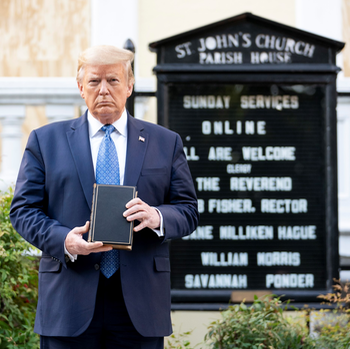
President Trump holding a Bible in front of St. John's Church

A. The Jewish School and Family Bible, by Abraham Benisch, published in England in four volumes from 1851 to 1861. Benisch, a respected journalist and Hebraic studies scholar, went on to become the editor of the Jewish Chronicles, the oldest continuously published Jewish newspaper in the world.

B. The Koren Jerusalem Bible, a Hebrew/English Bible from Koren Publishers in Israel. This edition followed their earlier publication of the Koren Bible in Hebrew, the first bible published in modern Israel, leading David ben-Gurion to state, “Israel is redeemed from shame.”

C. The Jewish Family Bible, edited in 1881 in England by Michael Friedländer, the principal of Jews’ College in London. Friedländer, who taught theology, Talmud, mathematics, Arabic and more, was best known for his English translation of Maimonides’ Guide to the Perplexed.

D. The Twenty-four Books of the Holy Scriptures, also known as the Leeser Bible. This edition was the first Hebrew Bible published in English in America. Isaac Leeser, a rabbi and educator in Philadelphia, finished this work in 1853.

E. The MAGA Bible, also known as “the bible that Ivanka Trump carried in her $1,540 Max Mara handbag to a photo op for her daddy.” Asked by reporters about the bible, President Trump replied, “It’s Ivanka’s bible. So it’s a Jewish bible. A Hebrew bible. Because Ivanka is now Hebrew, as you know. So she wouldn’t hand me a Christian bible like Eric would. But all bibles are good. Jewish bibles are good. Christian bibles are good. Muslims don’t have a bible. But anyway, the bible I held is more than good. It’s great. I call it the MAGA Bible because one of the ways we can Make America Great Again is by holding bibles. That’s why I went to that church to show the nasty demonstrators that good Americans hold bibles. I’m guessing that George Floyd is looking down and smiling at this bible, and saying this is a great thing that’s happening for our country. This is a great day for him, it’s a great day for everybody. This is a great, great day in terms of equality and the Bible.”

Click here for the answer.

CNN & Wolf Blitzer

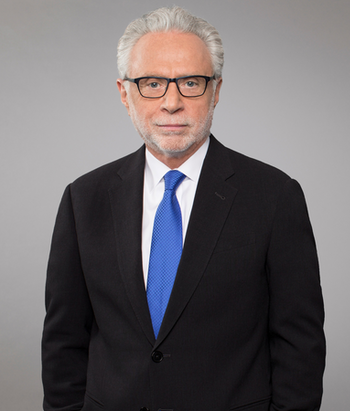
CNN not only reported the news, but was in the news last week, as one of their journalists was arrested live on TV by Minnesota State Police as he covered the demonstrations following the police killing of George Floyd. In addition, demonstrators in Atlanta defaced the iconic CNN sign outside their headquarters. CNN was launched in 1980 by Ted Turner as the first 24-hour cable news channel. In 1990, journalist Wolf Blitzer joined CNN as a reporter, and he eventually became a news anchor and host of CNN’s Sunday interview show, Late Edition with Wolf Blitzer. He has won numerous honors including an Emmy and the Anti-Defamation League’s Hubert H. Humphrey First Amendment Freedoms Prize. Blitzer’s parents were Auschwitz survivors who emigrated to Buffalo where he was raised. He studied Hebrew at Hebrew University in Jerusalem, and one of his first jobs was as a Washington correspondent for the Jerusalem Post. Not everyone is a fan of Wolf Blitzer, however. Which of the following has criticized Wolf Blitzer?

Wolf Blitzer

Wolf Blitzer - CNN Portrait by Philkirwin is licensed under CC BY-SA 4.0.

A. David Duke, white nationalist and former Ku Klux Klan leader, stated that the “Jewish media” was unfairly attacking Donald Trump, and said directly to Wolf Blitzer during an interview, “You can’t handle me, and you can’t handle the truth, and the fact is, you are an agent of Zionism. You work for AIPAC…You’re an Israeli agent.”

B. Journalist and MSNBC reporter Joy Reid criticized Wolf Blitzer for supposedly treating Jewish guests too deferentially. She wrote in a blog that Blitzer is a “former flak for the American Israeli Public Affairs Committee (AIPAC)” who “doesn’t even try to hide his affinity for his Israeli guests, or his partisanship for their cause, while turning instantly to prosecutorial mode when questioning any guest who has the dumb luck to be an Arab or Muslim in King Blitzer’s court.”

C. Wolf Blitzer recently criticized President Trump for concluding a coronavirus press briefing without taking questions from reporters. Said Blitzer, “This is the first time that the President has been afraid to answer questions from reporters...The President clearly, uh, shall we say, was chicken today.” Trump later tweeted about Blitzer, “Today I was called chicken by that kosher turkey Wolf Blitzer. HOW RUDE IS THAT. I’m the President. I answer questions when I want to answer questions.”

D. Kellyanne Conway, political consultant and advisor to President Trump, was offended when Wolf Blitzer asked her questions about her husband, George Conway, who is an outspoken critic of Trump. She responded, “You wanted to put it in my husband’s voice because you think somehow that will help your ratings or that you’re really sticking it to Kellyanne Conway. And let me make it very clear, you didn’t stick it to Kellyanne Conway. I think you embarrassed yourself and I’m embarrassed for you.”

E. Wolf Blitzer studied journalism at the State University of New York in Buffalo, where he joined the Jewish Alpha Epsilon Pi fraternity. He basically spent all of his time in the frat house in front of the TV, watching every news program he could find. He wouldn’t even hear his fraternity brothers calling out to him, thus earning him the nickname Laser Wolf because of his laser focus on the headlines. He adopted this nickname as a badge of pride and when he began anchoring a news program on the campus radio station, he called it “The Situation Room with Laser Wolf.” But shortly thereafter, he received a cease and desist letter from a lawyer representing the writers of Fiddler on the Roof which stated, “Your radio show title infringes on our copyright and brings discredit to our character, the butcher Lazar Wolf. Simply put–If Blitzer says he’s Laser Wolf, we pity him so. He’ll broadcast for three weeks. And when three weeks are up. We’ll drag him into court. We’ll guard our copyright. And thus we’ll sue you Blitzer. Litigate you, Blitzer. Prosecute you Blitzer. Here’s our court subpoena if you say you’re Laser Wolf!!!!”

Click here for the answer.

Hong Kong

Thousands of protesters were met by police with tear gas and water cannons in the streets of Hong Kong as China imposed new national security laws over Hong Kong, bypassing the territory’s legislature which normally would deal with such issues. The Jewish community in Hong Kong dates to the mid-1880’s. The Sassoon family of Iraq were among the first people to establish a business outpost in Hong Kong, which played a significant role in the growth of the territory. Another Jew who had an impact in Hong Kong was Matthew Nathan, who is remembered for Nathan’s Folly? What does that refer to?

Hong Kong skyline

Hong kong kowloon skyline by Gustavo Jeronimo is licensed under CC BY 2.0.

A. Matthew Nathan was a British general during the era when merchants of the British East India Company began to grow opium in Bengal which they then wanted to sell in China. The Chinese resisted these efforts, which were harmful to their economy and led to major addiction problems. General Nathan pushed the British government to support the merchants, leading to the First Opium War from 1839-1842. Nathan led the British troops to victory, resulting in the transfer of Hong Kong to the British. However, the victory was hollow as Chinese resistance continued and intensified after the war, eventually leading to the Second Opium War in 1856. As a result, the First Opium War has become known as Nathan’s Folly.

B. Great Britain’s 100 year lease of Hong Kong came to an end in 1997. There was great trepidation in Hong Kong as to whether China would impose their restrictive political and economic system on the territory, which had been operating as a free market democracy. Because of these fears, a recession set in with property values greatly plummeting. Seeing an opportunity, Matthew Nathan, a British entrepreneur, purchased office buildings, shopping centers, and other properties throughout Hong Kong, believing that China would respect their agreement to let Hong Kong continue to operate as they had under British rule. In fact, though China did not initially intervene in any significant way, Nathan was not able to capitalize on his investments because of the general fear of the future, leading him to declare bankruptcy in 2002 in the largest bankruptcy filing in Hong Kong history, which became known as Nathan’s Folly.

C. Matthew Nathan was a British engineer who went to Hong Kong in the early 1900’s as part of British civil service. He proposed building an access road to the swampy area called Kowloon from the developed area of Hong Kong. Nathan Road was seen by many at the time as a huge waste of resources, thus getting the nickname Nathan’s Folly. Eventually, however, Kowloon grew to what is now the most densely populated part of Hong Kong, and Nathan Road is one of Asia’s most notable shopping areas.

D. While there had been a Jewish community in Hong Kong since the 1800’s, the numbers remained small, with only a couple of hundred Jews in Hong Kong in the 1960’s. One of those Jews, Matthew Nathan, decided that the community should have a synagogue and community building, instead of meeting in people’s houses, as had been the practice. He began a fundraising campaign reaching out to local Jews as well as Jews in Europe and America, as he developed plans for a 500 seat sanctuary and a social hall large enough to seat more than a thousand. Many in the local community thought that this was a waste of resources, as the community remained small and somewhat disconnected. Thus they dubbed the project Nathan’s Folly. Yet Nathan managed to raise more than $1 million and oversaw the construction of the building, which has become a focal point of the Hong Kong Jewish community, which has grown to approximately 5000 today.

E. Matthew Nathan was an American Jew who was raised in New York City. His family had a tradition of eating out every year on December 24 at a local Chinese restaurant, along with everyone else they knew. Nathan ended up moving to Hong Kong, where he decided to open a Chinese restaurant. People told him that he’d never succeed, as there were literally thousands of Chinese restaurants in Hong Kong. They called the project Nathan’s Folly, but Nathan moved forward, believing that he had a “guaranteed not-to-fail” marketing idea. He named the restaurant Christmas Eve, because he knew from experience that on Christmas Eve, Chinese restaurants were ALWAYS mobbed with people. Sadly, the idea did not catch on, and the restaurant quickly closed.

Click here for the answer.

Jerry Stiller, z”l

Actor and comedian Jerry Stiller died last week at the age of 92. Stiller was most famous for playing the quintessentially Jewish, but technically non-Jewish Italian Frank Costanza, father of George Costanza on the Seinfeld sitcom. Born to Polish immigrant parents, Stiller grew up in Brooklyn and the Lower East Side, and studied drama after serving in the army during World War II. He married comedian and actor Anne Meara, and the two created a hugely successful comedy duo, focusing on their lives as an intermarried couple. Among their bits was an “I hate you” routine, in which Meara called Stiller a “matza head” and he called her a “shillelagh shiksa.” What was one of Jerry Stiller’s first acting roles?

Jerry Stiller

A. He played the part of the sailor, Ralph Rackstraw, in a high school production of H.M.S. Pinafore.

B. He had a small ensemble part in a Second Avenue Theatre production of the Yiddish play Yankele, which starred Molly Picon.

C. He played Franklin Roosevelt in a high school production of Roosevelt Goes to Heaven.

D. He played Adolf Hitler in a high school production of Hitler Goes to Heaven.

E. He played Charlie B. Barkin in a high school production of All Dogs Go to Heaven.

Click here for the answer.

Little Richard, RIP

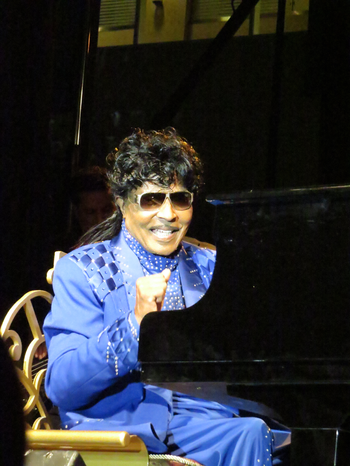
Rock and roll pioneer Little Richard died last week at the age of 87. Richard (whose real name was Richard Penniman) had his first hit, Tutti Frutti, in 1955, followed by other hits including Long Tall Sally, Good Golly Miss Molly, Jenny Jenny, and Slippin' and Slidin'. He was a major influence on so many musicians who followed, including the Beatles, the Rolling Stones, Bob Dylan, Joan Jett, Brian Wilson, Bette Midler, and Elton John. Which of the following is true about Little Richard?

Little Richard

IMG_8246 by xrayspx is licensed under CC BY-SA 2.0.

A. Little Richard was a presenter at the 1988 Grammy Awards, announcing the winner of the Best New Artist category. Richard, who had never won a Grammy, held up the envelope and said, “the best new artist is -- me!” After a standing ovation from the audience, he again held up the envelope and said, “and the winner is…still me! Being a brown Jew from Georgia, I had to tell the truth.”

B. Little Richard was one of the first musical heroes of Bob Dylan, who wrote in his high school senior yearbook that his life’s ambition was “to join ‘Little Richard’.” They met many times, and Little Richard was one of the main influences on Dylan’s decision to convert to Christianity in the late 1970’s. And oddly, it was Dylan who influenced Little Richard when Richard embraced Judaism in the mid-1980’s.

C. Shlomo Carlebach, the rabbi, composer, singer, and spiritual leader, began his singing career in Greenwich Village, where he met and worked together with Bob Dylan and Pete Seeger, among others. Dylan told “Reb Shlomo” about Richard and lent him some of his Little Richard albums. Carlebach later said, “I learned a lot about the importance of lyrics in music from Dylan, but I learned everything about the soul of music from Little Richard.”

D. At one point in his life, Little Richard converted to Judaism. One Friday in the 1980’s, Little Richard was recording with Paul Shaffer and Richard said he had to be done by 5pm because “It’s Shabbos and I’m an Orthodox Jew, have been for years. After sundown, I do no work.” The session ran a bit long, but Shaffer was able to show Little Richard that Shabbat didn’t actually start until 5:21pm that day. Little Richard told Shaffer, “Baby, you’re a better Jew than me.”

E. Little Richard was born and raised in Macon, Georgia. His family, like many black families in the south, had contact with the local Jewish community because many of the local businesses that served the black community were owned by Jewish immigrant families. As a child, Richard had already begun applying his musical and comedic talents when talking about his life, including referring to the local Jews as Heebie Jeebies. He eventually used that phrase in one of his first songs, Heeby-Jeebies, though the song had nothing to do with Jews.

Click here for the answer.

Honey Bees

For the first time, Asian giant hornets have been identified in America, having been found in the state of Washington, as well as in British Columbia. The hornets, which can grow up to two inches in length, can kill human beings, and can devastate bee colonies. With  honey bee populations already threatened by pesticides and climate change, the hornets could lead to a further decline, negatively impacting all plants that depend on bee pollination. Honey holds a significant place in Jewish tradition, most prominently at Rosh Hashanah when we dip apples in honey for a sweet new year. There was a question as to whether honey is actually kosher. The Mishna says in Tractate Bechorot, “That which comes from something which is Tameh [non-Kosher] is Tameh, and that which comes of that which is Tahor [Kosher] is Tahor.” Therefore, for example, camel’s milk and stork eggs are not kosher as camels and storks are not kosher animals. Why is honey kosher, when the bees which produce it are not kosher?

Honeycomb and bees

A. Numerous times in the Torah the land of Israel is referred to by God as a land flowing with milk and honey, first in Exodus, Chapter 3 Verse 8, “I have come down to rescue them from the Egyptians and to bring them out of that land to a good and spacious land, a land flowing with milk and honey.” Therefore, the rabbis ruled that God would not have used this phrase if honey were a non-kosher product.

B. The rabbis ruled that honey is kosher because they believed that bees did not produce honey, but only stored and transported it. The fact is that the rabbis are wrong, and bees do produce honey. But that knowledge has not changed the ruling that honey is kosher.

C. The Hebrew word for honey is d’vash. Using the system of gematria, wherein the numerical value of words is calculated and interpreted, the rabbis noted that the value of d’vash is 306. The word isha, meaning woman, also has the value of 306. Referencing the line from Genesis, Chapter 2, Verse 22, “And the rib, which the Lord God had taken from man, made He a woman, and brought her unto the man,” the rabbis noted that just as God brought woman to man, so too did He bring honey to man; therefore it must be a kosher product.

D. A quote in Tractate Bechorot says, “It is a land of wheat, barley, grapes, figs and pomegranates–a land of olives and honey.” From this, the rabbis defined honey as the sweet syrup of such fruits, rather than the product from bees. Over time, the designation of “fruit honeys” as kosher was extended to all forms of honey.

E. Honey was considered to be non-kosher until a famous rabbi, Reb Winnie, known as the Pooh-Bear Rebbe, noted that “The only reason for being a bee that I know of is making honey....and the only reason for making honey is so I can eat it.”

Click here for the answer.

NFL Draft

While it is still not clear if there will be an NFL football season this fall, the league is moving forward, having just held their annual draft of college players. The ceremony took place via teleconference, without much of the pomp that normally accompanies the announcements by teams of their selected players. One college player got the attention of the Jewish world in February when he was interviewed during the NFL Combine, the event where prospective players are showcased prior to the draft. The athlete appeared for an interview wearing a Star of David around his neck, and a reporter asked him the significance of the star. Who was the player and what was his explanation?

New Orleans Saints Football

A. The player was Yetur Gross-Matos, the Penn State defensive end who was selected by the Carolina Panthers in the 2nd round. Gross-Matos said, “I was raised Christian by my mom. My folks were divorced, but I still saw my Dad a lot. He’s Jewish so I wear the Star of David for him.”

B. The player was Shaquille Quarterman, the University of Miami linebacker who was selected by the Jacksonville Jaguars in the 4th round. Quarterman explained that at Miami he was a member of the historically Jewish Alpha Epsilon Pi fraternity. Said Quarterman, “Many of my friends in ΑΕΠ were Jewish, and a bunch of us bought the same Star of David to wear. It means a lot to my brothers and me.”

C. The player was Justin Herbert, the University of Oregon quarterback who was selected by the Los Angeles Chargers in the 1st round. When asked by a reporter from the Los Angeles Times why he was wearing a Star of David, Herbert looked surprised, and answered, “Umm, a Star of David? I don’t really know what that is. This is a sheriff’s badge. My grandpa was a sheriff in Eugene, where I grew up. When he died he left me his badge, and I’ve worn it ever since.”

D. The player was Josh Uche, the University of Michigan linebacker who was selected by the New England Patriots in the 2nd round. Uche explained that while he was at Michigan, there were rising tensions between black and Jewish students over issues including the Israeli/Palestinian problem and Black Lives Matter protests on campus. Uche joined a group of black and Jewish students who came together to attempt to find common ground and defuse the conflicts. Said Uche, “I became very good friends with a Jewish student who gave me this Star of David as a present on my birthday. That was real cool. It has a lot of meaning to me.”

E. The player was Jerry Jeudy, the Alabama wide receiver who was selected by the Denver Broncos in the first round. Jeudy explained, “My last name’s Jeudy. People sometimes call me Jeu...so I just got a Jewish star. I’m not Jewish though.”

Click here for the answer.

Toilet Paper

One of the complications of the COVID-19 pandemic is a shortage of toilet paper, which is a result of people hoarding, as well as the fact that everyone is using their home bathrooms exclusively, rather than also using bathrooms at work, or at stores, restaurants, and other public facilities. A few years ago an Israeli company, the Gefen Team, worked with Lily, an Israeli toilet paper brand that is a division of Kimberly-Clark, to produce a product to aid in the use of toilet paper. What was this product?

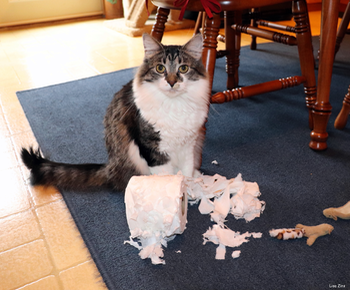
Toilet Paper

"I'm just as shocked as you are! WHO could have done such a thing?!" by Lisa Zins is licensed under CC BY 2.0.

A. They created  an internet connected toilet paper roll dispenser. The device keeps track of toilet paper use, enabling the user to generate usage reports, and also to automatically order replacement rolls of paper when needed. Users can communicate with the device using apps for iOS and Android systems.

B. They invented the Choose Your Own dispenser, a device which can hold up to three different rolls of toilet paper. This enables family members with different preferences to each use the toilet paper of his or her own choice–one ply or two, quilted, unbleached, gentle for sensitive skin, or others.

C. Toilet paper in Israel (as in many parts of the world other than the United States) is notorious for its roughness. Gefen, working with the Lily Company, developed a toilet paper dispenser that sprays a light layer of lanolin on the paper as it is dispensed, thus softening the paper and enhancing the comfort of the user. Lily determined that this was a less expensive and more environmentally friendly solution than changing production to the more expensive softer paper typically found in America.

D. They created a Shabbat toilet paper dispenser, which is internet-enabled, allowing it to keep track of the onset and end of Shabbat throughout the year. As a result, once Shabbat begins, the device will automatically tear and dispense the paper, enabling the Orthodox user to avoid the Sabbath prohibition against tearing. The device also keeps track of daylight savings time clock changeover, as well as Jewish holidays, and can be set to Israeli or Diaspora schedules, to accommodate the user’s practice regarding the second day of Chagim (holidays).

E. In response to a toilet paper shortage in Israel a few years ago because of a manufacturing plant fire at the Lily Company, they developed a toilet paper dispenser called TP-Yomi. The dispenser only provides one sheet of toilet paper per day, assuring that the toilet paper supply will last 7-1/2 years.

Click here for the answer.

Hey Jude

Fifty years ago (April 10, 1970), the Beatles officially split up. Their popularity, however, has not waned. At an online auction last week, an ashtray used by Ringo Starr at Abbey Road Studios sold for $32,500 and a drawing by John Lennon and Yoko Ono called Bagism sold for $93,750. The handwritten lyrics of the song Hey Jude sold for $910,000, nine times the pre-auction estimate. What was the Jewish connection to that song?

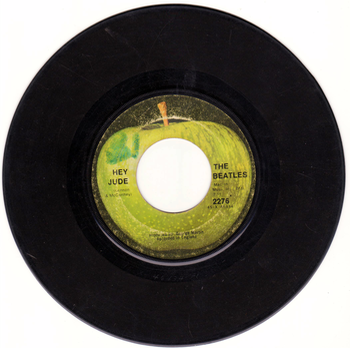
Hey Jude 45rpm record

Hey Jude/Revolution by Richard Bartlaga is licensed under CC BY-ND 2.0.

A. Paul McCartney originally wrote the Hey Jude ending as “la la la, la la la la…”, using the “la la” sound that was typical in pop music at that time. But as he refined the song, he remembered the Chassidic chants, or niggunim, that he heard at the bar mitzvah of Brian Epstein’s nephew, which included the “na na na” syllables, so McCartney changed the sounds at the end of Hey Jude to "Na na na, na na na na.”

B. Israeli peace activist Abie Nathan founded the Voice of Peace radio station in 1973, which broadcast from outside Israeli territorial waters on a boat, the “Peace Ship.” Nathan had purchased the boat with financial help from John Lennon. Hey Jude was the very first song ever broadcast on Voice of Peace radio.

C. When the Beatles traveled to India to study with the Maharishi Mahesh Yogi, Paul met Rabbi Zalman Schachter-Shalomi, who was also visiting the Maharashi’s ashram to explore Eastern spirituality. Paul learned from Reb Zalman about the group of Breslover Chassidim known as the “Na Nachs,” who found spiritual meaning in the phrase Na Nach Nachma Nachman Meuman (referencing Rebbe Nachman). McCartney couldn’t pronounce the gutteral Hebrew letter Chet so he just said “Na Na Na Na, Hey Man” which he later incorporated into Hey Jude, singing “Na Na Na, Na Na Na Na, Na Na Na Na, Hey Jude.”

D. Paul McCartney wrote the song about Julian Lennon, John’s son, and the original title of the song was Hey Jules. But McCartney changed it to Hey Jude because he liked the sound more. When the Beatles put a sign reading Hey Jude in the window of their London Apple Boutique store, McCartney received an angry call from a Jewish man named Mr. Leon who said, “How dare you do this!” He and many Jews thought this was an offensive slur, based on the German translation of Jew as Jude.

E. Until the release of the song Hey Jude, cantors in Reform and Conservative synagogues had sung Adon Olam to the tune of every pop song ever written. However, no cantor has ever managed to successfully fit the words of Adon Olam into the Hey Jude melody.

Click here for the answer.

Passover

The COVID-19 pandemic has greatly impacted Jewish life in every area, but probably the most significant is in regard to acceptable religious practices. Synagogues and Jewish communities across the religious spectrum have struggled with questions of the acceptability of live-streamed or Zoom services, whether kaddish can be recited with a virtual minyan, or what limits to place on funeral attendance and tahara (ritual preparation of the body). Upcoming Passover seders present many unique challenges as well. Which of the following is an example of exceptions to normal practice being allowed by religious authorities during this upcoming Passover celebration?

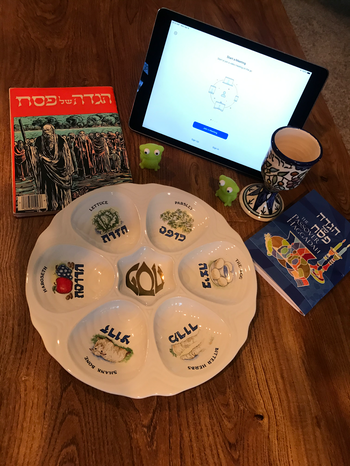
Zoom Seder

A. A group of Orthodox Sephardic rabbis in Israel have ruled that a videoconference with Zoom or other apps can be used for Passover seders, so long as computers are turned on and everything is set up prior to the beginning of the holiday.

B. The Vaad Ha-Rabonim of India, the assembly of Indian rabbis, has ruled that the use of roti, the traditional unleavened flatbread, is acceptable on the seder plate in those communities where matzah is not available due to production issues caused by the coronavirus pandemic. However, if using roti, the rabbis require the addition of a portion of the Al Cheyt prayers traditionally recited on Yom Kippur (e.g., “We have sinned against You unwillingly and willingly” and “We have sinned against You in our eating and drinking.”)

C. Rabbi Menachem Posner, staff editor at Chabad.org, has noted that it is acceptable to open the door for Elijah only so long as your door does not face your neighbor’s door.

D. Pesach Sheni, or 2nd Passover, falls one month after Passover, and exists to benefit those who were not ritually clean at Passover time (such as those who had contact with corpses), because these people are not allowed to eat the Korban Pesach, the Passover sacrifice, when impure. Rabbis in many Chassidic communities, including in Bnei Brak, the suburb of Tel Aviv that has been devastated by coronavirus, have ruled that the virus is a form of ritual impurity; therefore, Passover in these communities can be delayed until Pesach Sheni, which this year falls on May 8.

E. The Conservative Movement’s Rabbinical Assembly in the United States ruled that video conferencing is acceptable for seders. While the Assembly would prefer that a non-Jew activate the technology, lacking that option, the Assembly prefers that Siri or Alexa take on the role of the “shabbos goy.”

Click here for the answer.