


In Britain, ‘Jewish Greens’ chief mulls quitting party after ‘Zionism is Racism’ motion passes
By SHIRA LI BARTOV
(JTA) — The head of the Jewish Greens said she may leave the Green Party of England and Wales after it adopted a policy that defines Zionism as racism and calls for a single democratic state “in all of historic Palestine.”
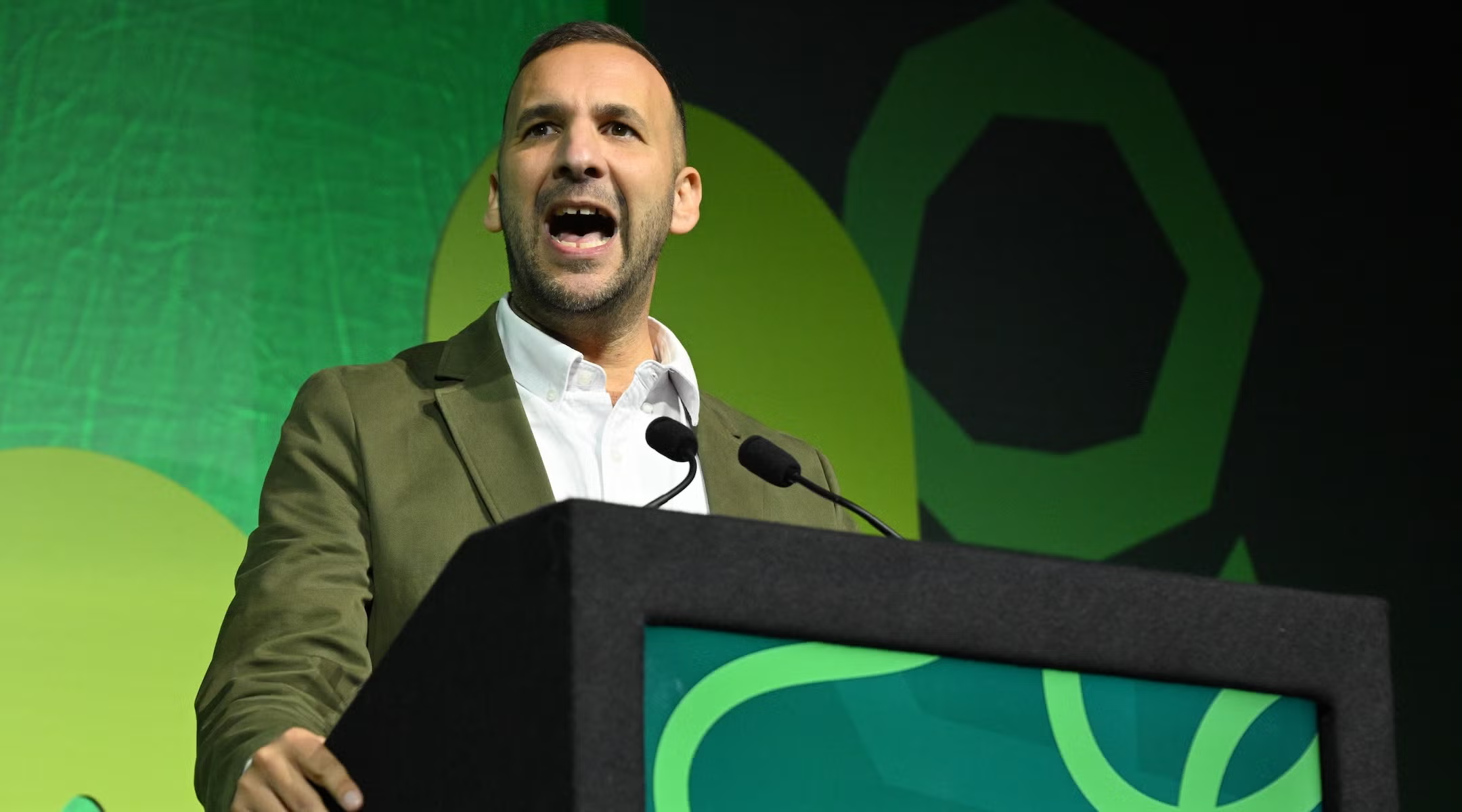
Green Party leader Zack Polanski delivers a speech during the Green Party autumn conference at the Brighton Centre in East Sussex, Oct. 2, 2026. (Will Colebourne/PA Images via Getty Images)
Vivien Lichtenstein, a 29-year member of the Greens who worked on Israeli-Palestinian peace initiatives since the 1980s, told the Jewish Telegraphic Agency that the policy “won’t make any difference to Palestinians in Gaza and the West Bank” but “potentially puts Jewish and other members at risk.” She will make a decision about her future in the party before the Jewish Greens hold elections in November.
The Green Party is facing global backlash and internal schisms after passing the “Zionism is Racism” motion at a conference in Brighton on Sunday by 1,022 to 813 votes. Members also voted down an amendment to protect Jewish Green Party members from being reported, pressured or disciplined based on their affiliation with synagogues or Jewish community centers that identify with Zionism.
The left-wing party, which enjoyed breakthrough victories and surging popularity earlier this year, was criticized on Monday by the European Green Party, representing 47 Green parties across the continent.
The umbrella group “unequivocally” distanced itself from the motion, demanding the English and Welsh Greens clarify their position on Jewish self-determination and “the protection of Jewish people and members in the party.”
The EGP said it condemns “the genocide against Palestinians and the human rights abuses committed by the current Israeli government,” while equally emphasizing “the fight against antisemitism and for human rights.” The group added that it has “always supported a two-state solution, with self-determination for both Israelis and Palestinians.” The International Court of Justice has not yet issued a final judgment on allegations of genocide against Israel, which rejects the charge.
Multiple English and Welsh Greens members said they were quitting the party in protest against the motion, including Sandy Ruthven, the chair of Amnesty International UK’s charitable trust, and Waterloo councillor Kieran Dams. Ruthven said the party “failed to confront prejudice when it appears on our own side.”
Lichtenstein said she was “considering” leaving the party as she weighs conversations with senior members and her colleagues in the Jewish Greens group.
“It isn’t up to the party to decide on the definition of Zionism — there are many definitions,” she said.
Zionism is a highly contested concept, defined by many supporters as the right to self-determination for Jews and by many opponents as an ideology of colonialism and apartheid. A survey released Monday by the London-based Institute for Jewish Policy Research found that 66% of British Jews identified as Zionist in 2025.
Ahead of the vote, the Jewish Greens shared a survey showing their members were deeply divided on the motion. Although 81% of 108 respondents said they did not identify as Zionist, 53% — including self-identified anti-Zionists — thought its adoption could make discrimination against Jews more likely. Meanwhile, 68% of respondents said they were concerned about the policy’s potential impact on the party’s electoral prospects.
There are 225 members of the Jewish Greens group, who do not include all Jewish party members.
Jewish Greens secretary Sam Alston proposed the failed amendment to protect synagogue-going members. Alston himself does not identify as Zionist, but he is a longtime member of a Liberal Jewish synagogue that promotes connection with and debate about Israel. He said his great-grandparents founded the Liberal Judaism movement in the U.K.
Alston told JTA that he believed the motion passed because “a number of people are rightly horrified about what’s happening in Israel and what the Israeli government is doing.” But he said that it backfired by fueling division, alienating Jewish members and reducing “our ability as a force to do anything to help the Palestinian people.”
“I think there’s an ongoing genocide in Gaza,” he added. “The party has been very successful at putting pressure on to try to stop the Israeli government doing the terrible things they’re doing, and there’s a big social coalition they could build to do that, and instead they’ve chosen to make the debate a focus about etymology.”
Alston and Lichtenstein also disagreed with the motion’s call for “a single democratic Palestinian State in all of historic Palestine,” saying that the form of a future state or states in the region should be decided by Palestinians and Israelis who live there.
“The particulars of the constitutional setting are not going to be dictated by Britain as a colonial power,” said Alston. “We’ve done that enough times to disastrous results.”
Fallout from the vote intensified scrutiny over the party’s decentralized structure, with policies made at two annual conferences that generally involve a small proportion of members. Less than 1% of the party’s membership voted on the Zionism motion. Four of the Green Party’s five MPs — Ellie Chowns, Adrian Ramsay, Siân Berry and Carla Denyer — publicly opposed the motion.
Zack Polanski, the Jewish leader of the Green Party who is seeking election to Parliament on Thursday and formerly served as treasurer of the Jewish Greens, did not attend the vote. That prompted criticism from party members.
“Zack should have made the effort,” said Lichtenstein, noting that members could register to vote remotely. “There was nothing stopping him being online.”
Polanski said in a statement Monday that no party member “will be made unwelcome because of their background, their faith, or where they worship” under his leadership, without explicitly disavowing or supporting the motion.
“As leader I will not accept any exclusion, or refusal to engage with anyone, because of the religious or communal body they are part of,” he said, adding that he was proud of the party’s “principled position on fighting for freedom and justice for Palestinians.”
Israel’s foreign ministry on Sunday said it banned Polanski from entering the country, calling the Zionism motion a “clear antisemitic text.”
Britain’s Movement for Progressive Judaism, which encompasses the Liberal Judaism movement, said the motion was “antisemitic in its formulation and intention” and made the Green Party “a racist party.” British Chief Rabbi Ephraim Mirvis also called it “poisonous antisemitism, a threat to British Jews and to Britain.”
Greens for Palestine, a group that is not officially affiliated with the party and led efforts to pass “Zionism is Racism,” urged supporters in recent months to join the party specifically to back the motion. The group said on Instagram that Greens member and Holocaust survivor Stephen Kapos spoke in support of the policy. Greens for Palestine did not immediately respond to JTA requests for comment.
