


Israeli election: Likud largest party, but no clear path to governing coalition, exit polls show
By JNS STAFF
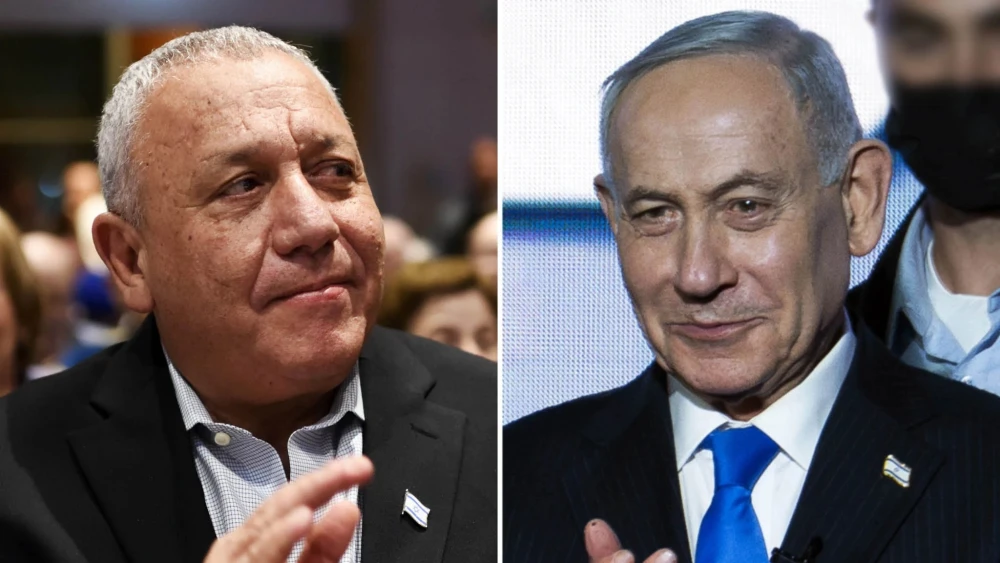
Israeli Prime Minister Benjamin Netanyahu and Yashar party leader Gadi Eisenkot on the campaign trail ahead of Israel’s Oct. 27 election. Credit: Flash90.
The exit polls varied widely, with Channel 14 projecting 30 Knesset seats for Likud, compared with 24 and 25, respectively, in projections by Channels 12 and 13.
Some exit polls showed a stronger showing for the opposition bloc led by Eisenkot, raising the possibility that he could be tasked with forming the next government.
Exit polls are often revised as votes are counted, and surplus-vote agreements between parties can also shift final seat totals. The count of double-envelope ballots—cast by soldiers, evacuees and other eligible voters voting outside their regular polling stations—is expected to continue into Thursday. The final tally is expected by Friday, although results could shift significantly overnight.
Channel 14:
Likud: 30
Yashar: 19
B’Yachad: 11
Joint List: 10
Shas: 9
The Democrats: 9
Otzma Yehudit: 7
Ra’am: 7
Religious Zionist-Zehut: 7
United Torah Judaism: 7
Yisrael Beiteinu: 4
Netanyahu bloc: 60 mandates
Opposition bloc: 43 mandates
Arab parties: 17 mandates
Channel 12:
Likud: 24
Yashar: 22
B’Yachad: 12
Joint List: 11
The Democrats: 9
Yisrael Beiteinu: 9
Shas: 8
Ra’am: 7
Otzma Yehudit: 6
Religious Zionist-Zehut: 6
United Torah Judaism: 6
Netanyahu bloc: 50 mandates
Opposition bloc: 52 mandates
Arab parties: 18 mandates
Channel 13:
Likud: 25
Yashar: 23
B’Yachad: 14
Joint List: 10
The Democrats: 9
Ra’am: 7
United Torah Judaism: 7
Yisrael Beiteinu: 7
Religious Zionist-Zehut: 6
Otzma Yehudit: 6
Shas: 6
Netanyahu bloc: 50 mandates
Opposition bloc: 53 mandates
Arab parties: 17 mandates
‘Likud is the biggest party’
Israeli Foreign Minister Gideon Sa’ar said in an X post on Tuesday night that “the left’s celebration is premature.”
“The certainties of biased commentators are ludicrous,” Sa’ar, a Knesset candidate for the Likud party, wrote in Hebrew.
“One thing is reasonably clear: Likud is the biggest party in Israel,” he added.
In his post, Sa’ar shared archival footage of Menachem Begin, Likud’s founder and its first prime minister. In it, Begin is seen urging patience with results on the eve of the party’s historic 1977 breakthrough election victory.
Meanwhile, Eisenkot claimed that initial exit polls amounted to “a complete vote of no confidence” in Netanyahu and his government.
“If these are the final results, this is a victory for Israel’s statist Zionist majority,” Eisenkot wrote on X in Hebrew.
He pledged to act immediately to carry out “the people’s decision,” replace Netanyahu and form a “Zionist conscription government” as soon as possible.
B’Yachad party No. 2 Yair Lapid also said on X that the Netanyahu bloc had “suffered a heavy defeat.”
“This is a total collapse, and the public told them to go home,” Lapid claimed.
Next steps
Once the official results are published on Nov. 4, Israeli President Isaac Herzog will consult party leaders before tasking the lawmaker he believes is best positioned to form a government.
That need not be the leader of the largest party, meaning Netanyahu is not guaranteed the opportunity.
Although no Israeli government has ever been formed on the basis of a minority coalition immediately after an election, Eisenkot told Ynet on Oct. 10 that he would seek to lead one if he fell short of the support normally required to secure a parliamentary majority.
The government-formation process follows a timetable defined by law. The first candidate Herzog designates receives 28 days, with a possible 14-day extension, to form a coalition. If he or she is unsuccessful, the president can assign another candidate 28 days. If that attempt also fails—or the president determines there is no possibility of forming a government—at least 61 MKs have 21 days to request that the president designate an alternative candidate. That candidate then has 14 days to form a government.
Failure to establish a government would trigger another election held in approximately 90 days. Herzog has pledged to try to avoid that outcome, declaring: “I really, truly will do all I can so there won’t be repeat elections.”
Some 7.33 million Israelis were eligible to vote on Tuesday, according to Israeli Central Elections Committee figures dated Sept. 6. That is an increase of 543,177 since the previous election in 2022.
Some 330,000 young Israelis were eligible to vote for the first time.
A total of 12,018 regular polling stations opened nationwide at 7 a.m. and closed at 10 p.m.
Election Day in Israel is a national holiday, with schools, kindergartens and most workplaces expected to close. Voters choose party lists rather than directly electing a prime minister. Lists must receive at least 3.25% of valid votes to enter the Knesset.
Military voting began on Oct. 21 at Israel Defense Forces bases and outposts across operational arenas, including in Gaza, Lebanon and Syria. Eligible Israeli diplomats serving abroad and their family members began voting on Oct. 15.
The vote for the 26th Knesset marked the Jewish state’s first general election since the Hamas-led massacre on Oct. 7, 2023.
