


Jerusalem Quartet marked New Orleans debut Wednesday night
By ALAN SMASON, Portions courtesy The Cleveland Jewish News
At age 33, Kyril Zlotnikov considers himself very lucky. He has lived through the devastating effects of the worst nuclear plant disaster in history, immigrated to Israel while barely in his teens, learned to speak and write Hebrew, and was accepted as a prodigy to the Jerusalem Rubin Academy of Music. Since 1993, with the other members of his group, the Jerusalem Quartet, Zlotnikov has garnered numerous international awards and acclaim, establishing him as a star cellist.

Members of the Jerusalem Quartet making their debut appearance at Dixon Hall on Wednesday night (Photo by F. Broede)
For the first time the Jerusalem Quartet performed in New Orleans on Wednesday evening. Their program of chamber music works by Hugo Wolf, Wolfgang Amadeus Mozart and Johannes Brahms marked the opening of the 2012-13 Friends of Music series at Tulane University’s Dixon Hall. They were received by five standing ovations including one for an encore performance of the slow movement from the Claude Debussy String Quartet.
Like Zlotnikov, quartet violinists Alexander Pavlovsky, 34, and Sergei Bressler, 33, are Soviet émigrés, while violist Ori Kam is a native of both Israel and the United States.
“I was born in (La Jolla) California, but I grew up in Israel,” Kam, 37, explained. His parents were students at the University of California at San Diego when he was born. He replaced founding violist Amichai Grosz three years ago after withdrawing from a position with the Berlin Philharmonic. A short time later in a move that seems ironic, Grosz accepted a chair with the Berlin Philharmonic shortly after Kam was invited to replace his position with the Jerusalem Quartet.
Even though Kam is slightly older than the other three members of the quartet, he proved to have no problem adjusting to their practice routine and busy performance schedule. “I’ve known these guys since 1995,” he bragged. But life for Kam as a Tel Aviv citizen was far less challenging than for the others.
Speaking of his earlier life in the former Soviet Union, Zlotnikov reflected on how far he has come. His family lived in Minsk, not far from the site of the Chernobyl nuclear plant accident.
“Life there was really difficult,” he explained. “Anti-Semitism was quite high, and of course, the environment, especially after Chernobyl, ecologically-speaking, was quite dangerous.”
People didn’t know what foods or drink were contaminated by radiation from the disaster. Not surprisingly, people wanted to get away from that toxic scene. “For Jewish people to move to Israel was always a dream,” added Zlotnikov, “but it wasn’t an easy move.”
Because he was young, Zlotnikov was better able to cope with the move. “For my parents it was much more difficult to leave their house, to leave their jobs, to move to a foreign country that they didn’t know and to not know how to speak the language,” he explained in his thick Russian accent.
His entire family, including his two paternal grandparents, had just $900 with which to start new lives in Jerusalem.
Zlotnikov had begun playing cello at the Byelorussian State Music Academy as a wunderkind at six. After arriving in Israel six years later, he was drawn to the Jerusalem Music Academy and to the Young Musicians Group of the Jerusalem Music Center founded by Isaac Stern.
Once accepted as a student, he received instruction from Avi Abramovich, a Romanian violinist and former quartet member. It was Abramovich who in 1993 put the quartet of teenagers together and set them on their course of international stardom.
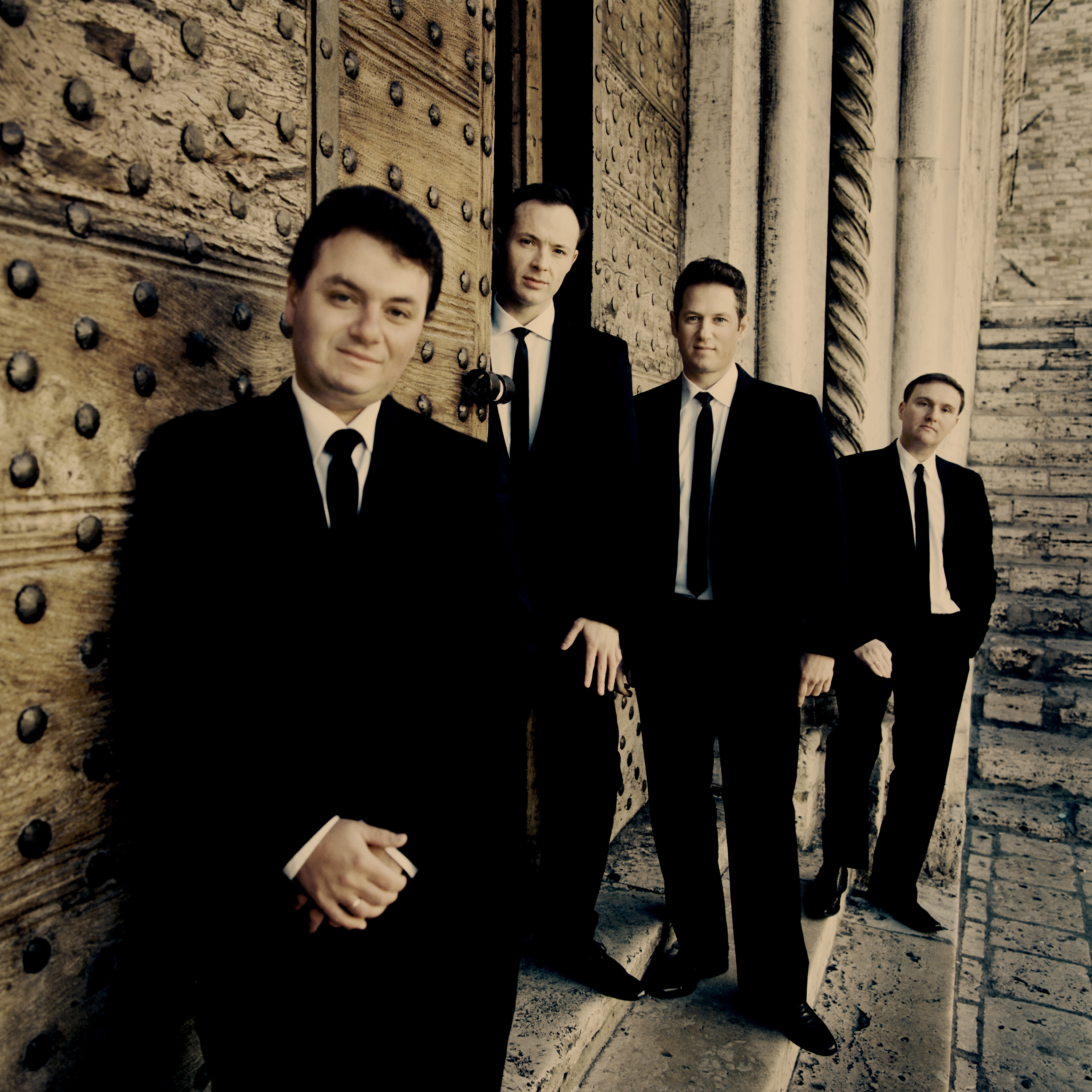
The Jerusalem Quartet (Photo by F. Broede)
Abramovich “played in string quartets in Romania, so he had an idea about how quartets should sound and the technical things that we should work on,” he explained. “We were really lucky that we had the best teacher and that we worked with him for four to five years.”
Their teacher bred in them a desire to play and rehearse together, to listen to the music collectively rather than individually, said Zlotnikov. “He helped to develop you as a group – to think of the string quartet as a living body. It should sound like 16 strong instruments, not just four.”
Success was almost immediate. By 1995 the quartet had already won the first of several major prizes in international competition. They made their first appearance in the United States a year later at New York’s Carnegie Hall.
“This was a special concert that the American-Israel Culture Committee was organizing and the Philadelphia Symphony was supposed to play,” he recalled. “Two or three days before the concert, they went on strike.”
Contacted as a last minute replacement, the quartet members hastily finalized arrangements, including travel visas, and hopped a flight to the US. “A lot of people were really amazed to see only four chairs on stage instead of a hundred,” said Zlotnikov. “To play Carnegie Hall at the age of 17 or 18 was really amazing. We sent a letter to the Philadelphia Orchestra thanking them for going on strike so that everyone could hear us,” he said, laughing.
Another aspect of a quartet is that they must practice together and as individuals. The quartet practices together for four hours three or four times a week, Zlotnikov explained. “But, of course everyone also has to practice individually.”
This togetherness was threatened when the individual members became of age to serve in the Israel Defense Forces. For the first time in Israel’s military history, however, allowances were made to permit a musical group to be simultaneously conscripted. This allowed them to continue to practice and rehearse their work as well as to perform for the troops while serving in the military.
“All of us had to wait for Amichai (Grosz), who was the youngest, to go together into the army,” Zlotnikov observed. “This was a lot of paperwork and took a lot of people to get involved to get us into the same basic training and at the same base in the army as a quartet.”
Because they served together, the quartet members maintained their close professional and personal relationships. Once their two-and-a-half years of service was completed in 1999, they were immediately able to begin playing in international competition.
Zlotnikov became friendly with pianist and conductor Daniel Barenboim after the two met and played together at the Jerusalem Chamber Music Festival in 2001.
Barenboim’s relationship with Zlotnikov deepened to a point where he extended the younger musician a precious gift.
It was the Sergio Perresson, the cello that was once owned by Barenboim’s deceased wife, the world-famous cellist Jacqueline du Pré. It stands as one of the most famous cellos in the world today.
Barenboim had given other musicians an opportunity to play du Pré’s cello, but the results were not good.
“Some tried to play it and they weren’t happy with it, but in my hands it worked from the very first second,” Zlotnikov explained. In recent years, though, the cello and cellist did not fare so well. Barenboim had the piece put into restoration and after the craftsmen had adjusted the modern instrument, Zlotnikov found much of his performance was not coming through. “It wasn’t working for me,” he stated sadly.
He has since begun to play a famous cello constructed by Giovanni Battista Ruggieri of Cremona (Italy) in 1706. The cello has been named in recent years to honor famous cellist and teacher Felix Salmond, who died in 1952.
In recent years several of the chamber music group’s performances in Europe have triggered protests from pro Palestinians, who view the “cultural ambassadors” as fitting targets to challenge Israel’s policies in Gaza and the West Bank. The fact they were all previously conscripted as members of the Israel Defense Force had done little to still those protests. As an example, a 2010 lunchtime recital from London’s renowned Wigmore Hall over the BBC was cancelled out of concern for the safety of the group members and the audience.
The Jerusalem Quartet began this tour of the United States with a stop in Cleveland last week and a stop in Houston. They will journey to Portland, Denver and Pittsburgh before returning to Israel. Besides London, their recent world tours have taken them to Paris, Rotterdam, Amsterdam and Munich, to name but a few.
The most recent CD on the Harmonia Mundi label by the Jerusalem Quartet is a May release of Robert Schumann’s Quartet No. 44 and Piano Quintet No. 44 with pianist Alexander Melnikov (HMC 902122). Previous award winning releases include Franz Schubert’s Quartettsatz (“Death and the Maiden”) (HMC 901990), Antonin Dvorak’s “American” Quartet and Piano Quintet with pianist Stefan Vladar (HMC 901899), Joseph Haydn’s string quartets (HMC 901823) and two volumes of Dmitri Shostakovitch string quartets (HMC 901865 and HMC 902030).
Next year the quartet is slated to perform the complete Shostakovitch string quartet cycle in Portland and for the Chamber Music Society of Lincoln Center in New York. “It (has been) really an amazing experience to work with Harmonia Mundi. I hope one day that we will record all 15 of (Shostakovitch’s) string quartets,” Zlotnikov said.
Kam agreed. “I’m sure we will at some point,” he said. However, he did suggest that recording the remaining quartets would be “tough to sell” to Harmonia Mundi at present.
The Jerusalem Quartet played Wolf’s “Italian Serenade” in addition to the “Prussian” String Quartet No. 22 by Mozart and the String Quartet No 3 by Brahms, both in B-Flat Major, at Tulane University’s Dixon Hall.
