


‘Kosher Jesus’ explored at Gates of Prayer, series continues for two more weeks
Congregation Gates of Prayer’s Rabbi Robert Loewy covered most of what was a very illuminating topic in the first of three “kosher” continuing education programs presented in concert with Congregation Beth Israel. The “Kosher Jesus” lecture focused on Jewish perspectives towards Christianity and how Jews deal with the often contentious history that has existed between the Church and Jewry.
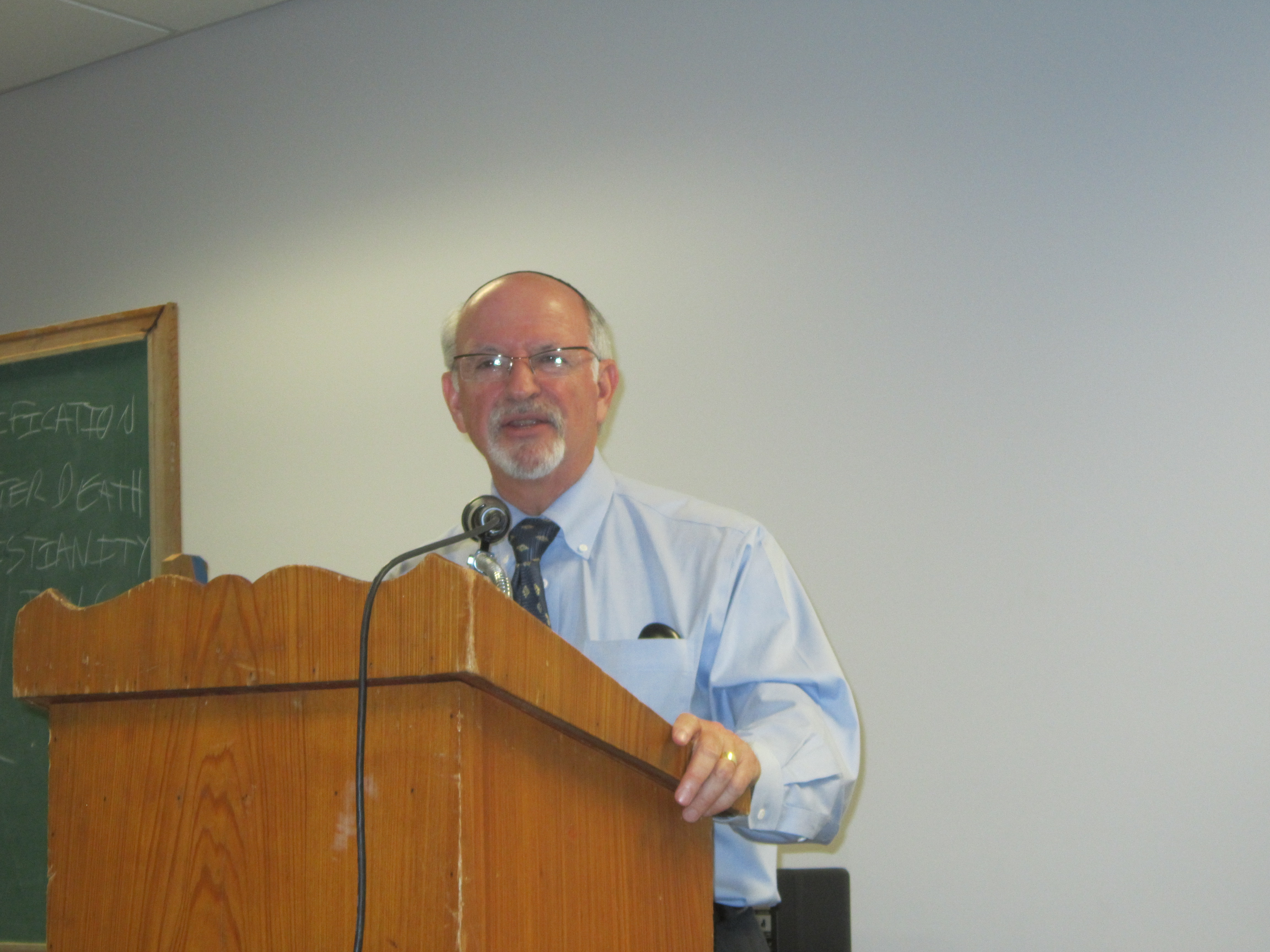
Rabbi Robert Loewy tackles the continuing education topic of "Kosher Jesus" at Gates of Prayer on October 10. (Photo by Alan Smason)
Loewy collected a series of questions from the audience to address and then focused on the conditions that existed during the period between the First Century B.C.E. and the First Century C.E. in Jerusalem and Judea. He recounted simplistically the role the Romans played as conquerors of the land and that of the religious leaders of the Sanhedrin. The so-called Messianic Era was a time when Jews were looking for a leader to unify and re-establish the Jewish nation. “The context of this was ‘We want to overthrow the Romans,” Loewy explained.
Loewy was quick to point out that Jesus was not a rabbi, as that honorific did not come into being until after the destruction of the Second Temple several decades after the documented death of Jesus. “He’s a public speaker,” Loewy said in describing the religious figure in contemporary terms. “He’s charismatic. He addressed the multitudes.”
Loewy emphasized Jesus was just one of several would-be leaders of the Jewish people at that time. “Jesus was a politician. He had a following,” he said. “There were other politicians. They had their followers. The Romans had him executed. End of story.”
Following the death of Jesus, Loewy continued, his followers attempted to convert Jews who comprised as much as 25 percent of the make-up of the Roman empire. In the First Century C.E., as the four Gospels were recounted and the Second Temple destroyed, many Jews did not accept Jesus as a Messiah who “died for our sins,” as Christians came to view his death. Christians and Jews both believe in an after-life, he noted, but the concept of having “eternal life” was only achieved by bracing Jesus, a practice to which Jews have refused to adhere.
When Roman Emperor Constantine embraced Christianity, making it the empire’s official religion, Jews began to be dealt with even more sternly, Loewy stated. As to the belief in a “tri-une presence (Trinity),” Loewy said he believed that Jesus “would probably be surprised” to learn of his divinity.
Loewy also called on Jews in the audience to no longer use the term “goy” or goyim” to refer to non-Jews, calling it a perjorative much like the “n-word” would be thought of for African-Americans. While admitting there is still some anti-Semitism in the world, he praised the advances made in the 50 years since the Vatican II Council was held which relaxed the Church’s attitude towards Jews.
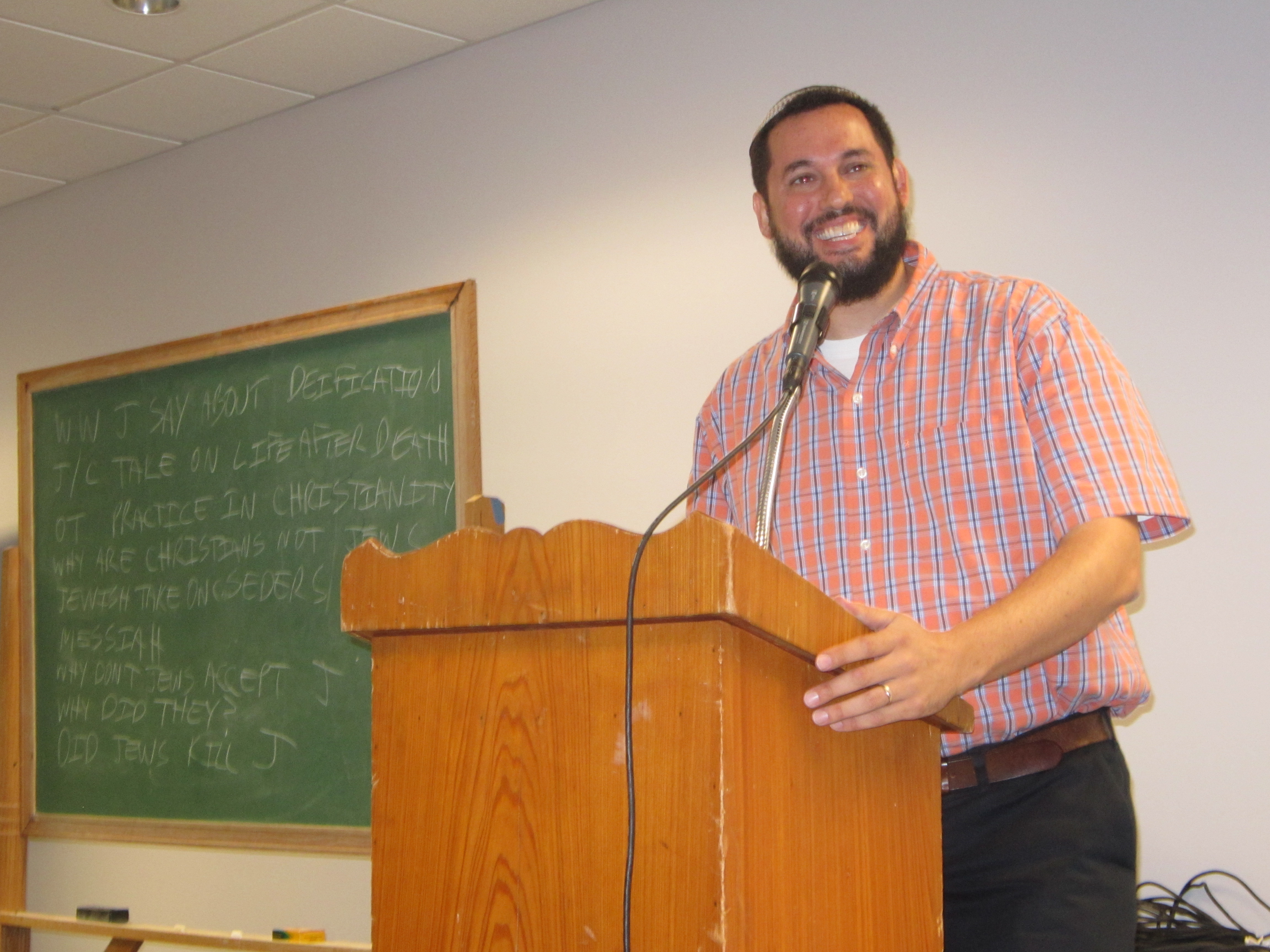
Rabbi Uri Topolosky of Beth Israel at Gates of Prayer talking about "Kosher Jesus." (Photo by Alan Smason)
Meanwhile, Rabbi Uri Topolosky had several comments of his own to add. Topolosky pointed out that this discussion has been part of his life since early childhood because his mother came from a family of Irish Catholics before converting to Orthodox Judaism. He said the concept of chovitz chaim (to save a life) on Shabbat had always meant that Shabbat could be broken to save a fellow Jew’s life, but not necessarily for a non-Jew. Rabbi Moshe Feinstein, Topolosky said, reportedly advised Jews to extend the practice to include all people in need.
On a personal note Topolosky admitted he had never been inside a church during services and had only been to the interior of a church for the eulogies of both of his maternal grandparents. He recounted he was asked to deliver his grandmother’s eulogy following a mass in her honor, which caused for him a personal challenge. However, he is firm in his belief that Orthodox Jews should not enter non-Jewish houses of worship as a precept of faith.
Both rabbis talked briefly about the differences in using wine in services for Jews and Christians and that the former see wine as the blood of their savior, whereas Jews view it strictly as wine, but an important part of the rituals.
Next week’s continuing education series topic will be “Kosher Queer” and will be an examination of how Reform and Orthodox Judaism consider gay, lesbian, transgender and bi-sexual lifestyles and actions. Members of AYLA, a gay advocacy group will be in attendance to expand on the rabbis’ talks. “Kosher Queer” will be held at Gates of Prayer at 7:00 p.m. on Wednesday, October 17.
“Kosher Sex” will be held on Wednesday, October 25.
