


Netanyahu leads in exit polls, but Eisenkot’s change bloc has more seats
By RUTH EGLASH
(JTA) — JERUSALEM – Israel’s parliamentary election has ended with Prime Minister Benjamin Netanyahu’s ruling Likud party remaining the largest faction, even though it appears he will struggle to form a government, according to exit polls published as polling stations closed at 10 p.m. local time.
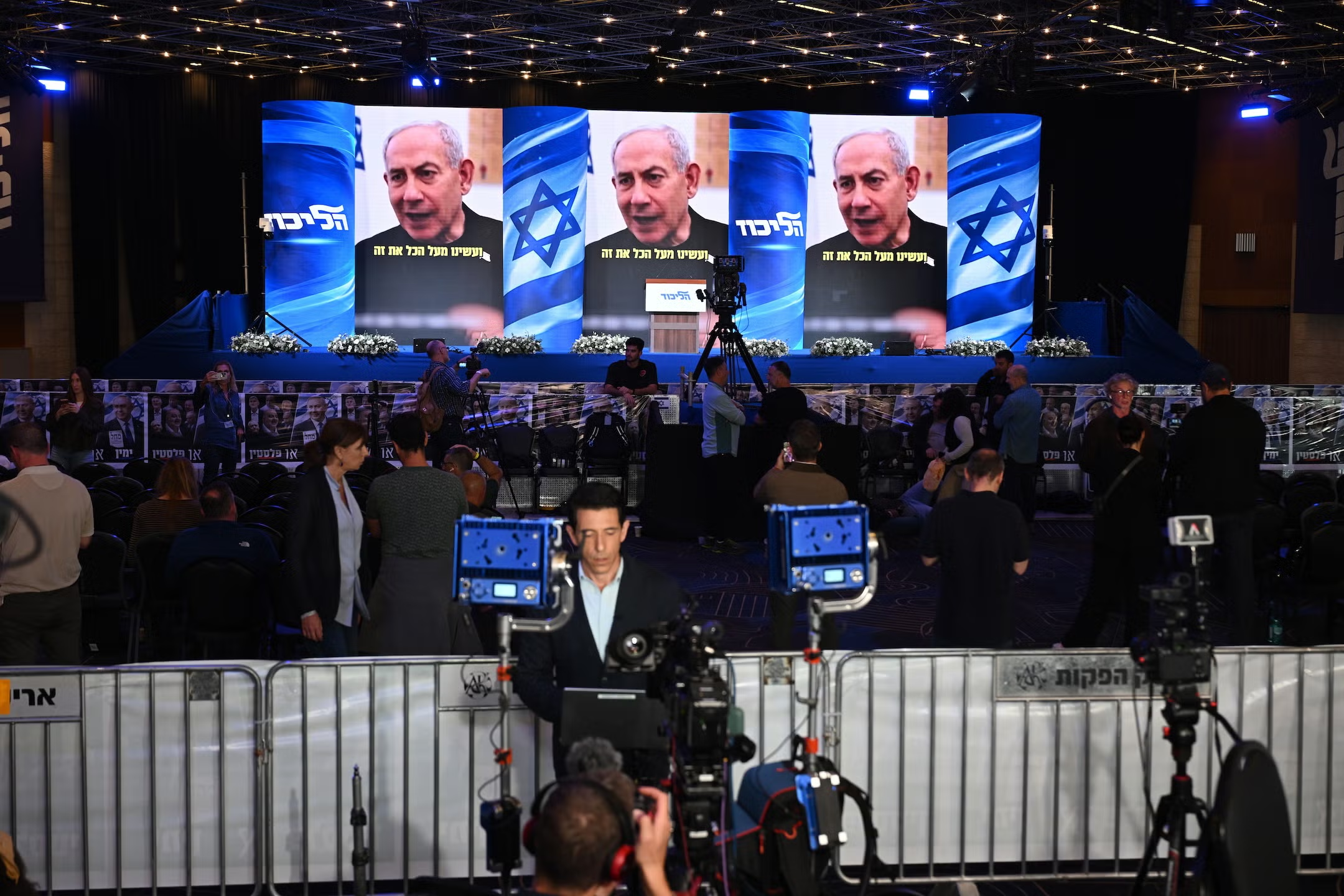
Members of the media working and conducting on camera interviews at the Likud Party election-night event at Teddy Hall, International Convention Center on October 27, 2026 in Jerusalem.(Photo by Alexi J. Rosenfeld/Getty Images)
However, the results showed that the rival bloc of opposition parties led by former army chief Gadi Eisenkot also does not have the requisite 61 seats, out of 120, needed to form a government either.
Exit polls, taken throughout election day, are only an indication of the final results. It can take hours or days for the official count to become clear, and the final results will only be certified on Nov. 4.
“The initial exit poll results point to an absolute lack of confidence in Netanyahu and the government responsible for Oct. 7 among the majority of Israeli citizens,” Eisenkot said in a statement. “If these results are final, it is a victory for Israel’s Zionist, national majority.”
However, analysts who spoke to the Jewish Telegraphic Agency after the exit polls were announced said it was too early to say what would happen next. They pointed out that no side appeared to be victorious.
They also said the biggest surprise was the apparent large turnout of Arab voters, some 20% of Israel’s population, who appeared to have boosted the size of the two Arab parties. Since both blocs have rejected the prospect of including Arab parties in their coalition, the growth in the Arab votes is another reason neither bloc has the necessary numbers to be able to form a government.
“Netanyahu did much better than anyone thought,” said Professor Jonathan Rynhold, from the department of political studies at Bar-Ilan University.
“It’s actually unbelievable how well he has done,” he said, but added that “he has cannibalized his own bloc,” meaning most of the voters shifted away from other right-wing parties that would have strengthened his coalition.
Rynhold concluded, “unless there is some massive change, Netanyahu does not have a government.”
But he noted that the opposition might not be able to form a government either. “They won’t go with Bibi [Netanyahu] and won’t have a minority government with the Arabs either. So if the opposition sticks to what they’ve said, then I am sure Netanyahu will be happy to go to another election.”
Gideon Rahat, a senior fellow at the Israel Democracy Institute and a political scientist at the Hebrew University of Jerusalem, said the biggest surprise was the Arab vote.
While some Israelis might see Arabs’ high voter turnout as a dangerous development, he said, others will say it is “a Zionist victory that at last they are taking part in the Jewish state” rather than staying home.
Rahat said that constant incitement against Arab citizens of Israel by government figures such as far-right Minister for National Security Itamar Ben-Gvir might have been what motivated them to vote in such unprecedented numbers on Tuesday.
The exit polls indicate that the Joint List of Arab parties could gain up to 10 seats, with Ra’am, the Islamist party, getting as many as 7. In the previous Knesset, the two parties had 10 collectively.
“I don’t know what the path forward is now. Ten years ago I would have said they would find a solution, but since then we’ve had one election after the other, that is now a viable option,” Rahat said.
He added that just because Likud was the largest party did not mean they would have the ability to form a government, especially because the exit polls seem to suggest that Eisenkot’s bloc will be the largest.
“These are still only exit polls and things can still change,” he said. But if Eisenkot does lead the largest bloc, “they could still make changes in the Knesset, which might change the reality,” Rahat added.
It was a dramatic day in Israel, with voter turnout reaching its highest level in decades, according to the Central Elections Committee. Final figures published at 10 p.m. showed that some 77.7% of the 7.3 million eligible voters had cast their ballot.
Indeed, lines at polling stations were longer than usual, with some Israelis waiting more than an hour to cast their votes.
Israelis have described this election, the first national election since Hamas’s Oct. 7, 2023 attack, as a battle over the country’s character and how best to address the security concerns that have arisen over the past three years.
Netanyahu and his coalition partners, a bloc comprising mostly far-right and ultra-Orthodox parties, have largely campaigned on a platform of protecting Israel from existential threats, including what they describe as security threats posed by the country’s Arab population.
Casting his ballot on Tuesday morning, Netanyahu said he was voting “For the future of the State of Israel.”
“We cannot leave this battle in the hands of the left and the Arab parties,” Netanyahu said, accusing them of wanting “to bring an end to the Jewish state.”
Adalah, a legal center for Arab minority rights, filed a complaint with the Central Elections Committee. It said in a statement that “senior government officials have been inciting against Palestinian citizens of Israel exercising their right to vote as turnout in Arab towns rises.”
The group of parties trying to oust Netanyahu – the “change bloc” – has argued that the election is a vote on Israel’s future as a liberal and democratic nation.
The opposition has framed the election as a referendum on Netanyahu’s handling of the aftermath of Oct. 7 and the subsequent wars in Gaza, Lebanon and against Iran.
After casting his vote in the city of Herzliya, Eisenkot told the crowd: “We are setting Israel on a new path. We will be worthy of your trust. I promise.”
It is traditional for party leaders to cast their votes in front of cameras and to campaign right up until polling stations close. Netanyahu and his coalition partners traveled the country on Tuesday trying to mobilize their supporters, warning they would not be re-elected unless their supporters turned out to vote.
However, under Israel’s system of proportional representation, differences in turnout among communities could drastically change the political map. Larger numbers of Arab voters, who tend to vote for one of the two Arab political factions, can affect the distribution of seats and the balance of power between the blocs, potentially complicating Netanyahu’s efforts to form a government.
While none of the three smaller parties — Amcha Yisrael, the Reservists-Economic Party, and the Haredi Public Party — appear to have gained enough votes to enter the Knesset, votes yet to be counted from polling stations on army bases and by diplomats stationed abroad could give them a boost, which would further change the political map when the final results are in.
This is a developing story.
