


OP-ED: The religious right dances as the Supreme Court drops the other shoe
By ALAN SMASON
As previously leaked to the media this spring, the United States Supreme Court took a momentous and highly fractious step in dialing back abortion rights in this country on Friday afternoon. With its 6-3 decision in Dobbs v. Jackson Women’s Health Organization, the high court reversed its previous decision in Roe v. Wade that guaranteed abortion rights for all women in this country.
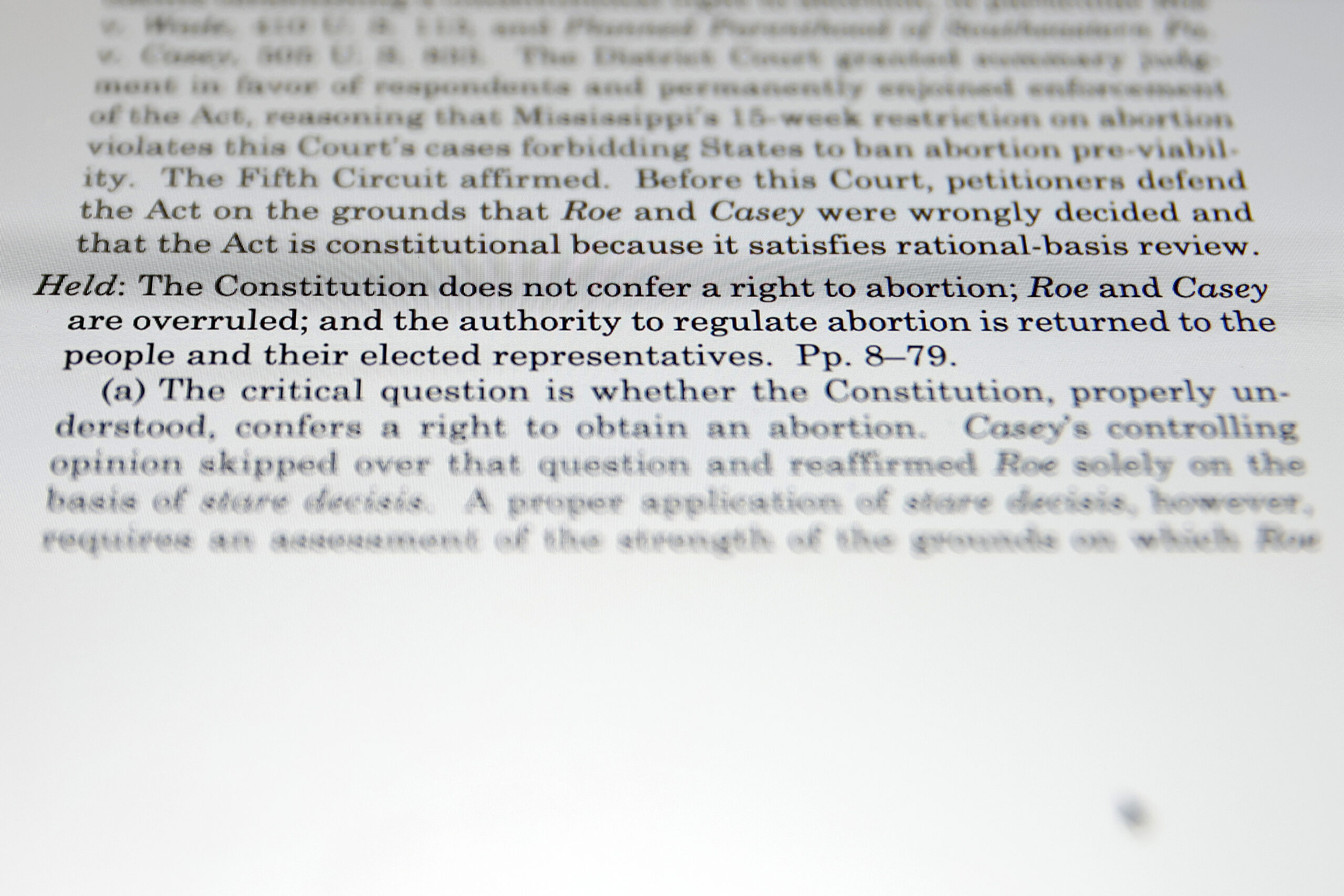
The U.S. Supreme Court decision in Dobbs v Jackson Women’s Health. (Photo by Chip Somodevilla/Getty Images)
Under the new ruling no contingencies for abortions exist including saving the life of the mother or for cases of rape or incest.
All three of the abortion clinics operating in Louisiana ceased operations when the announcement was made. This was due to the fact the Louisiana Legislature had already passed a restrictive law that kicked in the moment Roe V. Wade was struck down. No exceptions for abortion are accepted in states where similar measures have passed into law. Previously, exceptions for rape, incest and a danger to the life of the mother had been held. Now, not only is the medical procedure outlawed in Louisiana, but seeking out an abortion is a criminal act itself.
Women’s rights organizations have decried and denounced the new law of the land and promise they will work to restore abortion rights, while Conservative factions and religious leaders have praised the Supreme Court for what they view as a long overdue correction.
Rabbinic leaders have long held to the belief that life does not begin at conception, but at birth. So much of the religious rhetoric regarding a fetus’s right to life has been avoided. Increasingly, however, many Conservative Jews have aligned themselves with elements of the far right, who have found common ground in their unflinching support of the State of Israel.
“Politics makes strange bedfellows” is an adage that has never rung more true. And while opposition to abortion among Jewish philosophers has never achieved the kind of fanatical fervor found in elements of the Catholic Church or several evangelical groups, there are many Jews who believe that saving a life – pikuach nefesh – is a sound argument for striking down Roe v. Wade.
So what has happened as a result of this ruling? Let’s review.
Women are definitely more at risk. Being forced to carry a fetus to full-term could well become a death sentence for some mothers and might seriously compromise the health of the unborn children the law was designed to protect. Pregnant mothers looking to find an abortion clinic in a state not already triggered to ban the medical procedure might find the attendant costs to be prohibitive.
Then there is the horror of having to live with the painful reminder of sexual abuse or violence in the form of a baby conceived by incest or rape.
Whenever society has banned substances such as drugs or attempted to curb acts by fiat, cottage industries have arisen to fill in the vacuum the laws leave behind. The best example that typifies this kind of failure was, of course, Prohibition, the so-called Volstead Act. Banning alcohol and prohibiting its manufacture and distribution did little to curb the desires of Americans who craved it. Prohibition sent the production of alcohol to outside countries like Canada and created huge opportunities for criminal enterprise.
Before Roe v. Wade, women seeking abortions were forced to seek out illegal makeshift operating rooms, oftentimes having the procedures render them infertile or cause complications that imperiled their lives.
Surely, the religious right who hope to save millions of terminated pregnancies to the greater glory of God could not be promoting this new case law as examples of their faith’s kindness, charity and justice.
During their confirmation hearings before the Senate Judiciary Committee, each of the three recent Trump appointees to the Court – Neil Gorsuch, Brett Kavanaugh and Amy Coney Barrett – expressed beliefs that Roe v. Wade was settled case law. In 1810, the Supreme Court (in Hudson v. Gustier) issued its first reversal of a previous ruling (Rose v. Himely). Through the past 212 years, the Court has granted itself the capacity to review settled case law as its makeup changes. Like it or not, Dobbs v. Jackson Women’s Health Organization is now the law of the land. The pendulum of controversial justice that formerly allowed women the right to make a choice has now swung back in the opposite direction. The Court’s recent ruling says no such right to an abortion exists for any woman.
How long this ruling will stand depends on several factors, but key among them is the balance of power for the Democrats in the White House and the Senate. Midterm elections typically benefit the political party out of power. In this case it would be the Republican Party. With so many outraged women’s groups protesting this recent Supreme Court decision, we may see significant pushback for the Democratic Party.
But while the Democrats mobilize, the Republicans are largely rejoicing and, perhaps, metaphorically dancing.
