


Renowned arts and theatre critic Ira Bilowit dies at 90
IRA J. BILOWIT, an esteemed arts journalist of New York City passed away July 22 at the age of 90 as a result of a number of kidney and other health-related issues.
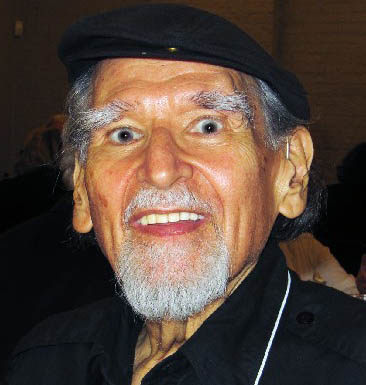
Ira Bilowit
He was briefly hospitalized in intensive care earlier this summer but had been released to rehab several weeks ago.
A longtime member of the American Theatre Critics Association (ATCA) since 1976, he worked in concert with fellow member Sherry Eaker to create many New York weekend conferences, the highlight of which was a luncheon held at famed Sardi’s Restaurant with luminaries from both the stage and screen world attending.
Bilowit was instantly recognizable at any gathering with a broad welcoming smile, bright eyes, feisty attitude, silver goatee and a willingness to share his encyclopedic knowledge with anyone who asked. His career and work with ATCA were honored in April 2014 when he was given emeritus membership status.
He also served as a former vice-president of the New York Drama Desk and was a member of The Dramatists Guild, the Outer Critics Circle and the International Association Of Theatre Critics.
Bilowit’s lengthy career in arts journalism encompassed work as a theater critic, feature writer and editor. He served as reviewer and an editor of Show Business from 1953-1958 and was its managing editor from 1961 to 1963. He was a contributing editor to Back Stage from 1980-1983 and editor-publisher of New York Theatre Review from 1976-1980. His extensive freelance work was seen in American Way Magazine, Theatre Crafts and Other Stages. He was still working in recent years, such as contributing a Metropolitan Diary column to the New York Times in February 2015.
Over a half-century, he interviewed many of the leading performing arts practitioners in almost every media from Sir Derek Jacobi to Milton Berle. Most were published in newspapers, magazines and even his own three experiments with online blogging. His articles recounted interviews and roundtable discussions many of them taped with Tennessee Williams, Eugene Ionesco, David Mamet, Ian McKellen, Patrick Stewart, Estelle Parsons, Diana Rigg, Joan Plowright, Jonathan Pryce, Edward Asner, Alfred Drake and Rex Harrison. Some of the articles were couched as if the interviewee had written them, but in fact Ira was the author and credited “as told to.”
Bilowit was also deeply involved in the creation of theater as a playwright, director and producer for Off-Broadway productions, children’s theater and dance presentations – as well as a general manager, production manager, stage manager and educator. He produced with Unicorn Productions his own musical adaptation of Of Mice and Men in 1958; wrote The Secret Concubine for Carnegie Hall Playhouse in 1960, and directed his own script, For Love of Candy, in 1971 at the Forestburgh Summer Theatre Festival in Monticello, NY.
Born in New York City, he attended City College of New York from 1947-1950 studying English and philology. He had written short stories, poetry and a novelette. But he had no deep interest in theater until a friend took him to a college rehearsal where he realized he might write plays. To do that, he had to volunteer to paint scenery, hang lights, do publicity and act, something he did not think he was cut out for.
But that allowed him to produce and to write one-act plays, some of them experimental. The turning point occurred at a chance viewing of some random theater scenes based on the works of John Steinbeck.
He bought the rights for a six-month window to adapt and write lyrics for Of Mice and Men along with a composer. With Steinbeck’s blessing, the show was mounted at the Provincetown Playhouse in November 1958 with a cast including Jo Sullivan and Art Lund. It was forced to close six weeks after its opening because a newspaper strike delayed reviews. It was given a developmental reading in 2007 by the York Theatre Company.
Survivors include two sons, Michael and Bill Bilowit, a Miami-based filmmaker, and his first wife, the acting teacher and coach Alice Spivak, with whom he remained close. His second wife, Debbie Wasserman, who was also a longtime ATCA member, preceded him in death.
Funeral arrangements are pending.
