


Under the stars of Mount Herzl, Israel marks 78 years of independence
By TANIA SHALOM MICHAELIAN
Organizers had quietly filmed a full dress rehearsal days earlier in case renewed fighting with Iran made a live public event impossible. A fragile ceasefire with Iran and Lebanon was holding—barely.
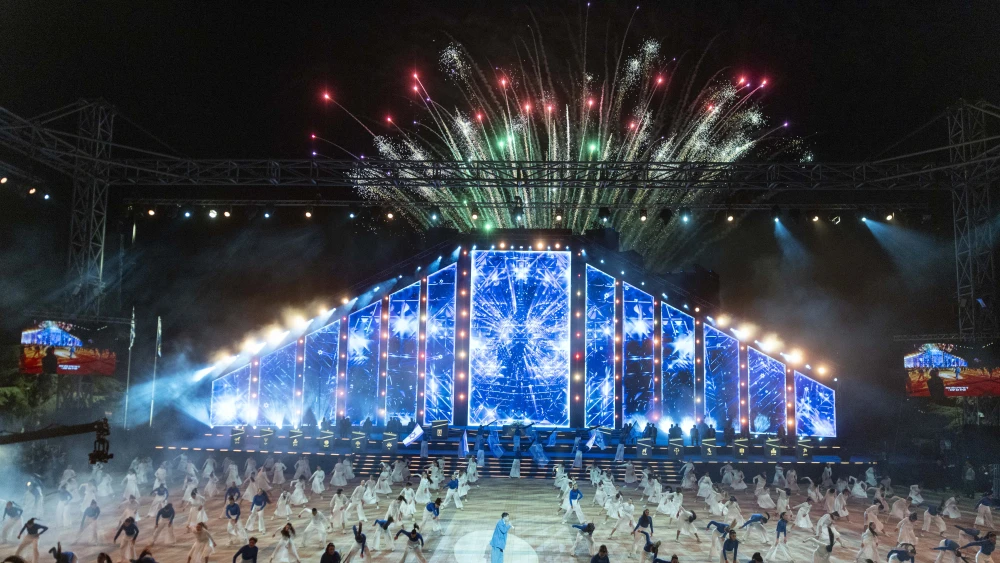
The 78th anniversary Independence Day ceremony held at Mount Herzl, Jerusalem, on April 21, 2026. Photo by Chaim Goldberg/Flash90.
Last year’s ceremony was canceled due to wildfires in the Jerusalem hills. This year, thousands arrived from across the country, determined not to miss the event.
What followed was one of the most emotionally charged Independence Day ceremonies in recent memory—a sweeping, two-hour program centered on the theme “Strengths of Renewal,” moving between grief and defiance, prayer and celebration, loss and victory.
Knesset Speaker Amir Ohana opened the formal proceedings by framing the evening’s emotional stakes. Drawing on language from the Book of Esther—“and it was reversed”—he cited developments from the past year as signs of national resilience.
“When in the past year, in the midst of war, 20,000 Jews chose to make aliyah—that is what victory looks like. When in the past year 177,000 babies were born in Israel—that is what victory looks like,” Ohana said.
Israeli Prime Minister Benjamin Netanyahu, who attended with his wife, Sara, delivered remarks via pre-recorded video, citing security concerns, saying Israel had “risen like a lion and fought like one” and had “struck hard at the regime of terror in Iran.”
Netanyahu said Israel is “stronger than ever,” praising what he described as major military achievements and the country’s alliance with the United States.
“Israel is stronger than ever, and together with the United States, we are leading the fight against the forces of evil in the world,” Netanyahu said, describing the current period as a “generation of revival” in which Israel is confronting longstanding threats to its existence.

Prior to the Yom Ha’Atzmaut activities, Prime Minister Benjamin Netanyahu consoled family members who had lost children during the war. (Photo by Ma’ayan Toaf/GPO)
He said Israel had delivered significant blows to what he called the Iranian “axis of evil,” which he accused of seeking to destroy the Jewish state. Referring to ongoing regional hostilities, he said Israel had taken decisive action to remove what he described as existential threats, including dangers posed by Iran’s nuclear and ballistic missile programs.
“In the War of Revival, in Operation Rising Lion and Operation Roaring Lion, we made major achievements,” Netanyahu said, crediting Israel’s security forces, citizens and leadership decisions with strengthening the country’s regional standing.
He highlighted new partnerships and diplomatic opportunities that he said had expanded Israel’s strategic position. “In every generation, enemies rise up to destroy us,” Netanyahu said, adding that Israel continues to confront those threats with unity and determination.
Twelve torches, twelve stories
At the heart of the ceremony were the 12 torch-lighters chosen to represent Israeli society. This year’s group included figures from the military, medicine, technology, culture and public service.
The ceremony opened with two IDF officers whose identities were partially concealed for security reasons. Lt. Col. M., a former squadron commander involved in operations against Iran, dedicated his torch to the thousands of sorties flown in defense of Israel and to the personnel supporting those missions.
Maj. N., a combat intelligence officer wounded on Oct. 7 who returned to duty before being seriously wounded again, dedicated her torch to wounded soldiers “hurt in body and soul” and to those continuing what she called “another battle on the front of rehabilitation.”
Venture capitalist Gili Ra’anan honored Israel’s hi-tech and cybersecurity sectors while remembering his daughter Adi, who was killed in the 2018 Nahal Tzafit flash flood.
“She reminds me how precious life is, and how great is our responsibility to build a better future here,” he said.
Prof. Dina Ben-Yehuda, head of hematology at Hadassah Medical Center, dedicated her torch to Israel’s medical community and to her nephew Itamar, a Golani combat medic who fell on Oct. 7.
“To the compassion and humanity that are the most important medicine of all,” she said.
Tamir Atallah, a Druze IDF officer who coordinated emergency relief efforts for Druze communities affected by violence in Syria, emphasized the partnership between Israel’s Jewish and Druze citizens.
“A covenant of partnership, loyalty and shared fate—a bond we are obligated to guard with all our strength,” he said.
Ora Hatan of Moshav Shetula, who remained in the northern border community throughout Hezbollah attacks while preparing meals for soldiers, dedicated her torch to residents determined to remain in the north.
“It is forbidden for us to ever lose the north,” she said. “And to our children—the generation of tomorrow who dream that the Galilee will bloom again. And it will.”
Chef Asaf Granit honored Jerusalem and Israel’s culinary sector, which has continued operating despite years of conflict and economic strain.
Roni Insaz, born in Tehran and brought to Israel after secretly assisting Jewish prisoners within Iran’s judicial system, addressed the Iranian people directly.
“The vast majority love the Jewish people and dream of freedom,” he said. “May we merit seeing the dark regime fall.”
One of the most emotional moments came when Talik Gvili lit a torch in memory of her son, Staff Sgt. Ran Gvili, whose remains were returned from Gaza. She was joined by Brig. Gen. (res.) Gal Hirsch, who served as coordinator for captives and missing persons.
“Know this—we are here, and we will remain here forever,” she said.
Filmmaker Moshe Adri dedicated his torch to Israel’s cultural creators and to young people in the country’s geographic and social periphery.
“Believe in yourselves, because there is no force stronger than determination, faith and the passion to turn imagination into reality,” he said.
Rabbi Avraham Zariv, a rabbinical judge and reservist armored bulldozer operator in Gaza, dedicated his torch to the privilege of serving both through Torah scholarship and military duty.
Fighter Ari Shpitz, who lost both legs and an arm when a booby-trapped structure exploded in Gaza, dedicated his torch to wounded soldiers.
“This is another war,” he said, “and in it too, we have no choice but to win.”

Argentina’s President Javier Milei sings at the 78th anniversary Independence Day ceremony, held at Mount Herzl, Jerusalem, on April 21, 2026. Photo by Chaim Goldberg/Flash90.Chaim Goldberg/Flash90
The ceremony concluded with an appearance by Argentine President Javier Milei, one of Israel’s most outspoken international supporters. Joining performers in a rendition of the Spanish song “Libre,” Milei later delivered remarks in Spanish reflecting on the symbolism of the torch.
“The passage from darkness to light is painful,” he said. “Creating light requires great and difficult toil.”
He concluded in Hebrew: “Am Yisrael Chai. L’tiferet Medinat Yisrael.”
Musical performances throughout the evening reflected the country’s emotional journey over the past year. Singer Ben Tzur performed “Abba” accompanied by recordings from battlefield communications. Amir Dadon sang alongside wounded IDF soldiers. Veteran singer Yehoram Gaon performed “Lo Tenatzchu Oti” (“You Will Not Defeat Me”), while Eden Golan, Israel’s 2024 Eurovision representative, received a standing ovation.
The ceremony concluded with Sasson Ifram Shaulov performing “Al Tira Yisrael” (“Do Not Fear, Israel”), bringing the audience to its feet.
The traditional flagbearers’ display formed images including a Star of David, a map of Israel and the number 78, before the ceremony concluded with the singing of Israel’s national anthem, “Hatikvah.”
