


US, Iranian regime trade strikes after weeks-long lull
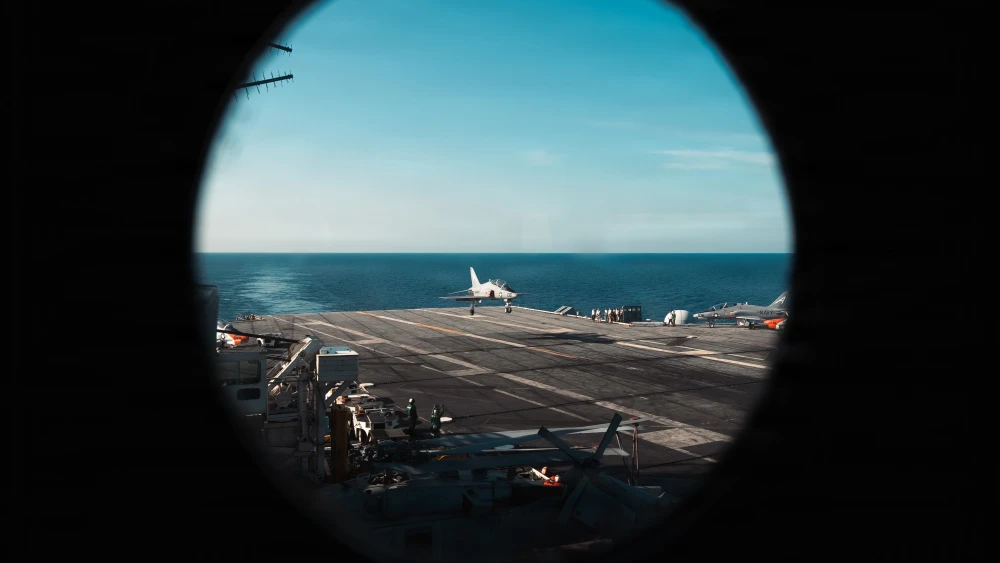
A U.S. Navy T-45C Goshawk jet trainer aircraft approaches the flight deck of Nimitz-class aircraft carrier USS Dwight D. Eisenhower, June 27, 2026. Credit: Mass Communication Specialist 2nd Class Miguel Santiago/U.S. Navy.
According to Navy Capt. Tim Hawkins, spokesman for U.S. Central Command, Iranian regime forces were seen readying to launch “rockets with sea mines into the strait,” the wire agency reported.
“U.S. forces took limited, precise action against IRGC minelaying forces posing an imminent threat in the Strait of Hormuz,” CENTCOM wrote on X. “In essence, Iran created the threat and the U.S. military eliminated it to protect civilian mariners, commercial shipping, and the free flow of global commerce.”
In response to the strikes, Iran’s Islamic Revolutionary Guard Corps fired ballistic missiles at U.S. bases in Jordan.
A Jordanian source told Amman’s official Petra News Agency that the military “successfully intercepted and destroyed” eight missiles that entered the kingdom’s airspace.
On Sunday night, U.S. President Donald Trump posted an AI-generated video depicting the destruction of Iran’s Kharg Island, writing, “Kharg Island being blown to smithereens!!!”
In peacetime, Kharg Island provides a port for the export of up to 90% of Iran’s oil.
In recent weeks, Trump has launched what said will be crippling economic sanctions on the regime. U.S. Treasury Secretary Scott Bessent last week announced “Operation Economic Outcast,” an expanded sanctions campaign aimed at cutting off what he called Iran’s remaining financial lifelines.
Bessent said Sunday that the Trump administration plans to sanction another bank this week as part of its campaign to clamp down on transactions involving Iran.
“This is going to be financial violence if we have to,” Bessent told AP. He said Washington would press its counterparts at G20 finance meetings in Asheville, N.C., to cooperate in isolating Iran.
Jason Brodsky, policy director at United Against Nuclear Iran, told JNS on Sunday that “today’s strike is a signal from the U.S. that it is not going to allow Iran to reverse the American gains in recent weeks over ensuring freedom of navigation in the Strait of Hormuz.
“It’s not a decisive shift to a new phase of the war,” he said. “Rather it is a reminder that the U.S. has the will to police the Strait of Hormuz. The Iranian retaliation was likely factored into U.S. planning.”
JNS asked whether the strikes surprised him. “I don’t think there were any true surprises,” he said.
Iranian Supreme Leader Mojtaba Khamenei on Sunday called the United States and Israel the “sworn enemies” of Muslim unity, accusing both countries of hostility toward the broader Muslim world.
“The criminal rulers of the U.S. and the illegitimate Zionist regime are the sworn enemies of this unity and friendship,” Khamenei said in a message marking Islamic Unity Week. He added that even rulers of Muslim countries considered allies of Washington and Jerusalem were not exempt from what he described as their hostility.
Iranian Foreign Minister Abbas Araghchi, meanwhile, said on Saturday that Tehran would not compromise on national security and warned that Iranian forces would “fight fire with fire,” reiterating that U.S. bases in the region could be targeted in response to attacks on the Islamic Republic, according to state propaganda outlet Press TV.
