


What you need to know about Macklemore and accusations of antisemitism
By SHIRA LI BARTOV
(JTA) — The last time Macklemore drew fire from the Jewish community for a controversial performance, he apologized, there was forgiveness — and the rapper asked fans to support the Anti-Defamation League.
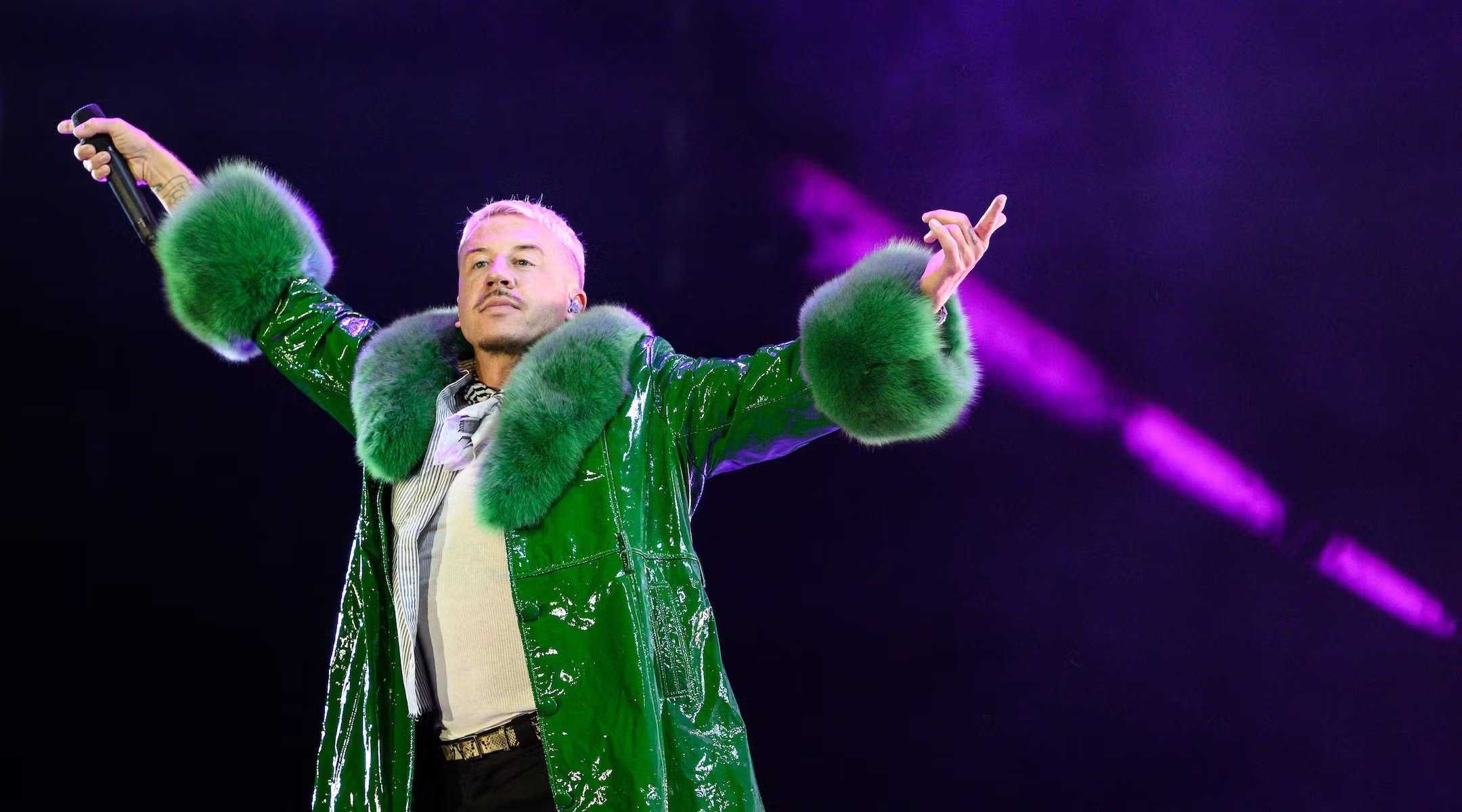
Rapper Benjamin Haggerty, known as Macklemore, performs at the Goldencoast Rap Festival in Corcelles-les-Monts, France, Aug. 30, 2026. (ARNAUD FINISTRE / AFP)
That was May 2014, when Macklemore wore an onstage costume featuring a large hooked prosthetic nose, black wig and bushy beard, prompting many commentators to say that he was indulging a Jewish stereotype.
Since then, the Gaza war has driven a deep chasm between Macklemore and Jewish pro-Israel advocates. Macklemore says that he is obligated to pro-Palestinian activism, while his critics say he that he crosses lines into antisemitism.
Macklemore is not apologizing for the pro-Palestinian comments that got him cancelled from opening for Ed Sheeran at stadiums, but doubling down, and has garnered support in the entertainment community. The ADL, a pro-Israel Jewish advocacy group, has called his actions “unacceptable.”
Robert Kraft, the pro-Israel billionaire who this week blocked Macklemore from playing at Gillette, the Boston area stadium he owns, appeared to reference the 2014 controversy in a statement about his decision. He said the rapper had “a broader history of antisemitic rhetoric and imagery.”
In 2014, Macklemore apologized for the costume that drew accusations of “Jewface,” saying that he intended to “surprise the people at the show with a random costume” and acknowledged that it could be “ascribed to a Jewish caricature.”
Abe Foxman, the late director of the ADL whose absolution once was the ticket for celebrities wanting out of pariah status, forgave the rapper. “We take him at his word that he did not have any ill intent and unreservedly accept his apology,” Foxman said at the time.
“Out of a negative can come a positive,” Macklemore said in his own 2014 statement. “Through this situation I’ve got hip to some incredible groups like the ADL and I encourage people to check the great work they, and others like them, do.”
Rapper Macklemore's 'anti-Semitic Jewish costume' sparks renewed fury pic.twitter.com/GO8yn4rHN1
— Daily Mail (@DailyMail) September 17, 2026
The war launched by Hamas on Oct. 7, 2023, and Israel’s destruction in Gaza, spurred Macklemore to pro-Palestinian advocacy.
Almost exactly 10 years after the costume incident, in May 2024, Macklemore released his song “Hind’s Hall.” It was named for Columbia University’s Hamilton Hall, which pro-Palestinian protesters renamed for Hind Rajab, a Palestinian girl who was killed by the Israeli military in Gaza.
Released at the height of the pro-Palestinian college campus movement, the track praised student protesters and denounced former president Joe Biden’s military support for Israel along with the American Israel Public Affairs Committee, a pro-Israel lobby.
The lyrics also dismissed accusations of antisemitism against Israel critics, saying that “lies” claimed “it’s antisemitic to be anti-Zionist” and lauding the “Jewish brothers and sisters” who stood in solidarity with Palestinians.
The Jewish reggae singer Matisyahu told TMZ at the time that he believed the song invoked stereotypes about Jewish people controlling the world.
Since then, Macklemore has repeatedly come under fire from high-profile Jewish and pro-Israel figures for accusing Israel of genocide and apartheid.
The criticism followed him abroad. In June 2024, he said to an audience in Germany’s western city of Mönchengladbach that “there will never be reparations” for the Holocaust, but “the only way that we can atone for our past is by today standing up against apartheid, against occupation, against genocide, for a free Palestine.”
The Central Council of Jews in Germany, the country’s umbrella Jewish organization, condemned Macklemore’s invitation the following year to Germany’s Deichbrand Festival, saying it signaled that “antisemitism is welcome on the big stage” and the festival was “no longer a safe place for Jews.”
In February 2025, Macklemore released a follow-up to “Hind’s Hall” called “F—ed up.” The song celebrated protests against President Donald Trump, his then-adviser Elon Musk and Israeli Prime Minister Benjamin Netanyahu. The lyrics also drew a connection between U.S. military aid to Israel and income inequality at home, saying, “Killin’ Palestinian kids and we gettin’ hit with the cost / “Why the f— you think you can’t afford the rent in your building?”
In the music video, one frame juxtaposed a photo of a Palestinian child in the West Bank city of Jenin with an infamous Holocaust image of a child raising his hands in the Warsaw Ghetto.
David Draiman, the frontman of the band Disturbed and a vocal supporter of Israel, said on X after the release of “F—ed up” that his fellow Jews were “noticeably absent during this explosion of antisemitism.”
But after Macklemore repeated his views this month to some of the largest crowds of his career, the backlash was fiercer. Opening for Sheeran at New Jersey’s MetLife stadium, Macklemore performed “Hind’s Hall” and declared the phrase “Free Palestine” while displaying images of Gaza.
Once again, he also sought to distinguish his criticism of Israel from antisemitism. “To all of my Jewish brothers and sisters: Criticism of Israel, criticism of apartheid, being against genocide in no way is a criticism of you,” Macklemore said on stage.
Macklemore announced online that Kraft ultimately barred him from performing at Gillette and rallied other stadium owners to boycott, telling Sheeran that he could not play in their venues if Macklemore remained on the tour.
Kraft acknowledged the decision, saying in a statement that Mackemore had advanced “divisiveness and hate” by “only sharing selective information and ignoring the actions of Hamas.”
“Much of my time and attention for the last decade has been focused on the fight against antisemitism and hate of all kinds, and I feel a responsibility to stand up when I believe that line has been crossed,” said Kraft.
Jewish figures including the singer Pink and Barstool Sports mogul Dave Portnoy criticized Macklemore or defended Kraft’s decision. The move was also celebrated by the Israeli-American Council, which petitioned Sheeran to drop Macklemore.
But Macklemore, this time around, is hardly a pariah. Sheeran’s remaining opening acts quit in support of him. He was backed outside of the music world by Vermont Sen. Bernie Sanders and New York Rep. Alexandria Ocasio-Cortez, two of the nation’s foremost progressives.
The ADL, now far from pardoning Macklemore, accused him of “performative, biased and hateful anti-Israel ‘activism.’”
“This isn’t new for Macklemore,” the group said on X. “He has a record of demonizing Israel and Israelis, falsely accusing Israel of genocide and engaging in antisemitic rhetoric and behavior.”
