


Cowen reflects on tenure as Tulane president
By ALAN SMASON, Exclusive to the CCJN
When Scott Cowen presided over his final Tulane University commencement on Saturday, May 17, at the Mercedes-Benz Superdome, it signaled the end of an era and the beginning of a new one for the private educational institution founded in 1834.

Tulane University president Scott Cowen in his Gibson Hall office. (Photo by Alan Smason)
Moreso, it signaled a new chapter in the life of the man who has served as the 14th president of Tulane University and, arguably, the university’s most pivotal leader.
In his new book “The Inevitable City: The Resurgence of New Orleans and the Future of Urban America” (Palgrave Macmillan) to be released on June 10, Cowen recounts many of the onerous decisions he made to keep Tulane University intact and to aid in the city’s recovery efforts following the destruction associated with Hurricane Katrina’s landfall in August, 2005.
Soon after reaching out to sister institutions across the nation, Cowen announced an unprecedented program that would allow all Tulane students to continue their studies elsewhere about the nation where they were dispersed, while the Uptown campus infrastructure and downtown medical complex were made ready to reopen in winter. In all, Tulane experienced $650 million of losses directly attributed to damage from the storm and related flooding.
Cowen’s decisions made in concert with his handful of dispersed administrators flung in far off Houston forever changed the face of the now 180-year-old institution. He eliminated the costly electrical, civil and environmental, and mechanical engineering departments and combined other departments into the School of Science and Engineering; merged the formerly separate Newcomb College and Tulane College of Arts and Sciences into the Newcomb-Tulane College; scrubbed one-third of the doctoral programs on campus and suspended half of the athletic programs.
Another judgment call was the elimination of several faculty positions at the renowned research university. Those that stayed behind or moved back to New Orleans needed housing while their homes were being rehabbed. Under the helm of Cowen’s leadership, Tulane made the unusual decision to rent a cruise ship to house faculty and staff members in the interim.
Recovering from the storm’s fallout, faculty and staff at Tulane and sister institutions like Dillard University and Xavier University needed a charter school to fulfill the needs of their children’s education. Prior to the storm, the contentious Orleans Parish School Board denied a request to charter a school to Tulane. Using a velvet glove in an iron fist bargaining style, Cowen gave the same board a 24-hour deadline and a $2 million offer on the post-Katrina table.
This time, the cash-strapped board readily approved the charter. That resulted in the creation of the Robert Mills Lusher High School on the campus of the former Alcee Fortier High School.
It’s exactly that kind of outside-of-the-box thinking that has marked Cowen’s career as a Tulane University president and, prior to that, as a professor and dean at the Weatherhead School of Management at Case Western Reserve University.
Time Magazine hailed him one of the Top Ten Best College presidents in the nation and his leadership skills have made him one of the most recognized voices in matters of higher education and urban recovery. He has accepted presidential appointments and chaired a number of esteemed academic bodies, all the while keeping in demand and busily serving on a multitude of prominent academic and civic committees.
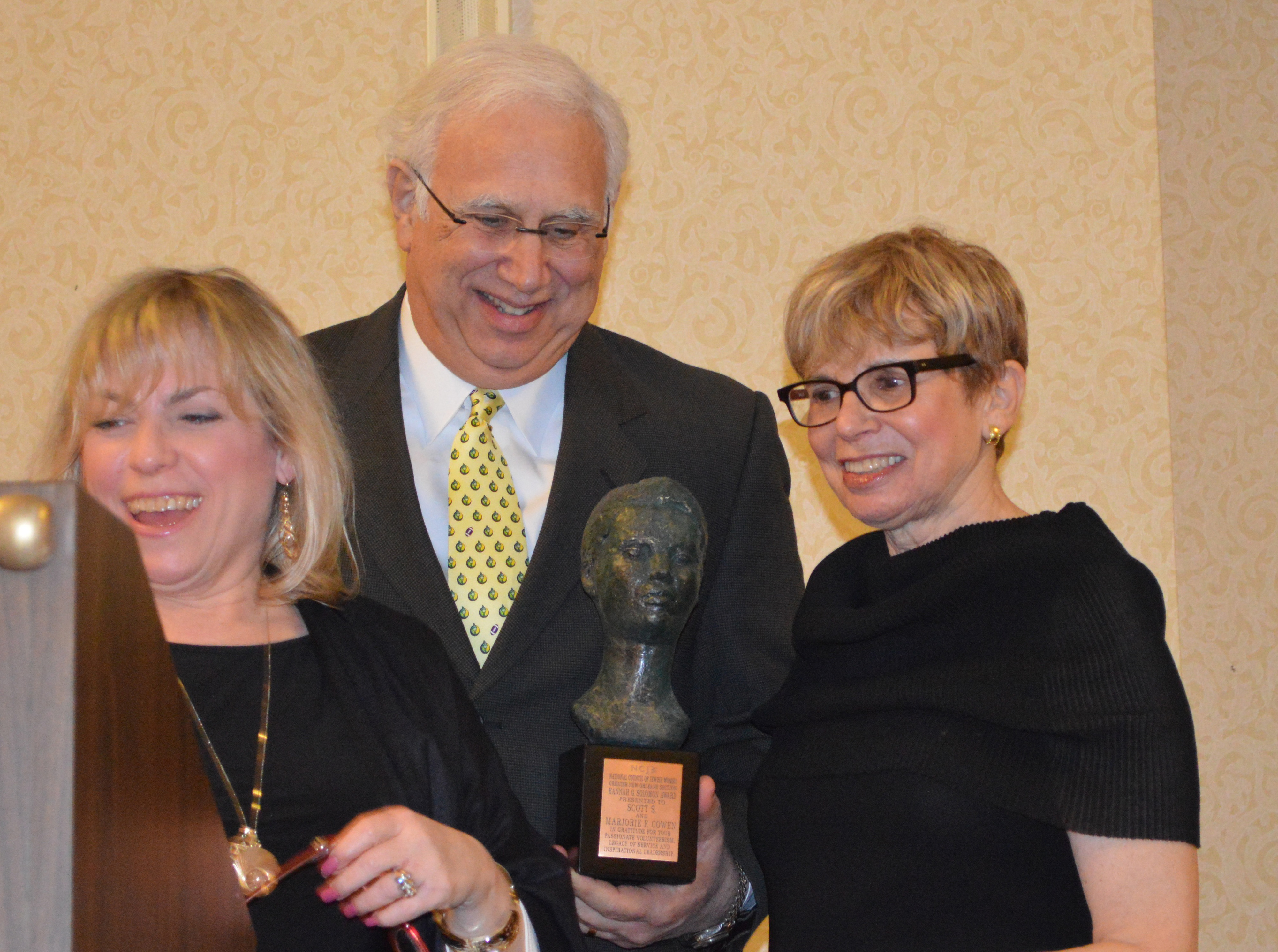
Scott Cowen, center, and wife Marjorie, right, accept the 2014 Hannah Solomon Award at the NCJW luncheon. (Photo by Karen Lozinski)
Cowen has received numerous citations and awards from being named a recipient of the Times-Picayune’s Loving Cup Award to his selection of Gambit Magazine’s “Man of the Year” in 2010 and the Hannah Solomon Award from the National Council of Jewish Women, which he received earlier this year along with his wife Marjorie.
Yet, as happy as the twinkle in his eye indicates he is, Cowen admits Hurricane Katrina, the $700 million rebuilding effort, the mobilization to increase the endowment to over $1.2 billion and the need to captain both the university’s and city’s recovery forever altered his original plan to retire within ten years of accepting the presidency.
“When I came in 1998, I told the Board (of Administrators) I would serve ten years,” he recalled. “So, therefore, it was my view that I would step down in 2008.”
But the intersection with Hurricane Katrina and the associated citywide flooding caused Cowen to rethink his retirement plans. With all that had to be done, he knew he could not turn over the Tulane presidency to anyone else. Also, it was important to make certain that when he did retire, the timing would be right. “I would peg my ultimate retirement from the presidency when I felt we were far enough behind Katrina and that the university would be on a very sound foundation and, therefore, my successor could build on that foundation,” he stated.
That successor, professor Michael Fitts of the Ivy League’s University of Pennsylvania, was announced earlier this year. He’ll take over as Tulane’s 15th president when Cowen steps down on July 1 after 16 years of service.
“If Katina had not happened, the university wouldn’t have gone through this tremendous transformation,” he averred. “I do believe the university is better and stronger for having gone through that transformation.”
Cowen also mused that a 16-year-long presidency will be highly unlikely in the future due to a number of factors. By the time a president at a research institution like Tulane hits his 10-year mark, Cowen suggested, he has either created his own programs or else could not solve the problems. In either case, it would be time for a transition.
Suppose Katrina had not happened and he was on target to retire 2008. What would he claim was his greatest accomplishment at that juncture?
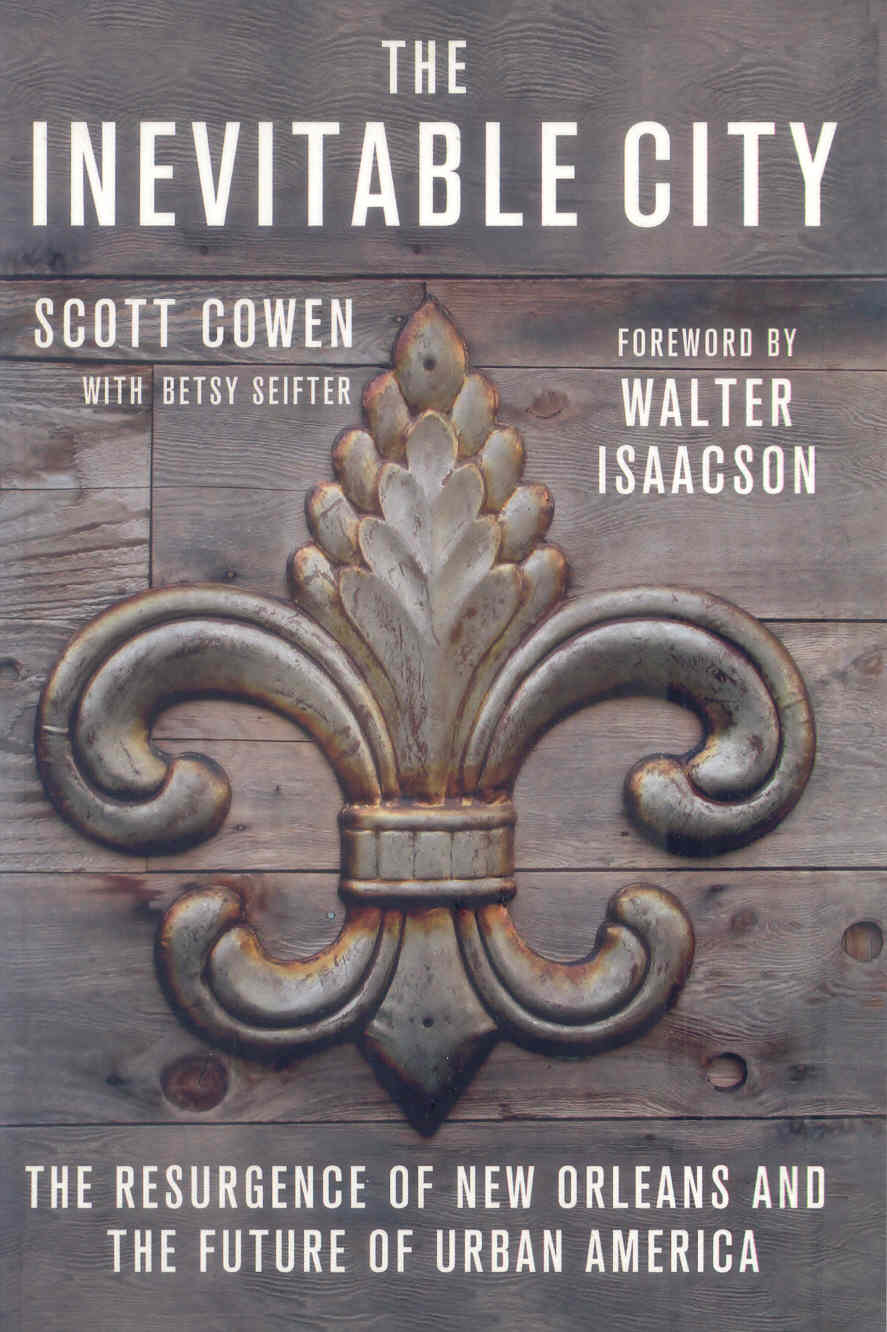
Cowen's new book with a forward by Walter Issacson is set for a June 10 release. (Cover: Palgrave Macmillan)
“I would say that at that moment in time, we had put together a fairly ambitious plan in 2000, substantially increasing the quality of the undergraduate body in terms of their SAT scores and selectivity,” he boasted. “The second thing would probably have been the very successful completion of a capital campaign that had started out at $550 million and ended up being 700 million.”
But, speculation aside, the unthinkable did occur. Just as was the case with Tulane, a post-Katrina city of New Orleans has also been transformed and Cowen had been one of its most important architects.
In the midst of strife, New Orleans endeared itself to the Cowens. “Most of all is this: we really admired their resilience and grit after Katrina. This is a city that people could have given up on. And I really respect people, who in the face of adversity, continued to fight for what they believed and they accomplished a lot in the last nine years,” he beamed.
“It’s a very iconic city. It’s the only city I know of that can claim its own language, its own music and its own architecture,” he continued. “I like how unusual it is and how unique and special it is. The second thing I really enjoy is the people here. They have this wonderful blend about living in New Orleans and about the South. I find them to be open and gregarious.”
When Cowen announced his decision to step down, speculation ran rampant that he might be leaving New Orleans for greener pastures. Those rumors were shot down quickly as the Cowens let others know they were putting down their roots in New Orleans for good. Although they will still maintain separate residences in Cleveland and on the eastern end of Long Island in New York, the Cowens will be living in a downtown condominium on the riverfront.
In his foreword to the book, Walter Issacson descibes Cowen as “the greatest leader” in post-Katrina New Orleans. Cowen dismisses the compliment from the renowned biographer (“Stephen Jobs,” “Benjamin Franklin” and “Albert Einstein”) as “hyperbole and exaggeration.”
Yet, Cowen knew Issacson, a native New Orleanian and former Times-Picayune and CNN CEO, was in a unique position to comment on his work. “I thought it was very important,” Cowen explained. “First off, he’s a good friend. He co-chaired the Louisiana Recovery Authority and, of course, he’s a well-known name. He read the book and put it in into context and was able to relate as to what is happening with the city.”
The book is a road map for recovery from disasters and how to apply vision to reshaping the future of America’s decaying urban areas.
Cowen was humble when asked to evaluate his legacy. “I think I’ll let historians write about my legacy,” he said, pondering two points. “(First,) I’m most proud of the way we rebounded from Katrina and the second is the culture of engagement.”
Part of that engagement is shown in Cowen’s establishment of the Center for Public Service at Tulane University, which requires public service hours from students for graduation. The recent “Cowen Service Challenge” netted 750,000 service hours in 250 days by Tulane students, faculty staff and alumni. Other colleges and universities have paid attention to the program at Tulane, but have made student service hours voluntary. “We’re still the only major university that integrates it into the core curriculum,” he pointed out.
“My view is that our job is to develop the next generation of engaged leaders in the world, so a lot of what we do is to get them to understand what leadership is about,” he continued. Programs like these reinforce the goal for them to be engaged as leaders and citizens, he affirmed.
He does not believe he would second guess himself. Cowen said for the record that everything he did, even when alumni were unhappy, was required and borne out by experience as absolutely necessary.
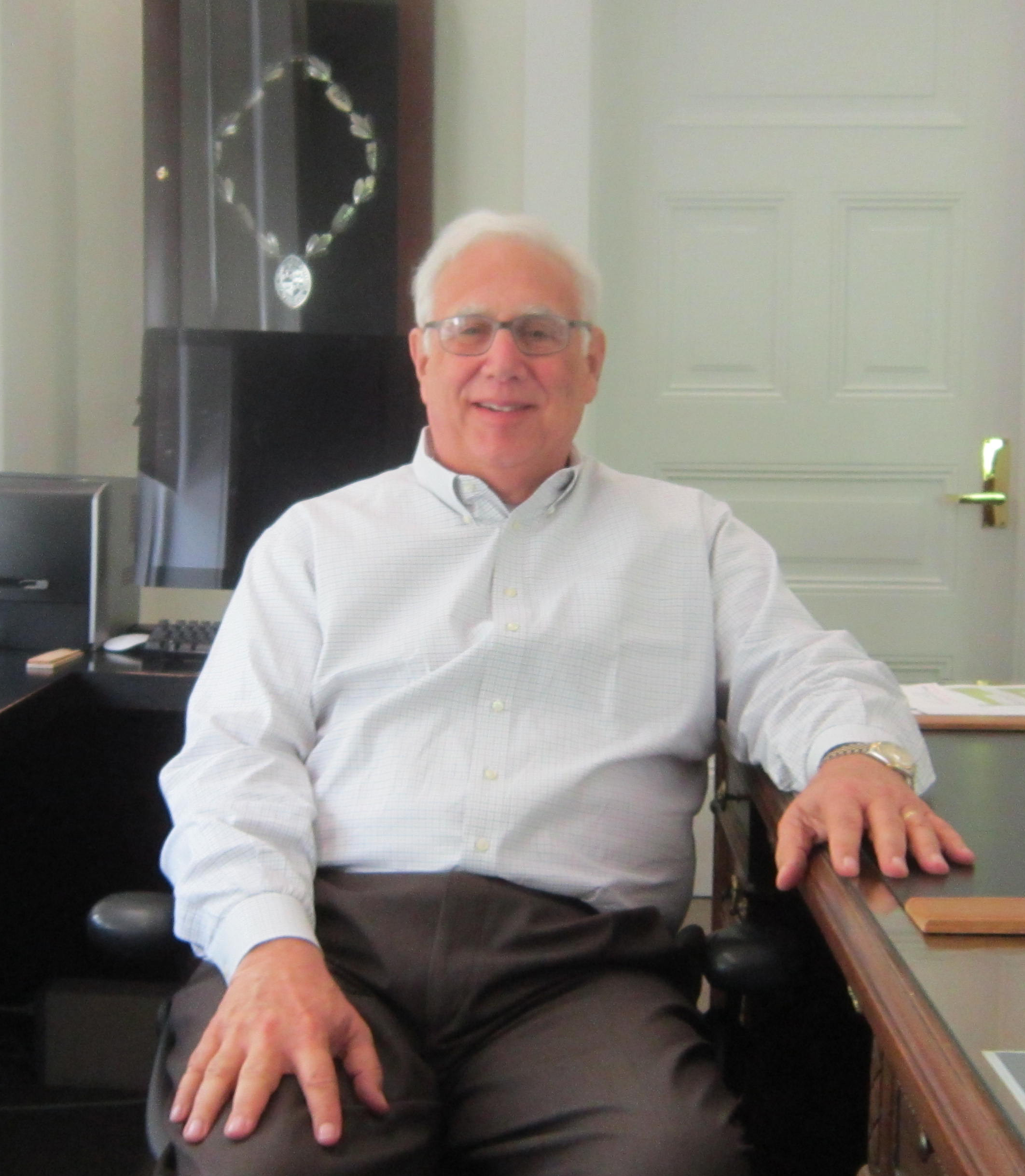
Scott Cowen in the president's office at Tulane University. (Photo by Alan Smason)
Carried along by word of mouth, Jewish student enrollment, which had traditionally been high at 26-27%, reached new heights under Cowen into the mid-30% range. “After Yeshiva (University) and Brandeis (University), we have the highest of Jewish students on the undergraduate level,” he acknowledged.
The Rohr Chabad Student Center, the Goldie and Morris Mintz Hillel Student Center and the development of a Jewish Studies Department and a building dedicated to it were all constructed during Cowen’s tenure.
The Hillel Center, which also houses a kosher kitchen, is an actual academic building attached to Tulane as part of its curricula offerings. Cowen said he was pleased with the collaboration between Rabbi Yonah Schiller at Hillel and Tulane officials, calling it “a very close, symbiotic relationship” similar to one put in place at Tufts University. The fact that non-Jewish students will be using the building for their classwork is also important to both Schiller and Cowen.
As to the rise in influence of Chabad at Tulane, Cowen also expressed a deep appreciation for them. “They play another very important role obviously for more Conservative or Orthodox students. I think it’s important we have Chabad here. I like what we’re doing,” he mused.
Although Cowen is a member of Touro Synagogue, he said he has been far too busy to be engaged as a Jewish community member on the scale he and his wife had been when they lived in Cleveland. Yet they are connected to the Jewish community in other ways.
“The most important part is I believe in tikun olam. I am very connected through my basic beliefs in Judaism,” he continued. “But that’s what is, in fact, my involvement. All of that was ingrained in my years in Cleveland.”
While Cowen may be stepping down, he will still be maintaining a busy schedule at Tulane tending to his non-profit Cowen Institute for Public Education and teaching classes at the A. B. Freeman School of Business. He will also be consulting to a number of non-profits across the nation and has plans to write and release yet another book.
Meanwhile, he is preparing for a number of local and national book signings once the book hits retailer’s shelves in he coming weeks. He acknowledges the work of Betsy Seifter and Heide Winston for their many contributions to “The Inevitable City,” the title of which was suggested to him by the publisher, but which he grew to love. “Heide really has been the lead person on the fact checking and all the notes and professional researching,” he noted. “Betsy has been with me in the writing and helped with some of the basic research topics.”
(Editor’s note: Cowen will be making an appearance on WYES-TV’s “Steppin’ Out” program on Friday, June 6 in advance of the book’s distribution the next week.)
