


ADL honors Glaser, Gershaniks & Boyle
By DEAN M. SHAPIRO, Special to the CCJN
A century after its founding in Atlanta, the Anti-Defamation League’s (ADL) South-Central Regional Office honored four of its own at a special awards dinner at the Hyatt Regency Hotel Grand Ballroom on Thursday evening, December 5.
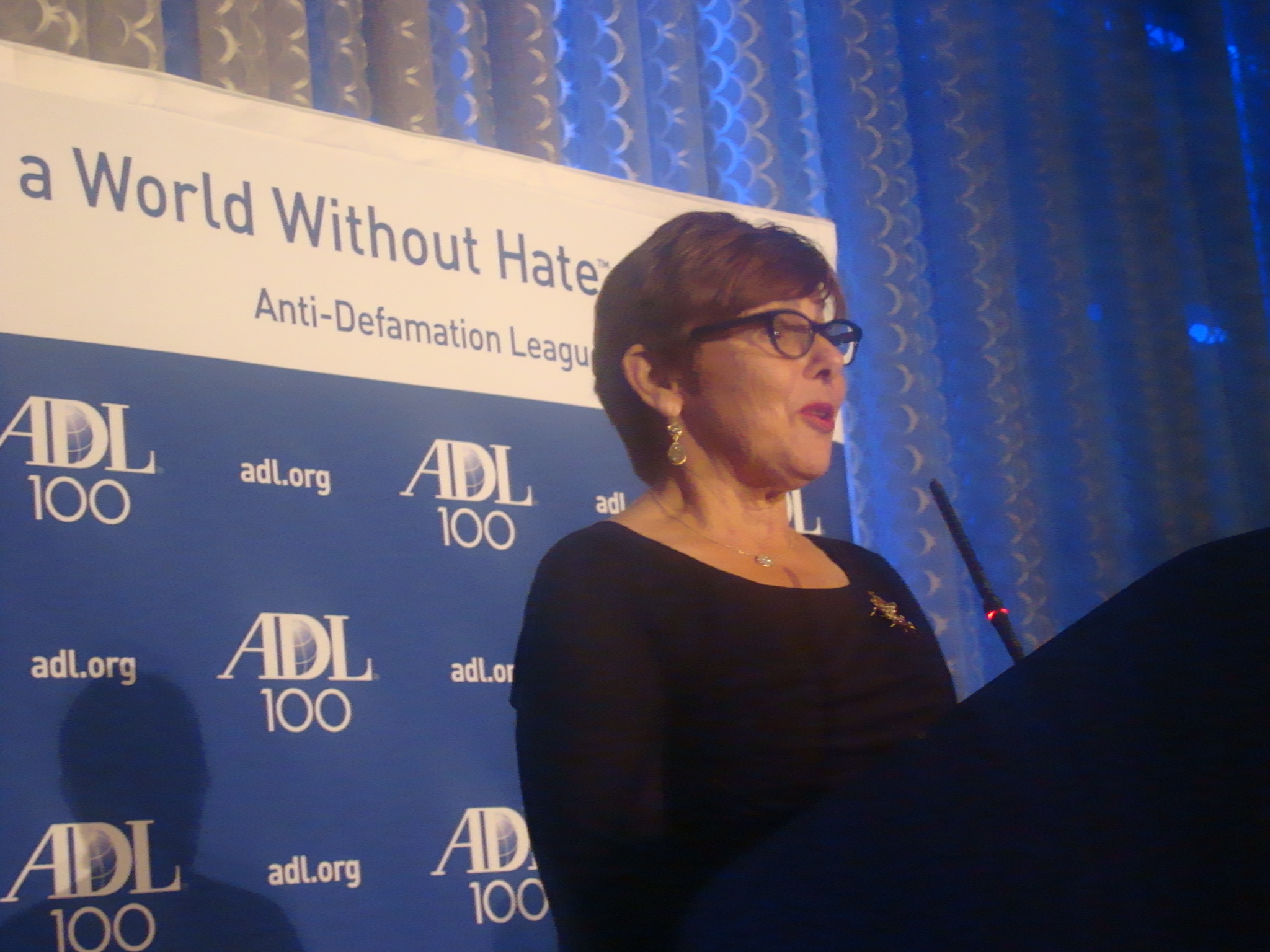
Former ADL South-Central Region director Cathy Glaser accepts a special award for her years of service combatting prejudice and hate at the Torch of Liberty Dinner on December 5. (Photo by Dean Shapiro)
Selected to receive the prestigious A.I. Botnick Torch of Liberty Awards for 2013 were New Orleans attorney Kim Boyle and Dr. Juan and Ana Gershanik. Cathy Glaser, who retired as the community director of the ADL’s South-Central Regional Office this summer, was recognized with a special award for her many years of service.
The theme of the evening’s presentations was “ADL 100: Imagine a World Without Hate.”
The evening began with a film showing the early years of the ADL, which was founded in 1913 in response to the anti-Semitism surrounding the murder trial of Leo Frank, a Jewish factory supervisor in Atlanta. Frank was convicted of raping and murdering a young female employee, Mary Phagan, even though evidence arose that suggested another worker was guilty of the crime.
Following the exhaustion of his appeals, the governor commuted Frank’s sentence to life in prison to great public outcry. Frank was later kidnapped from his prison cell by a vigilante mob of prominent citizens and lynched in nearby Marietta in 1915 . No one was ever indicted or charged with the crime. This was the crucible under which the ADL was born.
Several speakers also praised the work of South African anti-apartheid leader Nelson Mandela who had passed away earlier the same day.
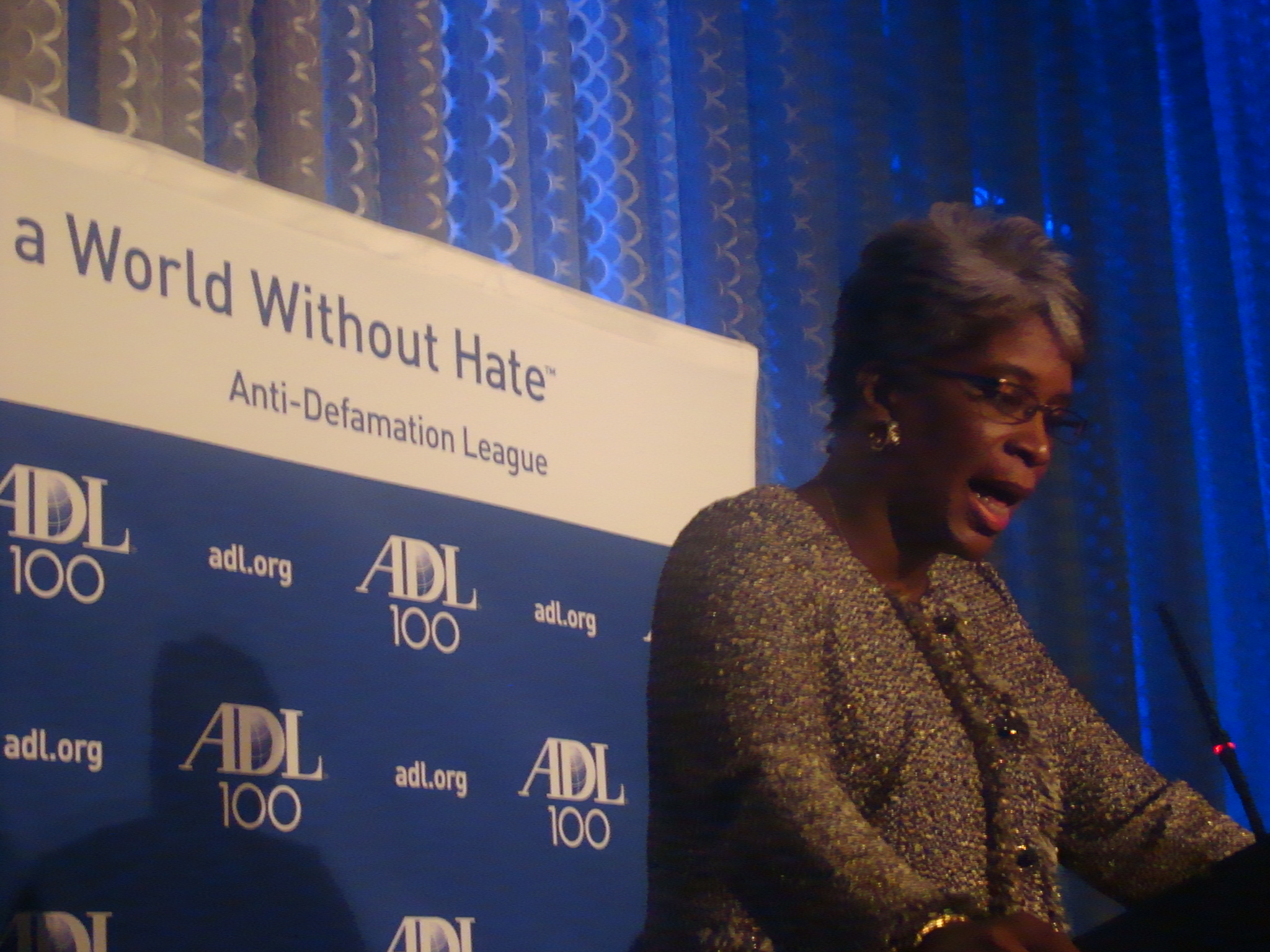
Kim Boyle accepts A.I. Botnick Torch of Liberty Award at the Hyatt Regency Hotel on December 5, 2013. (Photo by Dean Shapiro)
Included in that number was Boyle, who expressed humility and honor at being selected to received the ADL’s highest honor. “I am truly honored, privileged and humbled to be here tonight receiving this award and to be recognized in the company of the Gershaniks and Cathy Glaser.”
Boyle also paid tribute to the award’s namesake, Adolph Ira (A.I.) Botnick, a longtime ADL leader from the New Orleans area who passed away in 1995. She also praised African-American civil rights leaders Dr. Martin Luther King Jr., A. Philip Randolph, Thurgood Marshall “and many others who followed in their footsteps.”
Even, in 2013, the struggle for the ADL is ongoing, Boyle acknowledged. “The challenge appears so simple, yet is so difficult to put into practice in the troubling times in which we live, she said. “That challenge is to ensure justice and fair treatment to all citizens alike.”
Boyle singled out Botnick, who persevered in his fight against hate, despite many threats against his life. “The fight for true justice and equality continues,” she continued. “Despite the threats to his life, he persisted. We hear hope and optimism in his statements that things would get better for the next generation.”
Boyle also expressed dismay that some of the progress achieved for equal opportunity to all may be undergoing revision and that public discourse has been much more strident. “Many of the hard-fought gains of the civil rights movement appear to be eradicated.,” she bemoaned.
“Legislative bodies and courts are dismantling the legal mechanisms that were fought for and won with blood, sweat and tears by thousands and thousands of dedicated people. The fight isn’t just about doing what is legal, but also what is morally just and what’s morally right.”
In accepting their award, the Gershaniks spoke separately about the struggles they went through as they left their native Argentina following a military coup in the mid-1960s. For several years they moved around the South, from Miami to Lexington, to Kentucky, then to Charleston, then Shreveport and, finally, New Orleans. In every locale, they got involved in the local Jewish communities and they spoke out against discrimination whenever they witnessed or experienced it.
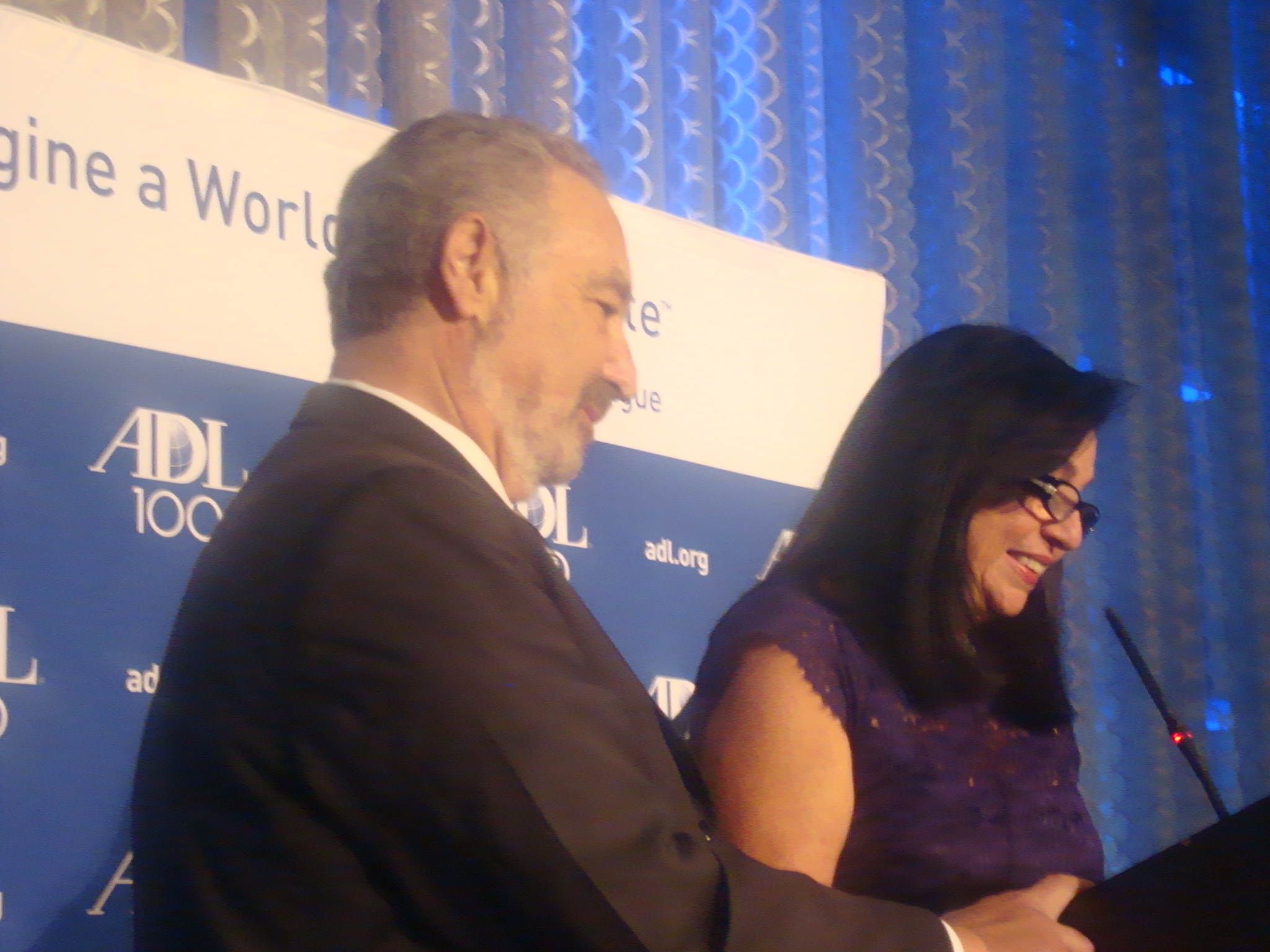
Juan Gershanik and wife Ana accept their award at the ADL Torch of Liberty dinner. (Photo by Dean Shapiro)
Ana, particularly, was active in trying to help resettle Jewish refugees from the former Soviet Union and the “Marielitos” who came to the U.S. from Cuba in small boats.
For the past 24 years she has written her “Nuestro Pueblo” (Our City) column for the Times-Picayune newspaper, citing the accomplishments and contributions of the local Latino community. In addition, the two of them continue to fight for comprehensive immigration reform and for programs encouraging students to stay away from violence and drugs.
In her brief acceptance speech, Ana spoke about the examples set by her parents and her grandfather in her native Rosario, Argentina. “My grandfather was among the pillars of the Jewish community in Rosario when I was growing up. He instilled in me at an early age the values of equality for all and always standing up to defend those whose rights were violated,” she said.
Gershanik said she followed his example by taking part in protests and marches set up to call attention to discrimination. “I marched against government oppression and discrimination in Argentina. My role models growing up were Martin Luther King, Jr., Gandhi, and the Kennedys. It was not surprising that, at 16, I fell in love with someone who shared the same passion for equal rights as I did. And that’s the guy standing next to me,” she said, pointing to her husband.
She added that the struggle is still not over and that everyone needs to be watchful and vigilant. “It is with great humility, emotion and pride that Juan and I accept the Torch of Liberty award. Muchas gracias!” she concluded.
The evening’s highlight was the presentation of a special award to Cathy Glaser who took the helm of the regional office shortly after 9/11 and stepped down this past June.
Glaser’s replacement, Talora Gross, departed her position at the beginning of November. Joshua Force, the ADL Board chairman, declined to comment on Gross’ “departure” other than to state it was not a termination and that a committee had been formed to seek out a new South-Central Region director.
 Following a standing ovation, Glaser began her acceptance speech by praising her predecessors, Botnick and Jerry Himmelstein, as well as number of other community leaders she has worked with over the years. “In the wake of Katrina, we realized the legacy of this organization had to be focused on education,” Glaser began. “Anti-Semites, racists and bigots are not born, they are made; and the antidote against prejudice and hatred in all of its forms is education. Everyone has to do their part to show we can change hearts and minds one person at a time,” she said.
“ADL has given to me this opportunity to give back to the community,” Glaser went on. “The ADL hat is not one you put on in the morning and take off at 5:00 in the afternoon. Hate has no time limits. It doesn’t sleep at night. When something happens, you have to be ready. It is a 24/7 experience,” she said.
Glaser admitted that her work with the ADL became both her personal and professional identity. “I’ve had my struggles and my challenges. Katrina and 9/11 had tremendous impact on all of us to such a degree,” she admitted. “Anti-Semitism is not a history lesson but still a current event.
We can take tremendous pride in our civil rights agenda and our ability to address and confront First Amendment legal issues and in particular, those that cover separation of church and state.”
She acknowledged she has become an expert in recognizing hate, prejudice and discrimination. “Over the years I’ve learned more than I ever wanted to know about hate groups, extremists and their ideologies. We must move people from being bystanders to allies and confronters in the fight against hate,” she added.
In calling up the imagery of the Shoah, Glaser looked to the ADL’s powerful record in assembling eyewitness accounts as lessons for generations to come. “Testimonies of Holocaust survivors are the most powerful tools in teaching respect and understanding to students so they can say, ‘Never again!'” she said.
“I also learned about Southern Jewry and what a great treasure it is. And what this office has accomplished since it was established in the early 1950s. But we were only able to do what we do because we stand on the shoulders of great leaders. I am a better person for having had the great privilege of serving and working with all of you,” Glaser concluded.
