


Somerville city council votes to divest from Israel
By GAVI KLEIN
(JTA) — SOMERVILLE, Mass. — The City Council in this city north of Boston voted 10-1 Thursday night to ban the municipality from doing business with companies complicit in humanitarian violations, specifically naming those operating in “Israel and Palestine.”
Councilor Kristen Strezo cast the only opposing vote on the 11-member board.
 Opponents of the ordinance fear that in execution it would be akin to a boycott of Israel, and as such would create a negative environment for the city’s Jewish and Israeli residents. The ban only involves companies that work with the municipality and does not impact companies that operate privately in Somerville. It also excludes sole proprietors (individuals operating as companies).
Somerville Mayor Jake Wilson’s office said given that the ordinance passed with a veto-proof majority, the measure is now considered final.
The ordinance was originally introduced in June by Councilors Ben Ewen-Campen and Ben Wheeler, after the City Council voted in November 2025 to implement ballot Question 3 on Israel divestment, which had been approved by 55.7% of voters earlier that month. Question 3 spoke of banning businesses that sustain “Israel’s apartheid, genocide, and illegal occupation of Palestine.”
During his campaign in 2025, Wilson did not endorse Question 3.
Nine councilors on Thursday night offered comments in advance of the vote.
Ewen-Campen, who wrote and revised the ordinance along with Wheeler, spoke about the importance of a Massachusetts city passing an ordinance about a country across the world, especially at a time when the federal government has clamped down on pro-Palestinian student protesters, noting two incidents of protesters being detained by ICE allegedly for speaking against Israel.
“I think the reason that people want us to be quiet about it is because when you do talk about it, there is just no way to justify it,” Ewen-Campen said.
“I am not under any illusion that Somerville is going to have some enormous impact on the world [by passing this ordinance], but I do think that all of us collectively deciding to be silent about this does have an impact on the world,” he said. “That is why I think it is worth it to have taken this action, and that is why I have asked for all of your support tonight.”
Strezo invoked the Holocaust to explain why she considered the ban antisemitic, referring to Kristallnacht, the Nov. 9-10, 1938, pogrom against Jews in Germany and Austria.
“A few years before Kristallnacht, the Nazis worked to deter the public from shopping at Jewish businesses,” she said. “Their efforts started in moments like tonight.” On behalf of her Jewish community, Strezo emphasized that the ordinance “makes us feel targeted. It makes us feel unsafe. It makes us feel unwelcome.”
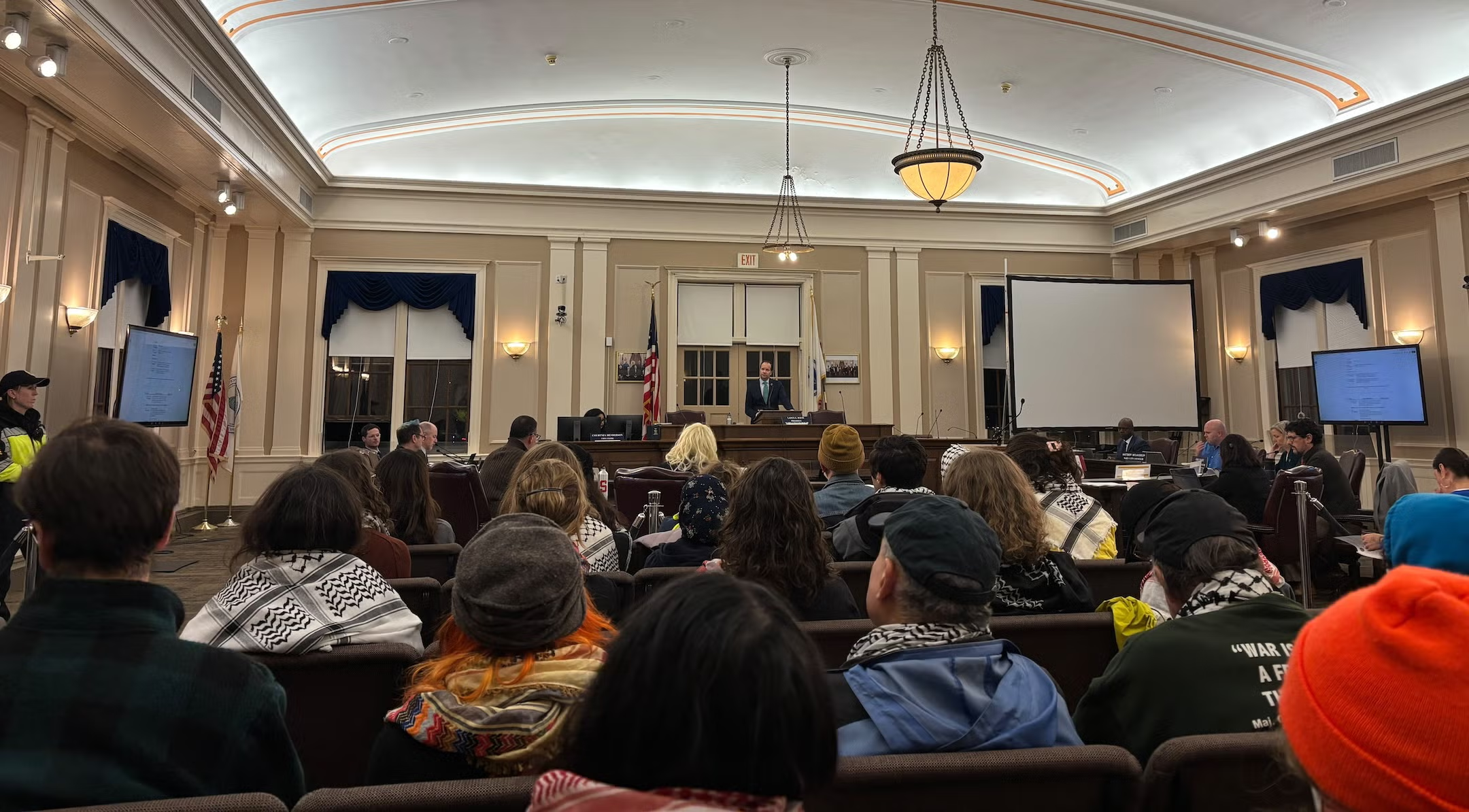
As she spoke, members of the group Somerville for Palestine (S4P), who had gathered outside City Hall for a rally in advance of and throughout the meeting, could be heard through the window, the chanting getting increasingly louder until the words were clearly audible over Strezo’s speech: “Disclose, divest, we will not stop, we will not rest.”
“This ordinance will do nothing to solve the real conflict in the Middle East,” Strezo said. “What it will do and has been doing is make Jewish people and Israelis feel less welcome in our city spaces.”
One councilor pointed out that the ordinance, while worth passing, was not what she’d hoped. Councilor Emily Hardt said, “Supporting Palestinian human rights and standing firmly against antisemitism are not contradictory positions. I believe that both are essential to our commitment to human dignity.” She went on to say that she would have preferred an ordinance that was focused on the actions of the U.S. government, “our government,” but given that this was the ordinance up for the vote, she would support it. “I appreciate the attempts to align use of our resources with our commitments to the rights and dignity of all people, in Israel and Palestine and around the world,” she said.
When the vote was finalized, members of the group Somerville for Palestine and other supporters of the ordinance, many wearing keffiyehs, stood up and cheered as they left the chamber. Shalom Somerville members and others opposing the ordinance, many of whom wore white shirts with blue square pins and had stickers with “I’m not welcome here” on their chests, stood silently as most of the room emptied.
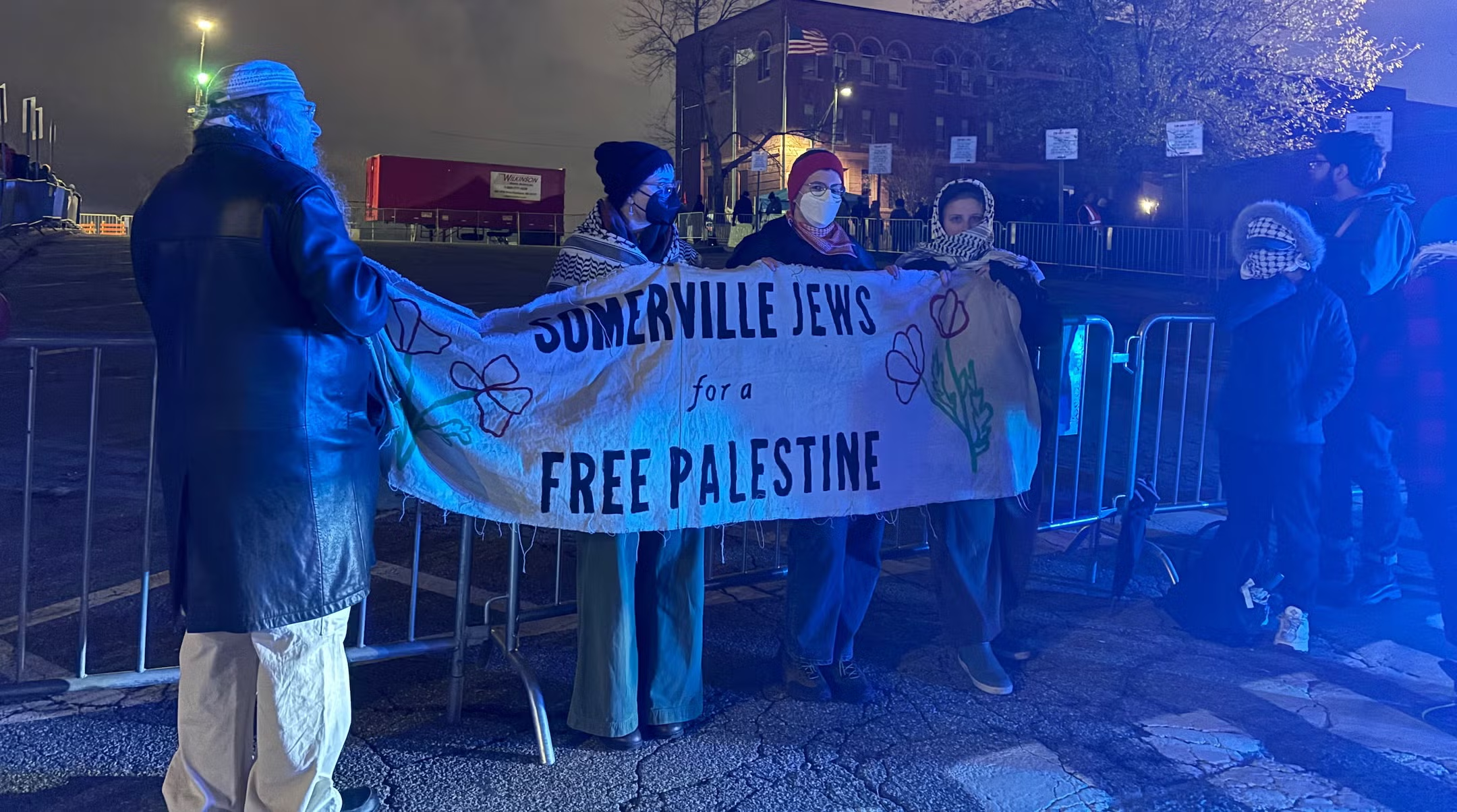
Activists from the group Somerville for Palestine hold a small protest outside City Hall, Somerville, Mass., Nov. 12, 2026. (Photo by Gavi Klein)
“It’s disappointing seeing councilors knowingly abdicating their responsibility,” said Sam Gechter, president of Shalom Somerville, the local community group that has been active in opposing both the 2025 ballot question and the ordinance. “[Mayor Wilson] made several promises that he would veto it during the campaign. He said he would veto anything that named a country, so we would love to see him do that.”
“It feels so clear that this is what the majority want given that ten of our councilors voted yes,” said Mo Katz-Christy, a member of S4P’s leadership and Jewish Caucus. S4P was a major advocate for the original ballot Question 3 and worked with Councilor Ewen-Campen on the ordinance.
“They passed a strong ordinance that named Israel and Palestine, that named the genocide,” Katz-Christy said, as the S4P group played music in celebration behind them. “It’s targeting companies that are really bad actors.”
Under the ordinance, any vendor who is submitting a bid for the city’s business would have to certify it meets the criteria outlined in the ordinance. If their certification is contested, the city will consult the findings of a number of international organizations and lists, including the database of business enterprises maintained by the United Nations Office of the High Commissioner for Human Rights, and the divestment short-list database maintained by the American Friends Service Committee’s Investigate Project. The ordinance specifies that a company could be excluded from this prohibition should the director of finance deem that their services “are essential to the operation of the city, including by avoiding a significant financial burden.”
In the final Legislative Matters Committee meeting discussing the ordinance on Oct. 27, chief procurement officer Angela Allen, echoing the earlier sentiments of City Solicitor Cindy Amara, expressed concerns that the ordinance “would likely not sustain a legal challenge.” She noted that the city does not have the legal authority to debar bidders (prospective vendors) and that she was unsure who would be responsible for making the final call on whether or not a company met the criteria in the ordinance.
“This adds another layer of complexity that I am concerned, from a practical standpoint, could cause confusion and delay that would not be in the best interest of the city,” she said.
The vote came after several rounds of negotiations in the city’s Legislative Matters Committee, during which councilors debated the ethical and financial merits of the ordinance. The final ordinance that was voted on included updates in language that specified the companies that would be included in the ban must be “directly, knowingly and consistently” enabling or facilitating violations of humanitarian law, including in “Israel and Palestine.”
Longtime Somerville resident and Shalom Somerville member Kate Auspitz, who was present at the meeting, said, “I will never vote for any of them [city councilors] again except for Kristen Strezo… I do think it’s antisemitic, whatever they say. I think it’s denying Jews self-determination.”
Outside, in line to enter the City Council chambers, Willie Burnley Jr., a member of Boston Democratic Socialists of America who ran for mayor against Wilson last year and supported ballot Question 3, said: “I’m here to support my neighbors who are fighting for a better world, who are trying to get their city councilors to fight for the will of the people.”
