


Inevitable president Scott Cowen launches new book at JCC
By ALAN SMASON
The primary title of outgoing Tulane University president Scott Cowen’s new book, “The Inevitable City,” comes from geographer Peirce Lewis’ prophetic description of New Orleans, which he deemed “the inevitable city on the impossible site.”
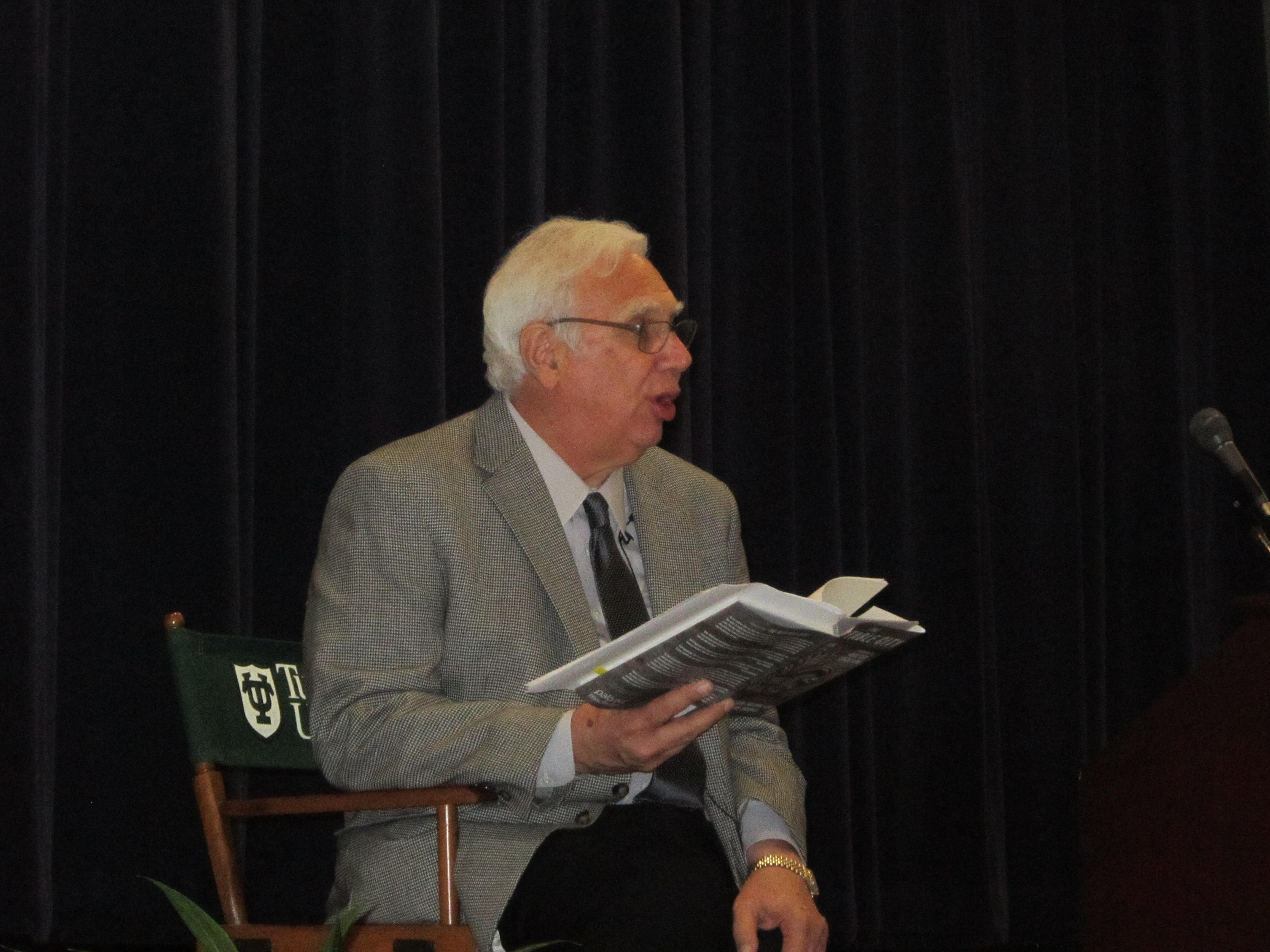
Outgoing Tulane University president Scott Cowen reads from his new book, “The Inevitable City” at the JCC on Wednesday. (Photo by Alan Smason)
That interesting title seemed fortuitous and when applied to the general themes contained within the work, particularly apropos, he said before an audience of 100 well-wishers and supporters gathered at the Uptown Jewish Community Center on Wednesday night, June 11.
The event held in the Mintz Auditorium had been rescheduled from the previous night, when a combination of a late flight from Washington, D.C. and expected inclement weather sent JCC officials scrambling into postponing the book talk and signing for 24 hours.
Cowen, whose work is subtitled “The Resurgence of New Orelans and the Future of Urban America,” credited Betsy Seifter as having assisted him with the writing of the book. He read passages and went through what he and Seifter had intended for each of the ten chapters and 242 pages it comprises.
Chapter One, titled “Hard Calls,” for example, dealt with the extremely difficult decisions Cowen and other Tulane University administrators were called into making following the destruction from Hurricane Katrina and associated flooding. The reality, he said was that 1,000 faculty members were ultimately let go, departments were scrubbed or reorganized and even colleges like Newcomb were absorbed into new schools.

Scott Cowen reading “The Inevitable City” at the JCC. (Photo by Alan Smason)
He has very critical words in the chapter titled “Chocolate City,” named after an infamous speech given by Mayor C. Ray Nagin, over which Cowen took the mayor to task. “What were you thinking when you gave that speech?” Cowen recalled asking Nagin.
“I was just saying that the city had to remain a racially diverse community,” he responded to Cowen.
“You were very successful to divide the city along race,” Cowen recalled answering.
Much of what Cowen described in the other eight chapters had to do with progress being made in education and attempting to curtail the problems associated with disconnected youth. According to Cowen, some 16,000 disconnected youth may account for the vast majority of the crime problem in the area.
He compared different approaches to the recovery effort from Hurricane Katrina, citing some that were better than others and noted that some, like Brad Pitt’s “Make It Right” efforts may have built homes, but not neighborhoods.
“The book comes alive to tell real stories about real people,” Cowen noted.
Cowen commented on the recent convocation exercises at the Mercedes-Benz Superdome last month at which trumpeter and jazz authority Wynton Marsalis delivered the commencement speech. “This man is pure poetry when he speaks,” he stated.
Cowen explained that Marsalis does not fly, but hired a driver to get him to New Orleans to deliver the speech. “He spoke. He played. He spoke. He played. He spoke. He played,” Cowen described Marsalis’ speech given in four parts.
“And he did it all in 16 minutes,” Cowen continued. “His constellation of words and how he put them down…it was just beautiful and his delivery in particular.” The university president declared his was the greatest commencement address he had ever heard.
Before ending the night, he entertained a number of questions from the audience and then began the task of signing the nearly 100 books sold that night by Octavia Books.
A dessert reception followed the talk.
