


Divestment issue will not alienate congregations, leaders vow
By DEAN SHAPIRO, Special to the CCJN
Despite the recent passage of a measure by the governing body of the Presbyterian Church (U.S.A.) calling for divestment in companies doing business with Israel and the publication of an anti-Zionist pamphlet by the church, those views don’t represent the views of all American Presbyterians, according to Senior Pastor Donald R. Frampton of St. Charles Avenue Presbyterian Church.

Temple Sinai Rabbi Ed Paul Cohn with St. Charles Avenue Presbyterian church Senior Pastor Donald Frampton with their olive tree. (Photo by Dean Shapiro)
Approximately 100 congregants from Temple Sinai, the St. Charles Avenue Presbyterian Church and contingents from other Jewish and Presbyterian houses of worship gathered in fellowship and solidarity on July 8 for a pot luck supper at the temple. They listened to remarks from Frampton, Rabbi Edward Cohn and Cantor Joel Colman of Temple Sinai, as well as members of the audience.
Emphasizing the longstanding friendship between his church and the New Orleans Jewish community, Frampton made it clear that the church hierarchy’s position did not reflect his own.
Controversy erupted in January of this year with publication of the church-funded Israel/Palestine Mission Network’s 74-page anti-Zionist congregational study guide titled “Zionism Unsettled.” The pamphlet went out for sale over the Mission Network’s website, accompanied by a DVD.
Six months later, at its June 2014 meeting in Detroit, the Presbyterian Church’s General Assembly narrowly voted to support a measure authorizing the church to divest in three large American corporations that do business with Israel.
The 310-303 vote specifically targeted Caterpillar, Hewlett-Packard and Motorola Solutions which, the resolution claimed, “further the Israeli occupation of Palestine.” The church, which Themeshas approximately 1.9 million members, has about $21 million worth of investments, according to a report in The New York Times.
In his opening remarks, Frampton explained that following the Presbyterian General Assembly vote, he immediately got in touch with Cohn and suggested that their congregations get together to discuss the issues and reaffirm their solidarity. “I just wanted to reach out to you, our valued friends at Temple Sinai, to assure you of our ongoing friendship and partnership, regardless of what happened in Detroit,” Frampton said.

St. Charles Avenue Presbyterian Church senior pastor Donald Frampton. (Photo by Dean Shapiro)
“I also wanted to share with you my own personal disagreement with the G.A.’s decision,” Frampton continued. “I was against it from the beginning and extremely disappointed that it passed.”
Weighing his next words carefully, Frampton added, “I can only speak for myself and not for the whole congregation. However, there is one thing I am able to say: Even from those who may have found some merit in the G.A. decision, never for a moment do they do so out of a sense of anti-Semitism, but only in the interests of peace in the Middle East. That is the reality.”
Frampton also said he wasn’t at the G.A. meeting where the vote took place and has never attended any of the nationwide biennial gatherings, despite his position as a local church head.
At the G.A. gatherings, “No one is instructed how to vote. Rather they vote as the Holy Spirit guides them,” Frampton said. “In secular terms, they vote their conscience. So any decision made on the G.A. level, does not necessarily reflect the majority view of any particular local congregation. That’s how our church works; how it governs itself.”
Continually emphasizing the closeness of the vote, Frampton nonetheless added, “It’s a fait accompli. What’s done is done. In the Presbyterian Church, much as I suspect it is in Reform Judaism, we don’t always agree with each other and we don’t always get what we want. Until the Assembly meets again in two years there is nothing that can be done about the outcome of the vote.”
Taking it down to the local level, Frampton said, “I think it is important to affirm that St. Charles Avenue Presbyterian Church does not look at Temple Sinai any differently than it did before this vote was taken. And we sincerely hope you did not see us differently either.” The two congregations would continue their friendly and cooperative relationships, “just as we have for decades,” he promised.
“My hope for tonight is what I see going on right now; table talk, rich conversation, getting to know each other and renewing acquaintances around the tables. Strengthening and affirming our friendship and the bonds that we have. . . . coming together as one; as people of God, and we’re doing that tonight,” Frampton said at the conclusion of his remarks.
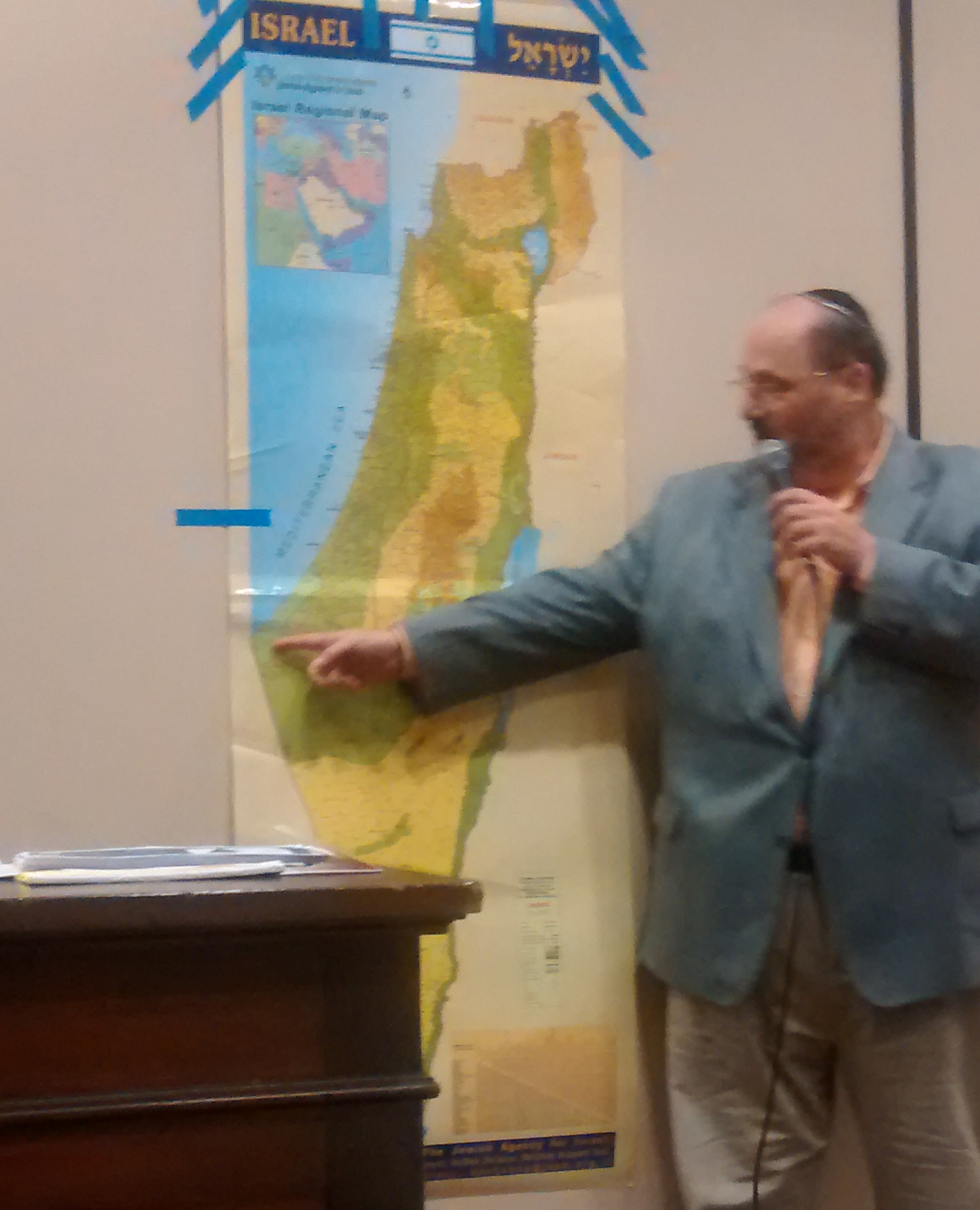
Temple Sinai Cantor Joel Colman points on a map to Gaza, from where hundreds of missiles have been launched at Israel. (Photo by Dean Shapiro)
Addressing the group, Cantor Colman stood beside a map of Israel and pointed to the location of the Gaza Strip, from which well over 100 missile strikes have been launched against the Israelis in recent weeks.
According to reports he is getting from his son, Josh, a soldier in the Israel Defense Forces, potential victims of the missile attacks may have only a few seconds – three minutes at best – to take shelter. Color-coded flyers containing this information are being handed out to Israelis in much the same way as hurricane preparation and evacuation tips are disbursed to New Orleanians, Colman pointed out.
“So, when people ask me, is he OK, I can say he is OK but it’s not OK what’s going on over there,” Colman said.
Ruthie Frierson, a member of the St. Charles Avenue Presbyterian congregation, said that when she heard about the divestment vote, “I was so sad I don’t even remember what that day’s sermon was about. The Jewish faith in this community has meant everything to our community, when you look at the education, the arts, the medicine and everything else I can think of.”
Continuing, Frierson said, “The generosity and commitment and everything that goes with it, has really helped make us who we are today.” Making reference to World War II, she added, “We just can’t turn our backs again,” and she encouraged people to speak out on this and other issues affecting Israel.
During his remarks, Rabbi Cohn took issue with the Presbyterian G.A. vote, saying that “it will be used as propaganda against Israel in a hurtful way.” Then, referencing the “Zionism Unsettled” pamphlet being distributed by the church, he called it a “loathsome publication” and added, “It’s impossible to describe the hurt caused by this congregational study guide, which seems to blame Israel alone for the absence of peace in the Middle East.”
Cohn went on to say, “From 1948 to 1967, when the West Bank was under Arab control, there was no Palestinian state. There could easily have been but there wasn’t.” Also from 1948-67, when no Arab nations recognized the existence of Israel, he added. “They were determined to keep the Palestinians as refugees. No one opened their doors to them.”
Cohn decried the analogy found in “Zionism Unsettled” that likened the present day situation in Israel to the apartheid formerly practiced in South Africa. “In Israel, Arabs and Jews sit side by side in restaurants,” he said. “They are treated in hospitals by Arab and Jewish physicians and nurses, and they study in the same universities with Arab and Jewish professors.
Regarding the divestment issue, attendees at the Detroit General Assembly in Detroit were being led to believe that large numbers of American Jews support divestment. However, when Cohn asked if anyone in the room supported it, no one raised their hand. He explained that a fringe group of Jews were at the G.A. wearing T-shirts supporting divestment but, he added, “They are as representative of Jews are snake-handlers are representative of Christians.”
Cohn concluded by assuring those gathered that “This decision by the General Assembly will not interfere, for one instant, with the close, trusting friendship and the commitment of Temple Sinai and St. Charles Avenue Presbyterian Church to be with one another. It would be a tragedy were it to be otherwise. We need to work together on so many social justice issues in this community which is in such pain. What happened in Detroit happened and it is unfortunate. We have to center our attention on what is happening and what will happen in the Crescent City. That is our mission, and our task.”
(Editor’s Note: Due to pressure from Jewish sources at the June General Assembly, members voted to remove the “Zionism Unsettled” publication from the Mission Network’s website but, as of July 11, it was still up on the site.)
