


Zapruder cites diaries at Yom Hashoah event
By ALAN SMASON
Diaries written during the Holocaust by adolescents like Anne Frank were a major focus of the tenth annual Yom Hashoah Community Wide Event on Sunday evening, April 12, at the Uptown Jewish Community Center. Discovered after the war, the diaries are important as both historical records and literary devices, according to Alexandra Zapruder, the program’s keynote speaker.

Holocaust survivor Eugenia Yuspeh, left, and second generation member Rachel Ladder Merlin, hand a memorial candle back to JCC director of Family Life Liba Kornfeld as Henry Rosenblat and speaker Alexandra Zapruder look on. (Photo by Alan Smason)
Zapruder, a Harvard graduate and one of the earliest researchers at the National Holocaust Museum in Washington, D.C., is the author of “Salvaged Pages: Young Writers Diaries of the Holocaust.” She read from her collection of diary excerpts, giving insight into many of these unsung literary heroes, who documented the horrors, fear and guilt they experienced, never knowing if the words they were writing would be their last.
“They had their own way of articulating what it was they experienced and it cut through any attempt to generalize or simplify what the Holocaust was about,” Zapruder said about the young writers.
While Frank is the most famous, several of the 60 young diarists whose work had been published after World War II are now out of print and many of their works are of unknown or anonymous origin, according to the researcher. Perhaps, the most surprising of the items that came out of these diaries was the attention to details that might have been left out by other writers, Zapruder noted.
“These writers were historians of themselves,” she continued. “They put down a record of their experiences and they left a record for us to contemplate. They captured the texture and the complexities of daily life without the knowledge of what the outcome was going to be,” she continued.
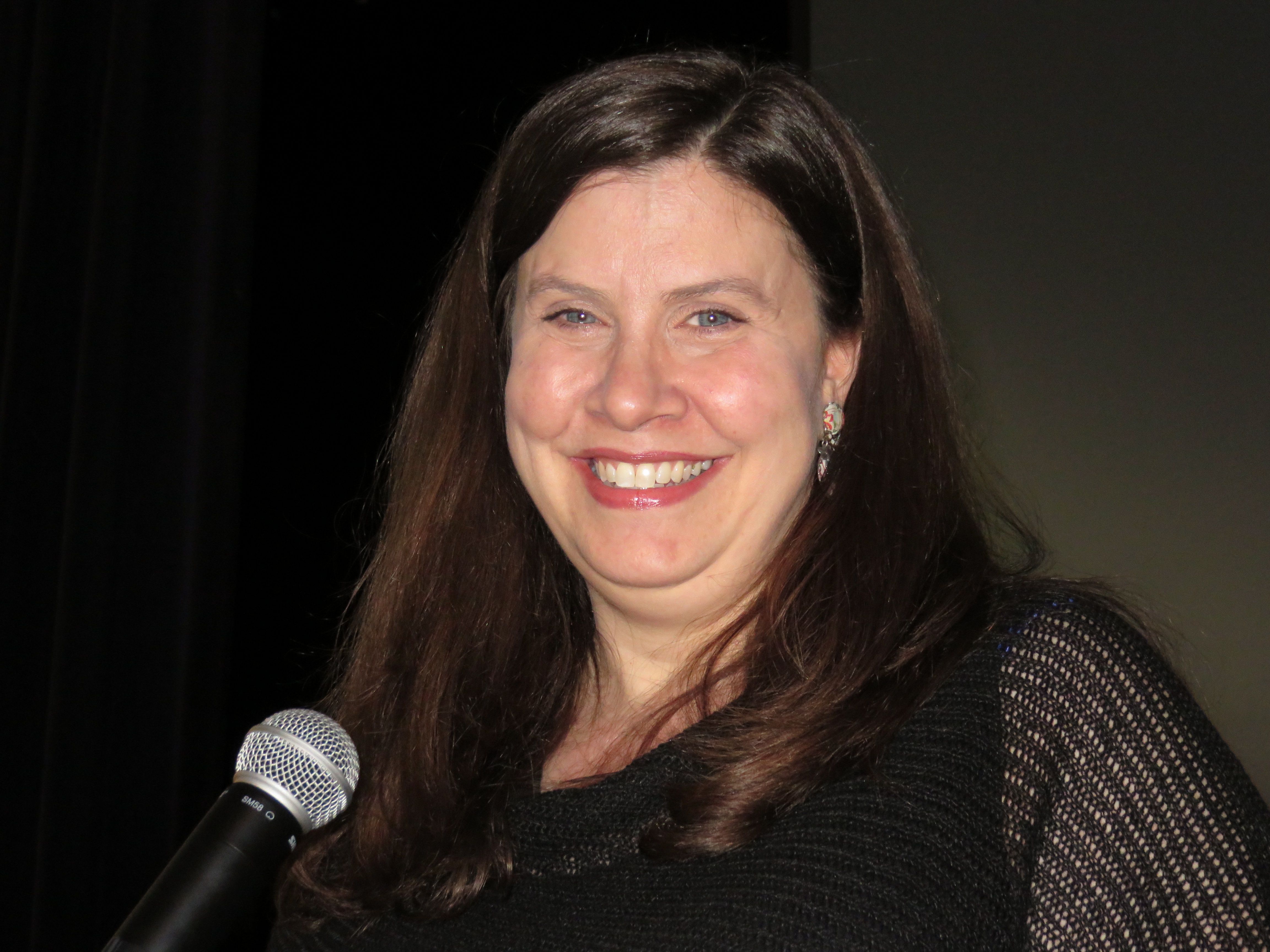
Keynote speaker Alexandra Zapruder (Photo by Alan Smason).
Beyond viewing these unique sources as simple glimpses into history, they also serve to give insight into a generation of skilled writers, Zapruder stated. “From a literary standpoint they used the written word to communicate their experiences. They grappled with language. How is it possible to express the inexpressible? How to articulate the inarticulated?” she posited.
The sentiments expressed in the six diaries from which Zapruder read went from the factual and mundane to the poetic and artistic.
Another common thread running through the diaries was that of guilt. Many were forced to steal food or compelled to take more than their fair share. “It was amazing to see how reductive hunger is,” Zapruder said. “One of the elements of their torment is shame.”
When caught up in the maelstrom of the Holocaust, everything else seemed miniscule or unimportant, she added. “They leave us with this material to grapple with for ourselves and to honor this labor of leaving a historical record for those who are to follow,” Zapruder concluded.
Earlier, the program began with the procession of the survivors, its ranks now shortened to just seven members. Several of the members of the Anti-Defamation League’s Donald Mintz Leadership Mission to Washington, D.C. accompanied the survivors and their family members, who each carried memorial candles to remember the lives of those who had survived the war and settled in New Orleans.

Educator of the year Caitlin Meehan-Draper, second from right, displays her certificate with (from left) Ruth Loeffelholz, speaker Alexandra Zapruder and Holocaust Memorial Committee chair Henry Rosenblat. (Photo by Alan Smason)
Allison Goodman-Padilla, the ADL’s South Central Region executive director introduced the members of the mission by name and school. The students from an assortment of Orleans and Jefferson Parish schools each read passages from famous Holocaust figures, New Orleans survivors and others. After reading each passage, the students lit a candle which was extinguished after the tenth and last student read his quotation.
The educator of the year award was presented to Samuel J. Green Charter School 8th grade English Language Arts teacher Caitlin Meehan-Draper. Meehan-Draper accepted a check for her school from Ruth Loeffelholz on behalf of her and her brother, Holocaust Memorial Committee chair Henry Rosenblat, from the Ralph and Gertrude Rosenblat Fund they administer.
Meehan-Draper was selected by the Holocaust Memorial Committee to receive the honor from a slate of teacher candidates who incorporate Holocaust studies into their classroom curricula.
Survivor Anne Levy welcomed John Rogers, a 97-year-old veteran of the U. S. Army’s Second Armored Division, who was honored as one of the Holocaust liberators. Rogers was the subject of a short video presentation which captured his memories of passing one of the death camps as he and his comrades marched towards the war’s conclusion.
Rogers accepted a certificate from a visibly moved Levy on behalf of the Holocaust Memorial Committee.
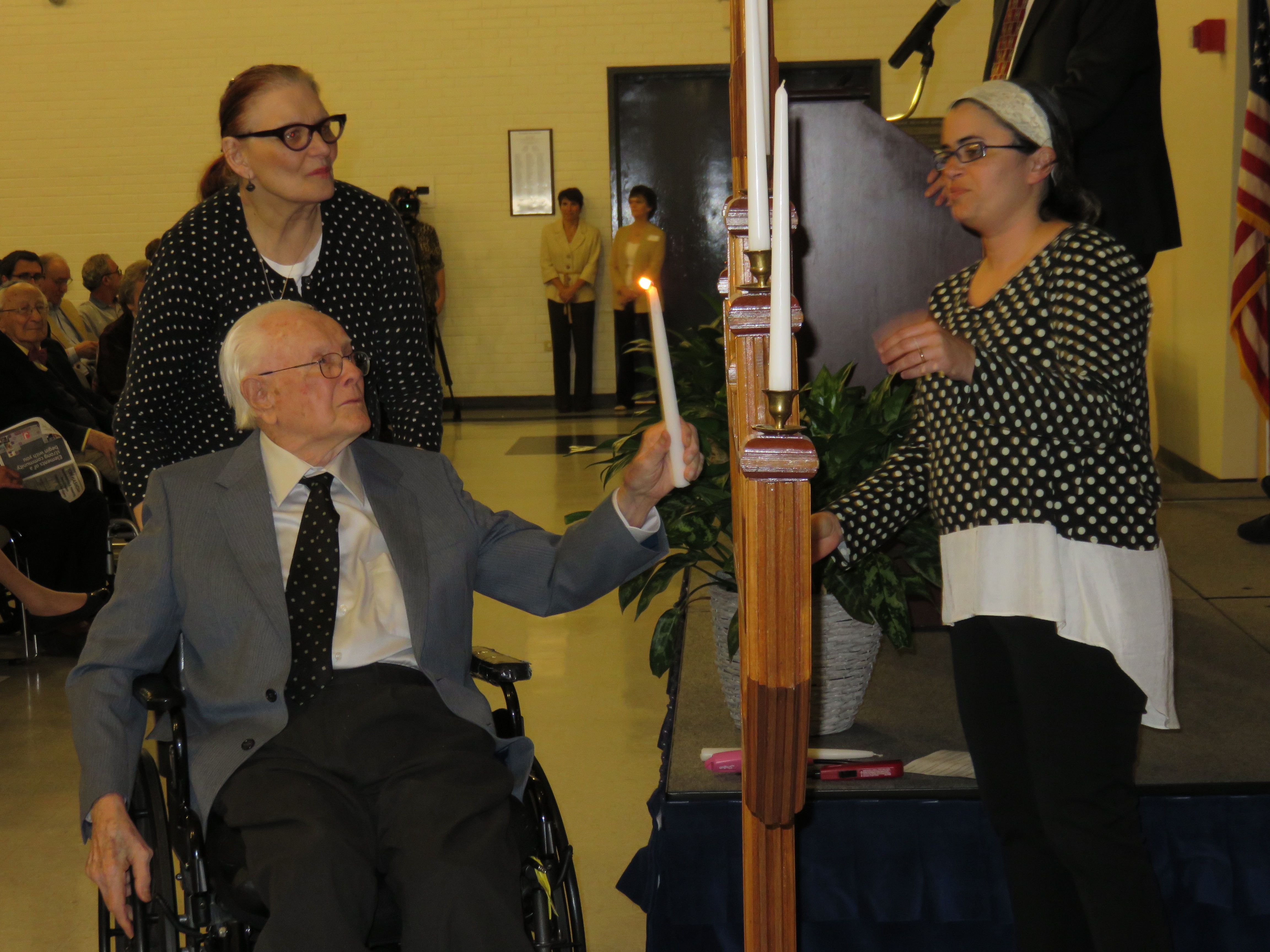
Rabbi Barbara Metzinger escorts liberator John Rogers to the lighting of the menorah as Liba Kornfeld prepares to place the candle. (Photo by Alan Smason)
Temple Sinai Rabbi Ed Paul Cohn opened the memorial event with a prayer evoking the memory of Frank and her hopeful spirit despite the dire conditions she and her family endured in hiding from the Nazis. “How could anyone declare someone like Anne Frank to be their enemy?” Cohn asked rhetorically.
The lighting of the six-tiered wooden menorah constructed in memory of the six million souls lost to the Shoah by survivor Isak Borenstein of blessed memory began with Meehan-Draper and Goodma-Padilla lighting the first candle. Rabbi Barbara Metzinger escorted Rogers who was in a wheelchair. Next up were survivor Jeannine Burk and second generation member Betty Moore. Survivor Eugenia Yuspeh followed with second generation member Rachel Ladder Merlin. The fifth candle was lit by children of deceased survivors Margo Berger and Henry and Peter Boraks. The final candle was lit by survivor sisters Anne Levy and Lila Millen.
Following a moment of silence led by Rabbi Yossi Nemes of the Chabad Center of Metairie, Cantor Dave Mintz from Touro Synagogue led the attendees in the singing of “Ani Ma’anin (“I Believe”),” a song long associated with the Holocaust and sometimes referred to as “The Hymn of the Camps.”
Survivor Joseph Sher chanted the El Maleh Machamim in honor of the victims of the death camps, after which Morris Brum recited the names of all area survivors and then led the assembly in the recitation of Kaddish.
Following closing remarks from Rosenblat, Congregation Beth Israel Rabbi Gabriel Greenberg recapped much of what happened earlier in the evening, thanking all who had participated as well as those that attended the event.


