


Could New Orleans become another Baltimore?
By DEAN M. SHAPIRO
Could the events that transpired in Baltimore several weeks ago be repeated here in New Orleans? New Orleans Police Superintendent Michael Harrison addressed that question and others in a talk during Shabbat service at Temple Sinai on May 8.
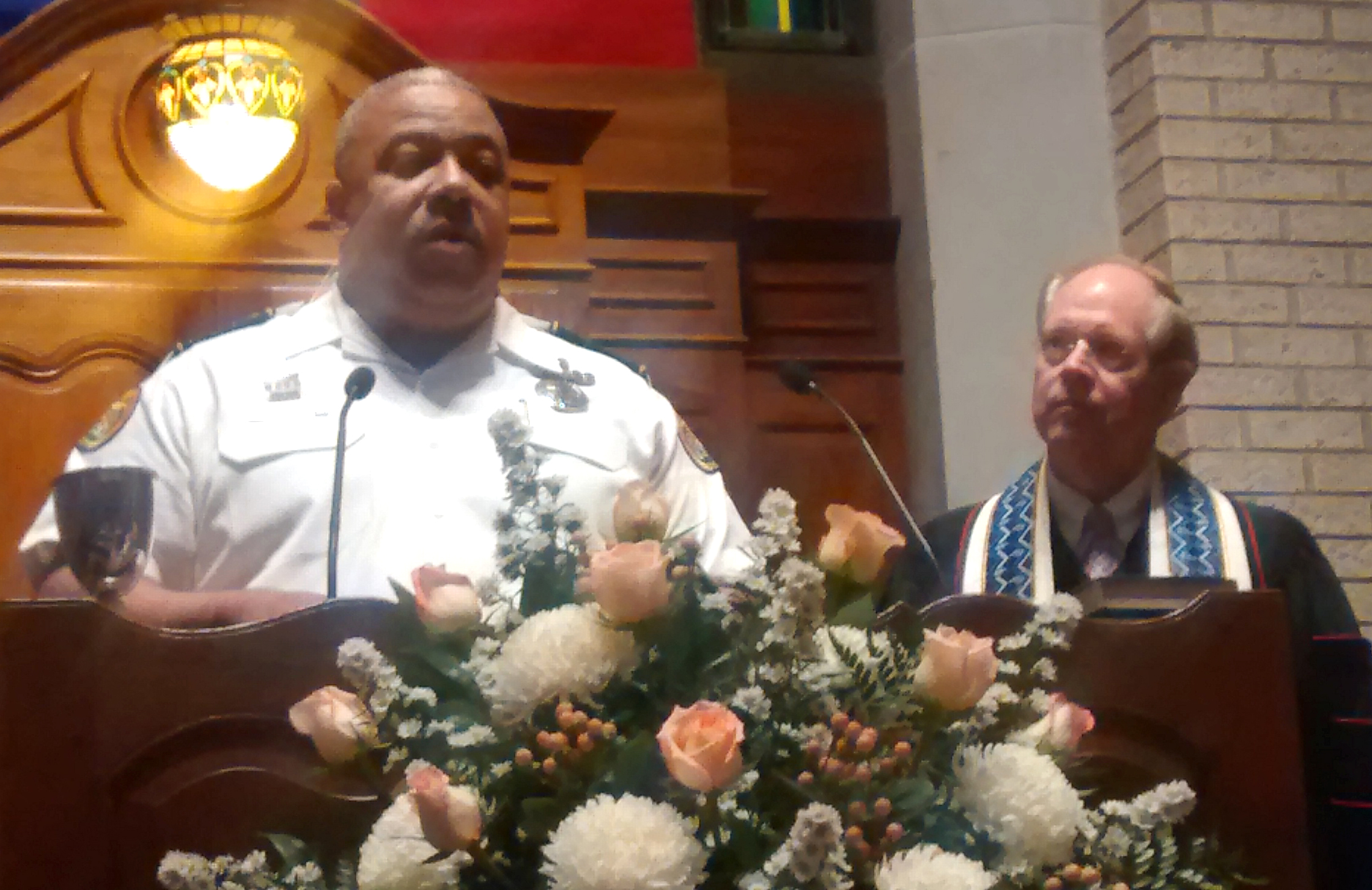
NOPD Superintendent Michael Harrison speaks at Temple Sinai on May 8, 2015. (Photo by Dean Shapiro)
Chief Harrison was appearing at the invitation of Temple Sinai’s Rabbi Edward Paul Cohn, a native of Baltimore. In his introductory remarks, Cohn decried the situation in that beleaguered city, where racial unrest exploded into violence recently in response to the death of Freddie Gray at the hands of Baltimore Police.
During his talk, the New Orleans superintendent outlined five goals for the police department he has headed since October 2014 that, he said, “could prevent New Orleans from becoming Baltimore.” The five goals, Chief Harrison, explained, came at the urging of New Orleans Mayor Mitch Landrieu.
The goals Harrison spoke of involved “reaching out to all faiths” to identify the problems and remedy them, growing the police department from its current 1,147 officers to somewhere between 1,400 and 1,600, increasing community policing, implementing “best practices” as called for in a consent decree from the federal government and “creating levels of accountability in which our people are expected to perform their tasks and are held accountable if they don’t.”
The rabbi began the evening’s presentation by citing his experiences and observations of Baltimore from a native’s perspective. He spoke of “a huge Jewish flight from downtown Baltimore” where all the temples, Jewish schools and Jewish businesses were located, and into the outlying counties from the 1950s through the ‘70s. “The city was no longer in the forefront of the lives and their caring, and that was a tremendous mistake,” he declared.
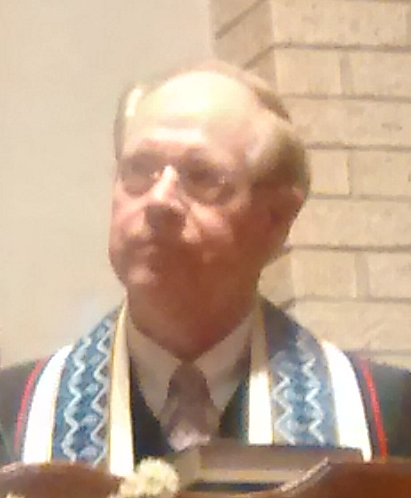
Rabbi Ed Paul Cohn (Photo by Dean Shapiro)
“The images out of Baltimore two weeks ago have been very hard to erase from my mind and I’m sure you can see it in yours as well,” Cohn said. “The ravished neighborhoods are heartbreaking in many ways.
“In our efforts to compare New Orleans to Baltimore we must examine the backdrop in which it (the violence) occurred,” Cohn continued. “Freddie Gray and the officers who arrested him were following a script written decades and even centuries ago. In order to change what needs to be changed, the intentions of the actors need to be modified. The script itself needs to be seriously revised and that will require far more than a handful of convictions in Baltimore.”
Chief Harrison began his talk by acknowledging, “There is some rebuilding that needs to be done” in the New Orleans Police Department. “My philosophy is to build relationships (in the community) that were never built, improve the good relationships that we have and repair the relationships that were broken.”
The superintendent also acknowledged “a slight increase” in murders from last year but prefaced it by saying that, overall, the crime level has gone down. Most of the recent murders, he said, involved domestic disputes that escalated into violence, as well as drug-related incidents between rival drug dealers. Down, also, is gang- and group-related violence, according to the chief.
Mayor Landrieu, the superintendent explained, tasked him with “putting together a vision of what I thought we should do to prevent New Orleans from becoming Baltimore.” From this City Hall directive came the five goals on which Harrison expounded at length.
“We need to build a police department that’s really engaged with the community,” \Harrison said. “I’m of the philosophy that there is no difference between the police department and the community. I live here. I was born and raised here. I went to school here. I got married here and now I’m raising my children who went to school here. When my son graduates college next week he’s coming back to live here. So I am the community, and that’s what we’re teaching our police officers. We are the community. And that’s what we want to make sure we convey to our citizens.”
Harrison also stated his belief that “community policing is the way to go toward building trust. As police officers, we have to put in the same sweat equity that everyone else puts in.” He cited playground cleanups, community food bank giveaways and picking up trash in vacant lots as just a few ways “our officers can stand shoulder-to-shoulder with the community. Only by putting in the same work ethic and sweat equity will citizens be able to view us differently. We want (the public) to see us as a partner. That’s the cultural change we’re working to teach to our police department.”
The superintendent also discussed the federal consent decree under which his department is operating, the goals of which are “making sweeping reforms” in such sensitive area in racial profiling, the use of force and improvements in training and ethics. “The decree is allowing us to study and implement the best practices from all around the country,” including the “Best Practices Model” program” developed by the San Jose (California) Police Department.
The police chief also addressed the image problem faced by NOPD, which mirrors the image problem other police departments around the country also face. “When you see the problems we’ve had in the media, it’s all been because of accountability,” he said. “We want to build a department you can be proud of, one that you actually pay for, and one in which we’re partnering with the community. We want there to be no distinction between the police and the community.”
Harrison also stressed the intensified training that all police officers, detectives, supervisors and others have to go through. The number of hours they have to put in in classrooms and training facilities has been increased, in accordance with federal guidelines.
Two members of NOPD’s SWAT Team were sent to Baltimore to help out and observe, then bring their experiences and observations back to New Orleans, the superintendent explained. “If we ever have an issue that’s similar, which we pray we’ll never have, we would be able to handle it.”
Harrison also praised the NOPD’s use of body cameras as a means of visually documenting what happens with officers in the line of duty. He cited two specific instances of extreme actions taken by NOPD officers in which the camera-recorded evidence left little room for questions by the media as to whether or not those actions were appropriate.
“All of our police officers who are responding to calls are now recording every incident. We are proud to say we are one of the leaders in the nation in the use of body cameras,” Chief Harrison said.
“So, building trust is the way to preventing New Orleans from becoming Baltimore,” Chief Harrison said, at the conclusion of his remarks. “It’s not just me: it’s every member of our police department.”
The media is not our friend,” Harrison added. “They’re not very helpful and they shape how people view us. So everything we’re doing now is about reshaping our image. It’s about holding people accountable, bringing the brightest and best into the police department and getting rid of the people who are hurting us.”
In his concluding remarks Harrison added that he and his top commanders must manage ” the department well enough to get out there and prevent crime, deter crime and apprehend those who do it.” Then, he noted, “we can sell the story in such a way that the media can’t hurt us. They can highlight the successes that we’re having.”
