


Israeli-American trio soared in NOFM program
By ALAN SMASON, Exclusive to the CCJN
Chamber music fans were in for a very rare treat on Wed., Feb. 24, when the Goldstein-Peled-Fiterstein Trio starred in a program of music sponsored by the New Orleans Friends of Music (NOFM) at Tulane University’s Dixon Hall. Prior to their 8:00 p.m. concert, the trio held a re-scheduled master class performance at 5:30 in Nunnemaker Hall on the Loyola University campus, which was cancelled due to inclement weather in the area on Tuesday.

Cellist Amit Peled, pianist Alon Goldstein and clarinetist Alex Fiterstein following Wednesday night’s concert. (Photo by Alan Smason(
The rarity of their appearance was reflected in the nature of this ensemble of three Israeli-Americans – pianist Alon Goldstein, cellist Amit Peled and clarinetist Alex Fiterstein – all three highly regarded solo performers with their own individual careers and who, only on certain occasions throughout the year, come together to perform as a trio.
The unusual nature of their association was noted in an exclusive CCJN interview with two of the trio’s members, Goldstein and Fiterstein, this past week.
“Although we’re not a regular group that practices every week, we have a familiarity of playing together,” Fiterstein noted. “The work that we do carries over.”
Even through the three grew up in Israel before coming to the United States to advance their careers, they did not get to know each other until they had begun spending their summers in America at the famous Marlboro Festival in Vermont more than a decade ago.
It was there they discovered their common Israeli roots and an affinity for the same kinds of repertoire. They began to enjoy each other’s company, while expanding their musical horizons and formed the erstwhile trio in 2005. Eventually, Frank Salomon and Associates, a noted classical artists agency, invited the three to take part in the 2009 Peoples’ Symphony Concerts in New York. The trio soon became part of its retinue of artists and Goldstein was signed to an additional contract as a solo performer.
The NOFM program scheduled could be likened to a sandwich. The trio played together during the opening and closing works by Ludwig Beethoven and Johannes Brahms, respectively. In between were solo works or duets by fellow Israeli-American Shulamit Ran, Franz Liszt and Ernest Bloch that allowed each member to show off his prowess as a solo performer.
The Beethoven Trio in B-Flat Major, Op. 11 that began the evening’s program is often performed by string trios with a violin substituting for the clarinet part.
Clarinetist Fiterstein believes the reason it was also scored for a different instrument may go back to Beethoven’s times. “Maybe the reason is the clarinet was not as prominent at the at time at it is today and he was maybe afraid it would not be performed as much,” he speculated.
“You’re being much too kind,” Goldstein interjected. “It sounds much much better on a clarinet.”
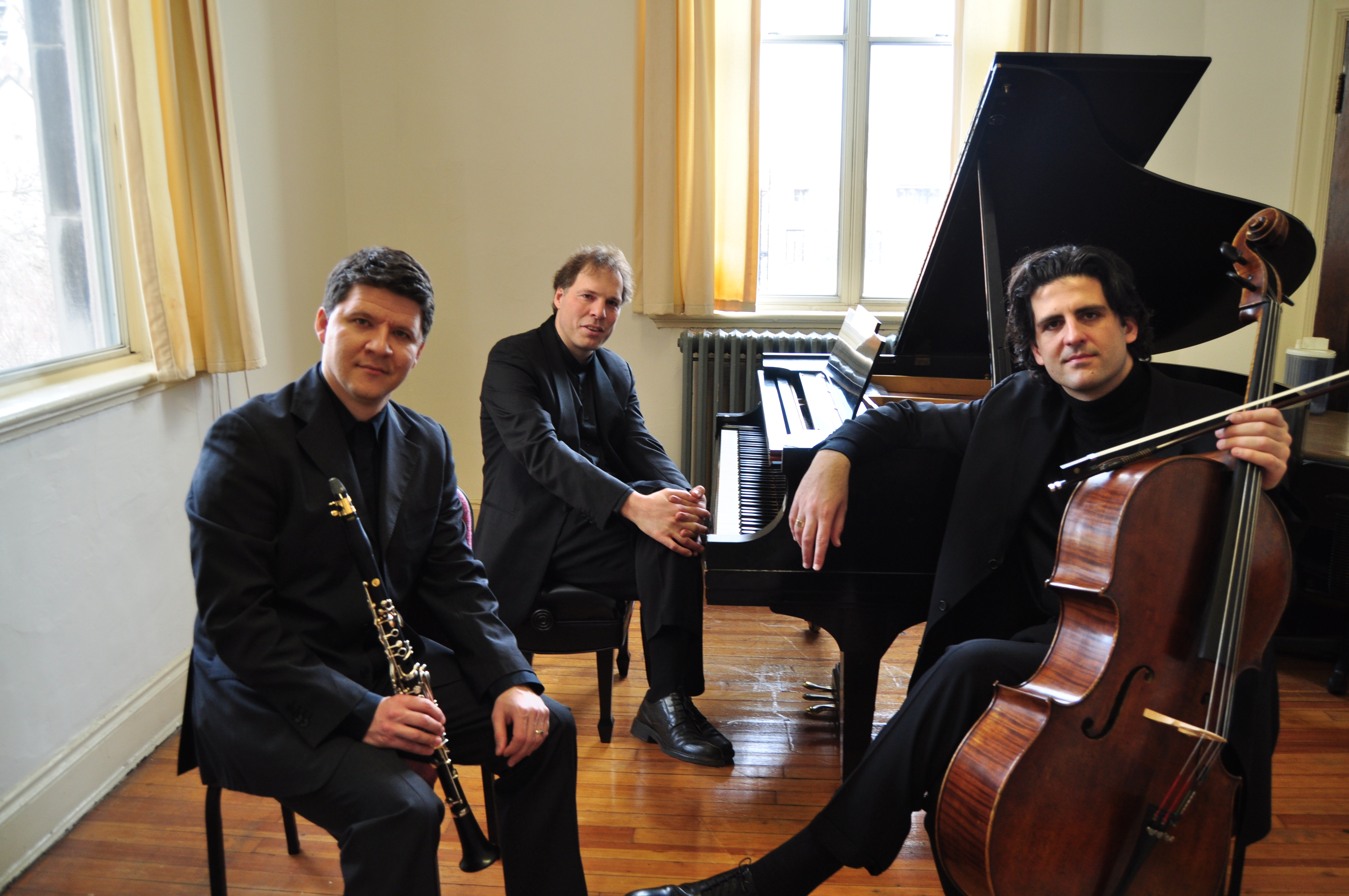
Clarinetist Alex Fiterstain, pianist Alon Goldstein and cellist Amit Peled. (Photo by Britt Olsen-Ecker)
The piece by Ran, “For an Actor: Monologue for clarinet solo,” allowed Fiterstein an opportunity to show his range. “It’s very modern and very avant-garde, but the structure is very traditional,” he admitted. “It stretches the limits of the clarinet and is a great showpiece for the clarinet.”
The piece, which was privately commissioned in memory of a former actor, was described by the clarinetist as “imitating a monologue in the theater. It’s basically a monologue without the words.”
Goldstein got attention as a solo performer in the deeply romantic Franz Liszt piano transcription of Richard Wagner’s “Liebedstod” from the opera “Tristan und Isolde,” which followed next. Unlike what some might expect, Goldstein said he is not biased against Wagnerian music, despite its connection to the Nazis and the fact that several of his relatives lived through the Holocaust.
“I think if my grandmother, who went through the Holocaust does not want to listen (to Wagner), I am not going to argue with her or educate her,” he stated.
But the pianist said he accepts Wagner for his musical gifts. “Listen to Wagner. He is a great musician. He was certainly a genius and certainly not a nice man. It is very hard to separate a genius and the personality. We sometimes think that a person who is a genius is also a wonderful personality.” That’s not the case in Wagner’s case or in the case of composer Carl Orff, who was a member of the Nazi Party, he pointed out.
Goldstein returned on the program in support to cellist Peled, who played three sketches from “Jewish Life” by Bloch. Peled played on a Venetian cello formerly the property of famed musician Pablo Casals and bequeathed to him by his widow several years ago. Constructed in 1735, the instrument, which he calls “Pablo” is insured for $3 million.
Bloch, who was born in Switzerland to Jewish parents, employed a number of Jewish themes in several of his major works. However, it was historically difficult to be a practicing Jew early in his career in Europe.

The members of the Goldstein-Peled-Fiterstein Trio, all three Israeli-Americans. (Photo by Britt Olsen-Ecker)
“He doesn’t have to practice Judaism,” countered the pianist in speaking about the Bloch work. “I don’t think you get much more Jewish than that.”
In describing one of the three works Peled performed, “Prayer,” Goldstein said it was much like a conversation between a cantor and his congregation responding. “It doesn’t get more Jewish.”
Fiterstein, who has played as a solo artist before as a performer with the Birdfoot Festival, said he looked forward to returning to the city, especially highly anticipating the program’s final work, the Brahms Trio for Piano, Clarinet and Cello in A minor.
“I think it’s a great piece,” the clarinetist mused. “Brahms at the end of his life actually wrote four pieces for clarinet. The quintet happens to be considered one of the best pieces for chamber ever written. The trio (Op. 114) is less ambitious than the quintet.”
But the trio they played hearkened back to some of Brahms’ earlier compositions, Fiterstein said. “It shows Brahms’ writing skills when he was much younger, whereas the quintet (Op. 115) is very nostalgic, looking back at (his) life.
“It’s a late piece and has a very upbeat section,” he concluded. “It’s not saying farewell like the quintet and as a clarinetist, I feel we are lucky to have it.”
