


FIRST PERSON: Baton Rouge – A call to action
By BRIAN SEYMOUR
(Editor’s Note: This past Wednesday, August 24, The Jewish Federations of North America (JFNA) Emergency Committee chair, Brian Seymour and JFNA senior vice president for Public Policy William Daroff met with volunteers in Baton Rouge. They presented $112,000 towards disaster relief in the area, the first installment from the Federation’s Baton Rouge flood relief fund.
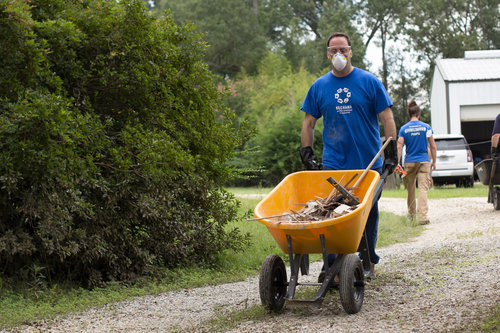
JFNA Emergency Committee chair Brian Seymour helps remediate a flood-damaged home in Baton Rouge. (Photo by Jeffrey Dubinsky/JFNA)
The two men met, and were briefed by local Jewish community leaders. They also visited the flooded home of Ellen Sager, executive director of the Jewish Federation of Greater Baton Rouge, and other destroyed or damaged homes in partnership with the Jewish disaster response organization NECHAMA.)
Two years ago, when I became chair of the Emergency Committee of The Jewish Federations of North America, I hoped to never experience the kind of situation we were created to address. Unfortunately, that has not been the case. Since I came to the helm, we’ve had to provide critical aid for several communities around the world impacted by severe natural disasters, but thereby making a crucial difference in their recovery and rebuilding efforts.
I just returned from Baton Rouge. You may know a little about what happened there, but it didn’t get the news coverage it deserves. What I saw was devastation on a scale I’d never previously witnessed. The area was hit with a 1,000-year flood event—the kind of intense rainfall expected only once in an entire millennium. Nobody could have prepared for such a crisis.
The impact is devastating and far-reaching. Approximately 110,000 people have made requests for federal assistance for their homes. In one area, 90 percent of homes were damaged, as were 91 percent of businesses. Approximately 10 percent of the Jewish community has been directly impacted, with many more affected indirectly by a loss of a job, or by the now dire need to feed and house friends and family.
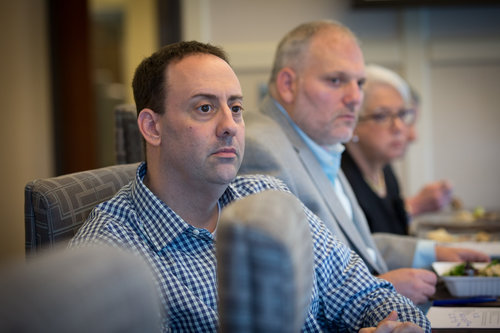
JFNA’S Brian Seymour, left, and William Daroff, center, listen with JFS executive director Roselle Ungar to Baton Rouge reports. (Photo by Jeffrey Dubinsky/JFNA)
I was honored to meet with some of the leaders of the Baton Rouge Jewish community and see the places they are proud to call home. They are resilient. They are organized. They are one people working together. And they need our help.
With so many businesses shut down and so many people affected, the needs of just the Jewish community alone are estimated to top $1 million. Take, for example, the story of David Spivak. Five feet of water inundated the small home he lives in with his twin 15-year-old sons. Think about that for a second. Water five feet deep—taller than some people you might know. David had to wade out of his home to catch a rescue boat.
The water came in so fast, David could not save much of anything. Outside his home now is a pile of refuse over six-feet-high that includes his furniture, drywall that volunteers have pulled out of his home, his stove, and virtually all of his possessions. His cars are destroyed. His sons cannot go back to their home. No one knows when they can return. David told us that they couldn’t even stand to be there to help clean up. Emotionally, it was just too much.
David’s story is one of thousands. The debris piles stretch for miles in front of homes and businesses. Some had flood insurance. Most, not being near a flood zone, did not. Regardless, they all need help. Insurance cannot cover total losses. Neither can FEMA, which typically allocates an average of approximately $5,000 and no more than $33,000 per home. Survivors need food (the local food bank was flooded out, as were the local Salvation Army warehouses), clothing, furniture and housing. And they urgently need emotional and psychological support and counseling; some children are now scared of the rain, with every drop increasing their fear.
The Baton Rouge Jewish community is, as they described and I saw, “small but mighty.” They have neither an established Jewish Family Services nor a JCC. They do have a part-time Federation CEO, a wonderful and dedicated woman who knows this devastation all too well; her own home was completely flooded. The focal points of the Jewish community are their synagogues, which are coordinating efforts with the local Federation. Rabbis and congregants are all pitching in.
But they cannot do this alone. Currently, staff is on loan from the Jewish Federation of Greater New Orleans, NECHAMA – Jewish Response to Disaster and the URJ Jacobs camp. But they need full-time coordinators. They need counselors and social workers to help survivors cope with post-traumatic stress. They need money to buy food and to give people small loans and grants to help get them back on their feet into temporary housing and ultimately back into their homes.
This is a long and expensive endeavor. It will be a while before any sense of normal returns. But this is where each of us can make a difference. Together, we can raise the estimated $1 million the Baton Rouge Jewish community needs to recover.
Federations have launched a relief fund for support this critical post-disaster work. So far, we have raised nearly a quarter of a million dollars, including generous grants from the Jewish Federation of Greater New Orleans and the Jewish Endowment Foundation of Louisiana. Every donation matters. Every gift is a statement of solidarity with Baton Rouge, an act of tikkun olam in the most tangible way possible.
We need your help. First, please make a donation to our Baton Rouge relief effort. Second, invite your friends and family to give with you. Third, reach out to your Jewish community—your synagogue, your community center, your online networks—and ask them to join you in donating to amplify your impact at an even greater level. If each of us steps up, we can make a collective, tangible difference in the lives of so many.
Thank you in advance for your help—from me and from the entire Baton Rouge community. My visit proved what I have long believed: The Jewish People survive because when one of us falls, the rest of us stop to lend a hand. That is what is happening now in Baton Rouge. Let them be an example to us all. We can and must help them help each other up.
