


Interfaith Gathering Draws Hundreds
By NICHOLAS HAMBURGER, Special to the CCJN
Six members and an additional representative of the East Jefferson Interfaith Clergy Association (EJICA) addressed a crowd of several hundred people at Congregation Beth Israel on Monday, August 21, calling for a unified denunciation of white supremacy and anti-Semitism. The event was organized in the wake of a large-scale white nationalist and neo-Nazi march in Charlottesville, VA, which turned violent and resulted in the death of one female counter-protester.
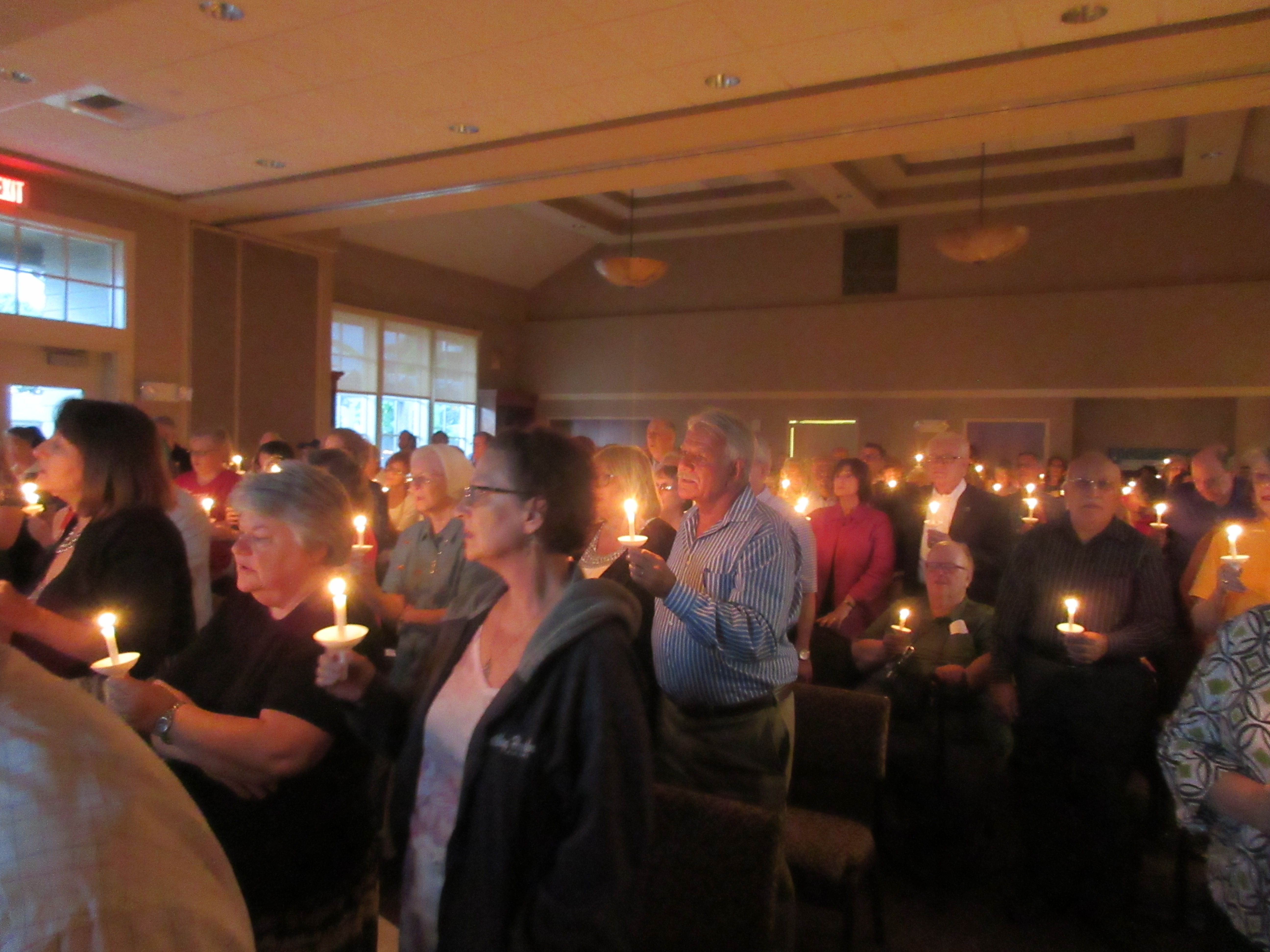
Attendees participate in a candlelight vigil (photo by Nicholas Hamburger)
President Trump’s response to the deadly violence in Charlottesville, in which he said “there is a blame on both sides” and defended the existence of standing Confederate statues, served as a backdrop for the interfaith gathering, which filled the sanctuary to such an extent that people lined the walls of the room. Moreover, the religious and ethnic diversity of the crowd was readily apparent, with numerous attendees clad in a yarmulke, taqiyyah, hijab, or nun’s habit.
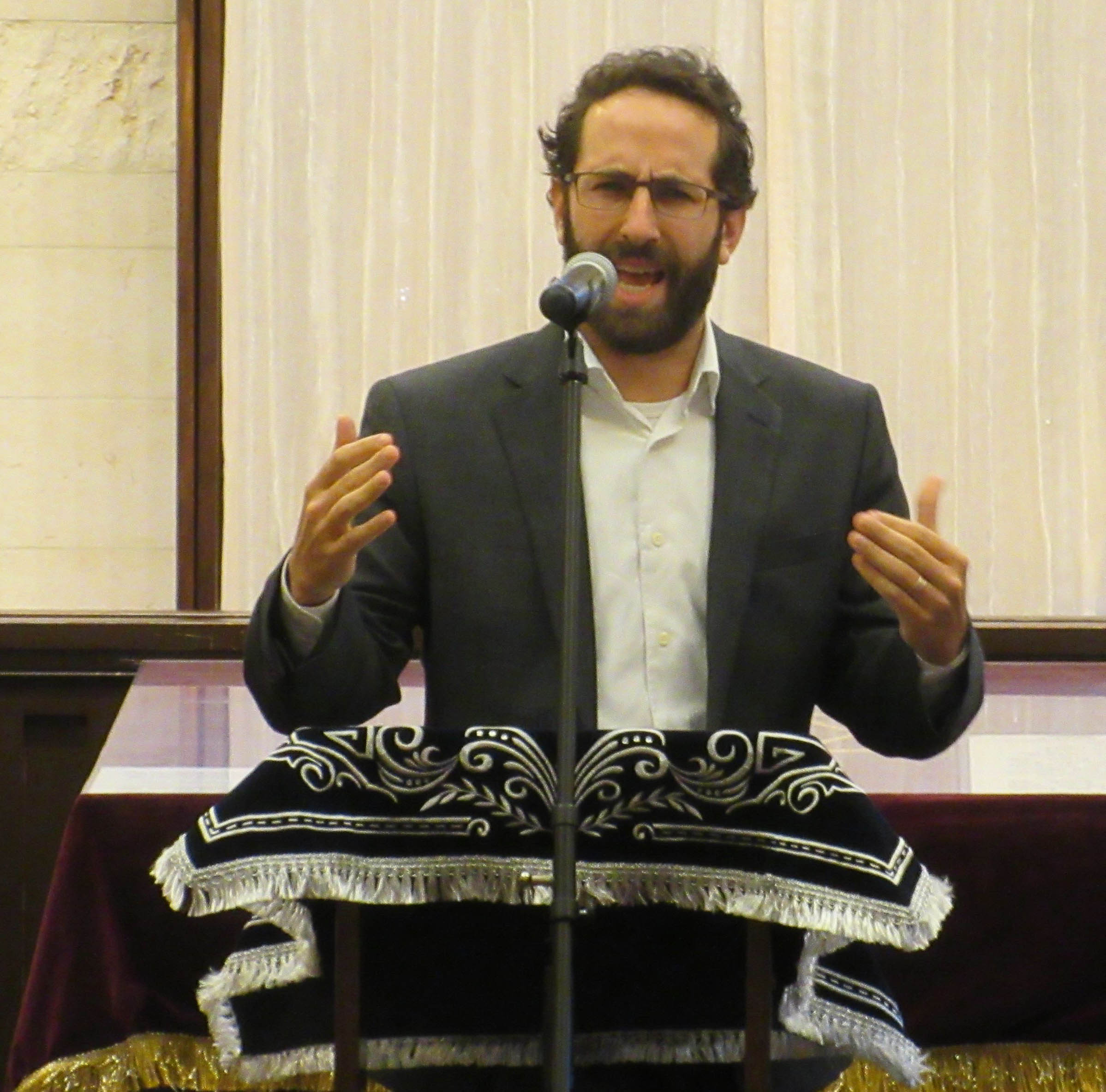
Rabbi Gabriel Greenberg at Congregation Beth Israel (photo by Nicholas Hamburger)
Speaking at a podium placed in front of the aron hakodesh, Fernando Guzman, an elder from Journey Christian Church, referenced Thomas Jefferson’s words in the Declaration of Independence: “In recent times like this we need to be reminded of the strong spiritual and visionary leadership of our country’s founding fathers, who said, ‘We hold these truths to be self-evident, that all men are created equal.’”

Leaders of different faiths in discussion after the event (photo by Nicholas Hamburger)
Imam Abdul Hakim reiterated the importance of striving for national equality before offering a pointed condemnation of bigotry. “We must be able to step out in this multicultural, diverse society that we have,” he said, “and condemn hate for what it is, condemn the ugliness and the injustice apparent in our societies.”
Meanwhile, Reverend Susan Lassalle, the principal organizer of the event and a pastor at United Church of Christ, quoted the German theologian Dietrich Bonhoeffer, who perished in the Holocaust: “‘Silence in the face of evil is itself evil. God will not hold us guiltless. Not to speak is to speak; not to act is to act.’” Lassalle added: “We cannot deny history. But we can and must, from this day forward, say, ‘This is not who we will be.’”
The acknowledgement and contemplation of an errant history – personal, communal, or national – was also suggested by Greenberg, who evoked the Jewish month of Elul, the month that leads into the High Holiday season. “Elul is a month of introspection and self-analysis,” he said. “We think about how in the past year we have failed, how we must return to the right, correct path. This process is called teshuva, which is often translated as ‘repentance.'”
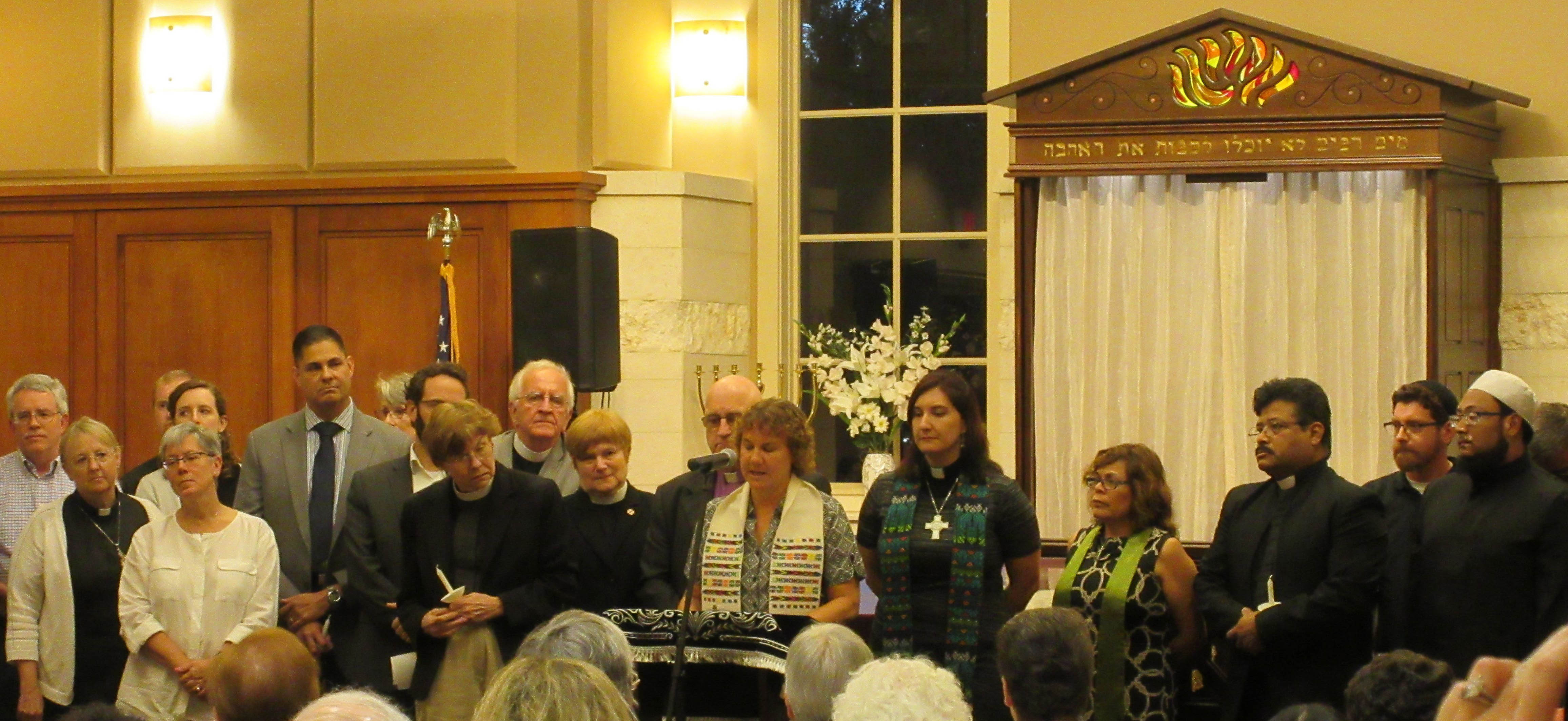
Clergy members of varying faiths stand in unity (photo by Nicholas Hamburger)
The event concluded with a candlelight vigil, at which point an attendee began singing the gospel spiritual, “This Little Light of Mine.” The crowd then joined her in an improvised and collective act of singing that included songs such as “America the Beautiful,” “Down by the Riverside,” and “This Land is Your Land.”
After the event, speakers and attendees discussed their reactions to the violence in Charlottesville as well as to President Trump’s subsequent remarks, which many felt failed to rise to a position of moral authority. “I felt horror for a few days afterward,” Lassalle admitted. “But the turnout and response tonight is very encouraging.”
Other attendees echoed her hopefulness. Jennie Lavine, who initiated the impromptu singing, expressed her pleasant surprise at the size of the crowd, which Beth Israel estimated at 250 people. Judge Sol Gothard concurred: “Coming together like this, everybody is reaffirmed.”
Nonetheless, Gothard was critical of Trump, who he asserted is “responsible for this hatred,” a perspective with which various attendees agreed. Gothard continued: “Since he campaigned, he’s had a problem denouncing the David Dukes and the Nazis of this world. I hold this president accountable.”
