


Meet Tulane’s new Jewish Studies Dept. chair Michael Cohen
By ALAN SMASON, Special to the CCJN
When the fall semester began in August at Tulane University, a familiar face was occupying a new position as chair of the Jewish Studies Department. Michael Cohen, who has been one of five Sizeler Professors of Jewish Studies, since the department was still a program, took over the chair from fellow endowed professor Brian Horowitz after 14 years of his guidance and leadership
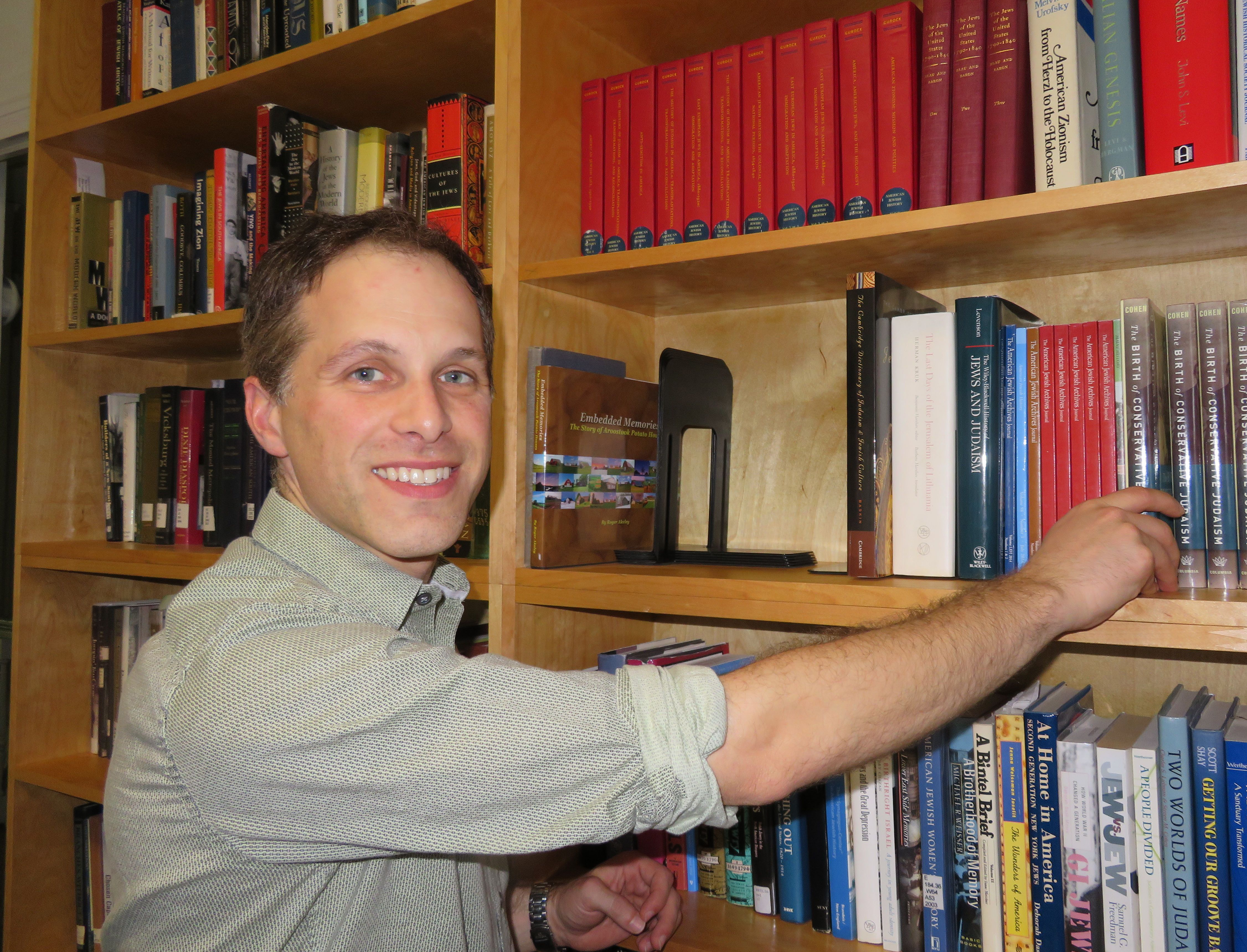
Tulane University Department of Jewish Studies chair Michael Cohen. (Photo by Alan Smason)
The Jewish Studies program was founded in 1981 by professor Joseph Cohen. From its infancy when it had just a few students and a small teaching staff until 2012, when it achieved department status, it grew to service the needs of more than 400 students for each semester. It was during that latter period of change that Cohen served as director of the program interacting with students.
As chair of the department, though, he is responsible to both students and faculty members. Although enrollment is slightly down from previous years, he feels that Tulane is more than holding its own academically with other Jewish Studies departments and programs elsewhere.
“We’re doing really well,” he said. “Our courses are generally full, which is bucking a lot of national trends. For most Jewish Studies programs across the country, enrollment is a big issue.”
Cohen believes part of the reason is a pushback from students in enrolling in the humanities and liberal arts, choosing instead to concentrate on professional degrees that will generate more earning capacity. “I don’t know why Jewish Studies is struggling around the country, but it is,” he conceded.
A native of Maine, Cohen attended Ivy League school Brown in Providence, R.I., from where he obtained his undergraduate degree with honors. He took a year off to essentially teach high school students in New York at the Edward Blank YIVO Vilna Collections Project, a position which afforded him unfettered access to the massive collection begun in Lithuania decades before the Holocaust and then later sent to the U.S. to be digitized and archived after the war.
Despite his original intention to obtain a law degree from Northwestern University (“They still have my deposit,” he confided), Cohen liked delving into Jewish history so much that he elected to pursue a doctorate degree at Brandeis University in Near Eastern and Judaic Studies, which he finished prior to his arrival at Tulane in 2002.
Cohen credits his predecessor and colleague Horowitz as having put the former program and now department on a very strong footing both academically and financially. “He has won grant after grant and I give him credit because he wrote the grant that brought me here,” he chuckled. “But, he’s made this very popular for students.” Horowitz took over his chairmanship from Chris Brady, who followed Cohen.
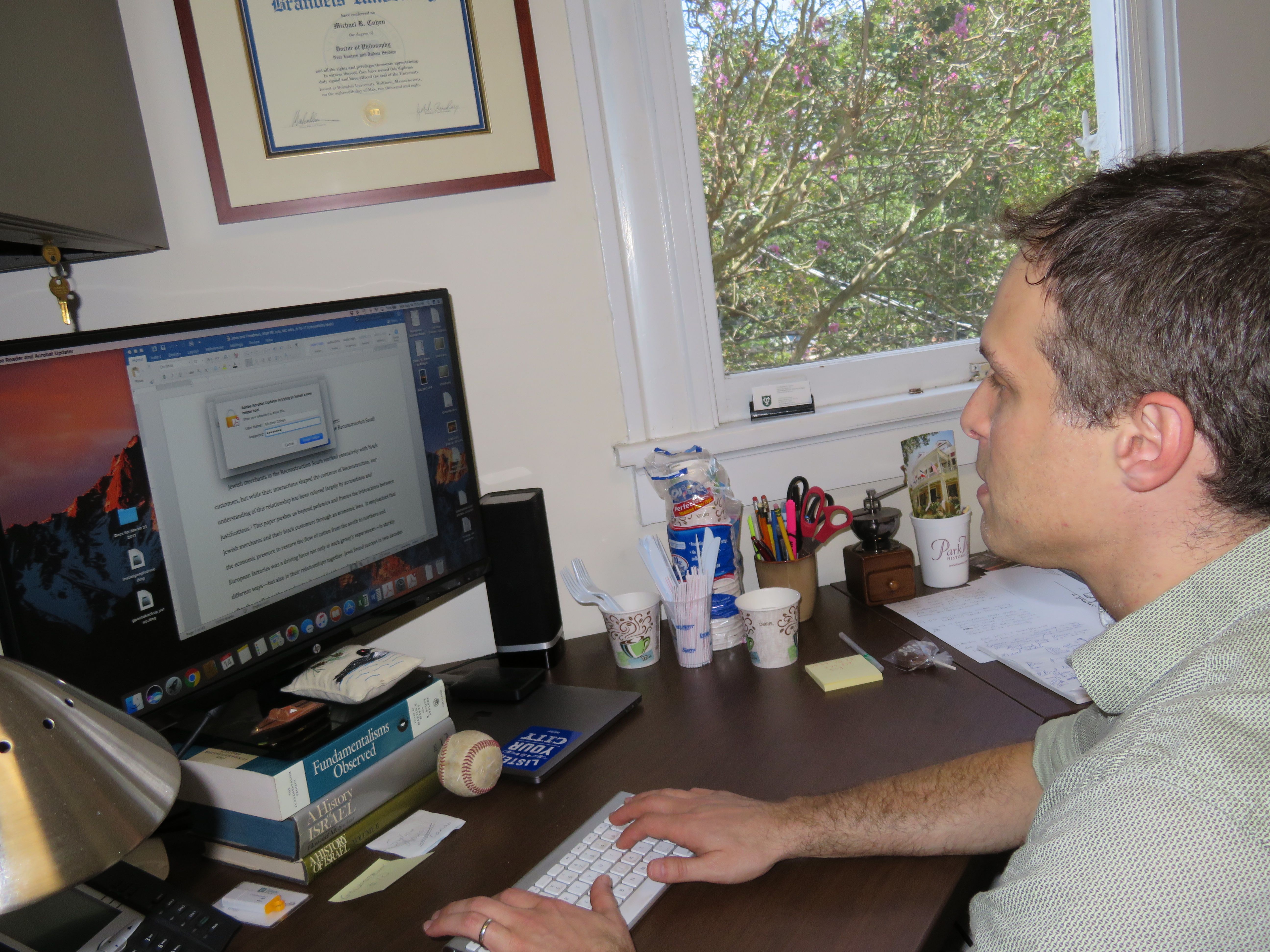
Tulane Jewish Studies Department chair Michael Cohen in his office. (Photo by Alan Smason)
According to figures compiled for a 2017 article on the most Jewish-friendly college campuses published in the Forward magazine, Tulane engages 92% of its Jewish population and 35% of its non-Jewish students and is tied for sixth best Jewish campus. With major influential Hillel and Chabad programs operating near campus, it is perhaps not that surprising that an estimated 30% enrollment in the Jewish Studies department is, in fact, not Jewish.
“We don’t cater to just Jewish students,” he explained. “One of the things that we’ve done is we’ve said ‘We’re going to look at the human experience from the perspective of the Jewish experience. We’re going to look at history. We’re going to look at sociology, anthropology, economics and look at it from all different angles.'”
While current Tulane president Michael Fitts is not, his immediate predecessor Scott Cowen is Jewish. Cohen recognizes that the Jewish Studies Department saw its greatest period of growth during the Cowen administration. The Goldie and Morris Mintz Center for Jewish Life, which houses the Tulane Hillel offices, Rimon Restaurant and several academic classrooms, was built in 2011.
Cohen admits the department is building on what Rabbi Yonah Schiller and Hillel is bringing into the mix . “The type of Jewish student that Tulane is attracting is a very engaged student (and), you know, interested in building community,” he added.
“The level of discourse in terms of Jewish life particularly here at Tulane is very strong, I think,” the professor pondered, praising Schiller for his efforts, which have generated him national attention.
“What we’re doing is also strong and our numbers are higher than the national trends and I think the two really sort of build off one another,” Cohen stated, adding that he believes the students are attending the classes because his department has made them interesting.
The proximity of the Jewish Studies Department building to two prominent Chabad-Lubavitch of Louisiana structures next door on Freret Street is also not lost on Cohen. The Rohr Chabad Student Center for Jewish at Tulane was constructed during the Cowen administration in 2008 and the Btesh Family Chabad House was refurbished, renovated and dedicated in 2014.
All of this has contributed to a blossoming of Jewish enrollment at Tulane with a Jewish population now estimated at 30% of its overall numbers.
Fresh off a sabbatical year that ended at the beginning of his term in August, Cohen is also now attempting to reach out to alumni from the past as an integral part of keeping alumni engaged.
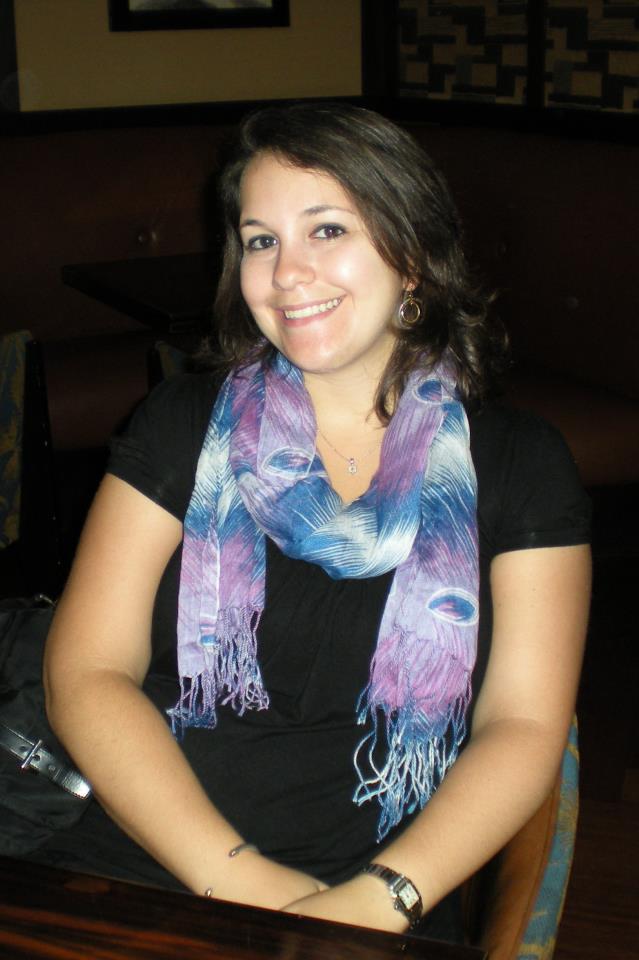
Rabbi Alexis Pinsky of Touro Synagogue, a graduate of Tulane’s Jewish Studies program. (Courtesy Alexis Pinsky)
One of the students he takes considerable pride in is current Touro Synagogue Associate Rabbi Alexis Pinsky, who completed a stint at Congregation Gates of Prayer in Metairie as well. Pinsky started out as a graduate from the Jewish Studies program at Tulane and was associated with Hillel when Cohen first arrived there.
“Alexis is the only one that I’m aware of, at least in my term, who has gone on to rabbinical school,” he noted. “It’s not the track that most Jewish students go in, but it’s great. She obviously found a passion for that here and it’s really neat to speak to her at Touro and to have these conversations with her now that are intellectually stimulating.”
He points to other alumni, who have used their undergraduate work in Jewish Studies to assist their academic load in graduate or professional school. One Jewish Studies graduate enrolled in law school had worked with the American Red Cross and was used to show how the response to the Holocaust or lack thereof has shaped their methods of dealing with ongoing civil emergencies. “Now she’s doing a lot of work with human rights through her law practice,” he beamed.
In addition to his teaching duties and his administrative workload, Cohen also manages to lecture on topics of interest to Jewish Studies programs across the country. He is a former scholar-in-residence of the Jacob Rader Marcus Center of the American Jewish Archives in Cincinnati, where he was a Bernard and Audre Rapoport Fellow. A recipient of the American Jewish Historical Society’s Ruth B. Fein Prize, Cohen also a Monroe Fellow at the New Orleans Gulf South Center at Tulane.
Earlier this year, Cohen published a new academic volume titled “Cotton Capitalists: American Jewish Entrepreneurship in the Reconstruction Era” through New York University Press in which he exposes the private credit network held by Jews prior to and following the Civil War. The network existed, he explained, because no one was willing to trust the Jews with credit.
“After the war, the banking system in the South absolutely collapses,” he continued. “No one has access to credit, except for the Jews because they had their own little networks.” Because of their positions in the markets as a primary source of credit, Jews did really well for a period of time during Reconstruction, he said.
His previous academic volume “The Birth of Conservative Judaism: Solomon Schechter’s Disciples and the Creation of an American Religious Movement” was published in 2012 by Columbia University Press.
Cohen is also the chairman of the Directors Group of the Association of Jewish Studies. He has seen first hand that one of the biggest challenges facing other college campuses is declining enrollments. He feels blessed to be at Tulane.
“The fact that we’re not declining, but growing and the interest is continuing to build is something that is not happening everywhere and is in no way given,” he concluded.
(This is the second of two articles on adult Jewish leaders at Tulane University.)
