


New services: The changing face of funerals in the time of a pandemic
By ANGELA MAONE, Exclusive to the CCJN
During this time of the coronavirus pandemic, many aspects of what had previously been viewed as normal Jewish communal life have undergone change. As with the living, many practices concerning the dead have also changed as have many of the Jewish customs by which friends and loved ones honor the dead.
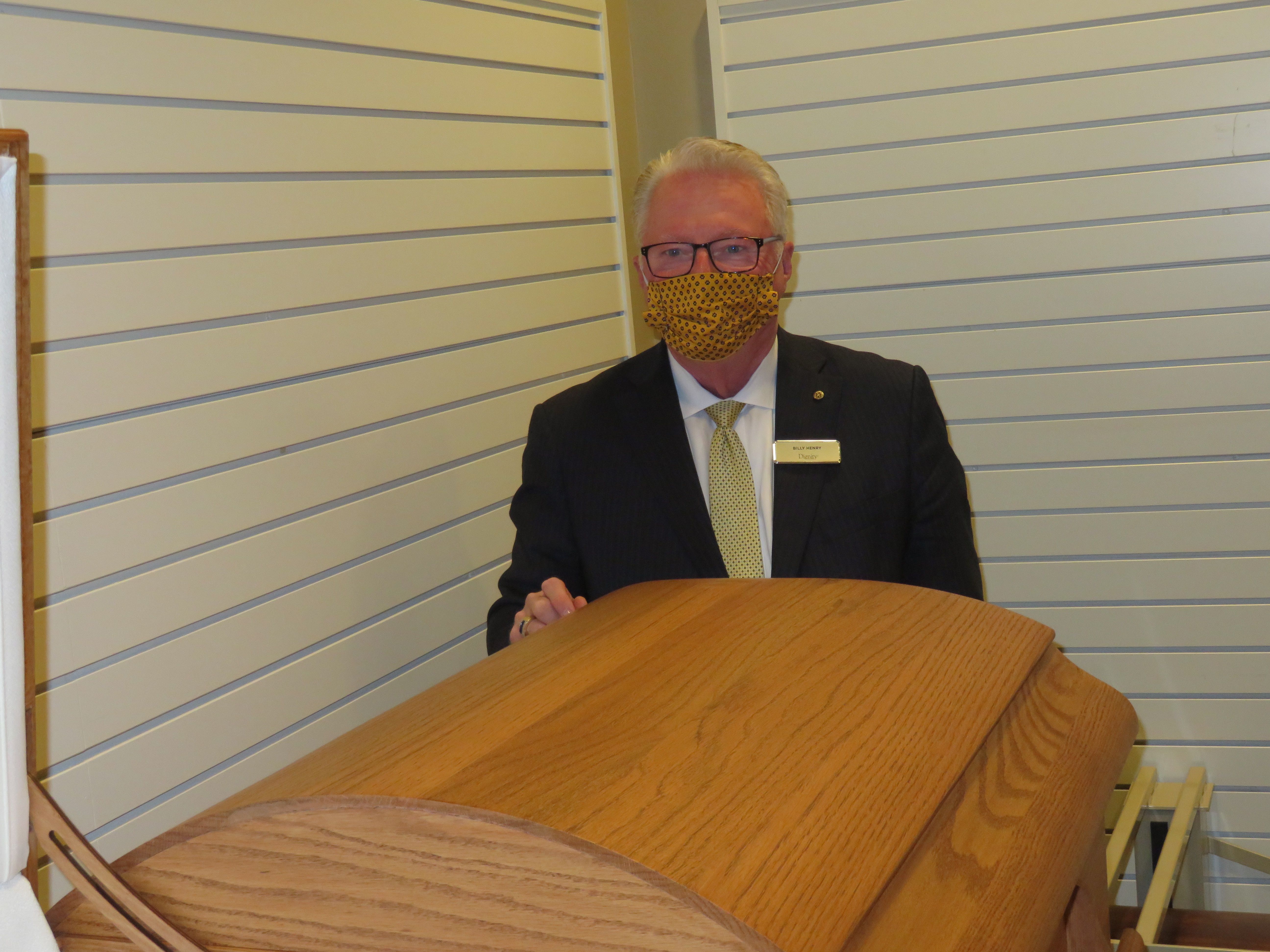
Lake Lawn Metairie Cemetery and Funeral Home executive director Billy Henry wears a mask when dealing with the public these days. (Photo by Alan Smason)
With limits placed on the size of public gatherings and social distancing mandated, funeral directors have had to adapt the services they offer and the manner in which they are extended. The Crescent City Jewish News sat down recently with Billy Henry, executive funeral director of Lake Lawn Metairie Cemetery and Funeral Home to discuss these changes. In addition, Sandy Lassen, president of the Chevra Kadisha (sacred society) of Greater New Orleans, gave some details on how the Jewish burial society performs its services.
Along with Stephen Sontheimer, a fifth generation funeral director, Henry sees to the funeral needs of the Jewish community at Lake Lawn. In addition to his duties there, Henry is also an instructor of funeral services, funeral home management and funeral home directing at Delgado Community College. These days he must wear a mask while conducting business.
CCJN: Our focus is how Lake Lawn is implementing changes because of all the restrictions put in place to fight the spread of COVID-19. What has been the most difficult thing for you, personally, during this time?
Billy Henry: I said to my colleagues, one day a few weeks ago, that I think that the funeral industry is changing by the day and we are the ones who are changing it. We’re changing it because of the needs of the families we’re called on to serve. We have, in the last month, not seen one family in this building. All of our funeral arrangements have been made either by phone and/or internet. The company also has initiated a program called Docusign which will electronically allow families to sign documents we need to have approved. All of those things we knew were out there somewhere in “technoland” have now become part of the funeral business. We are doing, especially with our New Orleans rabbis because they’re all so computer savvy and electronic, virtual graveside services where the rabbi shows up with a cellphone and a little tripod so that everyone that wants to join in in the family can dial into a number and hear the entire service and see the entire service. I think that is just awesome.
CCJN: Can you elaborate more on how the legal requirements have impacted funerals?
BH: Especially with the state guidelines that we can not have more than 10 people in a group to a funeral…(a virtual service) allows people who are out of town and people who are more than the 10 that are allowed to come can feel like they’re part of the services. We also had Rabbi (Katie) Bauman from Touro Synagogue do an entire funeral service from the sanctuary of Touro Synagogue. It was a live feed. The family was able to sit through it and it was just like they were in the sanctuary. Then, she (Rabbi Bauman) met them an hour and a half later at the gravesite and we did the burial. It was just an unbelievable positive thing that we were able to do for the family.
CCJN: What other changes are resonating with you?
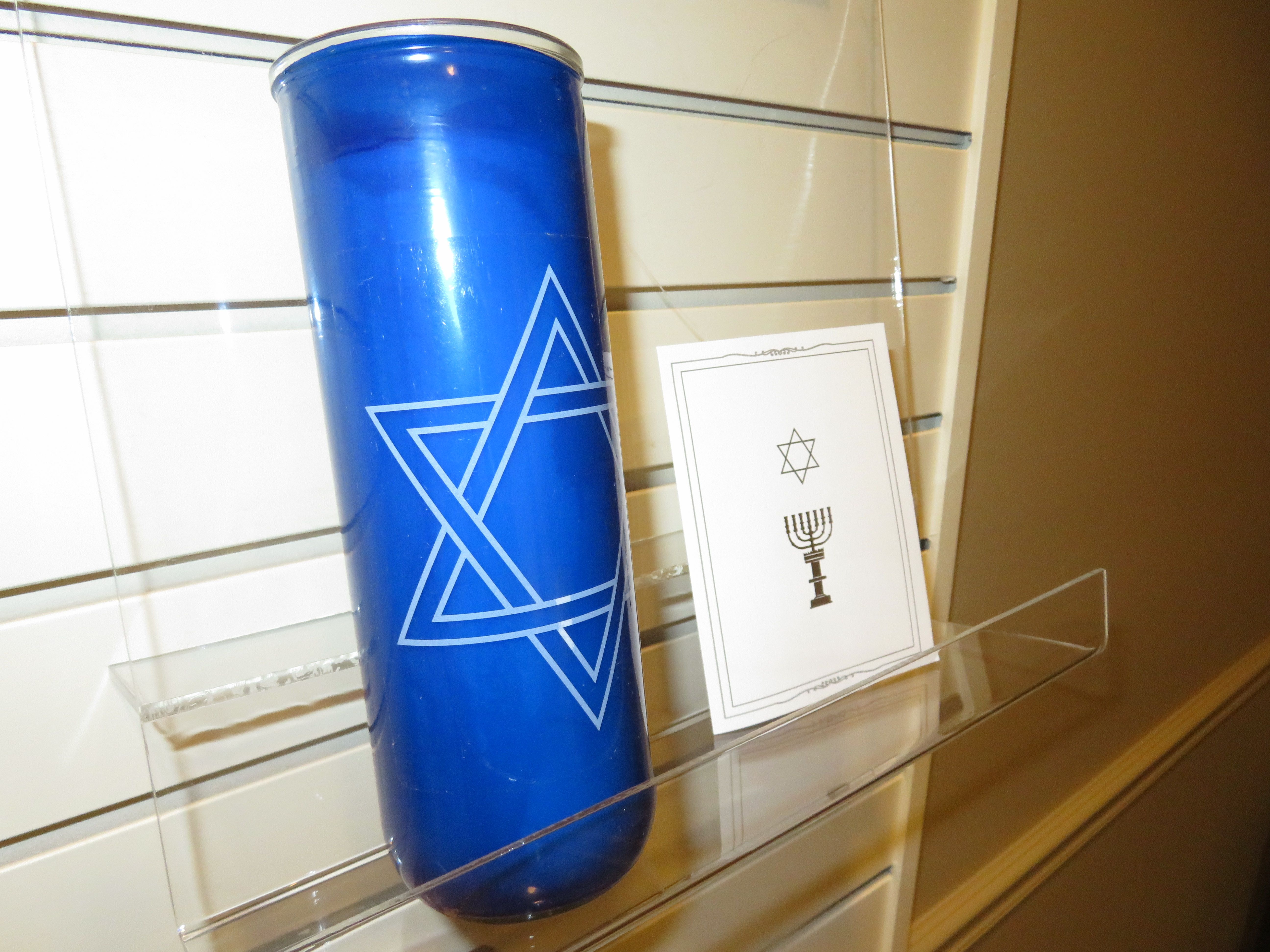
A memorial candle and card containing information about the deceased is shown at Lake Lawn. (Photo by Alan Smason)
BH: The thing that’s touched me over the last few weeks has been conducting funeral services where there may be no family in attendance and I’ve had three or four of those this last week. I have made pictures of the casket, pictures of the burial site –whether it’s a mausoleum or a tomb –and sent those to family members just because I wanted them to be able to feel like they knew that everything was handled properly for their loved one. We’ve had several where there’s only been two or three people and you know that if we weren’t under this coronavirus crisis there would be hundreds of people there instead of two or three. That part is touching when I know that these people and this community have given so much and are notable to have a funeral service that they deserve.
CCJN: Is there something that you can do to help people with grief that are not there? Is there something more that Lake Lawn makes available for those using their services?
BH: For many years the company has done programs such as the Widow to Widow program and programs with parents who have lost children; all different types of death situations. The company also has a program called The Compassion Helpline. If you’re working with our funeral home you have access to the 1-800 number and there are licensed professional social workers and counselors online who can talk to you and help you out.
CCJN: Are there any other services available to help with grief in our community of which you are aware?
BH: I think that there are several organizations within the Jewish community that have not been spotlighted as much maybe as they should have. Some of the best counseling in this city is done by Jewish Family Services. They have a terrific staff that really understands the needs of people. So many times we think that even though a funeral is actually a ceremony it is also closure. It is also being able to put a period at the end of that sentence and put some finality on the person’s life that’s passed away. That’s another thing I see right now that is so sad is that so many people cannot do that and that is very, very tough.
CCJN: Given the limitations put into place by the government and the public’s concern for safety, your business model on the whole has been drastically changed, yes?
BH: Even though as a funeral director this makes me sad, we’ve been able to make these services so intimate and personal and we’ve encouraged families to get the grandchildren to participate or whomever in the family that is involved, even if it’s just watching online. But they have been very, very personal, intimate services with maybe just their rabbi or just their priest and two or three family members.
CCJN: Do you think that process of having such an intimate service might continue into the future?

Jewish caskets on display at Lake Lawn. (Photo by Alan Smason)
BH: Yes I do. Even our funeral arrangements: for 300 years you went into the funeral home, to make arrangements, to select a casket, to do all of these things that you need to do to prepare for a funeral. And here and now we’re being able to present that to a family online or on their computer without their even having to leave their home. All of these things I think are going to continue.
CCJN: Do you think it’s easier on the family or do you think it hinders the closure at not being able to see the casket?
BH: I think it’s probably easier for the family to do the arrangements, but I think it’s harder to have closure for a family that’s not actually at the service or the burial. That is the one thing that is definitely hard on the family, but it’s also, as we believe in Judaism, it’s the last thing that you can perform as a mitzvah for your loved ones or friends. We are still doing taharas in the building and we are doing those with as much PPEs(personal protective equipment) as we possibly can for the men and women who perform them. I think it’s important for the community to know that we are still able to do it in the usual respectful manner.
CCJN: Are taharas done for all Jewish funerals?
BH: In this community we have Reform Jewish congregations, we have a Conservative congregation and we have Orthodox congregations and all of those approach funeral services from a little bit of a different twist. We are able to walk a family through whatever situation, whatever belief that they feel comfortable with, in order to adapt their funeral for that. For example, your Reform Jewish families do not want to have a tahara and they do not want particularly to have the body washed and the ritual; whereas Conservative and Orthodox families feel that that is a very sacred, respectful thing to do for their loved one.
CCJN: Any other things that differ in Jewish funerals?
BH: We do not do visitations in the Jewish community like we do in the Christian community. We have always taken the approach in Judaism that the greatest respect that we can have for the deceased is to be able to lay them to rest as soon as possible. Of course, that is not the belief in the Christian community and we many times will wait three or four days before burial.
* * * * * * * * * * * * * * * * * * * * * * * * * * * * * * * * * * * * * * * * * * * * * * * * * * * * * * * * * * *
In addition to her present position as the executive director of Congregation Anshe Sfard, the only Orthodox synagogue in New Orleans proper, Sandy Lassen is the president of the Chevra Kadisha of Greater New Orleans. Lassen also manages five cemeteries including Anshe Sfard, Tikvat Shalom Cemetery, Chevra Thilim, Chevra Thilim Memorial Park and Jewish Burial Rites Cemetery.
The CCJN interviewed Lassen via telephone.
CCJN: Chevra Kadisha is a holy Jewish burial society made up of volunteers. How does one join the society? Must the volunteer be Jewish?
Sandy Lassen: They call my phone number and say “I would love to work with the Chevra Kadisha.” If it’s a woman, we invite them to come watch a tahara the first time and, if they’re comfortable, they’re in. They get trained that first time. For the men, I believe it’s similar. In order to be a member, they must be Jewish. The thing that I think is really significant and important, is this is a New Orleans Chevra Kadisha, so we do not have just Orthodox, or just Conservative or Reform or Chabad, so we are open to any Jewish person wishing to perform this mitzvah, which is the greatest mitzvah you can do because you’re doing for someone who can never return the favor. It’s just a beautiful, beautiful thing. It’s like caring for a baby. It’s a very inspirational ceremony.
CCJN: What does Chevra Kadisha mean to you?
SL: As I said, to me, it’s the greatest mitzvah one can do for another person. It’s the ability to do something without any type of reward or thanks. It is giving of yourself to bring peace to another person. It’s a group of people that come together to wash, dress and pray over a body before it goes to its final resting place. It makes you feel so holy and special and yet you feel guilty for feeling that but you shouldn’t. But there is just something that goes on in that room, when it’s just you and a deceased person and a few others helping you, it’s just very spiritual. It’s very deep. It’s very moving. It’s very satisfying.
CCJN: You seem very committed to the Chevra Kadisha.
SL: No matter what else I do in my life Jewishly, the most important thing is the Chevra Kadisha to me. I never say no, because to me it’s something that I can give to someone else without expecting anything in return and get such a spiritual lift from it. The prayers you say over the body are basic prayers, but they talk about the goodness of the person and they talk about where the soul of the person is going to go now. It’s just beautiful prayers of Judaism that are used for this ceremony.
CCJN: Can you elaborate more on the tahara ritual?
SL: One of the beautiful things is when you bring someone new in and they do it for the first time. I think there’s only one person in the 30 years I’ve been doing this that said “I can’t do this.” And that’s amazing to me. It’s like a little miracle. I am not one of these touchy, feely kind of people. I’m sarcastic.This softens me. A lot of women who work with me feel the same way, because one of the things you have to do when you go in that room is you have to put aside anything troubling you. You are there for that person.
Lassen invites any interested parties looking to volunteer to be a part of the Chevra Kadisha to email her at slassen@cox.net or dial (504) 782-7218. She encourages volunteers of all ages and genders to contact her, but is especially interested in diversity of age, encouraging younger people to volunteer so as to carry on the time-honored tradition of the Chevra Kadisha.
