


WW2 Museum unveils interactive concentration camp liberation exhibit
BY DEAN M. SHAPIRO, Special to the CCJN
When Alan Moskin, along with other members of his military regiment, entered the village of Lambach, Austria, on May 4, 1945 in the closing days of combat on the European front of World War II, little did he know the horror that awaited him and those who were with him.

Former Staff Sgt. Alan Moskin, an interactive feature of the National World War II Museum’s “Dimensions in Testimony” exhibit. (Photo by Dean Shapiro)
Nor could he have foreseen that, 75 years later, he would be the centerpiece of an exhibit in a New Orleans-based museum dedicated to commemorating the war in which he had fought as a draftee in his late teens.
The gruesome sight that greeted Moskin and members of his regiment was the emaciated bodies of the survivors of the Gunskirchen sub-camp of the infamous Mauthausen concentration camp. There were roughly 15,000 survivors, most of whom were barely clinging to life. In their squalid, overcrowded huts were thousands of rotting, stench-producing corpses of mostly Hungarian Jews who had been force-marched there during a brutal winter and later died from starvation and disease, especially typhus and dysentery. They were among the millions of victims of the Holocaust perpetrated by Nazi Germany against the Jews and other minorities deemed as “undesirables” by Hitler and his minions. The camp had been abandoned by the Nazi SS guards just days earlier, leaving the helpless survivors to fend for themselves.
The story that the 95-year-old Moskin recounts of the suffering he witnessed at Gunskirchen is now the featured exhibit of a second floor gallery in the National World War II Museum in downtown New Orleans. The exhibit, titled “Dimensions in Testimony,” tells the story of the Allied “liberators” who freed the surviving inmates of the thousands of such detention camps spread out through Germany and the nations they conquered between the late 1930s and the mid-1940s.
The exhibit, which opened on Thursday, February 4, will run through July 25.

A family asks questions of Alan Moskin’s image. (Photo courtesy National World War II Museum)
A series of signs on the gallery walls, along with several greatly enlarged photos from that time, spell out for visitors the story of the Gunskirchen camp. A glass-enclosed case displays artifacts from that time, including a Nazi flag, a German luger pistol and the journal written by one of the rescuers from Moskin’s regiment. Moskin, himself, is the featured attraction of the exhibit, but not in person. Thanks to advances in modern technology he appears in an interactive installation projected onto one of the gallery walls, able to answer questions posed by visitors who click on a computer mouse mounted on a podium in front of Moskin’s visual image.
The traveling exhibit is sponsored by the University of Southern California (USC) Shoah Foundation.
Kim Guise, assistant director for Curatorial Services at the National World War II Museum, and Keith Darcey, the museum’s public relations manager, explained that Moskin was previously interviewed in person for five days and asked over a thousand questions. Moskin’s pre-programmed responses are triggered by the voice recognition of a number of key words, they noted.
“At The National WWII Museum we place primary importance on oral history and firsthand personal accounts of the war, hearing directly from those who experienced the war,” Guise stated in a press release. “Dimensions in Testimony allows participants to continue the conversations with Holocaust survivors and with liberators. Visitors and students can ask questions and receive real responses in the very words of those who lived through these experiences even when those witnesses can’t be present.”

A guest asks Alan Moskin a question, which he “answers” by playing back 1,000 pre-recorded answers. (Photo by Dean Shapiro)
As one of 500,000 American Jews to serve in World War II, Moskin was drafted into the Army at age 18 and assigned to the 66th Infantry Regiment, 71st Infantry Division, 3rd Army, commanded by General George S. Patton. In the interactive projection, as well as in live interviews and publications, he describes in gory detail the stench that emanated from the camp as the soldiers approached it and the sight of many survivors who were so emaciated he described them as “human skeletons.”
Other members of that unit, in a number of published interviews and personal journals, recall how overjoyed the survivors were to see the Americans who had come to set them free, but many of them were too weak and famished to celebrate the occasion.
Moskin and the members of his regiment spent several days in the camp feeding the survivors and gathering up residents of the nearby village to pick up the corpses and deliver them on wagons to a mass burial site. He later attended several sessions of the Nazi war crimes trials in Nuremberg, Germany, observing the proceedings in preparation for a post-war career as a lawyer, and he rose to the rank of Staff Sergeant prior to his honorable discharge in 1946.
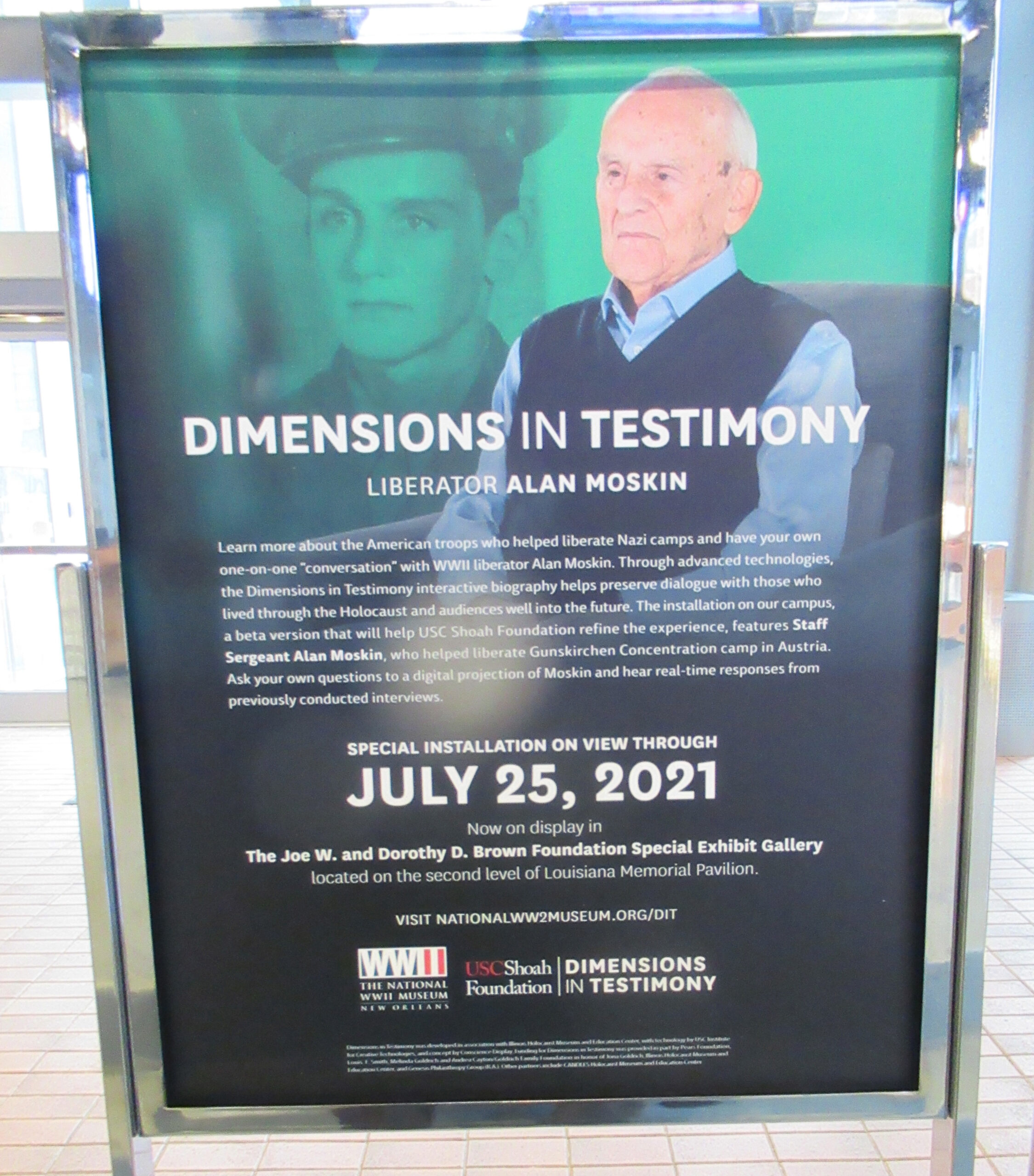
A sign advertising the museum’s “Dimensions in Testimony” exhibit now on through July 25. (Photo by Dean Shapiro)
Born on May 30, 1926 in a “mixed neighborhood” in Englewood, New Jersey, a mid-sized city just a few miles across the Hudson River from New York City, Moskin attended school and shul there. He later attended Syracuse University, both before and after the war, graduating there and going on to earn a law degree from New York University Law School.
Along with his wife and two daughters, they moved to Rockland County, NY, just across the state line from New Jersey. He practiced civil law before going into the private sector, retiring in 1991. Only rarely during those post-war years did he discuss the traumatic experiences he witnessed during the liberation of the Gunskirchen camp.
In previous interviews Moskin expressed his fears that discussing what he had seen would have been too traumatic for him. Even his immediate family members were kept largely in the dark. It wasn’t until 1995, 50 years after the war’s end and only after persistent prodding, did he finally come forward with the story of his experiences. Since that time he has traveled widely, over more than a dozen states and countries, lecturing at schools and events that were open to the public.
During his talks he explains that what compelled him to come out and speak publicly is the current trend of Holocaust denial and the passing of survivors who, during their lifetimes, could counter the arguments with recitations of their own experiences.

A photos of Alan Moskin taken during the war. (Photo courtesy of National World War II Museum)
During a recent talk at a college in Peoria, Illinois, he said, “They were saying it was exaggerated. Well, that really pushed my button. That’s why I am here. The people who were killed by the Nazis can’t speak, but damn it, I can. I am their messenger. Indifference is the same as consent. Inaction is the same as consent.”
On May 4, 2021, the anniversary date of the Gunskirchen liberation, Moskin will make a virtual appearance during a live webinar at the World War II Museum, telling his story and answering questions from those who are present.
The Crescent City Jewish News asked Moskin a series of questions from the podium and received his pre-programmed responses. Below is a summary of highlights of that virtual interview (edited for greater clarity):
CRESCENT CITY JEWISH NEWS: You were born in Englewood, New Jersey. Did you grow up there?
ALAN MOSKIN: We lived in a nice, regular household, houses very close together. A lot of Jewish families nearby. Black and Catholic families nearby. Very diverse neighborhood. I like to quote Maya Angelou who said “We are more alike than we are unalike.” I learned that when I was a kid. I never recall any actions of anti-Semitism or racial incidents. When I grew up I tried to carry that on. Unfortunately many other people didn’t have the benefits of growing up as I did in a very diverse area. It was part of my education.
CCJN: Did you see action in combat?
AM: During combat in World War II I was an 18-year-old soldier; one of the youngest in my division. Being in combat was like being in hell and back, seeing your buddies get blown away so often. Obviously it’s not a normal thing for a young 18-year-old boy to experience. I was well-trained. I did my job but I always say I was one of the lucky ones because if I was standing at the right or the left at any given time I wouldn’t be here talking about it. So a lot of these things go through your mind. You think about your parents, home, friends. You try to get your mind off it and just do your job.
CCJN: Did you know anything about the Nazi atrocities before you arrived at the Gunskirchen camp?

Part of the exhibit at the Dimensions in Testimony exhibit. (Photo courtesy National World War II Museum)
AM: Before we entered the concentration camp we didn’t know anything about it, as is my recollection. I was told by officers, my sergeant and buddies . . . we knew that Hitler wasn’t fond of Jews or (there was) hearsay that the Jewish people in Europe were having a rough time; general stuff like that. But as far as a concentration camp, I don’t recall anybody talking about it or knowing about it before we actually saw and liberated one. That goes for my officers. I don’t recall any of them indicating there was a concentration camp that we were approaching. That we were going to see one. I don’t remember any of that dialogue.
CCJN: What were your initial reactions on seeing the conditions of the camp?
AM: Commanding General Eisenhower got the word out to all of our officers that he didn’t want us to pick up the bodies and we needed to bring the people in from town to let them witness (the carnage). The officers would get the grunts – that what we called them in the infantry – to bring the people by truck into the camp and let them witness this and get it all down and then have them pick up the bodies and put them on the trucks. We brought civilians in. I remember them covering their eyes with their hands like they didn’t want to look or couldn’t look. That smell we’re talking about; they were trying to breathe and they would come out like they were in shock. Some of them were crying. They started carrying out the bodies and putting them on the truck as we witnessed it. The German-speaking interpreter, all he kept saying was “Everybody says they didn’t know about this. It was completely new to them.” That’s the word we got; they didn’t know what happened. And this was pretty close to a pattern. The stench – we smelled it before we even got to Gunskirchen. It permeated (the air). So they took the bodies to where they were supposed to be buried. I didn’t participate in that. It wasn’t long after that we left Gunskirchen altogether.
CCJN: Did you participate in the liberation of other camps besides this one?
AM: Yes. After Gunskirchen as the days progressed, it was the end of the war. Officially it was May 8, 1945 (that Germany surrendered) we started coming in contact with other outfits and they talked about other camps they had liberated. One after the other, whether it was Bergen-Belsen, Buchenwald or wherever. Over a period of time, a week or so, every outfit was liberating another camp. I found out later there weren’t just hundreds; there were thousands of these camps if you count all the sub-camps all over Europe. And of course more testimony came out later on during the Nuremberg war crimes trials and the information was more specific. There were other matters like hearsay; hearing from one guy, you assume it’s the truth and then every day you were hearing something else. There were so many camps and sub-camps you couldn’t keep track. And that’s why I attended the Nuremberg crimes trials, to try to get more detailed information other than what I heard from my buddies and other people.
CCJN: Did you personally attend the Nuremberg trials?
AM: Yes I did attend the Nuremberg war crimes trials several times. And the reason I wanted to go, and did go whenever I had a pass . . . was that I intended to be a lawyer; go back to school and go to law school. I wanted to see Robert Jackson who was our chief prosecutor at the trials and just see what was going on so I could know what kind of testimony I was likely to see. In the beginning there was a lot of curiosity but I was there more to see how the legal process would progress and that was my motivation, initially, to go to the trials.
CCJN: Did you have children and, if so, did you discuss your war experiences with them?
AM: I don’t think we ever had any conversations about my wartime experiences. I may have said it indirectly or casually at dinnertime or when something would remind me of something here and there but I really don’t think I went into that, as I recall. They always knew that I was a soldier in World War II. I think once in a while I may have spouted out something about what I experienced but I never actually sat down and talked about it. Maybe I felt that for my daughters in particular it might have been too heavy or too gross or whatever. I couldn’t talk to them like I maybe could to a boy. I might get them too upset by it. So I don’t believe I had any direct conversations about what I experienced when they were younger. . . I may have talked a little bit about it but I really didn’t get into it. I think I was fearful of discussing it too much from my own standpoint because I feared I had some residual effects which would probably be PTSD and not even knowing what it was because we never heard about it in World War II. They would just say you were shell-shocked and there’s something wrong with you. So knowing that in the back of my mind, I didn’t want to talk about my experiences in World War II.
CCJN: Why did you wait so many years before you began telling the story of your experiences at Gunskirchen?
AM: I got a call in the summer of 1995. Somebody who was the executive director of the Holocaust Museum in Suffern (NY) by the name of Barbara Grau. Somebody told her that a Mr. Moskin was a soldier with Patton and a liberator. When I realized that she was calling me up on the telephone asking, “Is that true?” I said “Yes.” When she replied, “Now I’ve got somebody to speak to the schools” I hung up the phone on her. I was shook up and I didn’t mean to be rude but she was asking me to speak which I hadn’t done. She kept calling me up being nice and asking me “Please, please, Mr. Moskin. Try it once. If it’s too much and upsetting, I’ll never ask again. But maybe give it a shot.”
So that’s what got me to try and speak the first time which was on June 10, 1995, 50 years after the end of the war in Europe and that was when I first talked. It was like a catharsis. All that what had been bottled up inside of me about this and that concentration camp just came back to me. I spoke for the first time at the local Nanuet Mall (in Nanuet, NY). It was an adult group; a bunch of people and I was shocked at how it was like a liberation coming out of me and the emotions came out in the people I could see who were emotionally affected by it. And everybody was very complimentary and that’s what got me to start speaking.
Since that day I’ve been a busy, busy boy. I’ve spoken in so many different schools, 13 different states in the United States. I went to Stockholm, Sweden. Spoke at universities. At last count they’ve got me at well over a hundred thousand students that I have spoken to. It’s been good for me and hopefully it’s been good for those who’ve heard my talk. My main goal is to get younger people to understand what we saw there and make sure that those of us who witnessed the horror will speak to their children and grandchildren so that, when we’re gone and when the Holocaust deniers come out of the woodwork, they make sure that (the deniers) understand that the Holocaust was no myth. It happened and they got to make sure that the hate that we saw there and all that garbage never happens again.
CCJN: Do you have a message for people today regarding the Holocaust and do you see any parallels going on today?
AM: Like I’ve said many times before and I’ll say it again, the most important message I can get out there is that we must not hate. Hate is a negative characteristic. Hate begets hate. Hate doesn’t accomplish anything for the individual or for the people that they hate. Let’s be positive and not think about hate. And so I would just say make every effort not to hate. Learn to love and hug each other. Be friends with each other and not hate.
(To view a more detailed, 20-minute talk by Alan Moskin go to https://www.youtube.com/watch?v=oh8O0C59q2k&feature=youtu.be)
To ensure a safe experience, Museum visitors are asked to reserve timed admission tickets in advance, practice physical distancing by maintaining a space of six feet or greater from other visitors and wear a face mask/covering at all times.
“Dimensions in Testimony: Liberator Alan Moskin” will be displayed in New Orleans from February 4 to July 25, 2021, in The Joe W. and Dorothy D. Brown Foundation Special Exhibit Gallery on the second level of Louisiana Memorial Pavilion. The National World War II Museum is located in downtown New Orleans on Andrew Higgins Drive between Camp and Magazine streets. Museum hours are 9:00 a.m. – 5:00 p.m. daily. For more information call the museum at (504) 528-1944 or (877) 813-3329 or visit their website. To reserve tickets click here.
