


Rabbi oversees construction of new Metairie eruv
By ALAN SMASON, Exclusive to the CCJN
It would seem Rabbi Stephen Belsky is more at home in a bucket truck than he might be in a classroom or on a pulpit. The suburban Detroit rabbi has spent much of his time in Metairie over the course of the last six months, working as a consultant on the re-erection of the Metairie eruv,
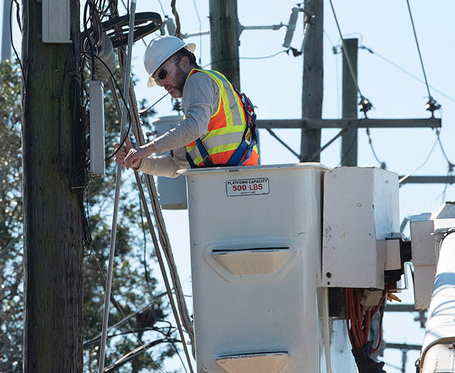
Rabbi Stephen Belsky attaches conduit to the sides of the utility poles, establishing a boundary of the Metairie eruv. (Photo by Alexander Barkoff)
Belsky was brought in as an eruv consultant following the declaration last year that the northern border of the eruv defined by the Lake Pontchartrain levee was no longer of a sufficient slope to be considered a proper wall, according to halachic interpretation.
Eruvs are enclosures, which emulate the walls of ancient cities and allow for the carrying of items like house keys, using a cane, picking up babies and pushing a baby stroller. Eruvs encourage the proliferation of observant neighborhoods beyond one’s home and can be a significant factor in attracting young couples.
Modern eruvs are typically defined by high tensile string like fishing line or wires suspended above a neighborhood. In many cases, existing structures like power lines and utility poles will substitute for physical walls.

The map of the new Metairie eruv.
The Metairie eruv, which is maintained by Congregation Beth Israel under the leadership of Rabbi Joshua Pernick, had been used for several years for families living along the West Esplanade Avenue corridor where Beth Israel, the Chabad Center of Metairie, Shir Chadash Conservative Congregation and the Goldring-Woldenberg campus that houses the Jewish Community Day School and the Jewish Federation of Greater New Orleans offices are located.
It had been erected and maintained under an original plan proposed by Congregation Beth Israel Rabbi Uri Topolosky. In addition to several existing power lines and utility poles along Causeway Boulevard and other streets in Metairie, the eruv used the Lake Pontchartrain levee structure as its northern border.
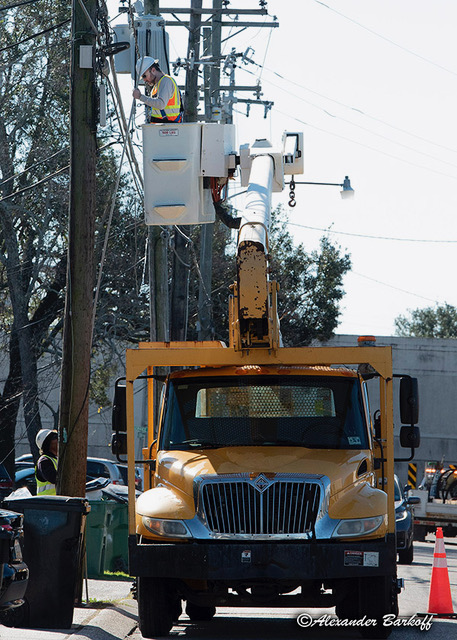
Rabbi Stephen Belsky in a bucket truck attaching conduit for the Metairie eruv. (Photo by Alexander Barkoff)
When work began on a planned Uptown eruv, initially proposed by Congregation Anshe Sfard Rabbi David Polsky, a Chabad eruv expert, Rabbi Sholom Shuchat, went out to Metairie to determine what had been erected there previously. He had hoped to duplicate the effort in Metairie and, possibly use the Mississippi River levee as an Orleans Parish eruv border.
However, he quickly determined that work done over the years to improve the Lake Pontchartain levees had altered their original slope and that the minimum ratio needed for an eruv boundary no longer existed. Several breaks in the northern border around the nearby Jefferson Parish pumping station also were noted as problematic. The consequence was that at the time in July of 2021 that the Uptown eruv was deemed “up,” the Metairie eruv was declared “down.”
The New Orleans eruv, which is maintained by Congregation Anshe Sfard under the leadership of Rabbi Yonachan Rivkin, benefits the Jewish communities living in the Garden District, Uptown, University and Carrollton neighborhoods. This includes Anshe Sfard, the Btesh Family Chabad House, the Rohr Chabad Student Center and the Goldie and Morris Mintz Hillel Center at Tulane.
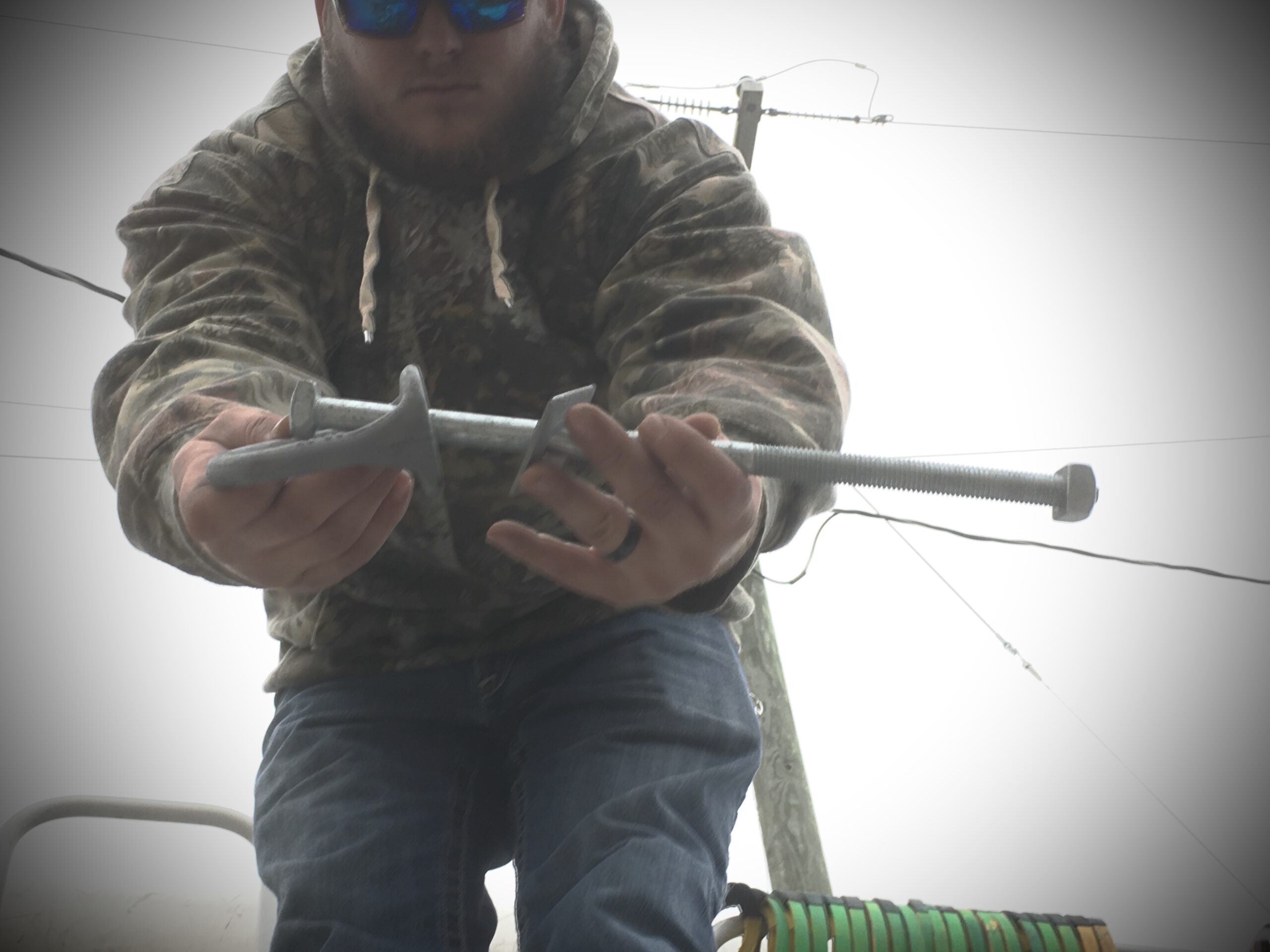
A worker shows an i-bolt which is drilled through a utility pole and used to attach fishing line for an eruv. (Photo by Rabbi Stephen Belsky)
Belsky received special training as an eruv consultant from Rabbi Micha Schotkin, a respected New Jersey eruv builder, following his work on the downtown Baltimore eruv. He is presently consulting on several other eruv expansions or erections of new eruvs and has completed work on three of them including the new Metairie eruv.
But the Brooklyn, New York native found his work in Metairie a bit of a challenge. Initially, Belsky came down to New Orleans from Detroit during the summer and stayed at the rabbinic residence occupied by Rabbi Pernick. He began to inspect the existing eruv structure and had hoped to be finished sometime after the High Holidays. However, his survey work was interrupted for several months due to the passage of Hurricane Ida on August 29, which crippled the area with no electric service.
Belsky was forced to put the Metairie eruv plans on hold, but returned to New Orleans in the fall and has been working on re-establishing an eruv for most of the last two-month period. His eruv work, which includes using bucket trucks or lifts to attach i-bolts and string fishing line to utility poles, could not be done entirely by himself. There were sections of the new eruv that required assistance from Entergy, which maintains the power lines in the area.
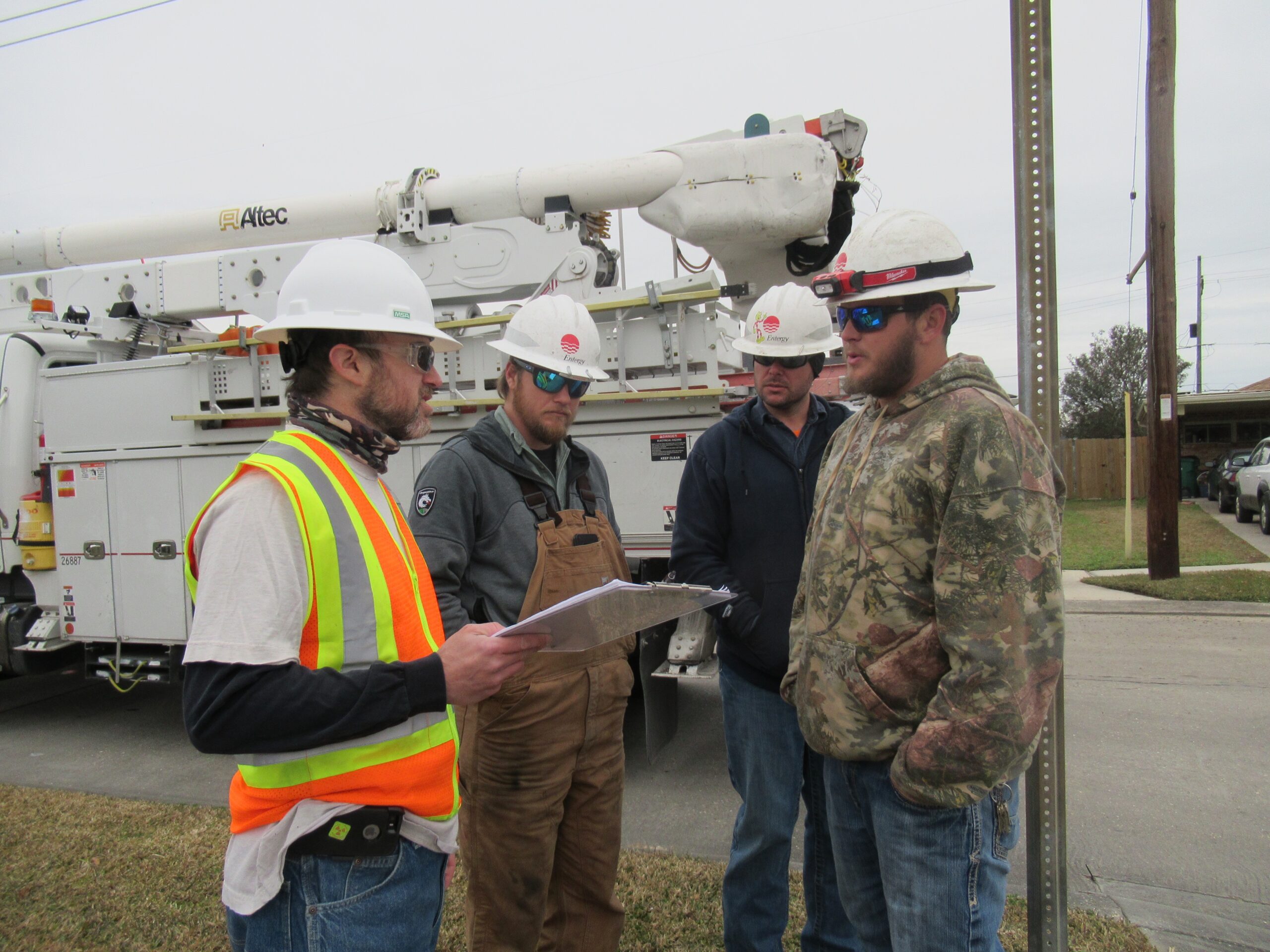
Rabbi Stephen Belsky, left, holds diagrams of where fishing lines need to be strung to complete the Metairie eruv, as Entergy workers await instructions. (Photo by Alan Smason)
He also worked with Jefferson Parish officials to get their approval and, after consulting with Entergy, arranged for several of their own crew and three bucket trucks to go out along several sections of the existing or proposed deruv where the utility poles were no longer vertical to the ground.
It was critical that Belsky receive approval and cooperation from Entergy as well as from Jefferson Parish or else the eruv would not be deemed to be kosher.
In a series of interviews with the CCJN, Belsky admitted his work as an eruv consultant, which employs the tools and equipment of a construction worker, fulfills a childhood ambition.
“I grew up in an apartment in Brooklyn, so there wasn’t a lot of hands-on power tools, do-it-yourself kind of activities going on,” he said. “I always wanted to learn how to build things. When I was little, one of my dreams was actually to be a construction worker.”
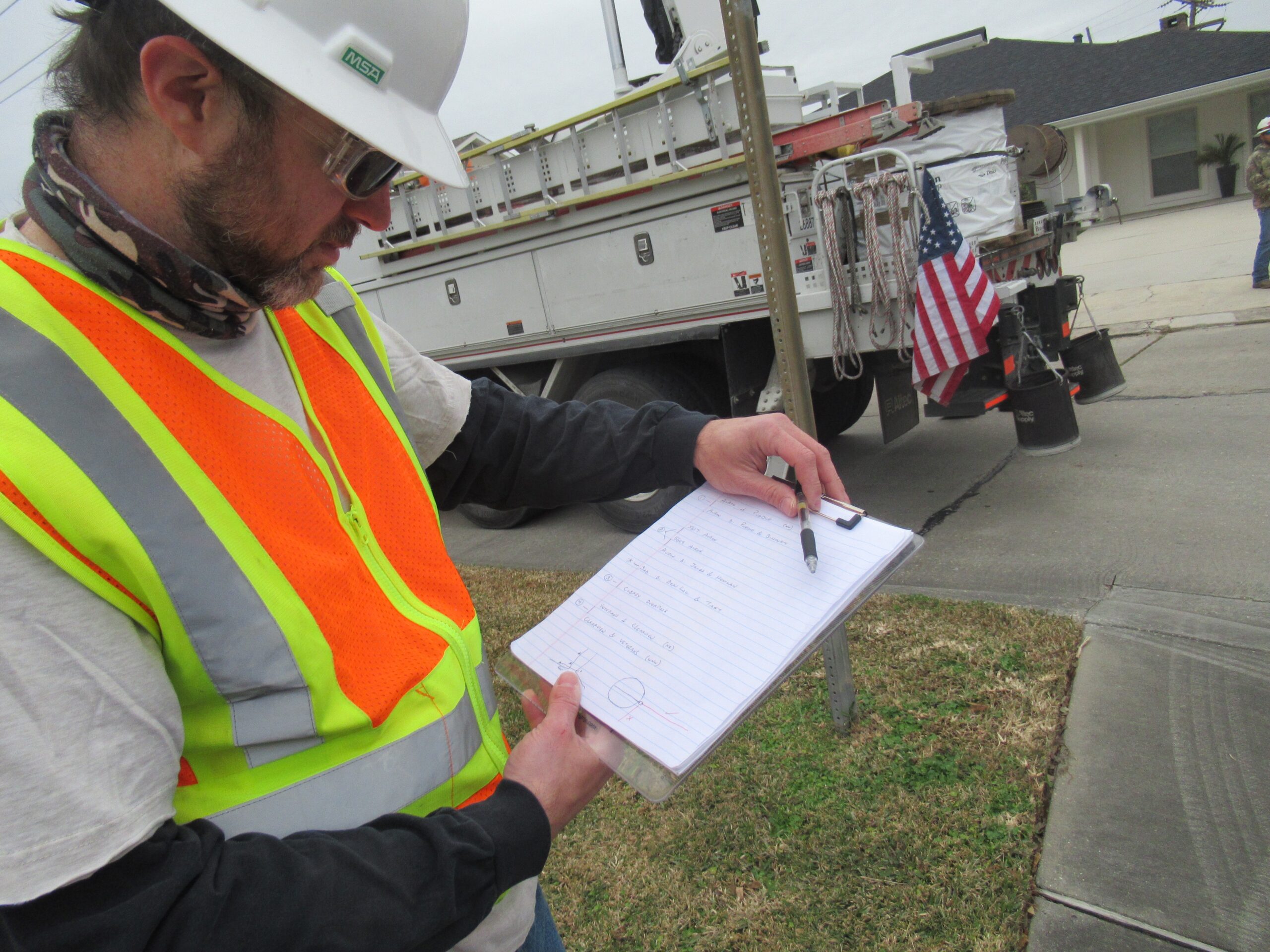
Rabbi Stephen Belsky consults the diagrams he has for completion of the Metairie eruv. (Photo by Alan Smason)
As he matured, though, he became more interested in Jewish education. His college track had him majoring in Jewish Studies and Linguistics and, following studies at the Pardes Institute in Jerusalem, he returned to his hometown to teach high school students.
After a few years of teaching, Belsky enrolled as a rabbinical candidate at Yeshiva Chovivei Torah (YCT) under the leadership of Rabbi Avi Weiss, a renowned Modern Orthodox leader. Following his ordination, he moved to Detroit, where he began to gravitate towards manual labor jobs and worked for a short time in manufacturing, while still teaching adult education classes for synagogues and other Detroit area community institutions.
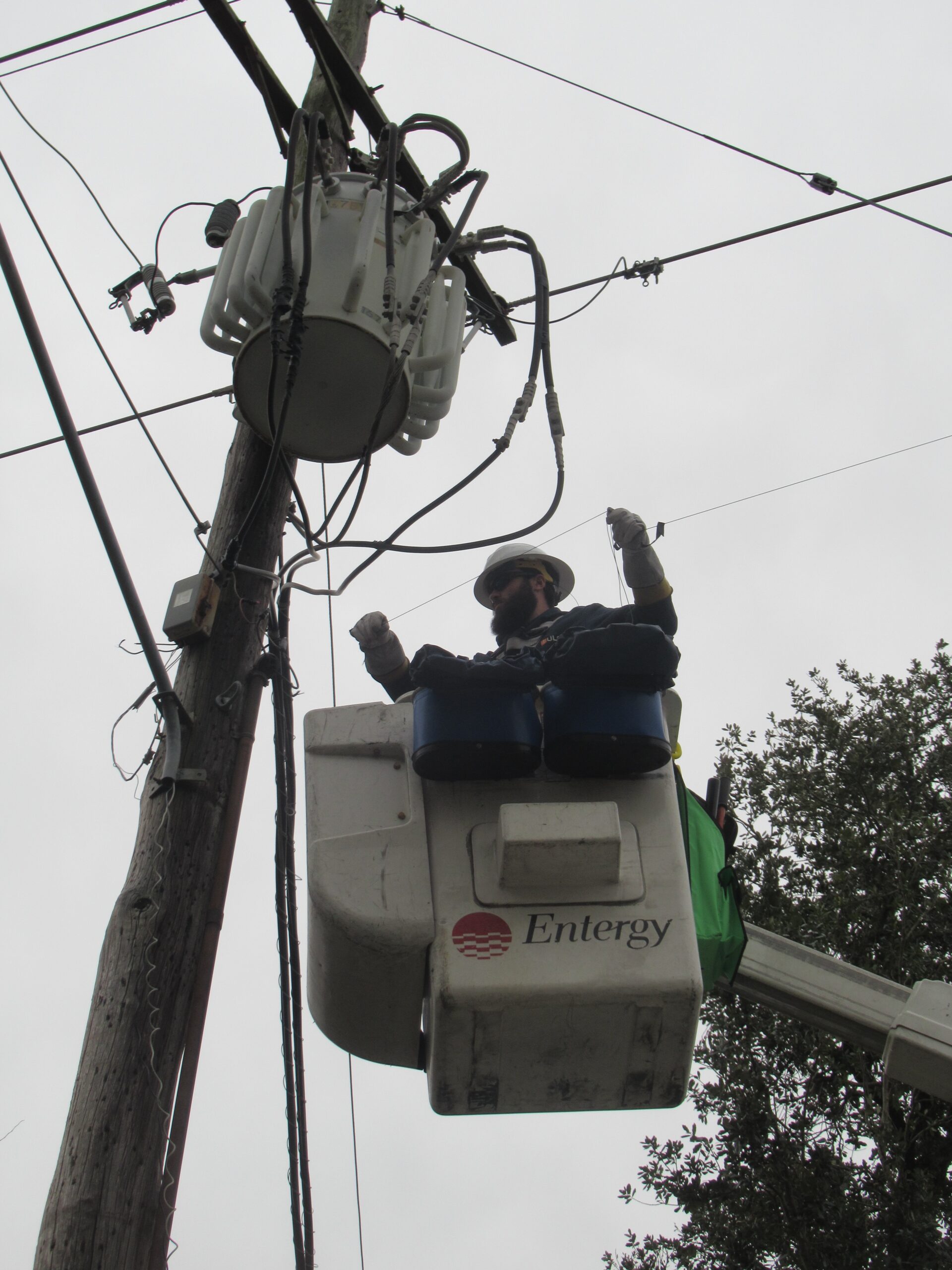
An Entergy worker attaches a fishing line to finalize the eruv. (Photo by Alan Smason)
Then one day in 2019, a friend called him. “‘You’re handy – do you want to build me an eruv?'” Belsky recalled the conversation in an email to the CCJN. That was how he got involved with the downtown Baltimore eruv and he’s become more involved with the process ever since.
“I realized that building eruvs was the dream job I never knew I wanted (combining Jewish legal analysis, creative physical labor, and service to the community, as well as sometimes great views from high up a utility pole),” Belsky continued. His training with Rabbi Shotkin took place shortly before working on the South Philadelphia neighborhood extension of the Center City Philadelphia eruv.
“While I’ve learned (and continue to learn) the halachic rules that define how eruvs function, I have no pretensions of being a halachic decisor / poseik,” he added. “Every community has their own rabbis who they turn to for halachic guidance, and I’m just the contractor/construction worker who follows those decisions and instructions.”
