


Jewish creatives, cast member breathe new life into ‘The Diary of Anne Frank’ at WW2 Museum
By ALAN SMASON, WYES-TV Theatre Critic (“Steppin’ Out“)
The National World War II Museum is presenting the final weekend of shows of an updated adaptation of “The Diary of Anne Frank” and it turns out that Joel Ellis, a member of the cast; Alix Page, the dramaturge and Rachel Whitman Groves, the play’s director, are all Jewish and spoke with the CCJN over the phone.
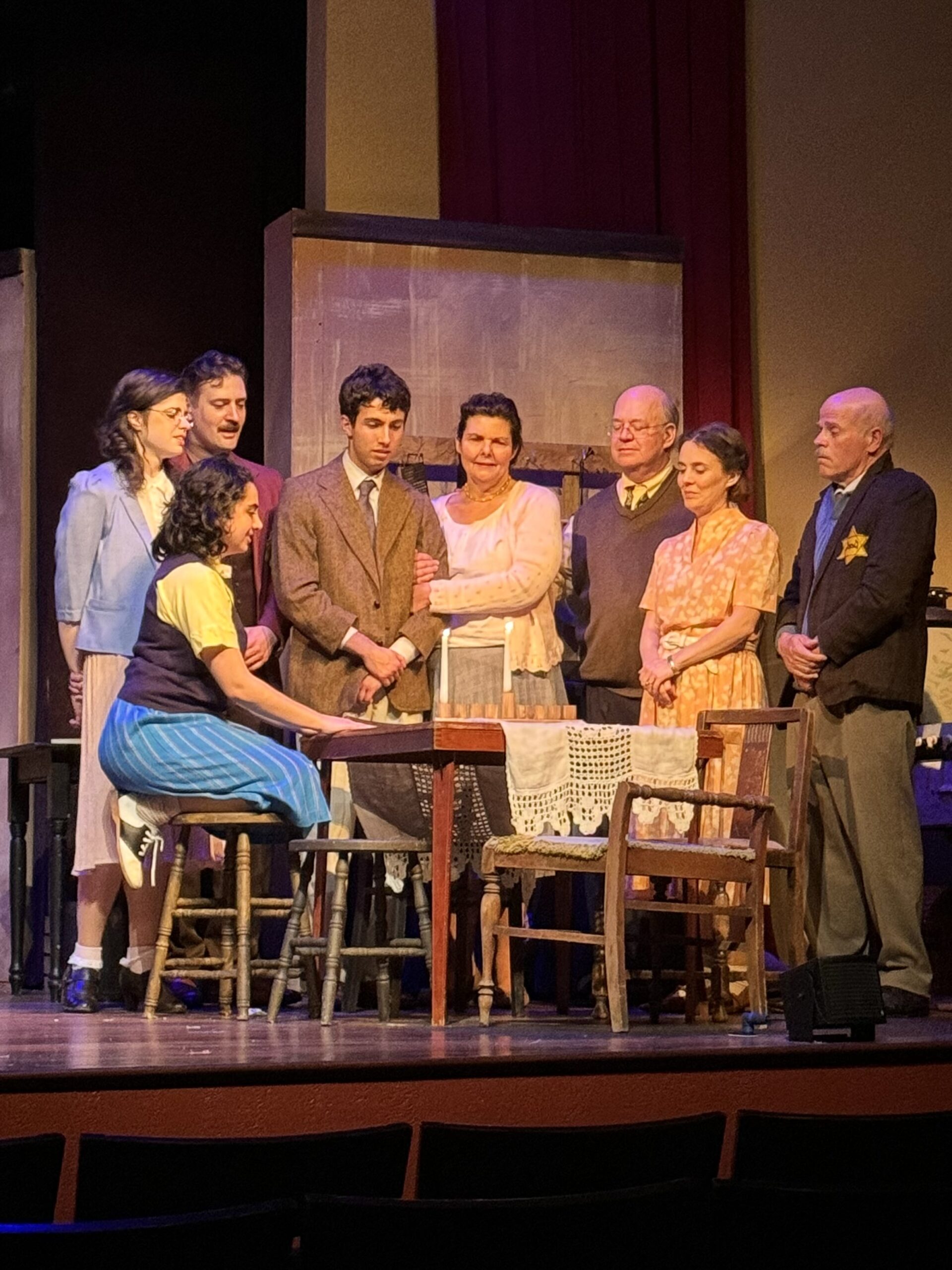
The cast of “The Diary of Anne Frank” on the stage of BB’s Stage Door Canteen, National World War II Museu.
The new adaptation by Wendy Kesselman is based on the original screenplay developed by husband and wife writing team Frances Goodrich and Albert Hackett. That team was responsible for penning MGM classic musicals such as “Easter Parade,” “Seven Brides for Seven Brothers” and classic screenplays like “It’s a Wonderful Life” for director Frank Capra.
Wendy Kesselman’s adaptation brings certain elements of the diary originally published by the author’s surviving father Otto Frank under the title “Diary of a Young Girl.” At the time of the publication, Otto Frank removed several passages in which his daughter spoke frankly about her coming of age as a woman and having feelings of sexual attraction for both male and females.
All three felt Frank had attempted to protect the reputation of his deceased daughter by keeping the salacious material out of its original publication. Because of the social mores at the time, he publisher would most likely not have accepted the material for publication had Frank kept it in.
Ellis, who identifies as a Conservative Jew and plays Anne’s love interest Peter Van Daan in the play, explained that “Kesselman modernized some of the elements in the language. She brought the timeline forward so that a modern audience might connect to it more readily.”
As a result, the originally excised material is back in the play. That new material has led at least one community in Florida to ban a graphic version of the diary. But the new material barely takes up a minute of additional dialog.

Mrs. Van Daan (Leslie Nipkow), and Mr. Van Daan (John Wettemark) with Mrs. Frank (Lauren Wells) and Mr. Frank (John Jabaley)
For first-time dramaturge Page, a board member at Touro Synagogue, the opportunity to work with Whitman Groves has been an exercise in joy. A former resident of New York who made her living on Broadway and toured with several national non-Equity tours, Page moved to New Orleans a little over five years ago with her husband, who previously was the director of the national tour of “Disney’s ‘The Lion King.'” Both having had theatrical experiences, she and Whitman Groves met at the Uptown JCC, where they both had small children enrolled in the pre-kindergarten program and connected.
Knowing of Whitman Groves as a Jewish actor and , Page had recommended her to helm the play following the dedication of the museum’s Liberation Pavilion and she feels that it was a good move.
“I think that every single director’s vision is going to be different,” Page cautioned, “but this was a large undertaking for the museum.”
The Kesselman adaptation moved away from the originally black and white depiction of the characters as being good or evil, Whitman Groves stated.
“In this play, I really try to make all of the characters very human,” the director mused. “They all go on their own journey and they all have a transgression at one point. They all have a point where they’re pushed too far and they’re human. Everybody’s a human with a foible.”
Whitman Groves said the Nazis created an atmosphere of dehumanization for “the other.” Jews were not people. They were the other, she explained.
It is the first full-length play of approximately two hours duration since Neil Simon’s “Biloxi Blues” presented at the BB’s Stage Door.
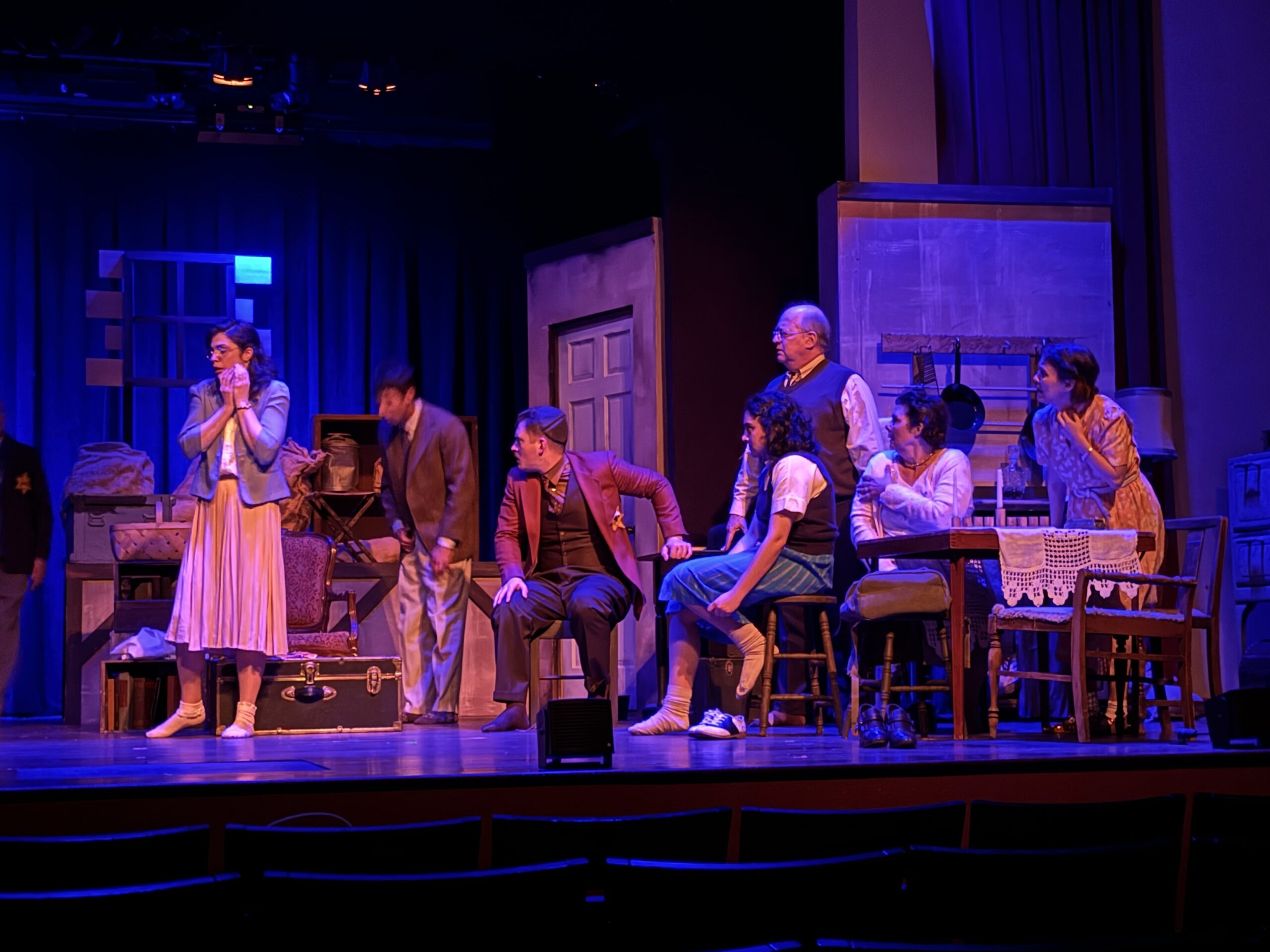
Cast members of “The Diary of Anne Frank” on stage at BB’s Stage Door Canteen.
In addition to public audiences seeing the play, several local and regional private, parochial and public schools have seen showings of the play as a part of the museum’s outreach. “This is a story going to be told to kids that otherwise would not be exposed to it,” Page noted. “(They) are not getting any kind of Holocaust education which, of course, is not mandated.”
Page added “That is crucial that they are exposed to this. It could be their entrance into Holocaust education.”
Ellis, who did learn about the Holocaust at his religious school agreed. “I was very exposed to what could have happened and the injustice that exists in the world especially for oppressed groups,” he explained. “A lot of times Holocaust is framed in the broader Jewish history going all the way back to Biblical times. At the end of the day people always seem to settle on the Jews as the scapegoat.”
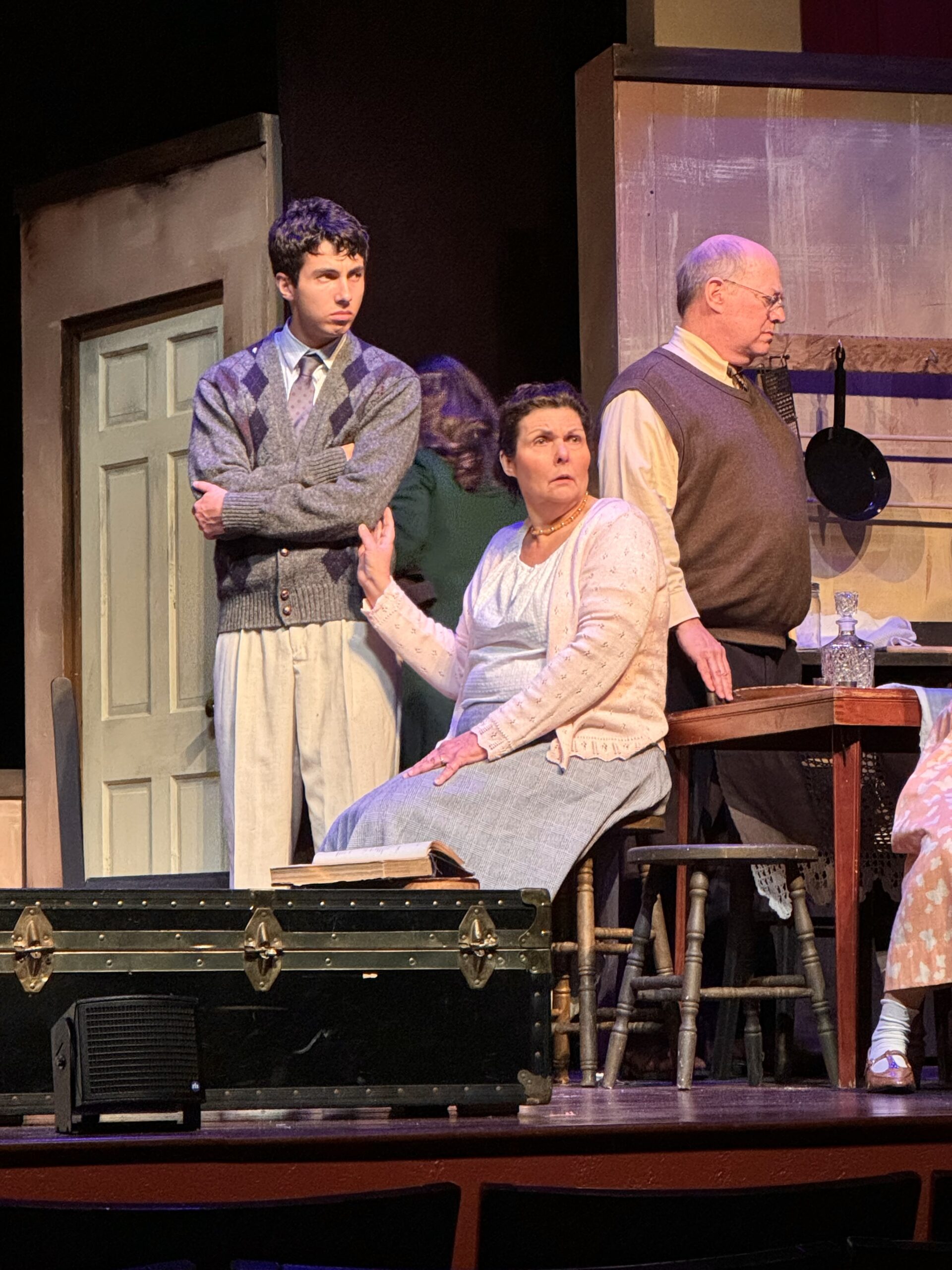
The Van Daan family Peter (Joel Ellis), Mrs. Van Daan (Leslie Nipkow) and Mr. Van Daan (John Nettermark).
Whitman Groves expressed an understanding for Anne Frank “She really is someone who is struggling with being a kid and being an adult and relationships and her mom,” she added. “She already has a whip-smart intellect and a desire for greatness in her writing and in her personality. You watch her go from a pre-teenager with pre-teen concerns to someone who’s really wrestling with her friend who she knows is in the concentration camp and who she thinks is dead, but in some ways, it’s a future pressure, because she’s the one who dies.”
Referencing the worst day of killing of Jews since the Holocaust, Page believes the story of Anne Frank and those in hiding in the annex is even more important in a post-Oct. 7 world.
“It shifted the whole because of the rise of antisemitism,” the dramaturge added. “I think the play really looks at why Israel was created – wanting to have a safe place. But, everybody needs a safe place.”
Whitman Groves also added that the play is important in how it shows the lives of the men and women in hiding went on. “I feel like the writing makes you see how much of the life was being lived in between the challenging moments,” she said.
“The point of this is that we can’t let this happen again,” Whitman Groves concluded. “My hope is that the play affects you because of how much they are living and enjoying their lives and finding their moments (especially) after you’ve lived with them and cared with them throughout the play and to find out what happened to them.”
“The Diary of Anne Frank” (2 hours with a 15-minute intermission) continues with shows tonight and Saturday night, Mar. 22 and 23 at 7:oo p.m. at BB’s Stage Door Canteen, 965 Magazine Street. A matinee on Sunday, Mar. 24 will be held at 1:00 p.m. For tickets click here or call 504-528-1943.
