


Abdul El-Sayed and Jamie Raskin sidestep Hasan Piker, and Israel, in Michigan campaign stops
By ANDREW LAPIN
ANN ARBOR – As Michigan U.S. Senate candidate Abdul El-Sayed made campaign stops with a prominent Jewish congressional leader on Wednesday, there was one subject neither he, nor his Democratic allies onstage, were interested in discussing.
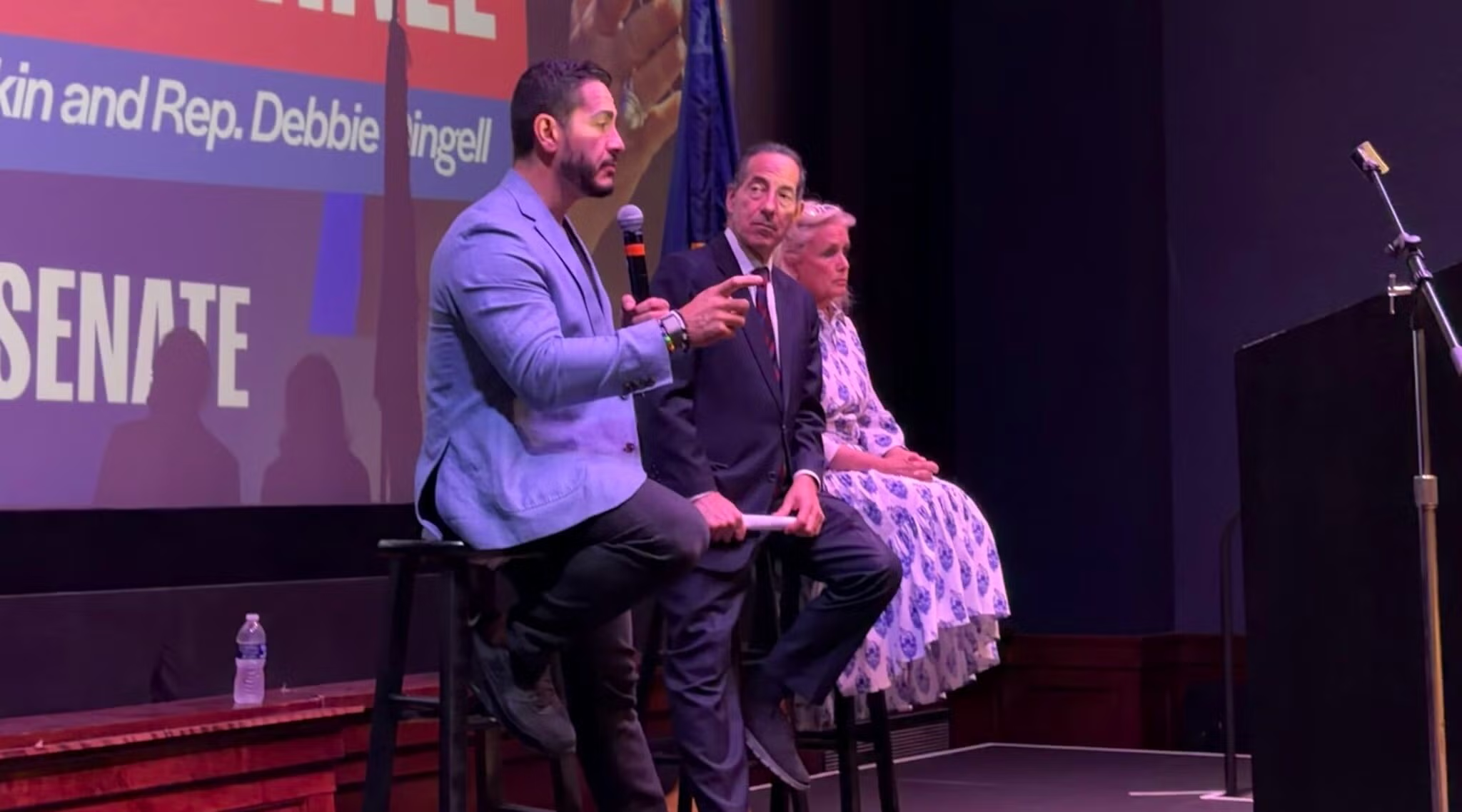
(L-r) Abdul El-Sayed, Michigan’s Democratic candidate for U.S. Senate, joins Maryland U.S. Rep. Jamie Raskin and Michigan U.S. Rep. Debbie Dingell for a town hall in Ann Arbor, Mich., Aug. 26, 2026. (Andrew Lapin/JTA)
“Don’t any reporter ask me again about Hasan Piker,” Michigan U.S. Rep. Debbie Dingell told the crowd at an Ann Arbor, Mich., town hall, to cheers. “It’s not what November is about.”
Dingell’s crack was the only time the prominent left-wing streamer’s name was mentioned at all during the pair of El-Sayed rallies that day. Piker recently commented, “If Jews in America keep putting this idea out there that they are singularly invested in Israel, eventually someone’s going to come around and take action… against American Jews.”
His remarks prompted uproar from several corners of Democratic leadership and pushback from El-Sayed, who distanced himself from Piker’s remarks in a statement prior to his latest rallies. Despite this, El-Sayed’s new Jewish campaign surrogate, U.S. Rep. Jamie Raskin of Maryland, avoided the topic altogether.
That reluctance to talk about Piker on the campaign trail Wednesday extended to the candidate himself. El-Sayed didn’t mention Piker, nor Israel, once in either of his campaign stops with Raskin, except when asked directly by reporters.
The former county health official campaigned with Piker during the primary — including at one stop at the University of Michigan a stone’s throw away from Wednesday’s event — as the two made opposition to Israel a central issue of his candidacy. But at a press conference following his Ann Arbor event, El-Sayed described Piker as “a streamer in California,” adding that the media was putting too much focus on his most prominent supporter.
“I’m less interested in going to the tabloid version of our politics where we cover this as who’s in, who’s out, who’s up, who’s down, who’s talking to who,” El-Sayed said. “I’m a lot more interested in talking to the people in the state who had a bum deal because of Donald Trump and the politics that [El-Sayed’s GOP opponent] Mike Rogers has been the epitome of for a very long time.”
Raskin, one of the most prominent Jewish Democrats in the House, also showed a reluctance to talk about Jewish voters in general. The Jewish Telegraphic Agency asked the congressman in Ann Arbor how he would sell El-Sayed to Jewish Democrats uncomfortable with his rhetoric. In response, he did not mention Jewish concerns.
“Those of us who have been fighting Donald Trump and his authoritarianism and corruption and violence against American citizens and immigrants for 10 years now understand that this is an essential referendum about the future,” Raskin said in response. “Will we have democracy or will we have autocracy?”
He added that he has been “campaigning for Democrats all over the country,” and praised the party for being “a very big tent.”
“Just like any big family Thanksgiving dinner, there can be arguments and people jostling, and there’s unruliness,” Raskin said. “But fundamentally, we all believe in democracy and freedom and the progress and prosperity of our people.”
Yet questions about Piker, and how close the movement he represents may come to remaking the Democratic Party’s values, hang over both Michigan’s Senate race and the future of Jewish inclusion in the party. As the party fights to retake Congress this fall, some liberal Jewish voters believe the growing backlash against Israel among the “big tent”’s progressive wing is damaging their historic coalition. A growing number of Jewish voters in Michigan who previously backed Democrats are now supporting Rogers instead, and El-Sayed’s association with Piker is often cited as a key reason why.
In playing the role of uniter, Raskin is slaloming carefully between the party’s different factions. Before campaigning with El-Sayed, the congressman stumped for Michigan Rep. Hillary Scholten, a moderate Democrat who has withheld her endorsement of El-Sayed while specifying his association with Piker as a sticking point.
Also being silent on the rallies is a key target of Piker’s: Michigan state Sen. Jeremy Moss, whose likeness the streamer had made his latest comments in front of. The Jewish and pro-Israel Democratic congressional candidate is running in a heavily Jewish district that encompasses Oakland County, where El-Sayed’s second rally of the day took place. In recent days, Moss said that El-Sayed was “going to have to demonstrate some serious outreach to Oakland County’s Jewish community.” He declined to comment to JTA about the day’s rallies.
As they largely avoided the elephant in the room among Democrats, El-Sayed and his allies also preached the importance of party unity in taking on their Republican opponents.
“There’s a big effort to divide us,” Raskin told the second rally’s audience in Farmington Hills. “They’re trying to pick on disagreements in our party, trying to exacerbate conflict, because we have freedom of thought in our party and freedom of speech in our party and freedom of dialogue.”
CORRECTION: The story has been corrected to reflect misplaced quote marks around a paraphrase, “suffer the consequences of the actions of the state.” The exact quote has been inserted in its place: “If Jews in America keep putting this idea out there that they are singularly invested in Israel, eventually someone’s going to come around and take action… against American Jews.”
