


Who are the first-time voters who could sway Israel’s election?
By MICHELE CHABIN
(JTA) — JERUSALEM — On Oct. 27, Yael Chernyvsky, 18, from Ramat Hasharon in central Israel, plans to cast her ballot for the first time.
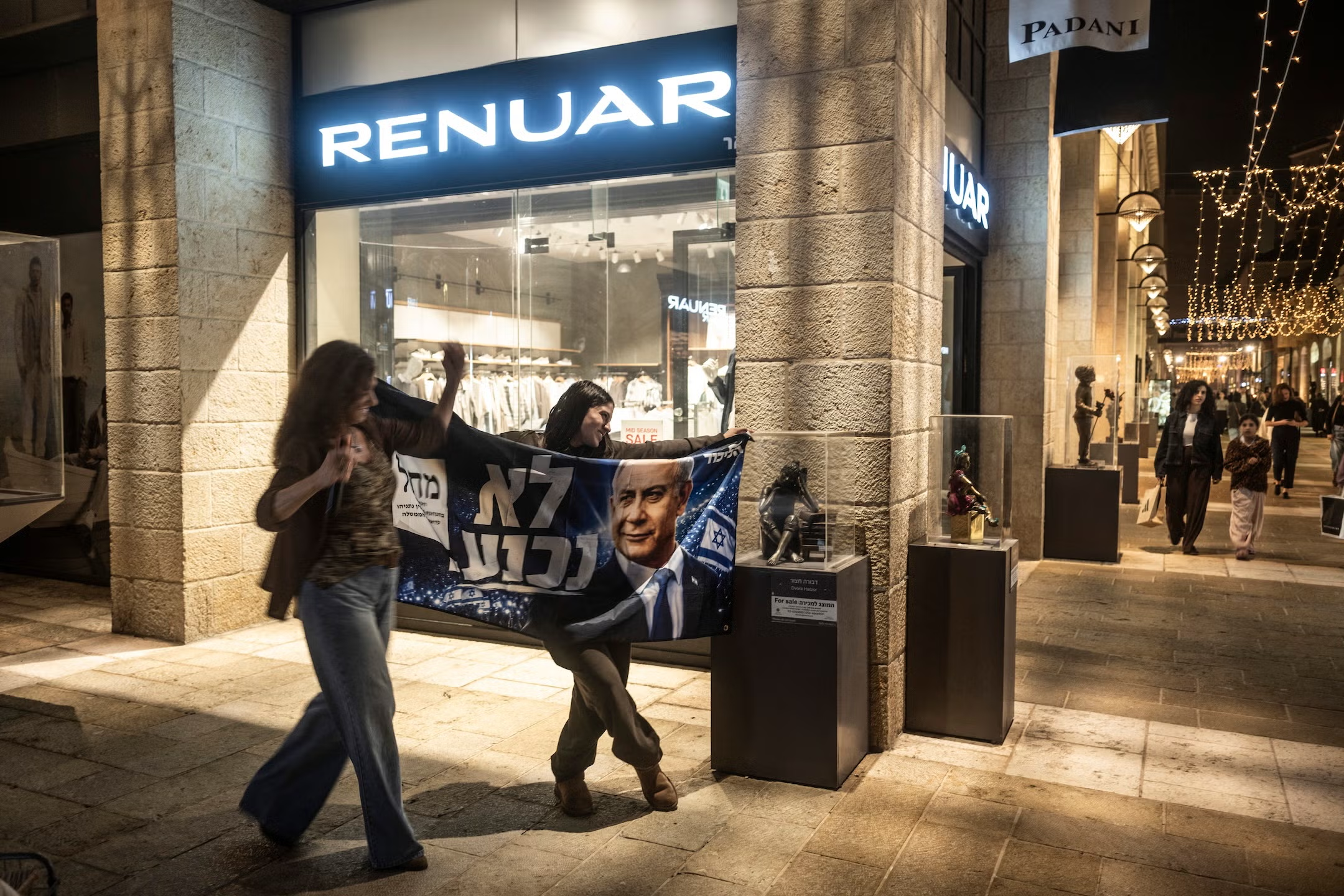
A young supporter of Israeli Prime Minister Benjamin Netanyahu poses with an electoral banner next to a musician in a market area in Jerusalem on October 21, 2026. (Photo by Jewel SAMAD / AFP)
“I’m voting so we can change the future of this country,” the teen told Jewish Telegraphic Agency earlier this month. She was entering a Tel Aviv auditorium where some of Israel’s top politicians were about to address more than 1,000 first-time voters, including many in pre-military programs.
Chernyvsky, who is studying in an army preparation program in the Negev, blames the current right-wing government led by Prime Minister Benjamin Netanyahu for the country’s problems.
So she said she will vote for one of the opposition parties in the “change bloc,” which seeks to oust Netanyahu, who has been in office since 2009 except for a brief period in 2021-2022.
Chernyvsky had not decided which party she will vote for, but she said it will “probably” be either the Democrats led by Yair Golan or Yashar led by Gadi Eisenkot.
“We’ve basically had the same government for 20 years, and I genuinely think it’s corrupt. Why has this war been going on for three years? Why did it take two years to return the hostages? Why does the government give so much money to Haredi Jews who don’t work and don’t serve in the army?”
Chernyvsky is one of the estimated 640,000 Israelis aged 18 to 22 eligible to vote in Tuesday’s election, according to the Israel Democracy Institute (IDI). Comprising nearly 10% of the electorate, their votes could determine as many as 12 seats in the 120-member Knesset.
“Israel is a young country with a high birth rate,” said Tammy Hoffman, head of the education policy program at the IDI, which co-sponsored the young voter event with the Yigal Allon Center. “If their turnout is high, as our research suggests, first-time voters will make a difference.”
In May, Hoffman and her colleagues surveyed potential young first-time Jewish and Arab voters about their attitudes and political engagement. Across Israel’s population groups, 80% to 95% said they would “definitely” or be likely to vote. Secular Jewish youth expressed the highest level of certainty regarding participation, while 87% of Arabs said they intend to vote.
It’s a higher percentage than in the U.S., where the youth turnout in the 2024 presidential election was only 47%, according to the Center for Information and Research on Civic Learning and Engagement.
More than four-fifths of respondents to the IDI survey described the opportunity to vote as either “fairly meaningful” or “very meaningful,” with particularly strong responses among traditional and religious Jewish youth.
A separate poll of 18-year-old to 22-year-old potential first-time voters for the Ynet and Yedioth Ahronoth news outlets also revealed high motivation: 67% of respondents said they were certain they would vote, while another 19% thought they would.
In both polls, national security and the cost of living were top priorities for both Jews and Arabs. Hoffman wasn’t surprised.
“For the past several years, they’ve lived in an unstable environment during their adolescence. They were in junior high during COVID, they witnessed the judicial reform protests, and of course Oct. 7. They are worried about their future.”
While the Hamas attack affected every Israeli, the fact that so many first-time voters are either serving in the Israel Defense Forces or will do so in the near future could influence how they vote.
Jewish Israeli voters of all ages have moved rightward politically over the past couple of decades, Hoffman noted.
“But military service doesn’t necessarily lead you to a nationalist stance,” Hoffman emphasized. “It can do the opposite: It can bring up questions about the war and its goals.”
Arab Israelis, meanwhile, haven’t shifted rightward, but they are more eager to vote in this election than previous elections, reflecting their growing engagement in Israeli society, Hoffman said.
In a Sept. 23 N12 poll, 74% of young people described their political views as right-wing or center-right, while 23% identified as left-wing or center-left. If the election were held at the time the poll was taken, 16% of respondents would vote for Eisenkot’s Yashar party and 14% would vote for Netanyahu’s Likud party.
Despite the assumption that the majority of Jewish youth will vote for right-wing and far-right parties, Hoffman said, mock elections at high schools around the country show a different picture.
She said the majority of students voted for Eisenkot’s Yashar party and Beyachad, led by former prime ministers Naftali Bennett and Yair Lapid from the opposition Change bloc, and “some for Netanyahu’s [right-wing] Likud, but not a lot for [Itamar] Ben-Gvir,” who heads a far-right party.
Omer Gross from Jerusalem, who graduated from high school in June and is now in an army-prep program in the Golan, plans to vote for the Religious Zionist party led by far-right politicians Finance Minister Bezalel Smotrich and Moshe Feiglin.
“I don’t really agree with what Smotrich has been doing in Gaza,” he said, referring to Smotrich’s objective to reestablish the uprooted Jewish settlements in Gaza and incentivize Palestinian emigration from the strip, “but I support what he does in the territories” – the West Bank. “We need a strong, secure Israel.”
Tomer Shiloh from Herziliyah, who attends the same Golan Heights program as his friend Omer, has different plans.
“I’m voting for the ‘Change’ bloc, for Gadi Eisenkot or Naftali Bennett,” the 18-year-old said.
If it were up to Shiloh, the next government would require Haredi, or ultra-Orthodox, young men to serve in the IDF, as he will do next year. He wants the next government to lower Israel’s high cost of living.
“I want the people who run this country to have good values and to do what’s best for the country and not for themselves,” the teen said.
Sgt. M is a 22-year-old office worker doing his first stint of reserve duty following the conclusion of his mandatory army service. He says ensuring that all Israelis serve the country either in the IDF or through National Service is at the top of his election priority list. But he will be voting for the left-of-center Democrats party mostly for economic reasons.
“Did you know that most university students have to work while they study to pay for tuition, books, food and housing?” the reservist, who requested anonymity due to IDF regulations, said as he traveled home by train from his army base. “I wanted to start studying right after finishing the army, but between the cost and reserve duty, that’s impossible,” he said.
Speaking from his home in the northern Israeli city of Shef-Amra, Khalel Alaa Sabeh, 18, said he plans to vote for an Arab party that will prioritize addressing resource gaps in the Arab community.
“I want to see more money allocated to the Arab community,” he said, noting that historically, Arab municipalities have received less government funding than Jewish municipalities. “But most of all, I want our families to be safe. There’s a lot of crime in the Arab sector and the Netanyahu government isn’t doing enough to stop it.”
Sabeh, who plans to start university next year, said he is urging his friends to show up to vote on Oct. 27.
“I want to see change in this country, and if Netanyahu wins we’ll have four more bad years.” Yet whatever the outcome on Election Day, he said, “I won’t leave the country. This is my land, this is my home.”
