


Berger assumes Tulane leadership
By ALAN SMASON, Exclusive to the CCJN
Growing up two blocks away from Tulane University, it seemed inevitable Darryl Berger would attend the sprawling Uptown campus. Yet, after attending Newman School, he was accepted to Vanderbilt University and instead traveled to Nashville for his undergraduate work.
Nevertheless, following his graduation, the irresistible lure of Tulane drew him back to New Orleans as he entered the School of Law and embarked on a career in the commercial real estate business and land development.

Chairman of the Tulane University Board of Administrators, Darryl Berger, in his downtown office. (Photo by Alan Smason)
“Never having lived four blocks from the Tulane campus my entire life, it is my first and deepest love, because it is in my home town,” he professes. “I’ve had a lifelong love affair with Tulane.”
That love affair began with a myriad of experiences from riding his bike on the well-manicured lawns of the university to swimming in the pool at the university center to being a Cub Scout and selling programs at Tulane football games. He also fondly remembers attending many of the hotly contested Sugar Bowl football games played in the 80,000-seat former Tulane Stadium. All of these experiences have blossomed recently as Berger has now assumed the chairmanship of the Tulane University Board of Administrators, one of a handful of Jews to hold that esteemed position.
The extremely fit and handsome developer seems much younger than his years. He speaks from his own building in an office suffused with light and a vaulted ceiling, overlooking the French Quarter.
As a Tulane alumnus, Berger has always felt the need to give back to the institution he’s known all his life. Even though he never practiced law, he considers the social experience and training he received in its hallowed halls as among the most important and invaluable of his life. “It was at the core of any success of what I’ve been able to achieve and at the core of my life experience,” he states.
Berger’s work as a developer has had him oversee a number of revitalization projects including the former Claiborne Towers into the Delta Towers and his most massive projects located on and near the former Jax Brewery downtown.
Berger began working with Tulane president Eamon Kelly and the Tulane School of Law in a variety of positions a quarter of a century ago. He was chairman of the president’s council from 2000-2003 and then accepted an appointment to the Board of Administrators at the time that term of office expired.
As a member of the Tulane board he has had an overview of the competitive nature of modern college campuses, particularly as Tulane recovered from Hurricane Katrina in 2005. “One of our challenges to go from great to really great is resources,” he explains. “Our peer institutions – most have them have great endowments on a student basis – and one of the biggest challenges is to grow the resources.”
Tulane’s endowment recently topped the $1.1 billion mark. Berger says he and the Tulane board are grateful for student enrollment, which has remained high, even after the destructive effects of the recovery from Hurricane Katrina. “We had 40,000 applications a few years back,” he recalls.
With room, board and tuition rates running at well over $50,000 per year, Berger is fully aware of the hardship endured by current students who seek a quality education at Tulane.
“Regardless of need, we need to reach out and provide this fantastic Tulane experience and this fantastic Tulane degree, which carries great currency throughout your life,” he opines. “Regardless of their ability to pay, we have to reach the best and the brightest. You need resources and scholarship and other means to assist the building and reaching of that student body.”
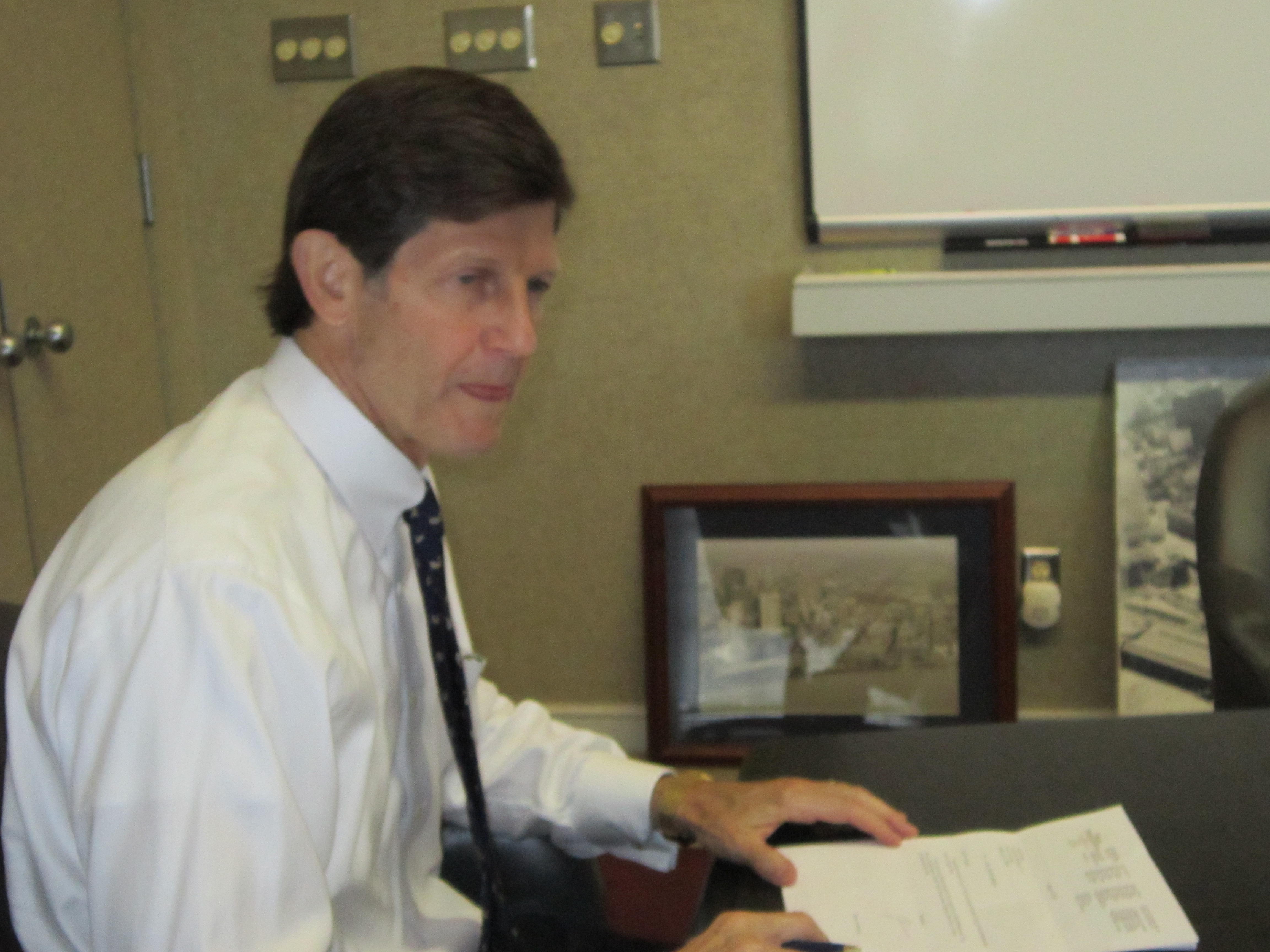
Berger Properties president Darryl Berger and chairman of the Tulane University Board of Administrators at his downtown office. (Photo by Alan Smason)
Recent resignations of longtime and beloved Tulane president Scott Cowen, slated to take place next year, and Tulane vice-president Dr. Ben Sachs as head of the Tulane School of Medicine mean that Berger’s administration will be replacing two key Jewish administrators.
In particular, Cowen is credited with reviving the Tulane campus as its most desperate hours, following the flooding of the Uptown campus and the dispersal of its student body in 2005 after the storm. A search committee has been put into place to determine the next president.
“He retires as a true heroic figure,” Berger says, admitting he will be hard to replace and hard to follow. “Having said that,” he continues, “Tulane and the institution of Tulane is greater than any one individual. Scott would be the first one to admit that. It’s greater than any one board or administrator. The Tulane University president is one of the most attractive of higher institutions. We are very confident that we will find a marvelous person to fill that spot and that person – he or she – will begin to carve their own path.”
As to Sachs, Berger says “Dr. Sachs did a marvelous job here, but a person of his great talent is going to be seeking other things. We have a wonderful new head of the medical school, Lee Hamm, and he will be a marvelous replacement for Ben and continue to build and work upon the great work Ben has done.”
Among other key asset problems being worked on at the Uptown campus are the lack of parking and the need to upgrade living facilities. A new dorm is being constructed on the corner of Broadway and Zimple to add to the living space for students, but Berger says he is unaware of any specific programs being put into place at present to address the upgrading of parking spaces there.
In recent years controversy swirled over a new downsized Tulane Stadium being constructed on the Uptown campus in a part of the much larger footprint formerly enjoyed by the original stadium. Berger says the controversy has died down as neighbors have accepted the plan and certain provisos have been put into place to limit the facility’s use.
Since 1975 Tulane has played its games at the Mercedez-Benz Superdome (formerly the Louisiana Superdome), but Berger saw the massive facility as a liability for the student athletic program. “It is not the best venue for college football presented by a university like Tulane,” he explains. “The best venue for college football is on your campus for all kinds of reasons, but first and foremost in having the sense of community.”
But both he and the Tulane board are firmly committed to the support of its athletics programs. “Let me say this. Since Katrina we have invested nearly $100 million in sports facilities at Tulane. If there’s any question about it, that should answer that question,” he points out. With such an impressive set of facilities and a new stadium that can help promote student pride in its football team, Berger believes Tulane has turned the corner and can now enjoy having true student athletes. Having a good student athletics program is important to him as to how many students the university graduates and what kinds of citizens they become, he says. “I’m very bullish on Tulane athletics.”
Tulane’s football team is thus far 5-2 on the year. Obviously, he is pleased with the team’s progress this season.
Concluding the interview, he is posed one last question. When Vanderbilt plays against Tulane University, who will the alumnus of both colleges promote?
“You gotta pull for the Greenies,” he smiles.
