


‘Deadly Medicine’ exhibit continues at National World War II Museum
By ALAN SMASON
Because of the circumstance of her birth as a twin, Eva Mozes Kor is alive today. Ironically, though, it was because of her status as a twin that she and her 10-year-old twin sister Miriam were subjected to a relentless series of tests and deadly experimentation by Nazi doctors. These experiments have shaped her adult life. In conjunction with the National World War II Museum’s ongoing exhibit “Deadly Medicine: Creating the Master Race,” Tulane University’s School of Medicine sponsored “Ethics in Medicine and Research: Lessons from Dr. Mengele’s Lab” on Thursday night.
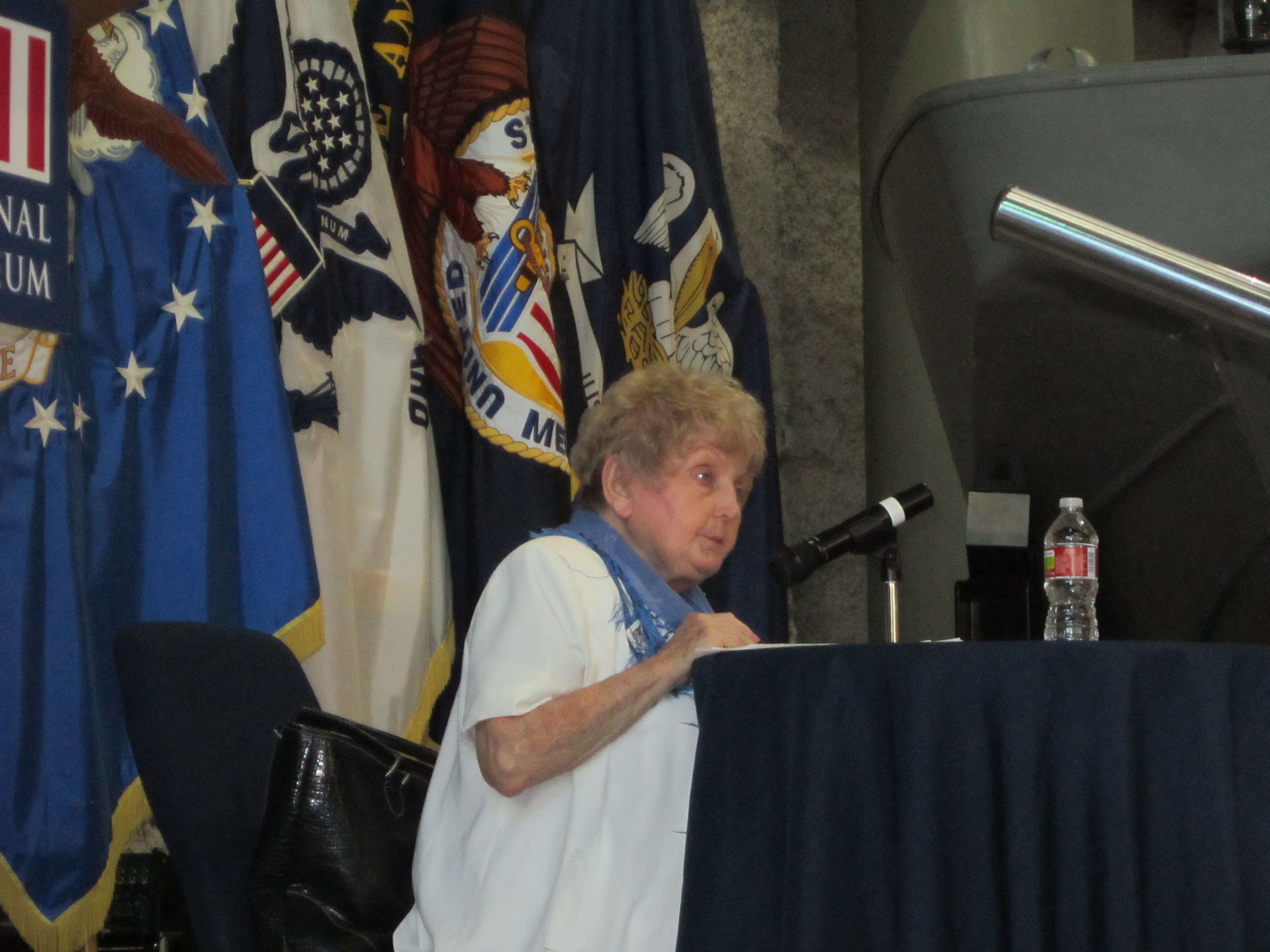
A diminutive figure, Eva Kor addresses the crowd at the National World War II Museum. (Photo: Alan Smason)
Kor, the guest speaker was one of 200 child survivors of Auschwitz concentration camp, nearly all of whom were twins. Kor told the gut-wrenching tale of her incarceration and survival in the concentration camp with her identical twin Miriam that started in the spring of 1944. She elaborated on their use as “disposable” human guinea pigs to further the genetic experiments of Dr. Josef Mengele.
Mengele, the so-called “Angel of Death,” and his medical staff conducted cruel and unusual tests on 1500 sets of twins – 3,000 victims in all – almost all of whom reportedly died as a direct result of these experiments.
“The idea that our children would be ripped from our hands and would have to confront absolute evil – absolute evil!- is beyond our understanding,” said Dr. Bernard Sachs, dean of the Tulane School of Medicine in his introduction of Kor before an overflowing crowd of approximately 300 in the voluminous Louisiana Memorial Pavilion. Many in the audience were current Tulane Medical School students and members of the faculty.
Sachs gave a short biography on Kor, relating her early life in Romania; her family’s transport to Auschwitz; the loss of her mother, father and two other sisters to the Holocaust; her emigration after the war to Israel in 1950; her work in the Israeli army as a sergeant major; her Tel Aviv marriage to another victim of the Holocaust and her resettlement to his naturalized home in Terre Haute, Indiana where she raised her family and began to be an advocate for Holocaust remembrance. “Eva Kor is one of the most remarkable people to walk the earth,” he concluded.

Twins were commonly used as human guinea pigs by Nazi doctors in concentration camps. (U.S. Holocaust Museum)
What made Kor’s story all the more compelling and, for some survivors of the Holocaust all the more unbelievable, has been her modern mission to forgive the Nazis for their atrocities. “I don’t understand why the smart Jewish people do not understand that they can teach the whole world as an example,” Kor said in an exclusive CCJN phone interview following the lecture.
“If the Jews forgive the Nazis for all their atrocities, wouldn’t that show an extraordinary example to them that the Jews are teaching the world to heal?”
Kor has been rebuffed by many of her fellow survivors for her courageous and unusual stand, but she cannot understand it. “Jewish people seem to say to me that I, as a survivor, must remain a hater. What kind of a statement is that?” she posited. “If we want to help the victims, then the victims are the key to healing the world.”
Of the 200 survivors at war’s end approximately 60 are still alive today, many of them in Israel. Kor has attempted to interview them, but has been met with resistance from them because of her stance on forgiveness of the Nazis. “I’m not giving up on them,” she claimed. “I’m trying everything I can.”
For her part Kor said she has learned several valuable life lessons. The first is “Never give up your dreams,” she recounted. This is the one lesson she claims she clung to her utmost during the horrible year she endured at the hands of her Nazi tormentors. At one point as she lay ill, a doctor laughingly claimed she had but two weeks to live. Through sheer will Kor said she never lost hope until her fever broke and she was restored to her sister Miriam. Her tenacity to cling to life was also inspirational to her sister, she said. Miriam survived the war and relocated to Israel, but died of cancer in 1995.
A second life lesson is “Prejudice is still with us today,” she continued. She said she has a particular distaste for low cut women’s clothing, tattoos, piercings and drooping baggy pants. “Even I have to get to know each person and judge them on their actions and the content of their character,” Kor admitted.
Her most powerful life lesson, though, was her capacity to forgive. She related how she learned of Dr. Hans Münch, a former Nazi doctor who worked under Mengele and had witnessed the gassing deaths of thousands of her fellow Jews at Auschwitz. After interviewing Münch in 1993, she noted his kindness, consideration and respect. Despite the history they shared, they became close and in 1995 he agreed to sign a document attesting to the existence of the gas chambers there as well as how he had certified the deaths of untold thousands. In turn Kor offered Dr. Münch a letter of forgiveness, an unusual act. “I had the power to forgive,” she related. “It was all mine and no one could give it to you and no one could take it away. Forgiveness is an act of self-healing,” Kor continued. “Forgiveness is a seed for peace.”
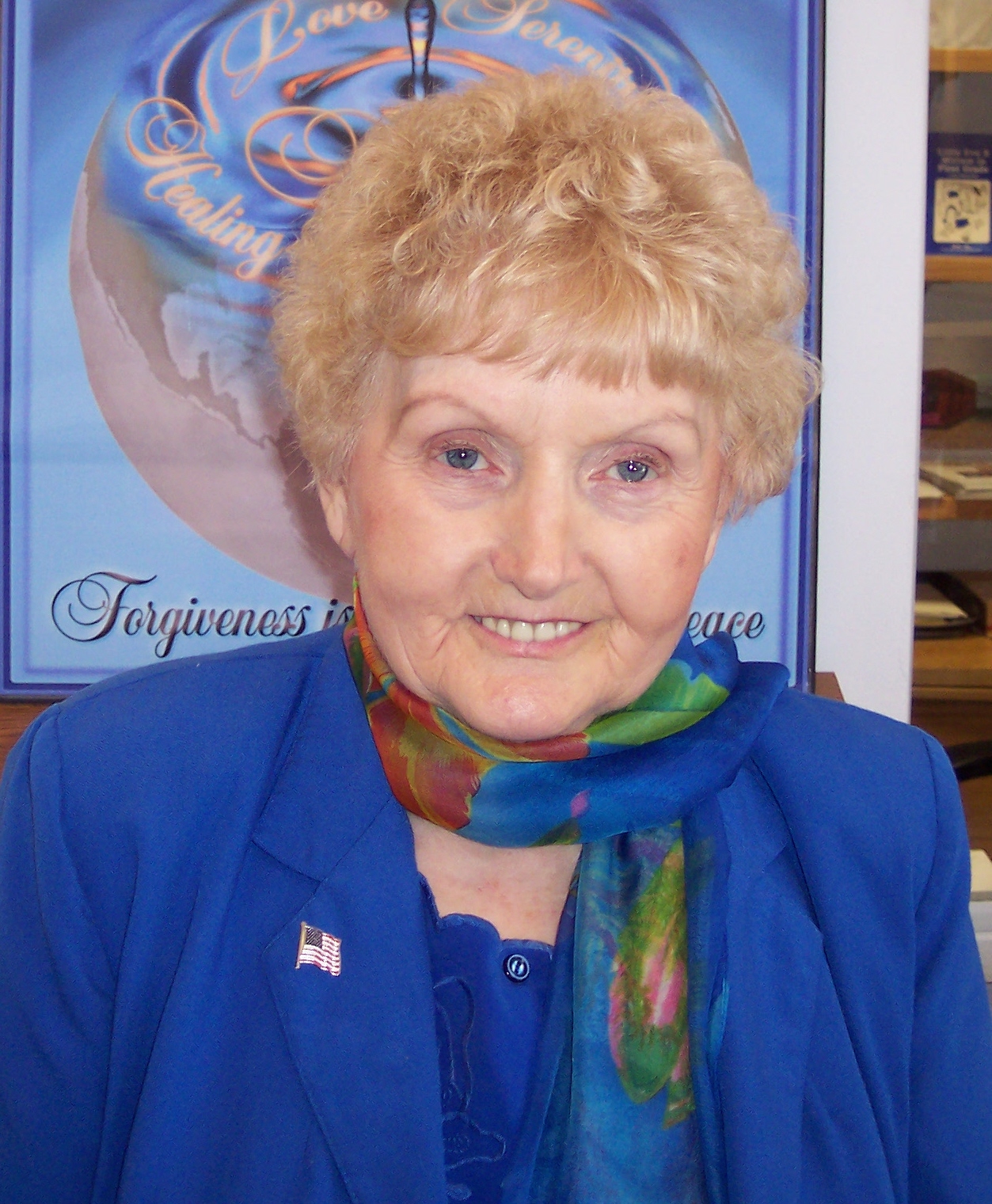
Hungarian Holocaust survivor and forgiveness advocate Eva Mozes Kor.(Photo courtesy Eva Kor)
As part of her unusual undertaking of forgiveness, Kor opened a small museum in Terre Haute in 1995 with mostly private funding. The CANDLES Holocaust Museum and Education Center housed artifacts from Auschwitz and contained various documents detailing the horrific experiments of Mengele and his staff. The purpose and ongoing mission of the museum has been to educate the public, especially young school-aged children. CANDLES is an acronym for “Children of Auchwitz Nazi Deadly Lab Experiments Survivors.”
The building was attacked by an arsonist in 2003 and utterly destroyed, but through the efforts of local and national supporters, a new building was re-erected on the site in less than a year and a half.
In her talk at the National World War II Museum, Kor used the metaphorical concept of a candle to extinguish the darkness across the world. “It has been said that a single candle can illuminate the universe,” she explained. Through her initiative, the CANDLES museum has “become a glowing light of caring ethical behavior” in medicine, she said. She said she especially enjoys speaking before medical school students because it is her hope that future doctors will never again allow the kinds of deadly and demeaning experiments to be conducted upon their fellow human beings.
The purpose of “Deadly Medicine” is to illustrate how competent scientists and physicians could be corrupted by society and commit crimes against humanity that seemed justifiable at the time. The exhibit was created by the United States Holocaust Memorial Museum in Washington, D.C. and will be on view on the second floor of the Louisiana Pavilion through October 15.
Through a series of multi-media presentations including film archives, posters, pictures and audio tracks, the exhibit details the science of eugenics and its German proponents, the claims of biological superiority that came out of that and the implementation of programs of forced sterilization and experimentation followed by Mengele and other Nazi scientists. Ultimately these claims of superiority led to the Nazis’ “Final Solution” in which millions of Jews and other so-called inferior groups were euthanized and gassed and their bodies sent off to crematoria.
Next week Los Angeles civil trial attorney Baruch Cohen is scheduled to continue the series sponsored by the Tulane Medical School. He will be speaking on “The Ethics of Using Medical Data from Nazi Experiments” at Tulane’s Dixon Hall on the Uptown campus at 6:30 p.m.
Tulane’s Newcomb College is slated to sponsor the next talk by Northwestern University professor Laurie Zoloth on September 20 at the Newcomb College Institute’s Freeman Auditorium and the Woldenberg Art Center. With a lecture titled “The Thief of the Futre: The Holocaust – Women, Reproductive Science, Eugenics and the State,” Zoloth will be delivering the 2012 Daspit Women in Science Lecture there at 7:00 p.m. For more information on this talk call 504-865-5422.
Last week’s scheduled lecture in the series with Arthur Caplan titled “Justifying the Unthinkable: The ‘Ethics’ of Nazi Medical Experimentation” was cancelled due to the inclement weather associated with Hurricane Issac. Sachs announced that lecture, originally scheduled to be held at the Tulane School of Medicine Auditiorium, would be rescheduled, but a final date and time has yet to be decided.
