


Federation defers decision to include interfaith members
By DEAN M. SHAPIRO
Current or former members of Jewish households who are not Jewish themselves will have to wait another three months to learn whether they will be allowed to join the Jewish Federation of Greater New Orleans, according to a decision announced by Federation officials at the 101st Annual Meeting on Tuesday, September 16.
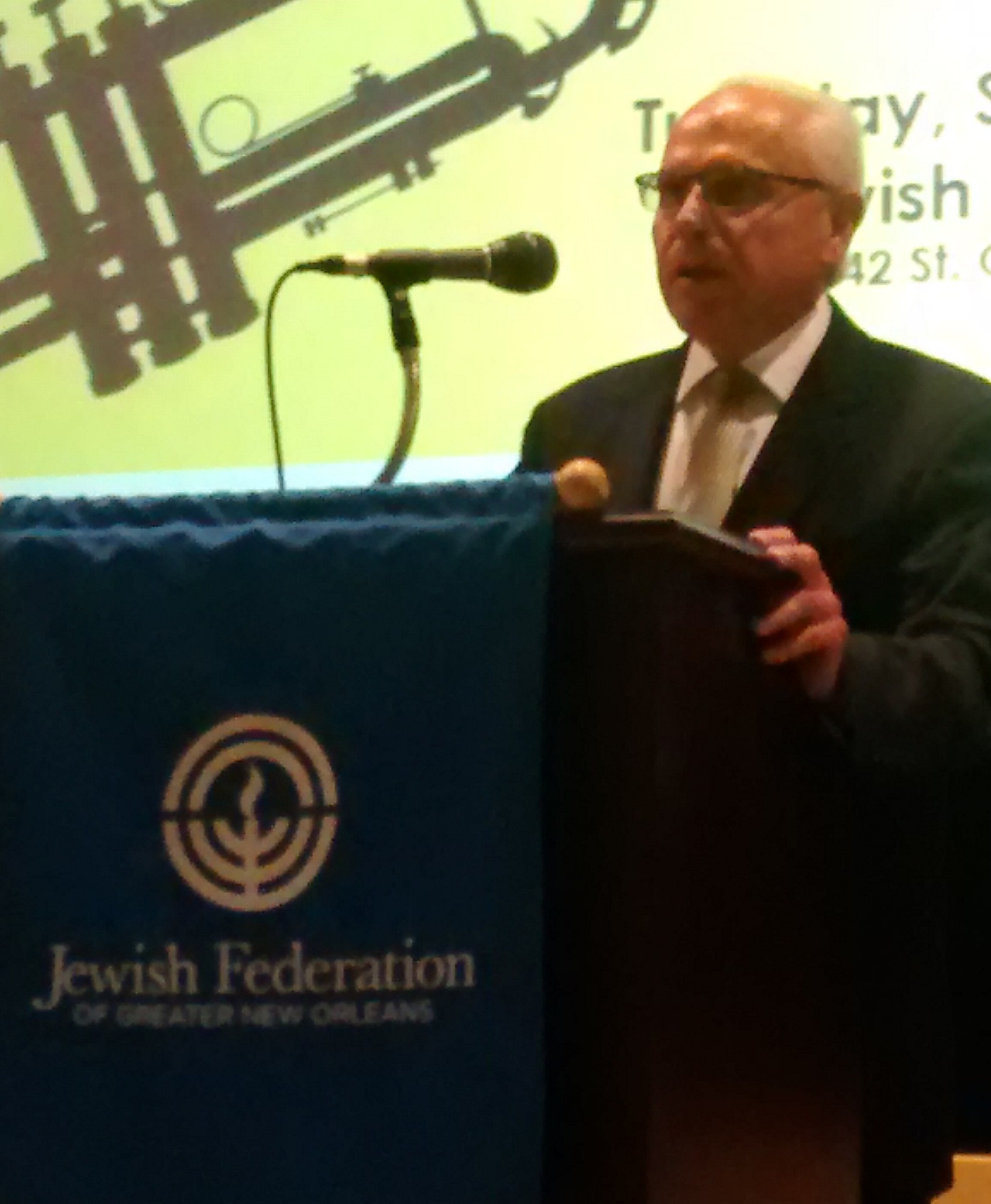
Federation president Morton Katz defers action on opening membership from strictly Jewish to Federation. (Photo by Dean Shapiro)
Federation president Morton Katz made the announcement at the beginning of the meeting held at the Uptown Jewish Community Center. It preceded discussion from the floor that appears to indicate the path to ratification of an amendment to that effect may be a rocky one. Comments from several members in the audience – including one participant who called it a “Pandora’s box” – revealed how thorny an issue this has the potential to become when it is taken up by Federation’s Board of Trustees at its December 17 meeting.
The crux of the issue revolves around the definition of what constitutes a “Jewish household” and whether or not that definition can be expanded to include non-Jews who are or were formerly members of Jewish households. Under Article III, Section 2 of Federation’s Articles of Incorporation it states:
All persons of the Jewish faith who are over the age of majority, support the mission of the Corporation, and who contribute to the Corporation’s Annual Campaign shall be members of the Corporation from the date on which the contribution is made through the end of the fiscal year succeeding the fiscal year during which the contribution is made.
The proposed amendment to the section would add the words “and members or former members of their households” after the opening words, “All persons of the Jewish faith.” This wording addition which, in effect, expands the definition of a “Jewish household,” Katz explained, “will make us (the Federation) more inclusive.”
That wording, he noted, will make it possible for widows and widowers of Jews or former spouses who are no longer married to Jews to become Federation members as long as they meet the other membership requirements of supporting the Federation’s mission and making an annual financial contribution.
“There are many officers, past and present of our Federation, who are married to non-Jews or have spouses who are non-Jewish,” Katz told the audience gathered in the auditorium of the Jewish Community Center on St. Charles Avenue. “Some of those spouses would like to participate in the Federation, whether it be on committees or whether it be on the Board. Studies are showing there’s more intermarriage than ever before in the Jewish community. And we don’t want to lose those people.”
Citing figures that show households of intermarried Jews and non-Jews as high as 40 percent, Katz added. “We don’t want to turn them away. We have to look toward the future of what’s happening amongst Jews worldwide. I’m not telling you how I feel; that’s how the Board feels.”
He also cited examples from other U.S. cities where this issue has been resolved to include non-Jews who are or were formerly members of Jewish households. He was careful to note that this does not open up membership to any non-Jew who wants to join the Federation, nor does it automatically open up membership on the Federation Board to them. Board membership will still have to be earned through diligent, sustained service to the Jewish community, he added.
However, despite these reassurances, some trepidation was voiced among several of those present, particularly over how the word “household” is defined within the wording of the amendment. One audience member worried that someone fitting the definition of a “former member of a Jewish household” who converted out of the faith could still qualify for membership and he suggested that the new wording be limited to “widows and widowers.”
Katz explained that the amendment is worded the way it is because it will hopefully include other household arrangements such as unmarried partners. However, he acknowledged that the final wording might be “fine-tuned” to be more specific.
Another audience member asked about the possibility of a straw poll being taken on the issue but Katz noted that this option has already been considered and decided against. “It might be misinterpreted. Someone looking at that might think we actually voted and we’re not,” he replied.
Still another audience member expressed reservations over the language of the proposed amendment, particularly as it applies to the criteria defining a member or former member of a Jewish household. “Who is going to determine who is a member of or a former member of a household? You are opening Pandora’s box to a lot of discomfort and perhaps to even litigation,” the speaker noted.
The final speaker from the floor, Rabbi Edward Paul Cohn of Temple Sinai, while not expressing a stand on the issue, thanked and congratulated the Board for taking up the task. He suggested that a new subcommittee be formed to “examine all of the intricacies of the feelings about the Jewish-ness of these individuals and all of the implications that have bothered people. I think, between now and December 17, there should be plenty of time to provide wording that people can examine and come to this meeting with a degree of intelligence, articulate their feelings and be qualified to vote on it,” Cohn said.
The meeting at which the vote on the issue will occur will be at 6:00 p.m., December 17, at the Goldring-Woldenberg Facility in Metairie.
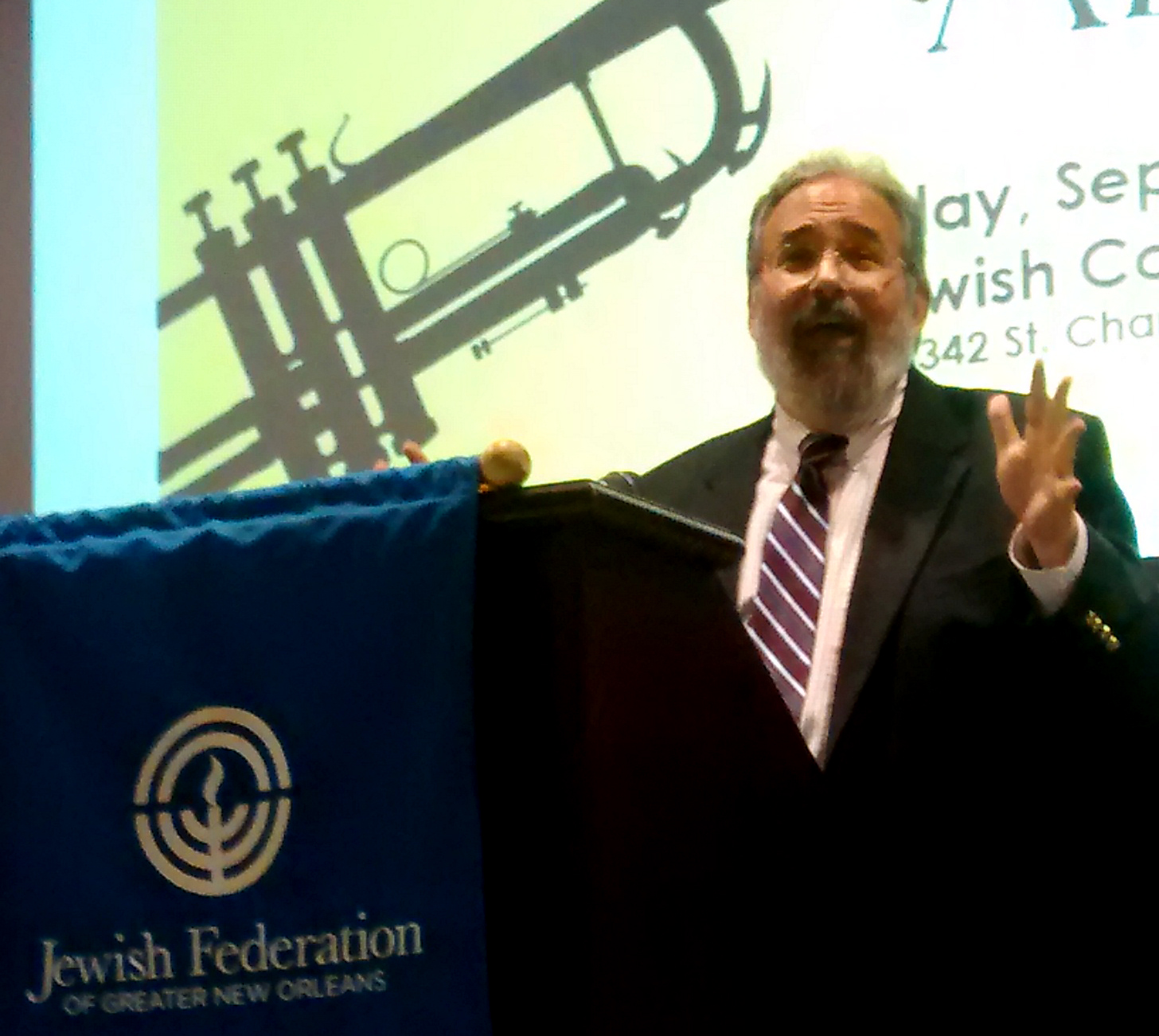
Rabbi Brad Hirschfield speaks at the 101st Annual Meeting of the Jewish Federation of Greater New Orleans. (Photo by Dean Shapiro)
Prior to the discussion on the membership amendment, members of the audience gave a warm reception to keynote speaker, Rabbi Brad Hirschfield. A renowned author, lecturer and president of The National Jewish Center for Learning and Leadership, he has been ranked by Newsweek magazine as one of America’s “50 Most Influential Rabbis.”
Hirschfield delivered a stirring speech on the current situation in the Middle East and the continued importance of supporting Israel in the face of growing worldwide hostility relating to the Gaza crisis.
Also at the meeting, outstanding members of the Greater New Orleans Jewish community were honored for their service. Valerie Marcus and Dr. Juan Gershanik received the Anne Goldsmith Hanaw and J. Jerome Hanaw Tikkun Olam Award for Campaign Excellence, honoring their volunteer work on behalf of the Federation’s Annual Campaign.
In addition, Gary Zoller was honored with the 2014 Herbert J. and Margot Garon Young Leadership Award. Financial reports on the Annual Campaign indicated a significant upward trend in donations from around $2.5 million to $2.7 million, the proceeds of which will go to constituent agencies supported by the Federation, Katz explained.
