


‘Fiddler’ revival a solid production
By ALAN SMASON, Exclusive to the CCJN
Theatre Critic, WYES-TV’s “Steppin’ Out“
The time-worn story of Tevye, the simple dairyman, his beleaguered family and the village of Anatevka first told by Shalom Aleichem and transformed into one of Broadway’s biggest blockbusters 52 years ago should by now be considered old-fashioned and out-of-date. It’s a story of a man who yearns to eke out a simple living in order to provide for his family and to perhaps – one day – rise above his station. It is a story of a man who wrestles with God in a respectful fashion as hard times force him, his family and his friends to make unwanted choices. The opening number “Tradition” is intended to set down the values each character is expected to cling to during this period of shifting loyalties. Yet, “Fiddler on the Roof” has a fresh quality to it and this newest of five revivals started last year still manages to bring smiles (and tears) to the faces of its audiences.

Five-time Tony Award nominee Danny Burstein stars in the role of his life as Tevye. (Photo by Joan Marcus)
The tricky part of playing the role of Tevye is to embue him with a sufficiency of humanity so that he is not merely a cartoon image of a downtrodden, oppressed Jew, but rather, a universal symbol of a person who adheres to his convictions during times and in places where he might otherwise be counseled to give up or capitulate to outside forces.
Danny Burstein is magnificent in the role of Tevye in the current revival of Fiddler on the Roof playing now through New Year’s Day at the Broadway Theatre in New York. His Tevye has exuberance and moxie, but also possesses the wisdom to know when to challenge authority, when to hold his ground and when to give in.
The book by Joseph Stein still holds up remarkably well, although many of the audience members seem to know what line is next, but despite that familiarity, the roles played by Burstein and Jessica Hecht, who plays his wife Golde, seem remarkably on the mark. Tevye should be a young man still, even if he has fathered five daughters. If he were married when he was in his late teens or early twenties, he would only be about 40 or so. That would also make Golde still a relatively young woman.
Hecht and Burstein have several excellent moments on stage in three of the many well-known numbers inspired by the original work of Jerome Robbins and based on the music by Jerry Bock and the lyrics by Sheldon Harnick. Sadly, Harnick is the only member of that quartet who is still among the living. The first takes place during the “Sabbath Prayer” when Golde lights the Shabbat candles and welcomes the Sabbath bride into her home. Tevye yields his authority to her as she begins the blessings and other families follow suit. The second moment is the extended “Tevye’s Dream” in which he relates his waking moments to his wife and she volunteers to interpret its meaning. The final and most touching is their rendition of “Do You Love Me?” in the second act, which has been slowed down and made into a gentle conversation between husband and wife.

The famous bottle dance originally choreographed by Jerome Robbins and updated by Hofesh Shecter is performed after the wedding. (Photo by Joan Marcus)
The big musical numbers we have come to love are still there in “To Life” and “The Wedding,” the latter of which includes the famous bottle dance with Robbins-inspired choreography. Burstein as Tevye and Steven Skybell as the butcher Lazar Wolf are at opposite ends generationally, financially and socially speaking in “To Life.” Tevye is poor with no dowery to offer the groom, a potential son-in-law a full generation older than him. As the butcher, Lazar Wolfe has more than enough finances to spare. What he yearns for most, though, is a wife and Tzeitel, played by Alexandra Silber, is what he wants in the bargain. The symbolic image of combining milk with meat – a violation of kashrut (kosher standards) – does not escape the attentive audience.
We suspect that the arranged marriage is not to be when early on we see how she and tailor Motel Kamzoil (Adam Kantor) dote on one another and practically complete each other’s sentences. “Miracle of Miracles,’ the number in which Motel expresses his relief and his coming into manhood (“Even a poor tailor deserves some happiness!”) is well done.

Broadway star of “Fiddler on the Roof” with CCJN editor Alan Smason. (Photo by Alan Smason)
Similarly, Perchik (Ben Rappaport) and Hodel (Samantha Massell) enjoy a duet together in the second act’s opening number “Now I Have Everything.” Perchik is everything Tevye despises about angry, young and alienated men. They don’t know their place in the world and they seem to challenge all that the opening number of “Tradition” stands for. For us we would like to see the beginnings of modern love winning out over traditional arranged marriages, but we delude ourselves into believing that such a long-established custom could be so easily altered far and wide. This was the exception rather than the rule.
The plaintive ballad “Far from the Home I Love” quickly brings us back to reality, knowing that Perchik is incarcerated and living in rugged conditions in Siberia. Massell purely sings the notes that would have both her own heart and her father’s heart breaking as she gladly accepts her fate and acknowledges they will best struggle together during the coming years.
The supporting cast of middle daughter Chava (Melanie Moore), who abandons her faith for the love of a fellow student Fyedka (Nick Rehberger), who is Russian Orthodox, are both adequate. Rehberger manages to convey his respect for Tevye and his family despite their denial of their daughter and him. It is a testament to Stein’s book that the dairyman who is constantly in the habit of examining “the other hand,” decides in this case “There is no other hand!” One of the best lines spoken by Tevye conveys his utmost devotion to his religion, “If I bend that far, I will break!”
The bare scenic design by Michael Yeargan meant to convey the large space of the village of Anatevka does not enhance many of the bigger scenes. In fact there were at least two scenes where cast members such as the fiddler could be seen flying through the air. It seemed a waste to spend money on rigging to fly a cast member above the stage when the amount spent on insurance and safety harnesses could have been translated into more realistic set designs. (The idea of the flying fiddler was no doubt inspired from a famous Marc Chagall painting.)
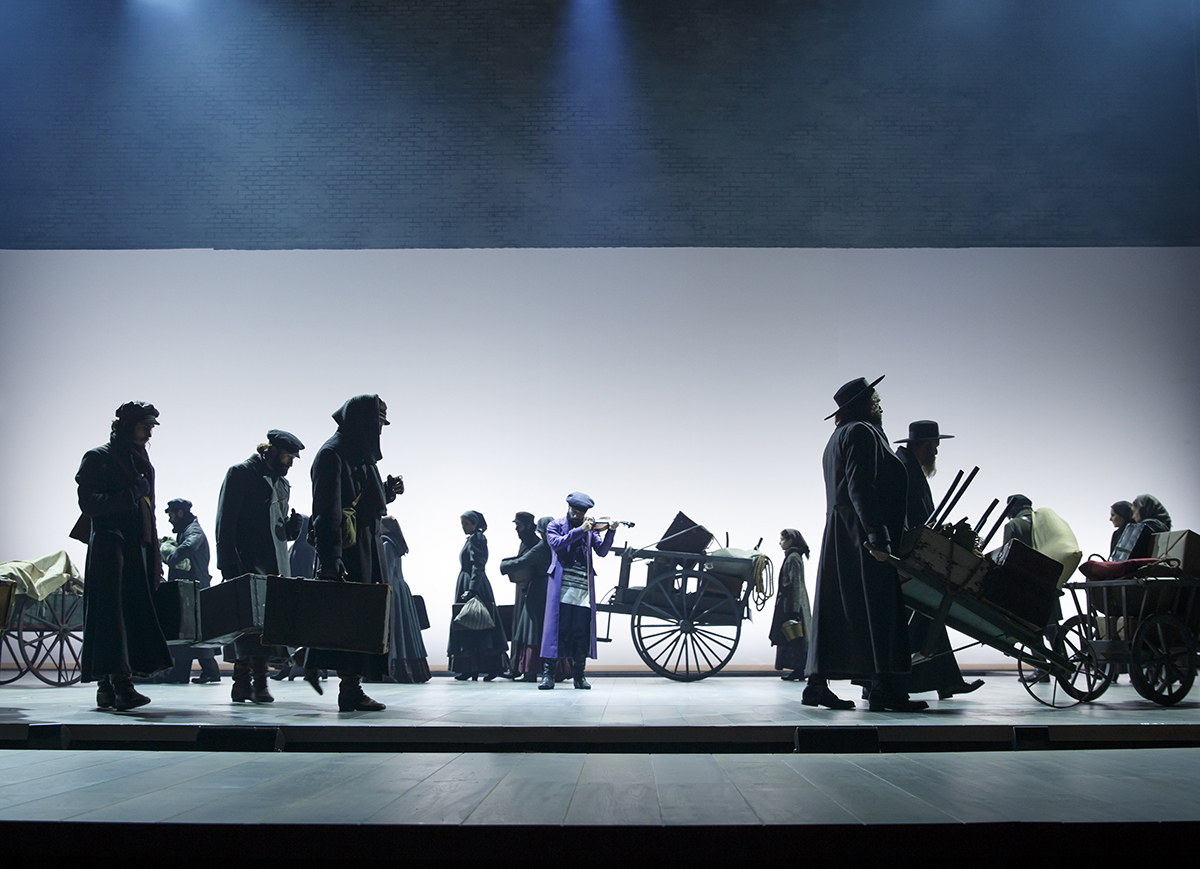
The final scene, “Anatevka,” from “Fiddler on the Roof. (Photo by Joan Marcus)
Also, the habit of having cast members climb stairs at the rear of the stage for entrances seemed a bit over the top when an entrance from stage right or left would just as easily made the point. This was a directorial choice by Bartlett Sher, who won this year’s Tony Award for Best Director of a Musical. His vision made this revival a wonderful production. Nevertheless, the drab set design definitely detracted from what might have been an even more spectacular production.
Music direction and new orchestrations by Ted Sperling were scintillating along with music coordinator David Lai’s contributions. Hofesh Shechter’s choreography was outstanding, although the lighting by Donald Holder seemed a bit too dark in the final scene. It seemed to suggest more of the hard times being endured by the villagers rather than the opportunity they would be enjoying in America and the Holy Land.
“Fiddler on the Roof” continues at the Broadway Theatre, 1681 Broadway, New York, New York produced by Jeffrey Richards, Jam Theatricals, Louise Gund, Jerry Frankel, Broadway Across America and others. Broadway veteran Judy Kuhn (“Fun Home”) joins the cast as Golde, beginning November 22. Tickets available through Telecharge and others. The show closes on December 31, 2016.
