


Houston: ‘We still have a problem’
By ALAN SMASON
Just a little over one month ago and days before the start of the official hurricane season, a massive cell of thunderstorms hit the Houston area, dumping 11 inches of rainwater into the city, overtopping bayous and sending flash floods roiling into homes and businesses.

The hard hit sanctuary at United Orthodox Synagogues of Houston on May 26, the day after the storm hit. (Photo by Jacob Kamaras.)
Many of those affected lived in the heavily Jewish area of America’s fourth largest city, not far from the campus on which the Jewish Federation of Greater Houston and the Jewish Community Center buildings reside. The flooding was indiscriminate. It affected retirees on fixed incomes, many of whom had never suffered flooding before. It sent young families with kids in elementary school packing and searching for relief in the form of temporary housing and supplies.
The response from the Jewish Federations of North America (JFNA) was swift. An initial $25,000 grant in late May was supplemented last week with an additional $250,000. However, as New Orleans residents who dealt with the Federal Emergency Management Administration (FEMA) following Hurricane Katrina can attest, that amount will fall far short of what the community will need to rebound from this cruel and unexpected act of nature.
“The price tag for this is very significant,” said Lee Wunsch, the longtime executive director of the Houston Federation. “We’ve estimated the cost – and this is a moving target in terms of philanthropic dollars – at three and a half million dollars.”
Wunsch, who grew up in Dallas, has been living in Houston for more than two decades,and claims this to be a significant challenge for his community. “Every synagogue has families affected by the flood,” he pointed out. Several of the Federation’s annual campaign expected gifts were
He expressed thanks to New Orleans residents who have responded to their plight, recalling the assistance they received a decade ago following the evacuation from Hurricane Katrina. “We really appreciate the support from New Orleans,” he said. “But,” Wunsch stressed, “we don’t have any expectation that repayment is needed.”
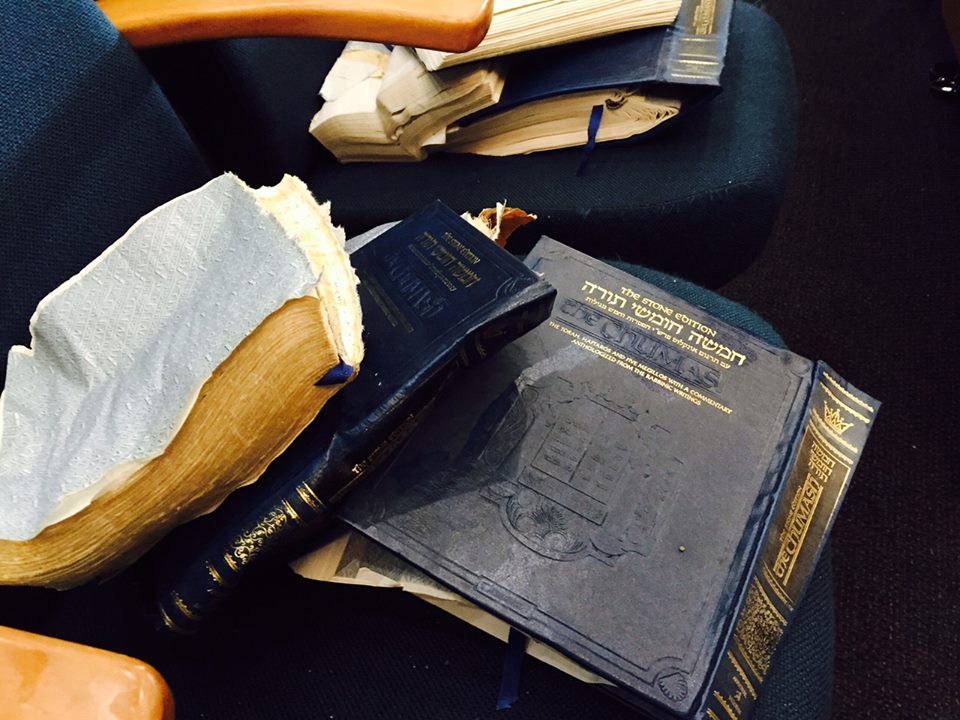
Chumashim bloated from flood waters on May 26, 2015. (Photo by Jacob Kamaras)
One of those who lives in the most affected area is JNS.org editor Jacob Kamaras. His moving first person article told of his own flood experience. The CCJN reached out to Kamaras for an update.
“There are a a lot of displaced families in different situations. Some are living with other families. Some have moved into apartments and are waiting to move back, but are not sure how long their home refurbishing efforts will take,” Kamaras reported. He acknowledged the early assistance of Federation, Jewish Family Service and the JCC as all helping organize volunteers for cleaning out residences and affected institutions. “Early in the process there were a lot of volunteers who came to help out including a number of Christian organizations,” he continued. “There’s been a groundswell of local volunteers. It’s been very inspiring.”
One of two Orthodox synagogues deeply affected by the flooding was the Meyerland Minyan. Located in a shopping center mall, the synagogue was completely inundated and destroyed by the passing storm and resultant flash flooding. It is feared that the losses to the small Orthodox institution are so severe that reorganization may not be possible.
The other Orthodox synagogue that has been sharply tested is the United Orthodox Synagogues of Houston, known as UOS.
Founded in 1963 by the merger of three Orthodox synagogues – Adam Emet, Beth Jacob and Adath Israel – UOS had experienced minor flooding three times previously from major weather events. Following Tropical Storm Allison in 2001, the last such occurrence, the synagogue’s leadership elected to raise the back portion of its structure by three to four feet. Known as Freedman Hall, that area is the only usable portion of the building today following the recent flooding. It is being used as an makeshift office, staging area and storage facility in addition to serving as an impromptu sanctuary.
UOS president Max Reichenthal, finishing the last of his three-year term, is unsure how the synagogue can recover from the flooding. The major question confronting the congregation is the decision on whether to rehab the present structure or to raze it and build an entirely new, raised facility that would on paper be impervious to future floods.
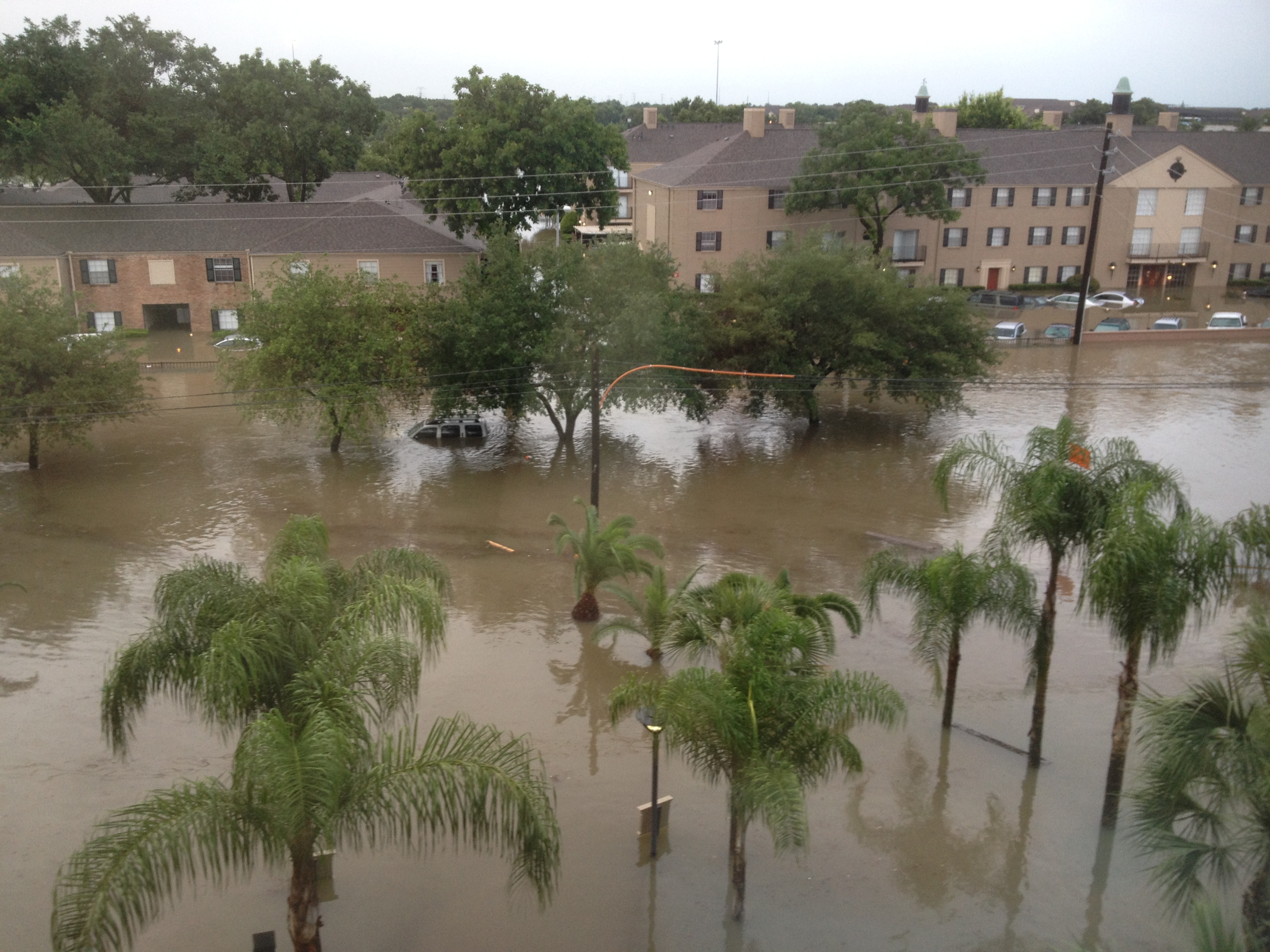
Braeswood Boulevard, the major thoroughfare in the Jewish section of Houston on May 26. (Photo by Jacob Kamaras)
Reichenthal is concerned. Many of his members are elderly and retired. He estimates that 50 or 60 members’ homes have been devastated, including that of Rabbi Barry Gelman, whose house was located across the street from the synagogue. Gelman’s entire family has been relocated blocks away, sheltered by members of his congregation who expect to house them for several more months to come.
Reichenthal’s estimates a new capital campaign for rebuilding could cost at least another $6 or $7 million. With just 325 families in the congregation, he muses “I’m not sure we’re going to have that kind of money.”
Days after the floods, a number of volunteer groups including All Hands Volunteers and Nechama, a Jewish relief organization, began organizing parties of volunteers whose mission it was to throw out soiled carpeting and furniture and to prevent the spread of mold and mildew by tearing out sheetrock in structures that had been affected. After three weeks of backbreaking work, the number of volunteers on the ground has slowed to a trickle.
This has been troubling to Jenelle Garner, the UOS volunteer coordinator who has been trying to match up donors of furniture and the like to needy victims. In many cases people who were not affected have chosen to make donations of items for redistribution. Between transportation of the items and the logistics of finding storage space and securing delivery trucks, Garner and her associate Holly Davies are at wit’s end.
An all-day furniture pick up and drop off event was held Sunday, June 28. Freedman Hall served as a storage facility.
“I can tell you right off, we need people,” Garner said. “It’s getting harder and harder to get people to move furniture. We need manpower. People are still packing up their houses. A lot of them are preparing to move into apartments for temporary housing and they don’t have any furniture.”
Garner and Davies are coordinating donations and trying to determine where the needs are most outstanding. In some cases, people who have not suffered damages are purchasing used furniture that is being donated to victims. However, some victims have refused help, despite suffering catastrophic losses. It is not easy for Jews to be on the receiving end of charity, she suggests. Reichenthal s estimate of 50 or 60 congregants’ homes being affected may be accurate, but Garner acceded that number may be off. “We don’t know for sure because people are not exactly forthcoming,” Garner noted.
Garner expressed frustration with the way relief is being handled by local organizations and said she believes badly needed funds are being “diluted.” She noted that Gelman’s discretionary fund has been a major source of charity for many families and that she is proud of his offering assistance, even to some non-Jewish families in need. Garner believes many families in need won’t go through the process of asking for assistance, because they will be embarrassed or too proud to fill out the forms.
As a matter of protocol for dispersal of funds, forms must be submitted in order to be considered for any monies available through Federation, Wunsch stressed. Wunsch also wondered out loud what kind of effect this would have on next year’s campaign, a year when community members will be rebuilding or, perhaps, considering a move. But, he countered with an unexpected pronouncement: “I’m the eternal optimist on many things including this.”
Reminded of the elderly couple who lost their lives after being swept away during a rescue attempt, Kamaras gave his perspective on UOS, which is his synagogue. “Despite the difficult situation,” he said, “the facility ultimately can be rebuilt and replaced. The people cannot.”
Kamaras said he was impressed with how many sectors of the Jewish community have come together in a selfless campaign to help each other. “It is a tough situation, but it has led to inspirational grass roots effort,” he mused.
He illustrated by recalling the Facebook feed during the night of the flood. “We could see the intense coordination of the volunteering efforts, just families literally tagging each other on Facebook: ‘This person needs help and this person needs help.’ It saved many people,” he recalled.
“It was marvelous to look at that and to see those immediate short term efforts,” Kamaras concluded. “I know it’s a long road, but the community trying to stick together.”
The Jewish Federation of Greater Houston is still soliciting donations on their website here. To reach UOS volunteers, click here.
