


Hurricane Ida presents challenges which differ from Hurricane Katrina recovery
By ALAN SMASON, Exclusive to the CCJN
Hurricane Ida, one of the strongest storms registered in more than 150 years, came crashing into the Louisiana Gulf Coast on Sunday bringing with it a massive storm surge and incredibly powerful winds that tore roofs off structures and downed trees and power lines across much of Southeast and South Central Louisiana.
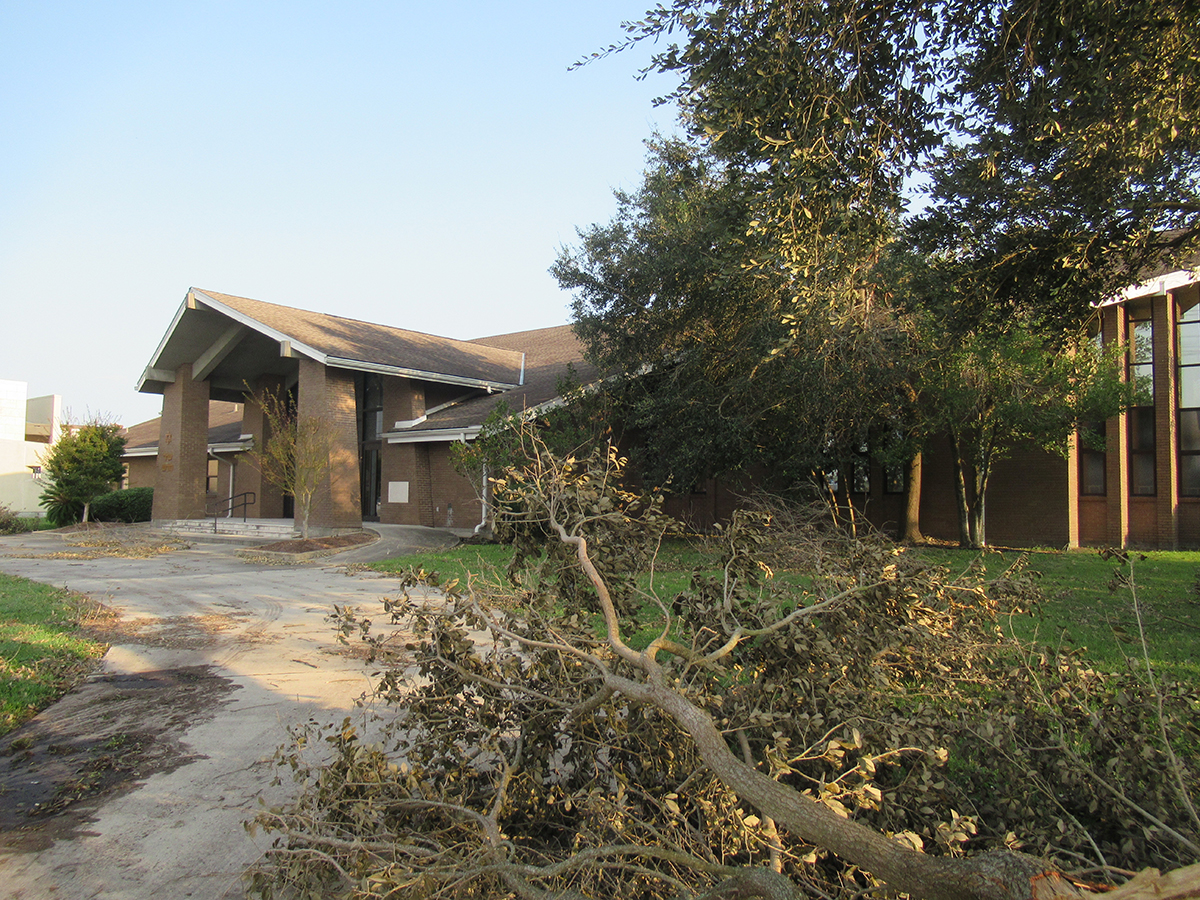
Shir Chadash Conservative Congregation shows little damage from the passage of Hurricane Ida on August 29 and 30. Several trees were down or damaged. (Photo by Alan Smason)
Expected to stay on a track northwest of the city, the storm took an abrupt jog towards the northwest and hung over the New Orleans metropolitan area, pounding the city with destructive winds and heavy rains until a massive transmission tower fell into the Mississippi River, taking with it eight dedicated power lines that serve the East Bank of Orleans and Jefferson Parishes.
All of New Orleans and 97% of nearby Metairie, where the largest concentration of Jewish community members live, were plunged into darkness as the storm lashed the city with unrelenting rain and winds that were among the most savage ever recorded in Louisiana.
The massive Category 4 storm, packing sustained winds of 145 miles per hour and torrential downpours of 10-15 inches of rain, maintained its unique double eye walls. At one time, the storm was so powerful that witnesses claim it actually caused the Mississippi River to reverse its course, sending the river back up towards Baton Rouge for at time. While unconfirmed, such an oddity has been recorded in other storms.
Unlike Ida’s predecessor, Hurricane Katrina, there was virtually no loss of life with this storm in the metropolitan area and the drainage canal system held firm.
Area officials have all expressed outrage at the timetables being advanced by Entergy and CLECO spokespeople for restoration of residential power. Industry and refineries will get the first restored service with residential areas not located adjacent to hospitals, police and fire stations or government offices having to wait.
But due to the hardening of the drainage canal structures in New Orleans and Jefferson Parish, there were no levee breaches and no standing water the day after the storm had passed. That was not the case when Hurrican Katrina made its ill-fated passage through New Orleans 16 years earlier on the exact same date.
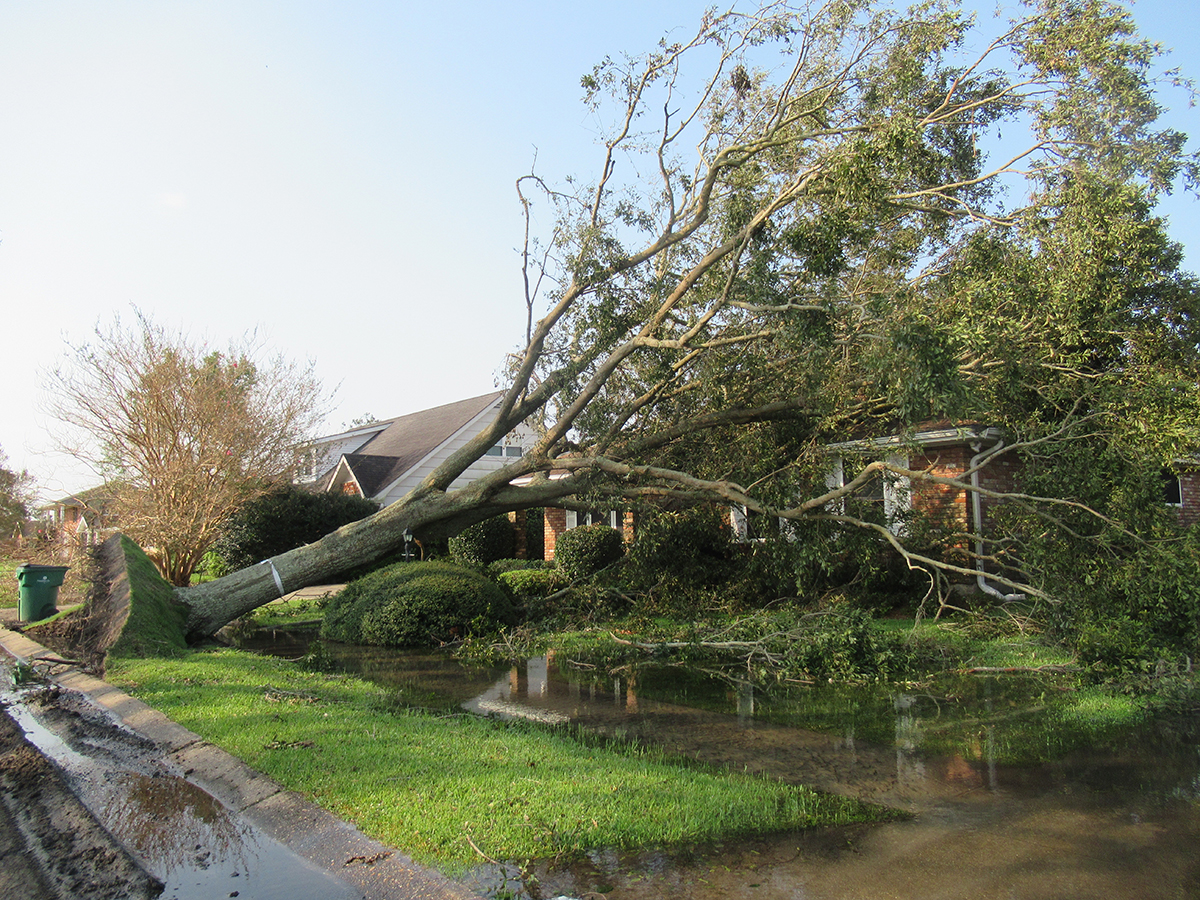
A tree lies atop a Metairie home, its roots ripping out water pipes, creating a torrent of standing water. (Photo by Alan Smason)
The breached levees coupled with toxic waste and sewerage made staying in New Orleans inhospitable and, for more than 1500 souls, un-survivable. The current conditions associated with Hurricane Ida – long gasoline lines, no electricity, no air conditioning and, in some parishes, boil water advisories – are harsh, but can be endured.
More than 25,000 linemen and crews from 32 states, some as far away as New York, have joined in the effort to help the Entergy and CLECO utility companies restore power. A literal bright spot was the firing up of a new power generation plant in New Orleans East shortly after midnight on Tuesday. A small section of homes and businesses there were overjoyed to learn they had their power back.
Slowly, neighborhood after neighborhood, are being hooked up to what remains of the grid. Most of the metropolitan area seems to be hopeful that power could be restored by no later than another week, September 8 or 9, but utilities were reluctant to give out firm dates until September 3, the date of the visit of President Joe Biden.
Biden promised the federal response would be faster than what occurred following Hurricane Katrina. He announced much needed gasoline supplies would be tapped from the nation’s strategic oil reserves and to allow truckers to drive longer schedules to get the fuel where it is needed.
Federal Emergency Management Agency (FEMA) assistance through points of distribution (PODS) have been announced and the waiting game continues as the electric grid is slowly tested and restored. After Hurricane Katrina, most residents were out of the city for at least three weeks during which time the water levels receded and power was returned. Only a few dared brave the conditions that followed the storm’s passage in 2005.
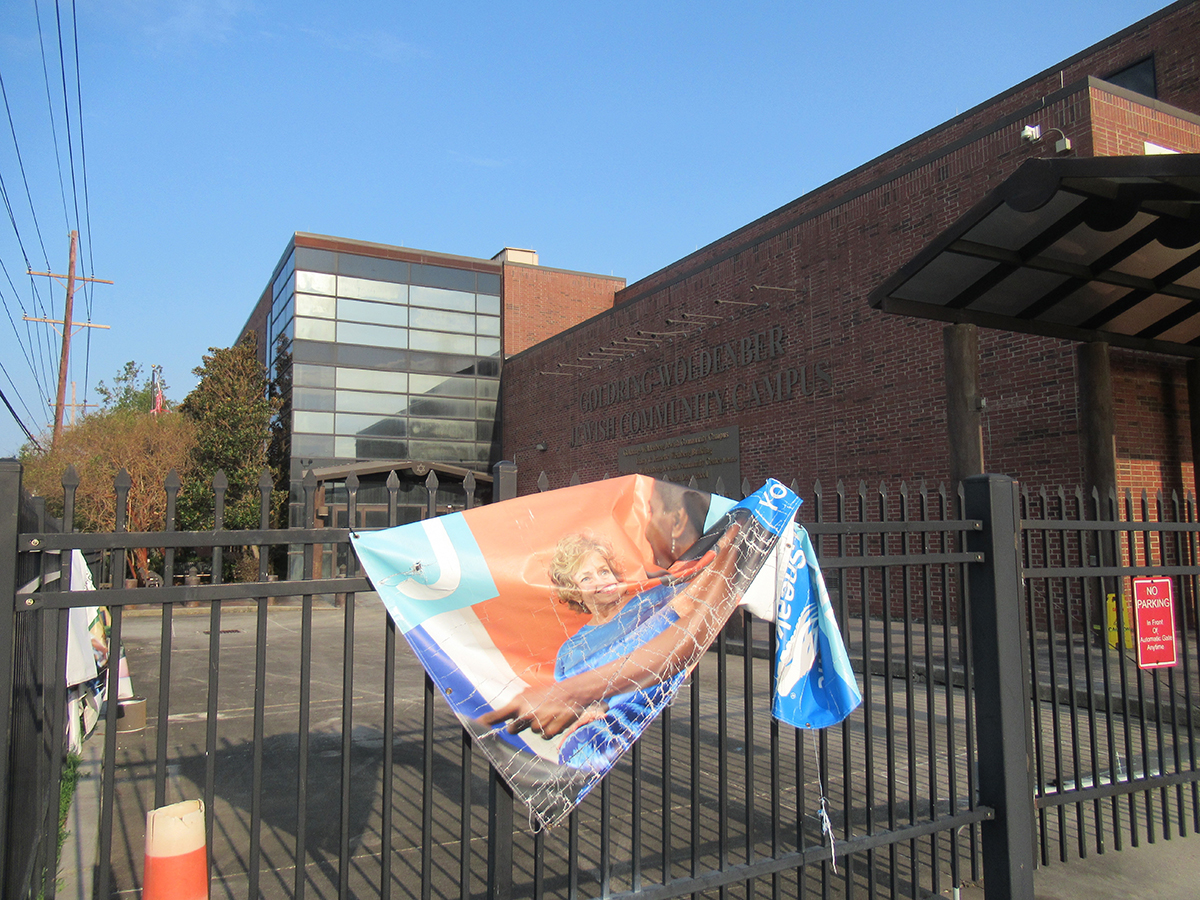
A tattered sign hangs on the gate of the Goldring-Woldenberg campus, the home of the Jewish Federation of Greater New Orleans, the Metairie Jewish Community Center and the Jewish Community Day School. (Photo by Alan Smason)
The New Orleans Jewish community is also more closely linked in a post Hurricane Ida recovery than what they endured after Hurricane Katrina. With high speed internet access in their places of refuge to emails and through applications like Zoom on smartphones and other devices, virtual attendance for Rosh Hashanah services and broadcasting from New Orleans for some synagogues equipped with generators.
Some Reform temples will be broadcasting services from other URJ temples in order to reach out to their dispersed members. Congregation Gates of Prayer Rabbi David Gerber and Assistant Rabbi Alexis Erdheim will be broadcasting from Shaare Emeth in St. Louis.
Rabbi Daniel Sherman will be broadcasting the services from his hometown of Tulsa, Oklahoma, where his father has been a long-standing and now retired community rabbi. Cantor Joel Colman will be joining that broadcast from where he has evacuated: Birmingham. Both the cantor and the rabbi plan to use Zoom and live stream their services over the Temple Sinai website.
The local Chabad-Lubavitch organizations are hoping to welcome members and guests, depending on whether they receive power. The Chabad Center of Metairie has indicated it will hold Rosh Hashanah services regardless of the power status. Starting Sunday, they will begin distributing Rosh Hashanah meals prepared by the Chabad of Dallas organization.
Jewish Federation of Greater New Orleans announced late on Friday that Chaim Goldfeder of Kosher Palate in Texas and through the Texas Jewish Community Response, they will be distributing 75 kosher High Holiday family meal boxes on Monday morning, September 6.
Congregation Beth Israel, the Orthodox shul that relocated to Metairie after Hurricane Katrina will host a Kabbalat Shabbat service prior to the onset of Shabbat tonight via Zoom from Mobile, Alabama, where administrator Rabbi David Posternock is expected to lead services. Rabbi Josh Pernick should also be on the broadcast, joining from Memphis, Tennessee. They also expect to host Mincha services prior to the onset of the Jewish New Year.
Rabbi Katie Bauman of Touro Synagogue, a native of New Orleans, is also back in Memphis, where she was a rabbi for several years. She plans to livestream services being conducted in Memphis.
Rabbi Deborah Silver, the spiritual leader of the Conservative movement in the Greater New Orleans area, has made Dallas her temporary home and is hosting a Kabbalat Shabbat service tonight and a Havdalah service on Saturday night.
On Erev Rosh Hashanah, Rabbi Silver will be part of a triumvirate of leaders ensuring High Holiday services will take place for Shir Chadash. Rabbi Silver will conduct services in Dallas with High Holidays Cantor David Kaplinsky, a rabbinic student from the Ziegler School of Rabbinical Studies, adding his voice from Los Angeles. Josh Sands, a congregant, will serve as the shofar blower from Houston.
