


Interview: Dr. Tom Oelsner speaks out prior to his acceptance of JTS Award
By ALAN SMASON, Exclusive to the CCJN
Dr. Tom Oelsner, a member of the Judah Touro Society (JTS) and the longtime chief of the Nephrology Department at Touro Infirmary, will be honored with the JTS Award this Saturday night, Nov.4, at the annual Touro Foundation gala at Mardi Gras World.
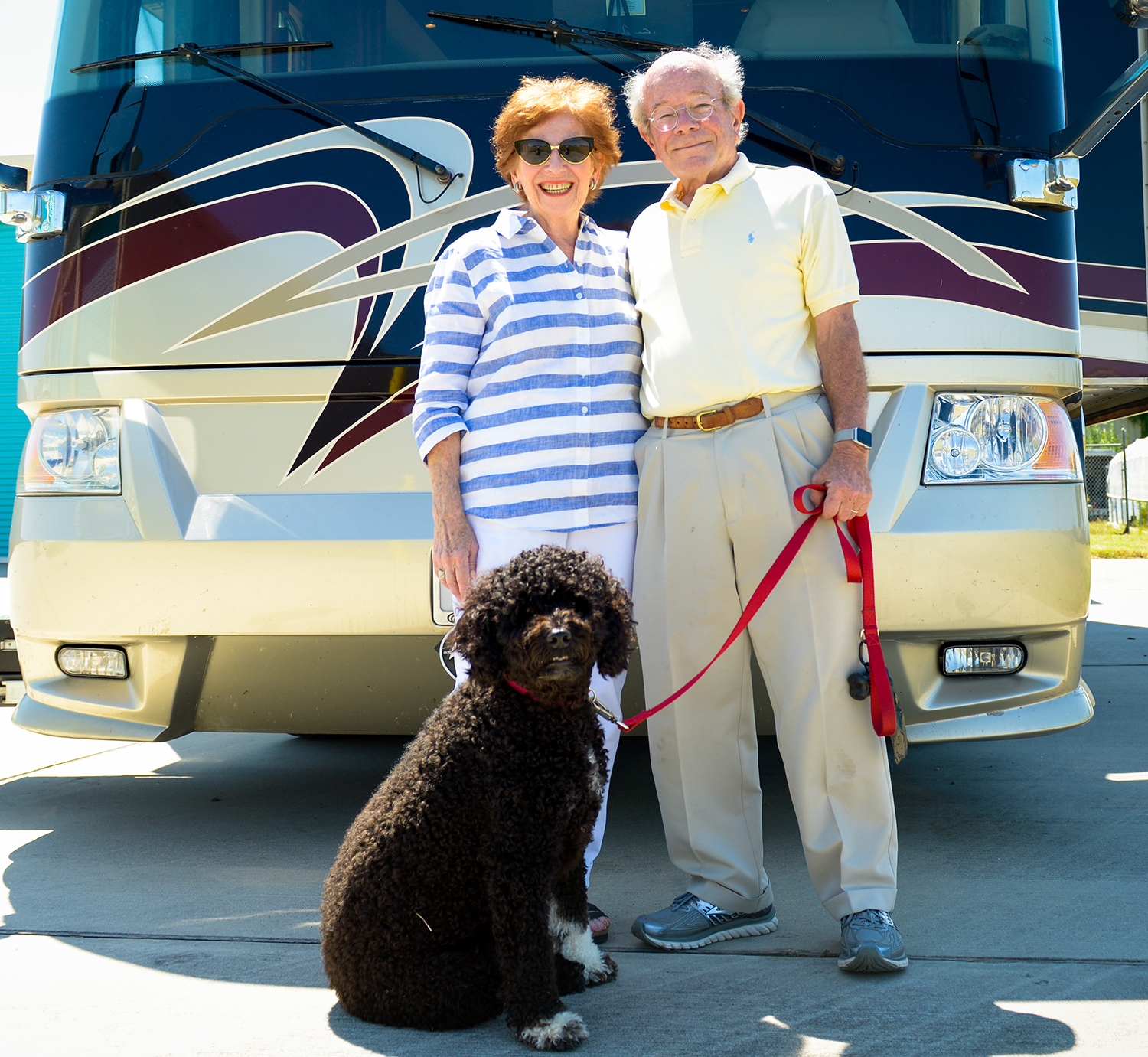
Marilynn and Dr. Tom Oelsner with their dog. (Photo courtesy Touro Foundation)
As part of its spotlight on the doctor and some of his activities since his 2006 retirement, the society members chose to title the affair “Road Trip,” as a reference to the extensive travel he, his wife Marilynn and their dog have racked up in their recreational vehicles, The Oelsners have traveled to all 48 contiguous states and amassed hundreds of thousands of miles on the road.
The CCJN conducted a phone interview with Dr. Oelsner, an octogenarian as of March, to discuss with him his long career and to go over some of the things that keep him busy in retirement. At the time of the call on a sleepy Sunday morning, he was otherwise occupied, solving Soduko puzzles on his home computer.
CCJN: You might be a good example of somebody who maintains his mental agility as much as he does work out his physical body and the benefits of that.
Oelsner: Absolutely
CCJN: Tell us about that.
Oelsner: Well, I’m kinda addicted. I do three different Sodukos on the computer every morning, some of them pretty complex. In fact, this morning was the first time I ran across one that I couldn’t solve at all, at least not yet. That doesn’t mean I won’t solve it eventually. It might take me an hour or more.
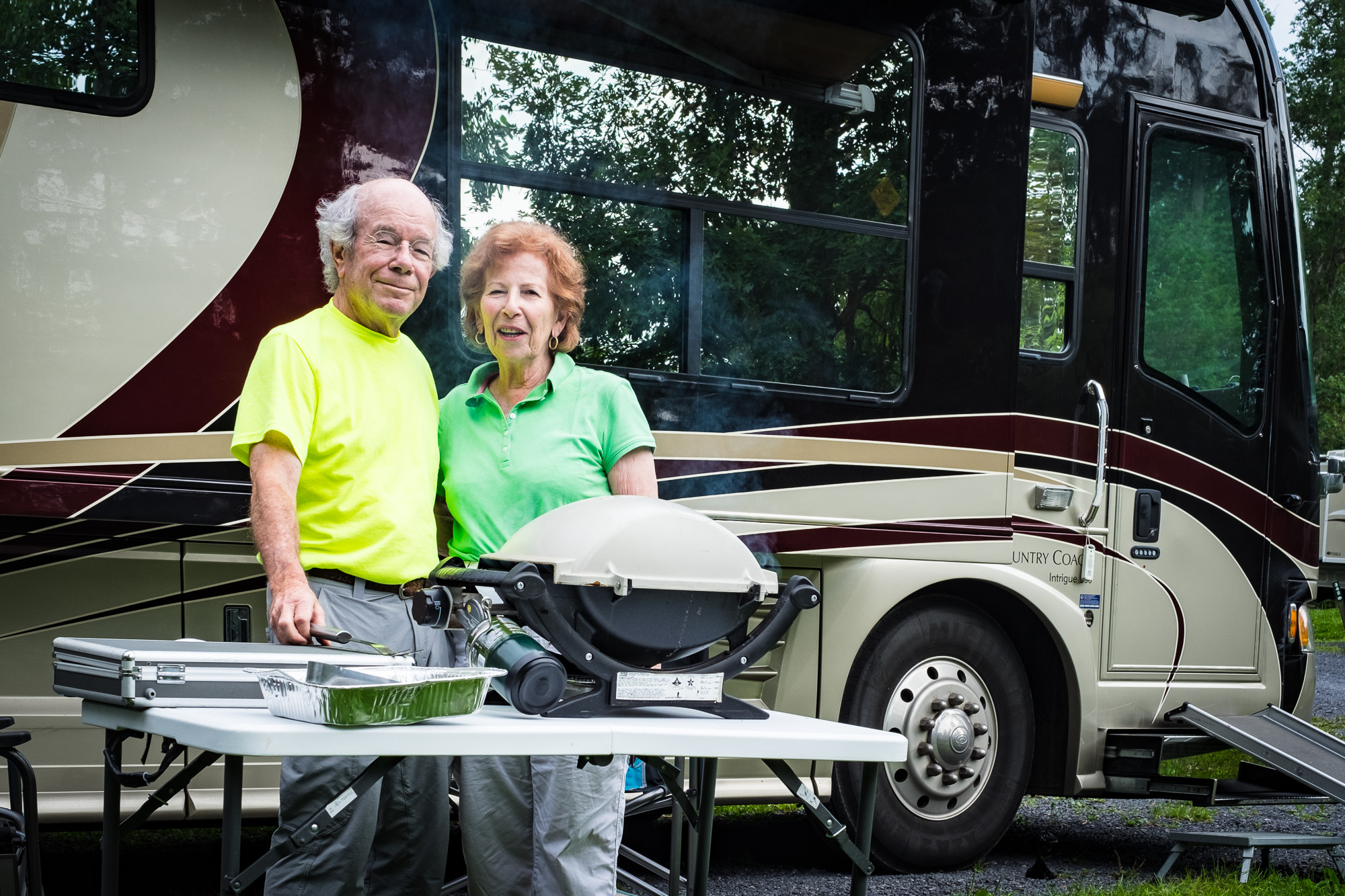
With their motorhome behind them, Dr. Tom and Marilynn Oelsner enjoy camping at RV sites. (Photo courtesy Tom Oelsner)
CCJN: For someone who is so busy, to take up that much of your time to do a puzzle – something that doesn’t do more than give you satisfaction – is that a luxury or is that something you feel is a necessity?
Oelsner: Well, number one, I’m not so busy anymore now that I’m retired and I’ve slowed down my life a little bit. I have plenty of time; I can do whatvever I want.to do That’s the beauty of retirement.
CCJN: How long have you been retired?
Oelsner: Almost 12 years.
CCJN: One of the reasons the Judah Touro Society is calling this “Road Trip” is to reference that you and your wife have taken to the road in an RV (recreational vehicle) and seen all of the Upper 48 states.
Oelsner: When we retired in April of 2006, I knew I wanted to see the country and I loved the country – and we had a dog – so we decided to go look at RVs. We had never owned or even been in an RV. We were amazed at what’s out there and we ended up buying a 36-foot motorhome. We didn’t have a clue as to what we were doing and we started traveling four months every summer and two months in the winter. We upgraded about three years later to a 45-foot, more luxurious motorhome and we’ve been driving that ever since.
CCJN: The big question is: where do you put a 45-foot motorhome?
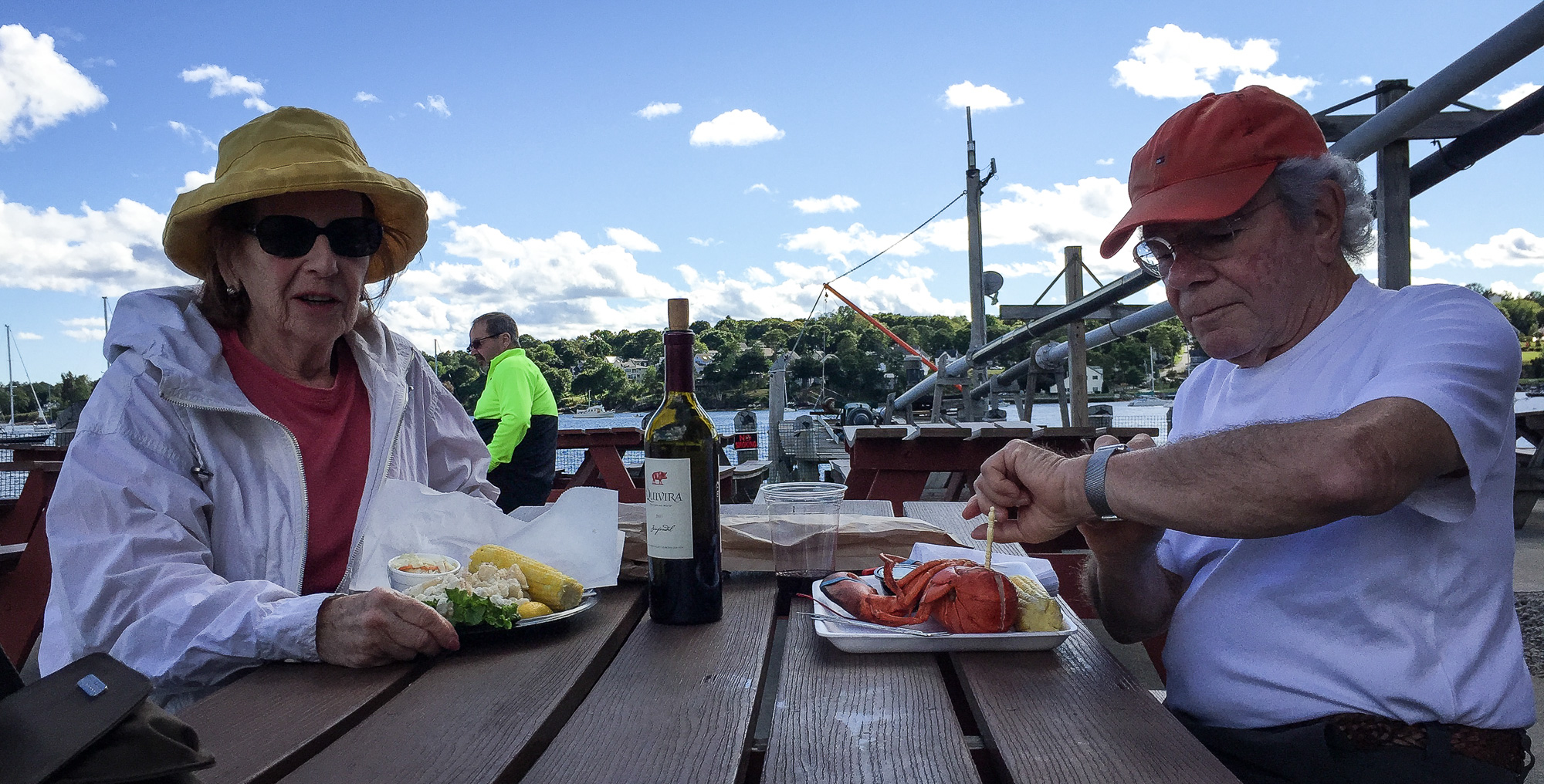
The Oelsners dining al fresco on the road. (Photo by Touro Foundation)
Oelsner: You have to stay in campgrounds. We tow a car behind us. There’s thousands of campsites around from luxurious ones to very plain ones all over the country. We have books and online ratings about those. We always find at least acceptable, if not very fine places to stay. We stay there as long as we want to or as short as we want to. We keep the motorhome there, but then we go touring in the car.
CCJN: This must have given you an appreciation for camping. As a nephrologist, you are probably familiar with tubing, but it takes on new meaning when you have to hook up to a site.
Oelsner: (Chuckling) That’s right. As I said, we were pretty much novices, but now we consider ourselves pretty much pros. The interesting thing is we both love it. Most couples that we know, either the husband would like to do it or the wife would like to do it, but not both. But we both just absolutely love it and this country is so fabulous. There’s something to see in every nook and cranny, even in the most remote places. There’s always museums. There’s always theatre. There’s always something to see. It’s fabulous country; we don’t appreciate how fabulous this country really is.
CCJN: And you get to meet a lot of interesting people along the way?
Oelsner: Well, we do to some extent. We don’t necessarily socialize at every place we go to, but we do in some places. We meet some interesting people and we chat with people. We have a dog and the dog is a source of meeting people.
CCJN: That’s the second time you’ve mentioned your dog. How old is your dog if he started with you in 2006?
Oelsner: We had a dog and we had to put him down. That was Coco. We had to put him down about two and a half years ago. He traveled with us everywhere.
CCJN: So, you have a new dog?
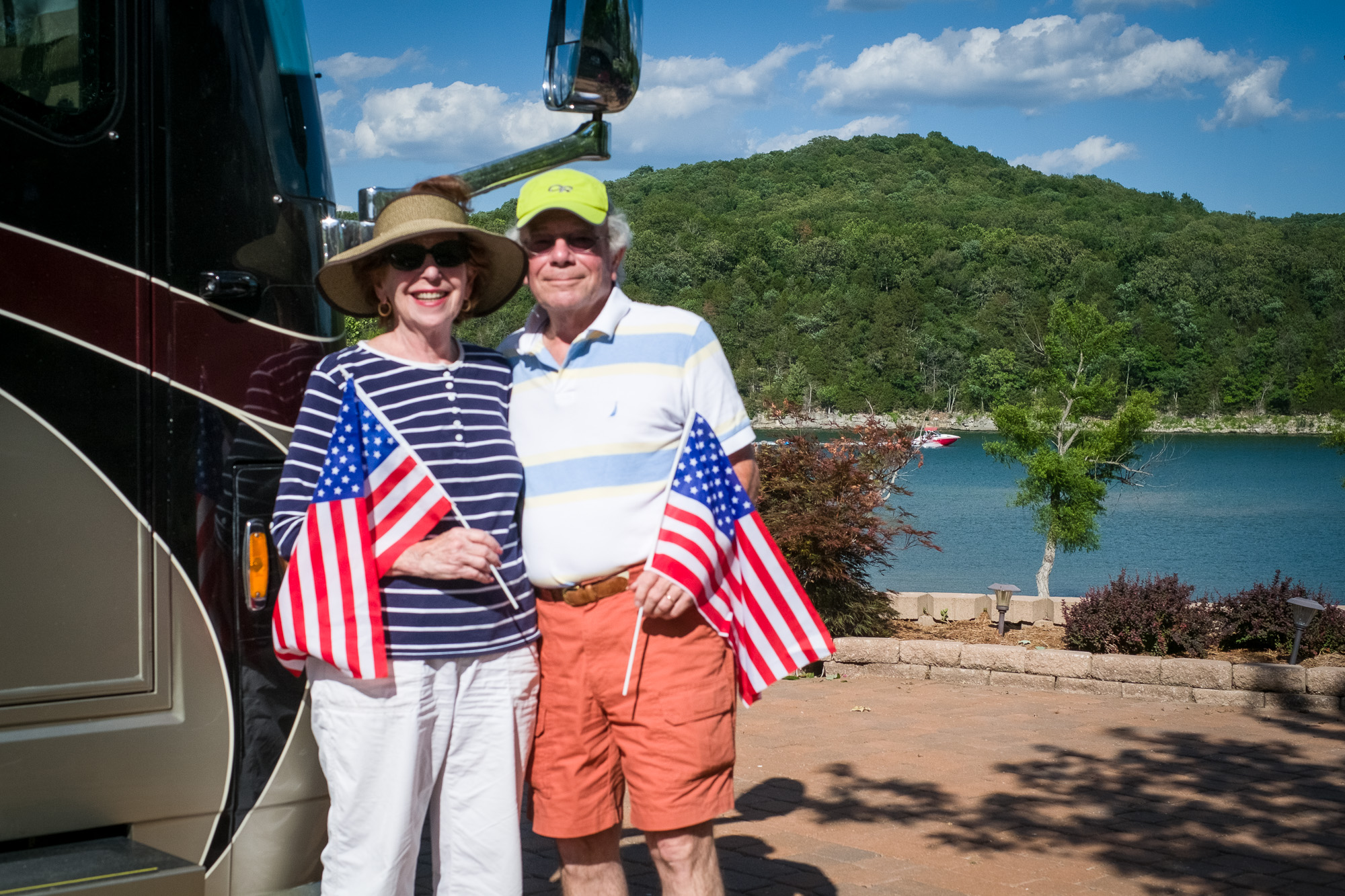
The Oelsners have been to all 48 contiguous states. (Photo courtesy Touro Foundation)
Oelsner: We were going to wait about a year to get another dog, but we shortly thereafter fell in love with a puppy. This is a Portuguese Water Dog and she’s now two years old. She is related to Obama’s Portuguese Water Dog; she’s a close relative and was bred by the same breeder.
CCJN: This is a very exciting time for you, no doubt, to be honored by the Judah Touro Society. You’ve been a member of the Judah Touro Society for a long time?
Oelsner: Yes, since I was in practice; since its inception.
CCJN: According to many of the people on the board, they feel you richly deserve this honor.
Oelsner: I don’t mean to sound modest. I’m certainly flattered and humbled by it. I never really expected to be honored like that.
CCJN: You were Chief of Nephrology at Touro Infirmary for how long?
Oelsner: Well, that goes way back. I was the first nephrology fellow at Tulane Medical School. Nephrology did not exist as a sub-specialty until the early Sixties. It existed around the country and I was the first fellow – in fact, there was no fellowship in nephrology at Tulane. I took it without pay, because there wasn’t any funding for it. So, I worked for a year in nephrology without pay. So, when I came to Touro, although there were some people that were sorta trained in nephrology like Dr. Ed Hyman and Dr. Meyer Kaplan, there was no speciality board or any of that. The Touro Dialysis Unit was the first functioning chronic dialysis unit – we did some dialysis in the city of New Orleans –but there was no previous chronic functioning dialysis unit until Ted Bloch and myself started it in 1966.
CCJN: Yes.
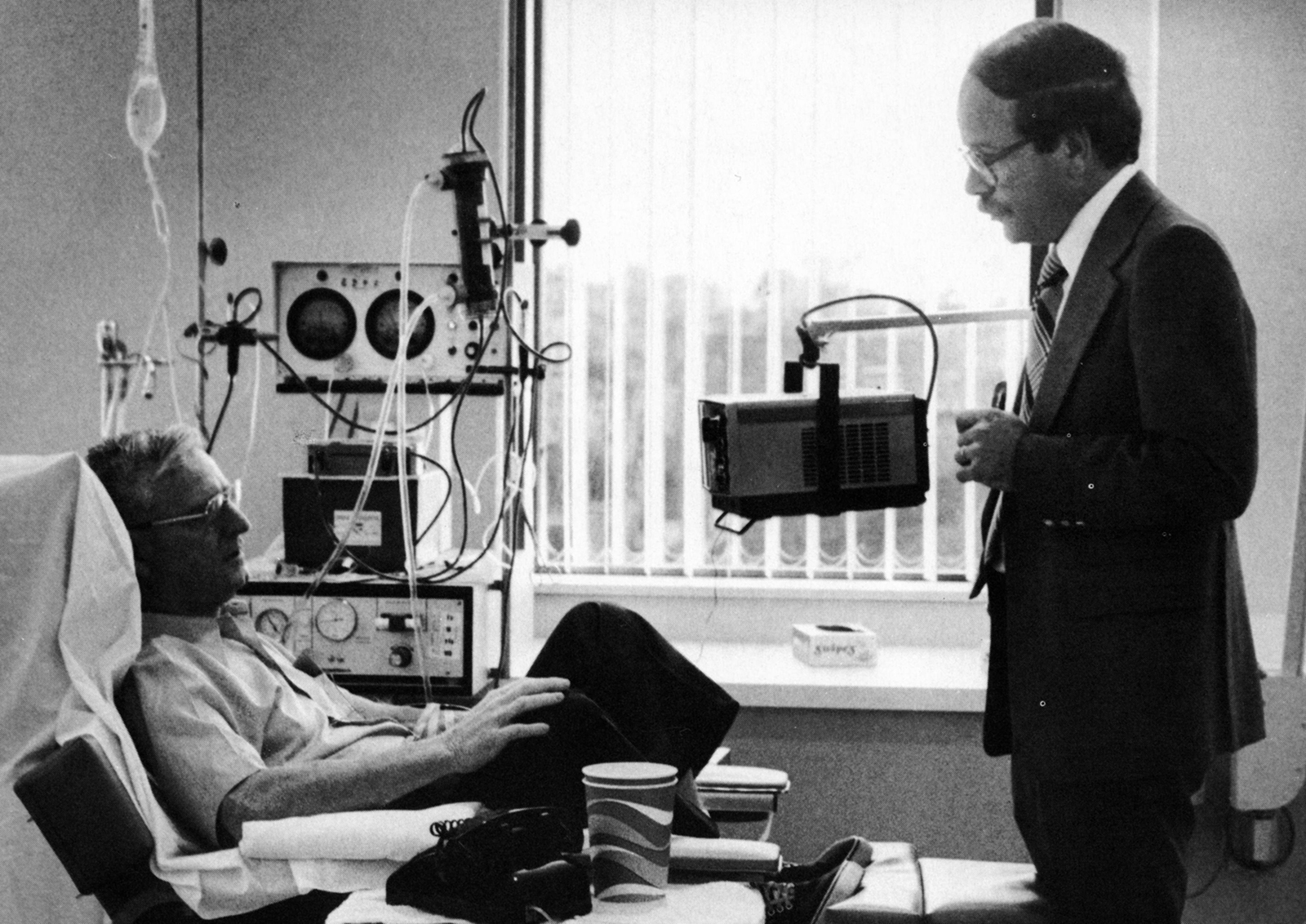
A photo from 1978 and an early dialysis patient at Touro Infirmary, left, with Dr. Tom Oelsner. (Photo courtesy Touro Foundation)
Oelsner: There was a need for dialysis. Ted Bloch had the political wherewithal for getting the dialysis unit started. I had the medical knowledge since I trained in it. We started the dialysis unit at Touro and I became head of nephrology and it remained that way until I retired.
CCJN: It seems like you could probably talk about the entire history of dialysis in the city just from your perspective.
Oelsner: I really could. I could say that I was really privileged to be on the ground floor of a new specialty and starting a new procedure such as dialysis. It was very, very exciting. Most physicians don’t have that privilege to be at the very bottom and work their way into a procedure that’s becoming nationwide. As an example, I went to a meeting back in 1966 of dialysis people in the South and about eight of us sat around a table to discuss what we were doing and we all gave different ideas. About three years later that meeting consisted of 4,000 people.
CCJN: Wow
Oelsner: It was a brand new field and I always thought how privileged and exciting it was. We sat around and discussed a procedure. “I did it this way.” Somebody else did it another way. We tried different things. We learned from each other. We tried different techniques. It was just a brand new open field without any standards and without any previous experience. Fabulous.
CCJN: Hand in hand, there’s been so much progress made in the transplant field. There’s been so much progress there too that the two – dialysis and transplants – have probably extended the lifespans of thousands and thousands of people.
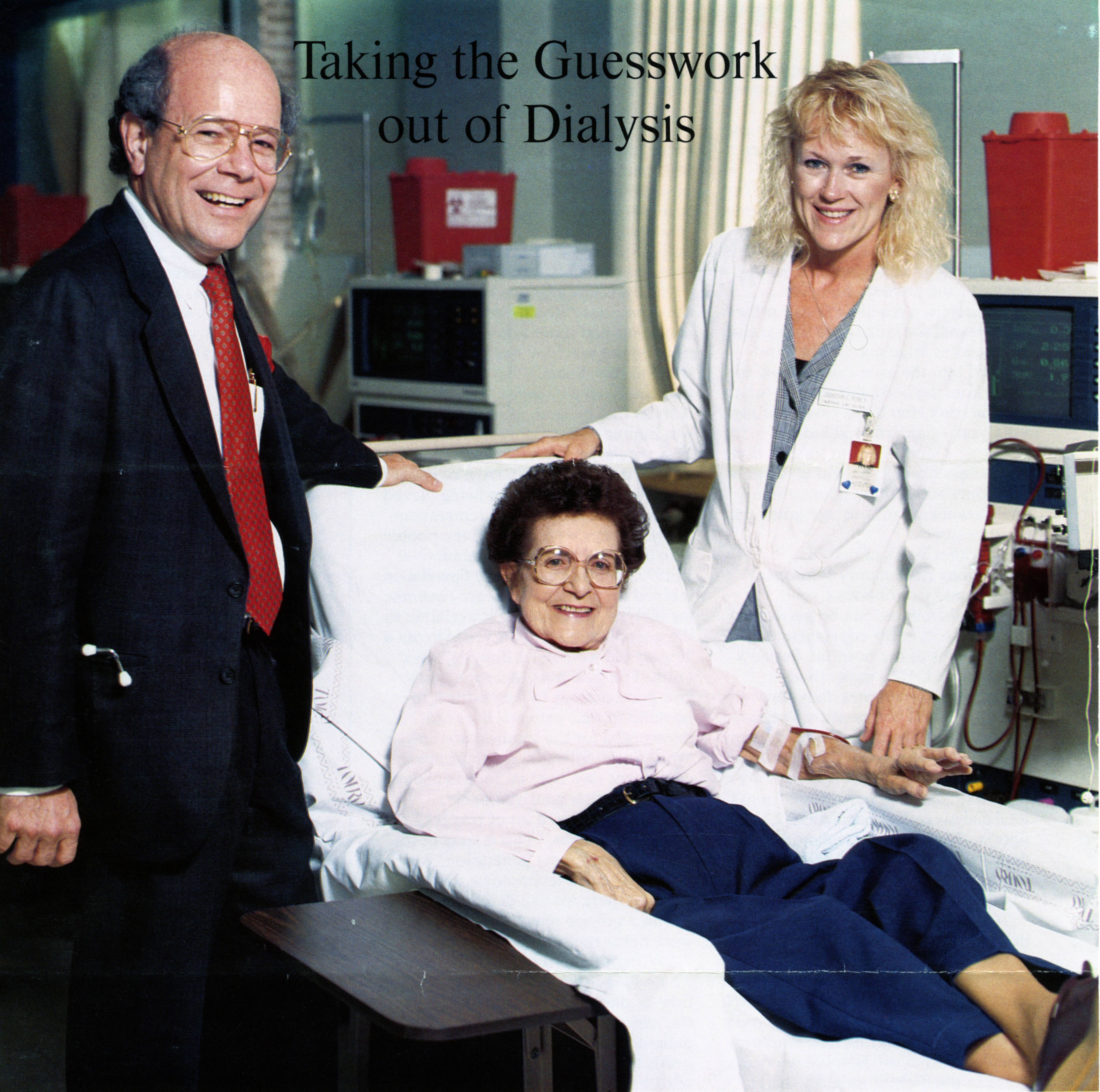
An advertisement trumpeting the success of dialysis. (Photo courtesy Tom Oelsner)
Oelsner: Oh, tremendously. Tremendously. I had some patients that were on dialysis for close to 20 years. They would’ve died before we had started them; they would have died of kidney disease. Talking about transplants, a point of interest was then when i was doing my fellowship down at Tulane, they were doing chimpanzee kidney transplants – taking chimpanzee kidneys and transplanting them into humans. I was involved with that by virtue of my dialysis work down at Tulane at the time. That was also a very exciting period when transplant(ing) was brand new. I certainly wasn’t doing the surgical aspect of it, but I was doing the dialysis in support for those transplant patients.
CCJN: Nowadays, kidney disease is not necessarily a sentence of death, as it might have been in the past. We’ve made such great strides.
Oelsner: Oh, no. People can live with dialysis or with transplants. In many cases people may have spent years on dialysis and the get a transplant or vice versa. There are treatments. There are no cures, but there are treatments.
CCJN: You retired after Hurricane Katrina, during a time which was one of the most crucial in New Orleans city history. Do you recall what that time was like?
Oelsner: Yes, absolutely. Actually, I had planned to retire at the end of the year in 2005. That was my plan all year. I guess I made the decision sometime earlier. When Katrina came along, I decided to stay on and practice for three months later, so I retired on April 1, 2006 instead of January 1. With Katrina, the dialysis population was seriously threatened because the facilities were closed down for lack of electric power, for lack of transportation, for flooding, for all kinds of reasons. Those people had to be transported out of the city facilities and that was a major issue.
CCJN: And (sadly) not all of them made it.
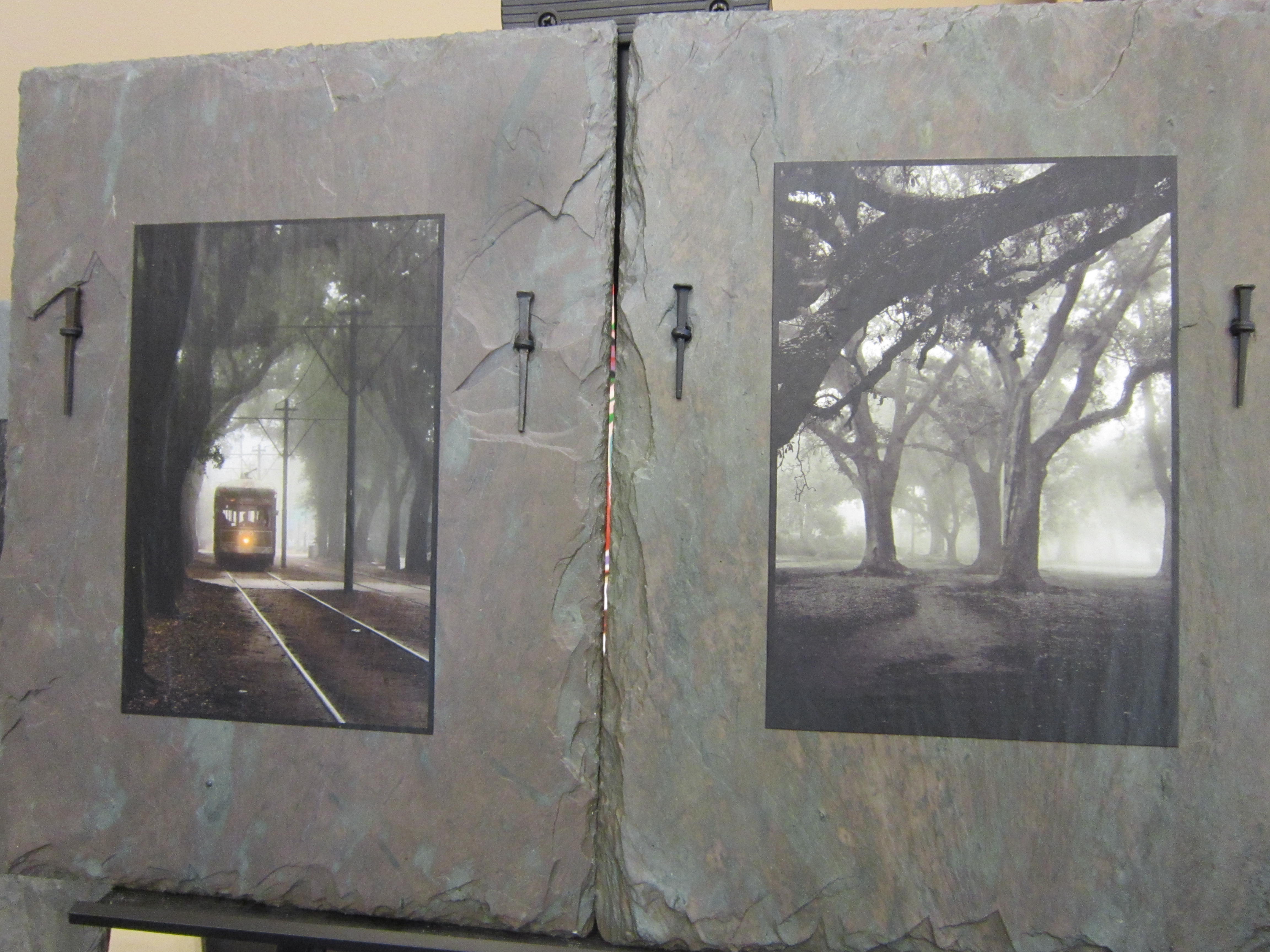
Two of Oelsner’s works of photographic art affixed to slate. (Photo by Alan Smason)
Oelsner: Not all of them made it. No. (A slight pause) But, I would say, a large percentage of them did make it. We were able to get them to places, but, you know, the problems were almost overwhelming. There wasn’t even a way of communicating. Cellphones were down. Telephones were down. So there wasn’t even a way to communicate with them and telling them where to go or how to go about finding a place. It was just a real issue, but most of them had the wherewithal or some family resources or got in touch with us and were able to be transported to Houston or all over the country, actually.
CCJN: Do you recall how long it took for the Touro Dialysis Department to come back after Katrina?
Oelsner: I’m not sure. Our office was able to function, but we had a generator and a truck across the street from Touro and that was late October of 2006. I really don’t remember. The hospital didn’t open for several months thereafter. It took quite a while to get the hospital back to opening, but I don’t honestly remember when dialysis got back.
CCJN: While this is quite an honor on Saturday night, a lot of people don’t know about your artistic side. You participated in the CCJN’s Jewish Art Exhibit in the fall of 2013. We appreciated your being there. How did you get interested in that aspect of your life?

Oelsner with his photographic art on display at CCJN art event in 2013. (Photo by Alan Smason)
Oelsner: I guess I got interested in doing photography as a child. My father gave me a little camera and a starter darkroom set when I was 11 or 12 years old. I remember starting photography back then. I got more serious with it when I moved into my current house 40 years ago, because then I was able to dedicate a whole room to being a darkroom. So, I’ve been doing photography and darkroom work all of my life, but more seriously for the last 40 years. I guess I started having shows maybe 20 years ago. My first show was down at a coffee house on, I guess it was Julia Street, years ago, and I was amazed since I sold most of my photographs at the time. I’ve not been seriously trying to sell work, but I do it for fun.
CCJN: Yes.
Oelsner: I had a show last year with a friend of mine on Julia Street with a friend of mine on Julia Street in one of the galleries there. I’ve been doing serious photography work for years and enjoy it. I belong to the Camera Club and I’ve enjoyed that hobby. It keeps me quite busy. Of course, I do it all now on the computer. I no longer use a darkroom. I do it all by digital. That’s changed, but if anything it’s enhanced it.
CCJN: And what do you use in terms of computer enhancement? PhotoShop?
Oelsner: PhotoShop and Lightroom. Those are the main software that I use.
CCJN: It does show a different aspect of your abilities. Maybe that artistic side is the same side that’s enervated by your Soduko puzzles.
Oelsner: (Laughs) Maybe so. I don’t know. Another side of me is curiosity. I’m always curious about things. The Soduko is a challenge to my brain and I don’t know whether it helps, but I feel like maybe it will keep me thinking longer.
CCJN: Last, but not least, this gala is going to benefit the Wellness Center at Touro. Are you familiar with it and the work that they do there?
Oelsner: Very much so. I have personally exercised in the Wellness Center probably I’m guessing for at least 25 years. When I was in practice, I would go to the Wellness Center in the afternoons or whenever I had a free hour and go and exercise, usually three times a week. Even when I retired, I continued to do that until the last year or so when I started getting a lot of back troubles and just can’t do that kind of exercise anymore. But my point is that I’ve personally been involved in the Wellness Center for years and loved it and also referred lots of patients and lots of friends there to get exercise. Then, in addition to that, there was the Cardiac Rehab Center, which was for cardiac patients so that I would refer my medical problems to the Cardiac Rehab Center to get specific therapeutic rehab. It’s a very fine facility, very well run and really serves a great need.
Tickets for the Touro Foundation’s Judah Touro Society gala are still available by clicking here. After the gala, an after-party will be held with a deejay and a more relaxed atmosphere. Proceeds from the after party ticket purchases will support the Family Birthing Center, Rehabilitation Therapeutic Recreation and Emergency Medicine. To purchase tickets to the after party or to find out more information, visit www.touro.com/gala-after-party.
