


Menken’s ‘Sister Act’ running now
By KAREN LOZINSKI, Special to the CCJN

Ta'Rea Campbell as Deloris Van Cartier, right, gets a once over from Mother Superior (Lynn Wintersteller). (©Broadway Across America)
It’s easy to imagine how thrilled composer Alan Menken may have been at the thought of “Sister Act” (the musical) being set in late-1970s Philadelphia—that era and setting offer some seriously fertile musical soil from which to grow great numbers, and that’s exactly what Menken did in collaboration with lyricist Glenn Slater.
Some of the highlights of “Sister Act,” based on the popular movie starring Whoopi Goldberg, draw heavily (and gleefully) from Motown, rhythm and blues and soul music of the era. Menken and Slater also move into gospel, funk, rock, and rap to the overall benefit of the production.
As one half of the team with the late Howard Ashman and, later, Tim Rice, Menken has been one of the most prolific of animated film composers (“Beauty and the Beast,” “The Little Mermaid” and “Aladdin”). While still writing for film (his latest release is Disney’s “Saving Mr. Banks”), Menken has enjoyed a string of successes on Broadway including the staging of “Beauty and the Beast” and last year’s still-packed run of “Newsies.”
Menken, of course, is no stranger to working multiple genres and period music into his work, particularly that found in one of his earliest successes: “Little Shop of Horrors.” With “Sister Act,” Menken and Slater, along with Jewish book writer Cheri and her husband Bill Steinkellner, apply a deft sense of humor and exuberant characterization, though some of the finest and funniest instances are reserved for the male characters in this story, which focuses mainly on the lives of the nuns, who live within the walls of the Sisters of the Angels Church.
That doesn’t mean the leads and various female characters don’t shine—Ta’Rea Campbell as Deloris Van Cartier /Sister Mary Clarence is vibrant and energetic and her voice is rich, beautiful, and booming. Mother Superior, as portrayed by Lynne Wintersteller, has the requisite (wimple) starch and poise of nuns of yesteryear, with all the troubled introspection and heart that back up her eventual acceptance that times have changed. Despite what these women bring to their roles, their songs trend towards the expositional, and lack the jocularity and resultant big laughs of the male characters’ numbers.
At the top of that list is the song “When I Find My Baby,” performed by Curtis Jackson (Melvin Abston), the erstwhile boyfriend of Deloris. Curtis croons in velvety tones reminiscent of signature Motown desire that he’ll get Deloris back…and kill her. He’s backed up by his goofy and lovable stooges: Joey, Pablo, and TJ, who provide comic relief within a musical comedy.
Another memorable moment for the guys of the show, compliments of Menken and Slater, comes when police officer Eddie Souther (Chester Gregory), declares his ongoing love for Deloris, for whom he has harbored feelings since they attended the same high school. “I Could Be That Guy” is infused with tenderness and excitement while still prodding the audience to a few good laughs.
The homeless people dancing with Eddie, however, come across as misplaced and potentially misconstrued, since very little of gritty 1970s Philadelphia outside musical references is evidenced in the book, save for a few nightclub and bar scenes.
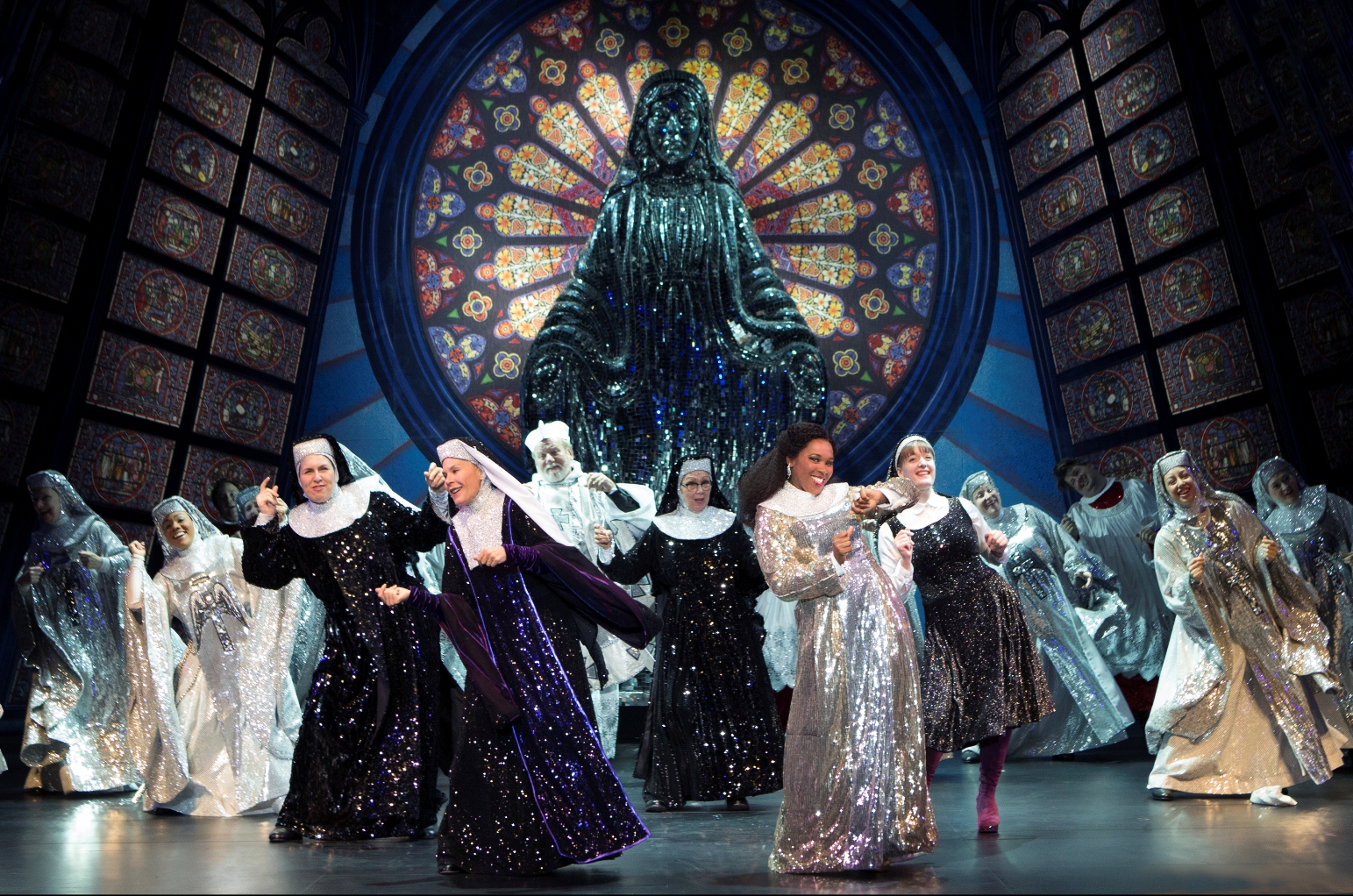
Ta'Rea Campbell as "Sister Mary Clarence, right, gets the sisters of the abbey into the swing of things. (©Broadway Across America)
The guys get one more gem in the form of “Lady in the Long Black Dress,” in which Joey, Pablo, and TJ attempt to outdo each other in their demonstrations of how they’d woo the nuns in order to get to Deloris, only to find out towards the end of the number they’ll be dressing as nuns themselves in order to infiltrate the convent.
Other than resetting the location from Reno to Philadelphia, the plot of “Sister Act” is very familiar and extraordinarily close to that of the 1992 movie on which the production is based. Deloris goes through the greatest transformation of all the characters, as she’s no longer the world-weary wannabe and, in fact, becomes the star of whom she yearns to be.
Her character, while on a literal run for her life, finds she has more of her life ahead of her, and a burgeoning romance with Eddie too. Although Campbell’s Deloris is highly likable and identifiable, the redemption of her character when she realizes how much she has come to love the other nuns, comes across with less value and depth than we might have expected.
The plot embraces its cinematic predecessor’s. Deloris Van Cartier is a singer with ambitions defined by fame and fortune. She performs in her boyfriend’s club, until he lets her down both professionally and personally, offering her a gift of a tacky fur coat that had previously belonged to his wife.
When she goes to his club to deliver the news she’s leaving him, she witnesses him shooting stool pigeon Ernie. She takes refuge at the police station, where she’s reunited with old school chum Eddie Souther, or Sweaty Eddie, as she fondly calls him. He in turn delivers her to the convent for her protection, where her bold, big-mouthed, and brassy approach to everything naturally clashes with the austerity of religious life.
Though well executed by the entire ensemble, the production has an uneven narrative pace through most of the Act I. Many of the scenes feel rushed, particularly the scene in which Deloris directs the convent choir. The improvement in the nuns’ singing and musical abilities is almost instantaneous, which is fine if you merely need to get to the next scene. The eventual betterment of the sisters’ singing could have been deployed thematically to greater effect and believability.
“Sister Act” provides dependable entertainment with broad appeal that is family-friendly; an obvious extension of the movie version refreshed by lush, gorgeous, and innovative staging, costumes that take sparkle quite seriously, wonderful choreography, and the entertaining and ebullient music of Alan Menken. Broadway enthusiasts will delight in its spectacle, and fans of the original movie should be intrigued as well.
“Sister Act” continues at the Saenger Theatre now through Sunday, December 22. Performances are nightly at 7:30 p.m. with matinees at 2:00 p.m.
