


Merz warns that Jews are not safe in Germany, as voters choose parties linked to antisemitism
By TOBY AXELROD
(JTA) — German Chancellor Friedrich Merz’s warning this week that Jewish life in his country “is no longer safe” reflects concerns voiced by some Jews in Berlin.
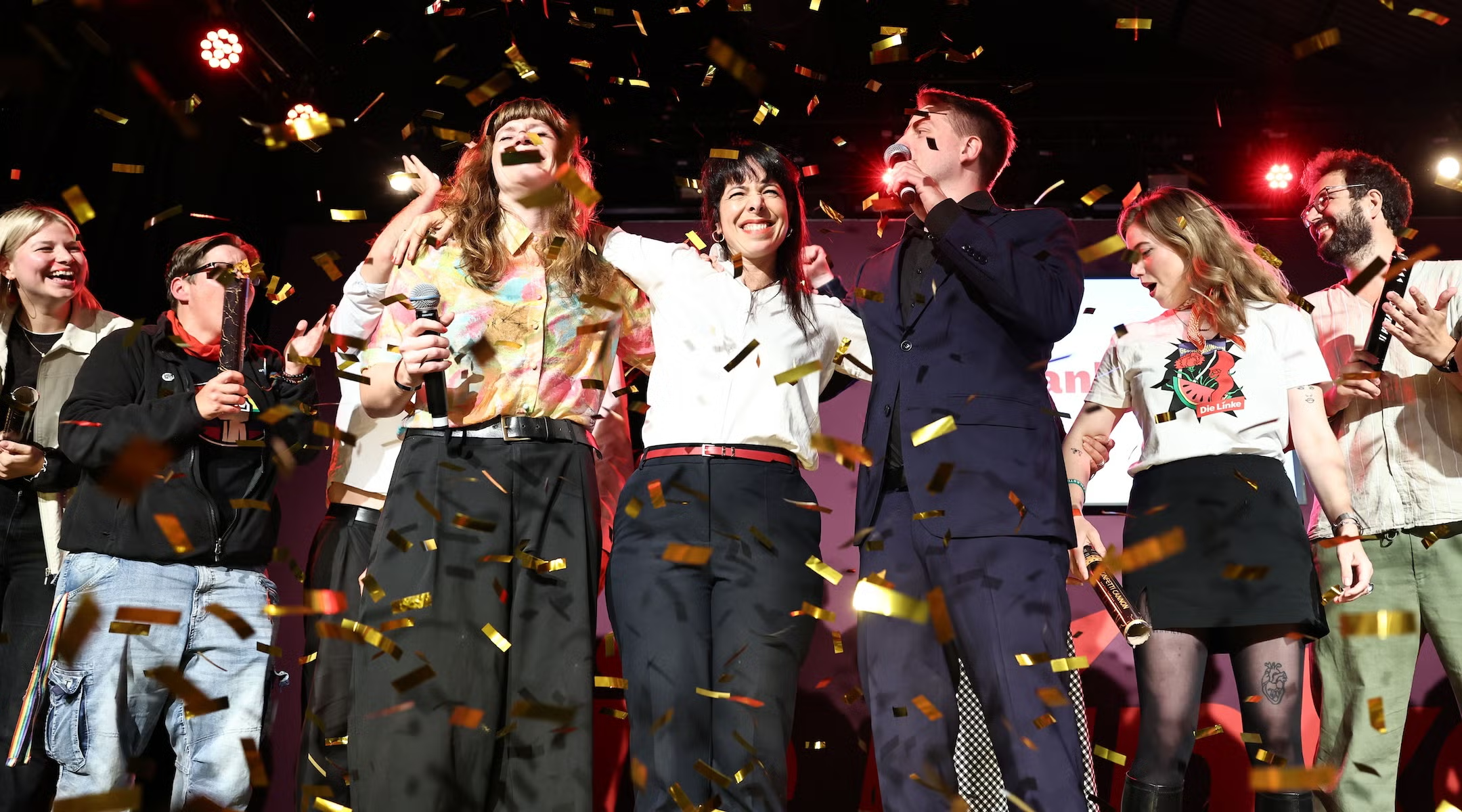
Elif Eralp (C), lead candidate of the leftist Die Linke, and supporters of the leftist Die Linke react to preliminary election results following the closure of polling stations in Berlin state elections on September 20, 2026 in Berlin, Germany. (Nadja Wohlleben/Getty Images)
They are alarmed by the success of the left-wing socialist Left Party in Sunday’s municipal election, which coincides with the rising power of the far-right Alternative for Germany (AfD) in several state elections this month.
Leaving the Left in charge of the country’s capital would be “like putting the fox in charge of the henhouse,” Berlin Jewish Community President Gideon Joffe said in an email press statement this week.
The Party “bears a special responsibility for the consequences” of tolerating Islamic extremism, left-wing antisemitism and what German authorities call “clan crime,” organized criminal activity involving extended-family networks in the capital, said Joffe, who represents some 9,000 registered Jewish community members, out of an estimated 30,000 Jews in the nation’s capital.
He spoke out after the Left received 25.7% of the votes in Berlin’s municipal elections, more than Merz’s Christian Democratic Union (CDU), which garnered 18.8%, followed by the AfD with 16.3%, the Greens with 14.3% and the Social Democratic Party (SPD) with 12.1%.
Berlin is a city of contrasts and deep political divisions, a city that has always been oppositional. It saw street fights between Nazis and communists in the 1930s, and similar face-offs in the 1990s after unification. It is also the German city where the most Jews were hidden and saved by non-Jews in defiance of authority during the Holocaust.
Thus it was not surprising that in Berlin, as the right-wing AfD is growing in popularity nationwide, the Left might be the strongest opposition to that development.
Mainstream parties, such as Merz’s CDU, which had tried to block the far-right, are flailing. The anti-immigration AfD, in contrast, took the lead in two former east German states: Saxony-Anhalt, on Sept. 6 with 43.8% of the vote, and Mecklenburg-West Pomerania on Sept. 20 with 38.2%.
The Left’s platform, which was adopted in 2024, takes an egalitarian approach: It supports Israel’s right to exist alongside a future Palestinian state and disavows antisemitism alongside other societal plagues. “For The Left Party, lived antifascism is linked to the fight against warmongering, antisemitism, Islamophobia, racism and national arrogance,” the platform reads in part.
The Party grounds its stance in the post-war slogan, “Never again war, never again fascism.” Some affiliates on the extreme left hold anti-Zionist stances; the Party has been criticized by Jewish leaders and mainstream parties for not forcefully distancing itself from those elements.
In 2010, prominent Party members took part in the Gaza Freedom Flotilla, which the Israeli military intercepted in an operation that killed 10 activists. German Left politicians were among those arrested and deported home.
At its convention in 2025, the Party adopted the “Jerusalem Declaration on Antisemitism,” which rejects the notion that some anti-Israel expressions are antisemitic, as put forward in the working definition of antisemitism of the International Holocaust Remembrance Alliance. The Party said that the IHRA definition “paves the way for authoritarian state action” by Israel.
More recently, during the Party’s Berlin campaign, “calls were made for the Intifada and the death of Israeli soldiers, and the audience sang and danced along,” said Josef Schuster, chair of the Central Council of Jews in Germany, in a statement released Sept. 22. The council represents some 90,000 members of Jewish communities nationwide. In all, there are about as many people who identify as Jewish but don’t belong to communities.
“That a party whose campaign stage openly called for the death of people emerged victorious from the election deeply disturbs me,” he said, adding that the party had “lost all credibility” by failing to combat “Jew hatred” within.
Berlin resident Anetta Kahane sees parallels between the extreme parties on the left and the right.
“It is a big shame that the AfD is winning, and it’s a big shame that the Linke Partei is winning,” Kahane, 72, who grew up in the former East Germany, said in a telephone interview. “Because both are very deeply antisemitic. And I don’t want to be governed by antisemites.”
Kahane, whose parents had fled Nazi Germany in 1933 and ultimately settled in East Germany (the German Democratic Republic, or GDR) as dedicated socialists, told JTA she realized as a young adult that the Communist party her parents supported was run by “the same antisemites, the same Germans as in the west.”
“Today, we hear the same slogans we heard about Israel and the Jews during the GDR: They are like the Nazis. Israel is a fascist state. They are imperialists. They are colonialists. They are the worst of the worst,” said Kahane, who founded the Berlin-based Amadeo Antonio Foundation, which fights xenophobia and antisemitism, in 1998.
“I hear people saying that, well, the world is so complicated, we don’t need [democracy], we need a good dictator,” said Kahane, because “democracy is discussing and discussing and never achieving anything.”
While the cost of living and taxes are rising, politicians fail to “talk in a way people can understand,” she added. The more “brutal and populist” their language, the more people will vote populist.
Despite their rising popularity, neither the Left nor the AfD is likely to be part of the newly elected state governments. That’s because the mainstream parties are forming coalitions to block out these upstarts – a firewall, when it comes to the far right.
In Berlin, most Jewish voters find themselves eschewing both extremes. But not all Jews are upset at the results.
“I’m hopeful that there will be a coalition with the SPD and the Greens, and that we’ll have a more promising future for Berlin,” Donna Swarthout, 67, told JTA in a telephone interview from Berlin.
She said she voted for the Greens “so that they would be in the governing coalition,” but she isn’t put off by the Left Party and has been drawn to its mayoral candidate Elif Eralp.
“She just really resonated with me because of her emphasis on social justice issues,” she said.
Swarthout, who grew up in the US and obtained German citizenship 14 years ago as the daughter of German Jewish refugees, says it’s important for Jews in Germany “to work in coalition with other minority groups… We need a broader, more positive, future-oriented dialogue. And I’m hoping that she [Eralp] can help shift the dialogue.”
Elvira Groezinger worries about younger voters in general. “As 16-year-olds were allowed to vote [in Berlin] for the first time, and Muslim migrants dominated the discourse, the outcome is a cause for concern,” Groezinger, a literary scholar who was born in Poland in 1947 to Holocaust survivors, said in an email to JTA. The Left’s campaign “was accompanied by antisemitic incidents and pro-Hamas declarations of Muslim candidates and voters.”
“The fact that 36 years after the unification, the fall of the Berlin Wall, and the establishment of a democratic system, communist ideology is so attractive to over a quarter of voters, depicts the political failure in implementing democratic values,” she added.
The Left and the AfD have a lot in common, she noted: Both support Putin and oppose help for Ukraine; both espouse anti-Americanism and support totalitarian ideas.
The Left’s 2024 platform demands “the dissolution of NATO and its replacement by a collective security system with the participation of Russia.” While the AfD supports continued membership in NATO, it posits that “European security cannot be attained without Russia’s involvement.”
But while “the AfD is anti-Islamic and not openly antisemitic like the Left, and even claims to be pro-Israel, its ideology of ‘Germany for Germans’ is just as dangerous for Jews, who are regarded as non-German,” Groezinger remarked.
Left leaders this week rushed to defend themselves against accusations that they tolerate antisemitism and criminality in their ranks, after an alleged pro-Palestinian militant and a person with ties to a Middle Eastern crime family were seen celebrating with a Left legislator at a victory party on Sept. 20 in Berlin.
Eralp said it was “absolutely unacceptable” to “celebrate violence and terrorism,” adding that she would “do everything to ensure that Jewish people – just like Muslims, queer people and everyone in our city – can feel safe.”
A Party spokesperson did not get back to JTA by press time.
Elio Adler, founder of the Berlin-based, pro-democracy Jewish Values Initiative, has pushed back against both the Left Party and the AfD, urging mainstream parties to come up with clear options for voters.
“As long as politics still doesn’t address very relevant and burning topics, the extremist parties on both sides will have their voters and the firewall will get cracks, election after election and, one day, it will break down,” he said.
The Initiative published an open letter to Berlin’s democratic political parties on Sept. 15, urging them to shut both the AfD and Left out of any coalition talks to form a government for the city-state.
Up to now, the term “firewall” has generally referred to a boycott of far-right parties by the mainstream parties.
But “we say if you establish a firewall, it needs to be a round wall protecting democracy against attacks – or fire – from all sides. It can’t be a firewall just protecting against one side,” said Adler, who was born in Essen in 1971; his father was a Holocaust survivor.
”I’m not too happy that antisemitism somehow appears to be the main topic” of discussion. “It’s sort of a strawman argument, in place of many other topics,” he added. “As a group that is at risk and dependent on protection, we are deeply alarmed by the Left Party’s plans to weaken the police and, in particular, to abolish the domestic intelligence service.”
The Left Party “accepts a lot of antisemitism within their ranks. Of course, if you ask them, they are against antisemitism,” Adler said. “They’re against right-wing antisemitism, which is good, which is correct.”
But “they absolutely forget their own antisemitism and all the migrant antisemitism and the extreme-left antisemitism. So they are really blind in more than one eye.”
