


Neil Simon’s ‘Biloxi Blues’ – a nostalgic look back
By ALAN SMASON, Theatre Critic, WYES-TV (“Steppin’ Out”)
When it was announced last year that the National World War II Museum would be producing a full-scale production of Neil Simon’s Biloxi Blues, there was little doubt that this first full-blown non-musical production would be up to the exacting standards of Victoria Reed, the entertainment director, who is responsible for setting all of the shows at BB’s Stage Door Canteen.
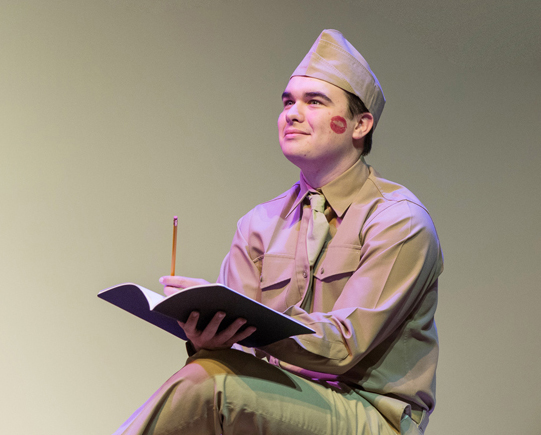
Logan Halliburton stars as Eugene Morris Jerome in “Biloxi Blues” at BB’s Stage Door Canteen at the National World War II Museum. (Photo courtesy of National World War II Museum)
Reed has drafted some surprisingly experienced choices in the nine-member cast playing the roles in this middle chapter of the trilogy of plays Simon loosely based on his life growing up in New York that started with Brighton Beach Memories and concluded with Broadway Bound. One third of the cast is composed of AEA (Equity) players. It is 1943 and Biloxi Blues transplants New Yorker Eugene Morris Jerome into the steaming swamps of summer in Mississippi as he and his fellow recruits endure ten weeks of basic training prior to their shipping out for combat in World War II.
Playing Jerome is Logan Halliburton, a University of Southern Mississippi theatre major whose easygoing style and self-assured manner on stage makes him a charming narrator for the play.
“The entire time he is writing his memoirs,” mused Halliburton about the character he plays in an interview with the CCJN. “What better time to write his memoirs than starting basic training in Biloxi, Mississippi?”
At one point in the play, the character of another fellow Jew, Arnold Epstein (Stephen Stanley), accuses Jerome of being an uninvolved and detached observer, writing his observations in his notebooks.
“The character really hit home for me because Eugene barely says anything to anyone nor has a side and is non-confrontational,” the actor admitted.
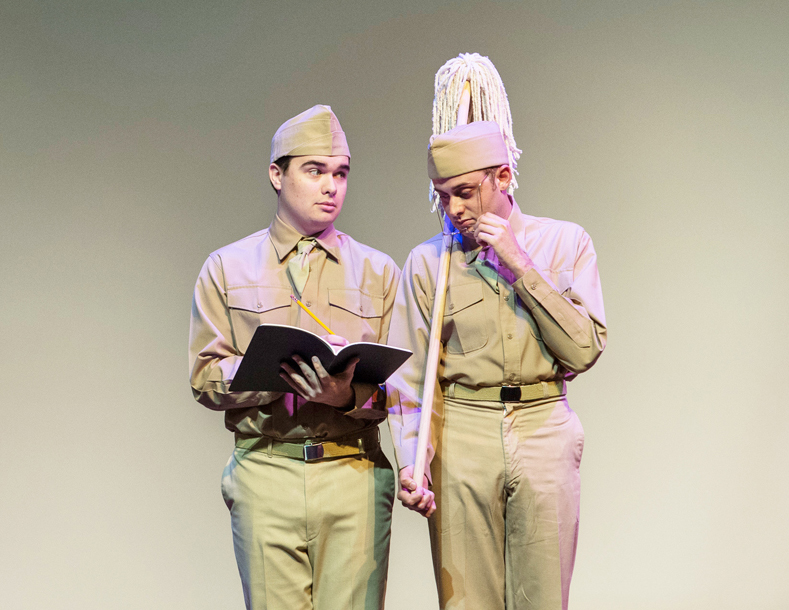
Jewish privates Jerome and Epstein (Logan Halliburton and Stephen Stanley) in “Biloxi Blues.” (Photo courtesy National World War II Museum)
We are introduced to three other characters who travel to Mississippi together on the same transport. They are the hulking Joseph Wykowski (David Lind), a Polish anti-Semite with a thick head, but a soldier’s manner; the simple-minded, but passionate Roy Selridge (Todd D’Amour) and Don Carney (Reed Luckett Wiley), a man who has a hard time making up his mind about everything.
The quintet soon becomes six with the addition of James Hennessy (Cooper Bucha), a well-liked soldier who gets along with everyone.
Patrick Ryan Sullivan plays the pivotal role of Sgt. Merwin Toomey, whose job it is to whip these young upstart recruits into fighting soldiers. A head injury has sidelined him from taking part in active combat duty, so he takes out some of his frustration in the grueling way he trains the men under his charge.
Sullivan, who has played major roles on Broadway, has returned to his Louisiana home and so was available to play this gruff and ready character. His is an essential role for several reasons.
Simon uses the opportunity for the disparate men to bond together over a common enemy, not the Nazis, the Japanese or the Italian fascists, but Toomey. During the ten weeks, Jerome and the others experience growth in many ways, but having to satisfy the exceedingly demanding orders of Toomey prove to be too much for them to stand.
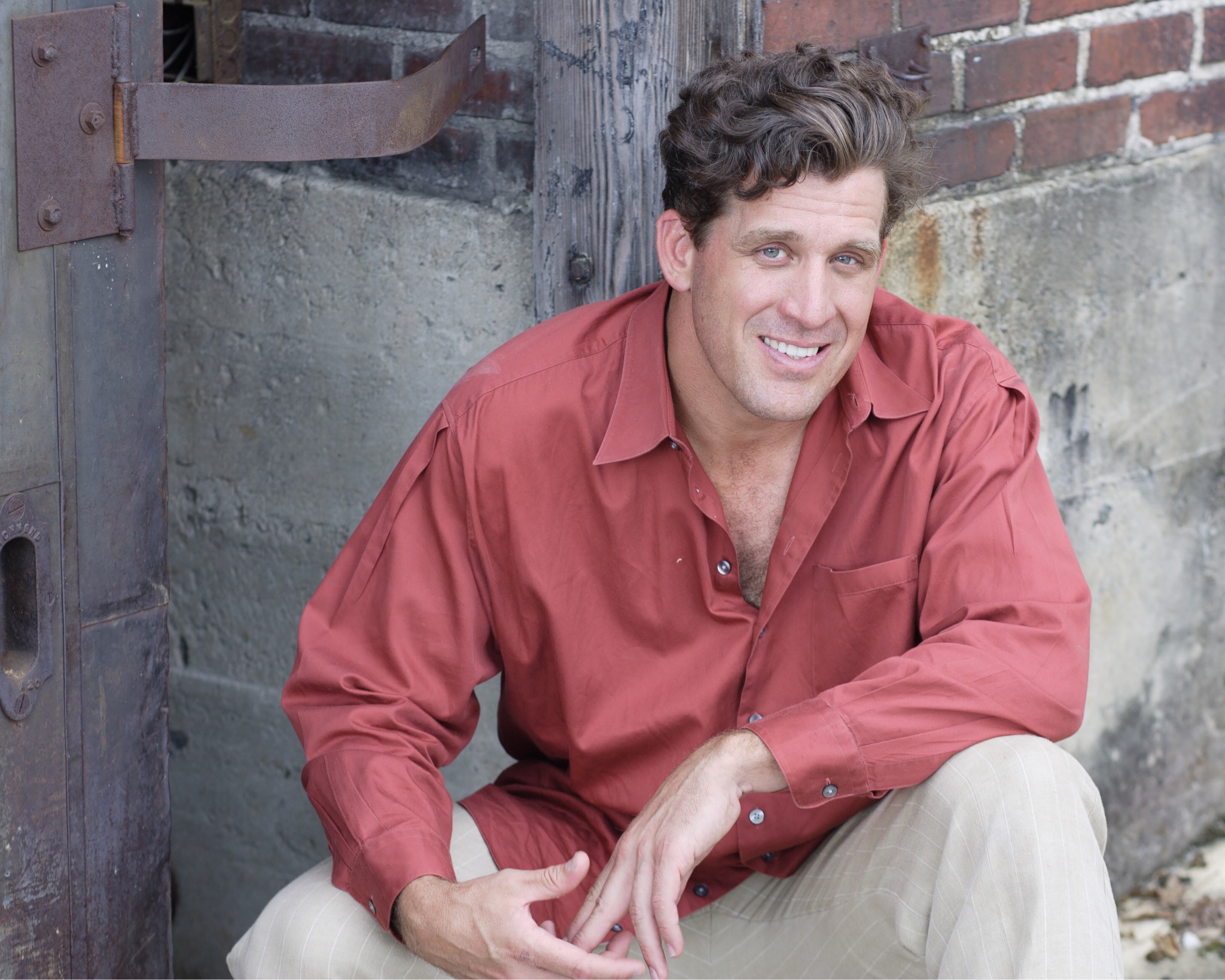
Broadway veteran Patrick Ryan Sullivan, who portrays Sgt. Merwin Toomey. (Courtesy of National World War II Museum)
Toomey, who actually whips the men into fighting shape, has one thorn in his side – a recruit who refuses to yield to him and constantly questions his authority, Epstein.
Meanwhile, Jerome has set out at the start of the play to do three things: 1) lose his virginity, 2) fall in love for the first time and 3) become a real writer.
Biloxi Blues addresses how Jerome achieves each one of these goals, often with the help or assistance of another character in this play, which contains more than its share of comedic moments. It does, however, also possess several serious scenes dealing with aspects of anti-Semitism, homosexuality, physical and mental abuse, interfaith relationships and love.
Key scenes with the defiant Epstein character help push the narrative forward and reveal much about the nature of his Jewish identity. Part of what fuels the ways he views life is his “Talmudic reasoning.” In the end we see that Jerome has been transformed by the Army into one of the boys, but Epstein is largely unchanged. Simon may be making the case here that unlike many of the European Jews who strove to assimilate, but were never truly accepted, many American Jews were different. In the end their defiance may have been a strength of character the Army could not recognize as efficacious in fighting the Nazis and fascists or the imperialist Japanese.
“All of the boys in Biloxi Blues are from New Jersey, New York or Connecticut,” Halliburton added. “I’m sure it was very easy for him to relate, having known people like that.”

Kate Kuen (Courtesy of National World War II Museum)
As a counterpoint to the males on stage, Kate Kuen as Rowena and Shelby Kirby as Daisy Hannigan have great presence during the key scenes they play opposite Halliburton. Kuen is the object of his lust, while Kirby plays the object of his heart’s desire.
The large turntable used for the set is an effective scenic device by David Raphel. It moves the action from the opening and closing scenes in a railway car to the base barracks to the mess hall and beyond with ease. Alex Quimby’s lighting design is also effective in scenes that take place on and off the stage throughout the show.
While many other productions now playing across town are vying for attention, this is one show that should be considered. It is a nostalgic look back at the era of “The Greatest Generation” that is part of the raison d’etre for the National World War II Museum. That is certain. But the writing here is insightful about America of that time and this coming of age tale has a universal appeal to it.
Biloxi Blues puts its audience through two hours of humor and pathos and in the end we know that the characters are all changed from how we perceived them at the start. As they begin to meld into a combat unit, we see how they face the uncertainty of life with trepidation and the reality of war with determination.
“Biloxi Blues” plays on the stage of BB’s Stage Door Canteen from now through April 22. For tickets click here. Evening shows start at 8:00 p.m. Sunday matinees start at 1:00 p.m. Dinner and brunch options are available. Call 504-528-1943 for more information.
