


New exhibit on Nazi propaganda opens at WW2 Museum
By ALAN SMASON
How did Adolf Hitler and the Nazis, a ragtag group of rough and tumble disenfranchised citizens, use propaganda to transform themselves from a political joke to the supreme political party in Germany in just a few short years?

“He is to blame for the war!” The Nazis sought to provoke hatred and mistrust of Germany’s Jews. Mjölnir [Hans Schweitzer], artist; 1943.–Library of Congress, Prints and Photographs Division, Washington, DC.
This question and several others are posed with the arrival of the latest traveling exhibit from the National Holocaust Museum in Washington, D.C., “State of Deception: The Power of Nazi Propaganda,” which opens next Friday, January 27 at the National World War II Museum.
Steven Luckert, the current senior program curator of the Levine Institute of Holocaust Education, worked as the curator on permanent exhibits at the Holocaust Museum in 2009, when the exhibit opened, eventually seen by more than 1.7 million visitors. A member of the museum’s staff for more than two decades, Luckert spoke via telephone with the CCJN in an exclusive interview about the traveling exhibit that was culled from his original exhibit.
“What we wanted to do was to show in the exhibit here (in Washington) and with the traveling exhibits was really to show how the Nazis used propaganda in a democracy, because this is something that scholars and others have tended to forget,” Luckert noted. “But it was during a democracy when the Nazi Party had to compete against 30 other political parties that they honed their skills as message makers.”
Luckert suggested that Hitler and his cronies took advantage of dissatisfaction with the status quo and a power vacuum. “The Nazis never won a majority of the votes under any free election,” he said.
“His (Hitler’s) cabinet was made up of mostly conservatives with a few Nazis, but he was able to eradicate the democratic system in a matter of months,” Luckert observed.
As a scholar, Luckert is impressed with what the Nazis were able to do in their application of propaganda to paint themselves as champions of the downtrodden, while ignoring their hidden agenda of murdering Jews and others.
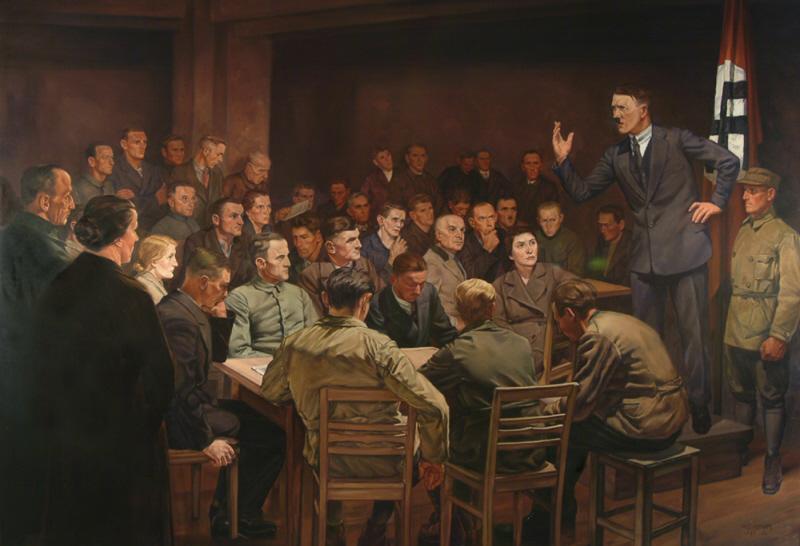
“In the Beginning Was the Word,” a painting by Hermann Otto Hoyer, ca. 1937, US Holocaust Memorial Museum/National Archives and Records Administration, College Park, Md.
“What they did in many ways was astounding,” he exclaimed. During the last decade of the German Weimar Republic, the Nazis were considered an oddity, capturing just 12 seats in the German Parliament out of 500. That number increased nearly ten-fold in 1930 when they were able to capture 107 seats and more than doubled again in 1932, when they amassed 230 of the available seats, he considered.
“They were able to develop techniques (and) strategies to distinguish themselves from their rivals and to win millions of votes and supporters,” Luckert continued.
“Hitler’s a guy that never held political office in his life. He (first) ran for president in 1932. He had only become a German citizen shortly before that,” the curator said. “He didn’t win, but he got 13 million votes. Hitler very skillfully crafted an image of himself as a persona and as a politician that worked.”
Luckert pointed out that Hitler started in the party as its propaganda chief, before rising to its chairman and replaced by ardent supporter Josef Goebbels. “(It’s) only the Nazi Party that’s able to do this in German history: to go from obscurity to prominence in such a short time,” he said. “I don’t think any party in world history has done that.”
The Nazis achieved these gains while operating under a democratic regime. The took advantage of unchecked and rampant unemployment and political instability at the top that translated into dissatisfaction at the polls, he observed. Hitler and Goebbels were careful to downplay their anti-Semitic agenda, particularly in areas where they might have received pushback.

The poster by Mjölnir [Hans Schweitzer] for the film “Der ewige Jude” (The Eternal or Wandering Jew), 1940, US Holocaust Memorial Museum, courtesy of Museum für Deutsche Geschichte
“Voters who would never have voted for the Nazi Party in the past cast their vote for this new party,” Luckert stated.
“We want visitors to really reflect upon themselves and think about propaganda. Even when the Nazis were defeated after 1945, propaganda didn’t disappear,” Luckert asserted. “We’re constantly bombarded with messages, most of them benign, but some that are dangerous.”
This aspect of the exhibit takes on added meaning for today with the charges of so-called fake news leveled at the media by President Donald Trump. “This is a very contemporary concern that we all have and how we address that,” Luckert continued. “One avenue is to use education and to really think about that and how propaganda works, how it appeals to you and functions.”
Despite America’s reluctance to do so, the Nazis used the word propaganda ubiquitously. “At the creation of the Nazi’s Ministry of Public Enlightenment and Propaganda, he told Hitler ‘Let’s not use that term,'” Luckert revealed. “’People associate that with lies and exaggerations and things like that.'” Hitler countered: “No, it’s a good word and we’ll use it.”
Starting with the Soviet Union in the 1920s, governments began to develop the use of radio as a propaganda tool, which Luckert described as the Internet of its time. “Radio became an important vehicle for disseminating propaganda, both good and bad, across the airwaves,” he said.
This practice exploded during the decade of the 1930s. “Nazi Germany began broadcasting in English in 1933,” he said. “By 1938 they were broadcasting in 12 different languages and then that expanded.”
At the same time, the BBC in England was experiencing the same kind of growth and trying to get its messages broadcast globally, Luckert added, and the same could be said with Radio Bari in fascist Italy.
Luckert, who joined the museum staff in 1994 only six months after its opening, noted there will be three simultaneous exhibits traveling to different cities. Besides New Orleans, traveling exhibits will open simultaneously in Paris and at the United Nations in New York.
While he will miss the opening of the exhibit in New Orleans, Luckert will be in New Orleans for the first time in April when he is scheduled to deliver a talk in April on “Fueling Extremism.”
“A number of my colleagues have been there,” Luckert mentioned. “They kind of prepared me for the great artifacts that are there. I’m very excited about it.”
“State of Deception: The Power of Nazi Propaganda” follows the 2012 touring exhibit from the United States Holocaust Museum “Deadly Medicine: Creating the Master Race.” It runs from January 27 to June 18 at the National World War II Museum, 945 Magazine Street. For more information call 504-528-1944.
